
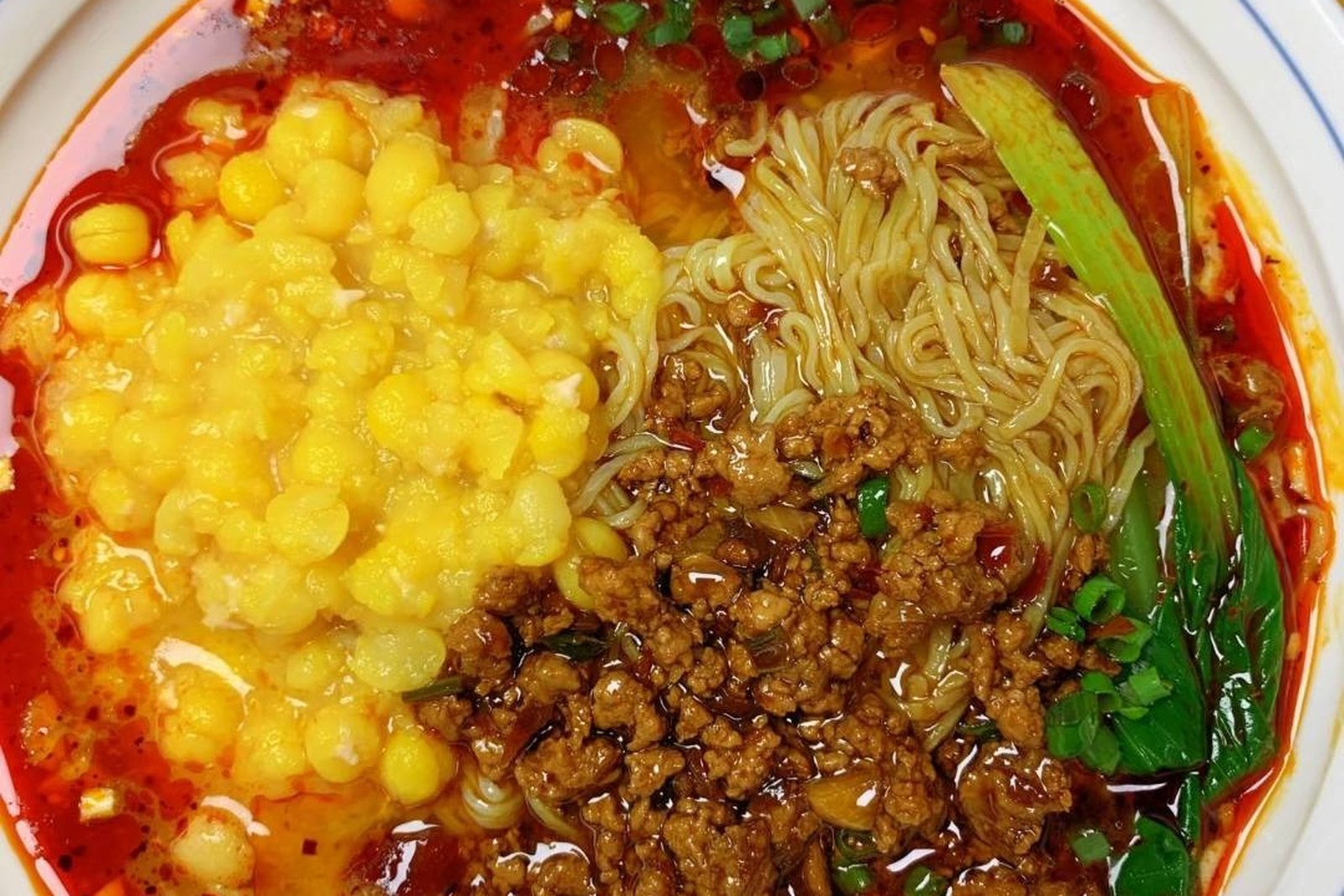
The bowl arrives without ceremony. A wide bowl of pale green-beige noodles, minced pork darkened by chilli, a slick of red oil, and a heap of 白菜 Báicài Chinese cabbage on top because that is how the order goes. 豌杂面 Wānzá Miàn pea-and-minced-pork noodles, and beside it a small bowl of 绿豆汤 Lǜdòu Tāng mung-bean soup, cold and sweet, the chaser the dish is built around. This is 龙氏机场豌豆面 Lóng Shì Jīchǎng Wāndòu Miàn the Long family airport pea noodles, in 两路 Liǎnglù Lianglu, the old administrative town of what was 渝北区 Yùbèi Qū Yubei District. The shop has traded for about thirty years, the airport has run since 22 January 1990, and the two are related without being the same trade: the noodles grew up beside the runway and are not the airport’s food.
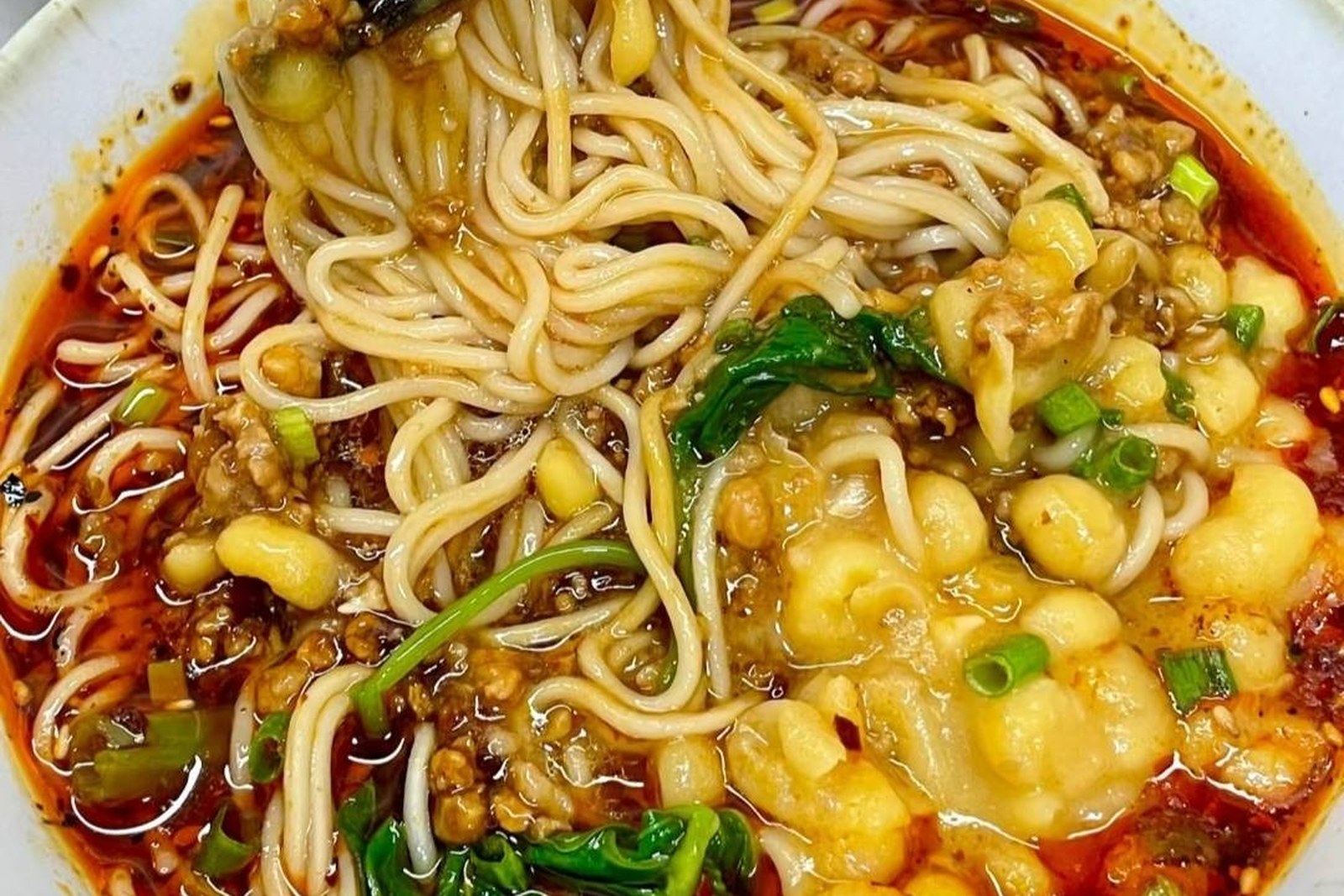
One thing has to be said plainly, because the name misleads outside Chongqing. 豌杂面 is not 小面 Xiǎomiàn, and the difference is one of flour. Xiaomian is a wheat noodle, pulled and boiled, dressed in a small quantity of seasoned oil and chilli; it is the city’s own breakfast noodle, it belongs to Yuzhong District, and it is not what this page is about. 豌杂面 is a legume noodle: the pea flour is the dough, not a wheat substitute cooked alongside it, and the result is a thicker, softer, more adhesive strand with a greenish cast, which is why it holds minced pork and cabbage instead of carrying a film of chilli oil. The 杂 zá, “mixed”, refers to the pork and greens folded through the noodles, not to heat.
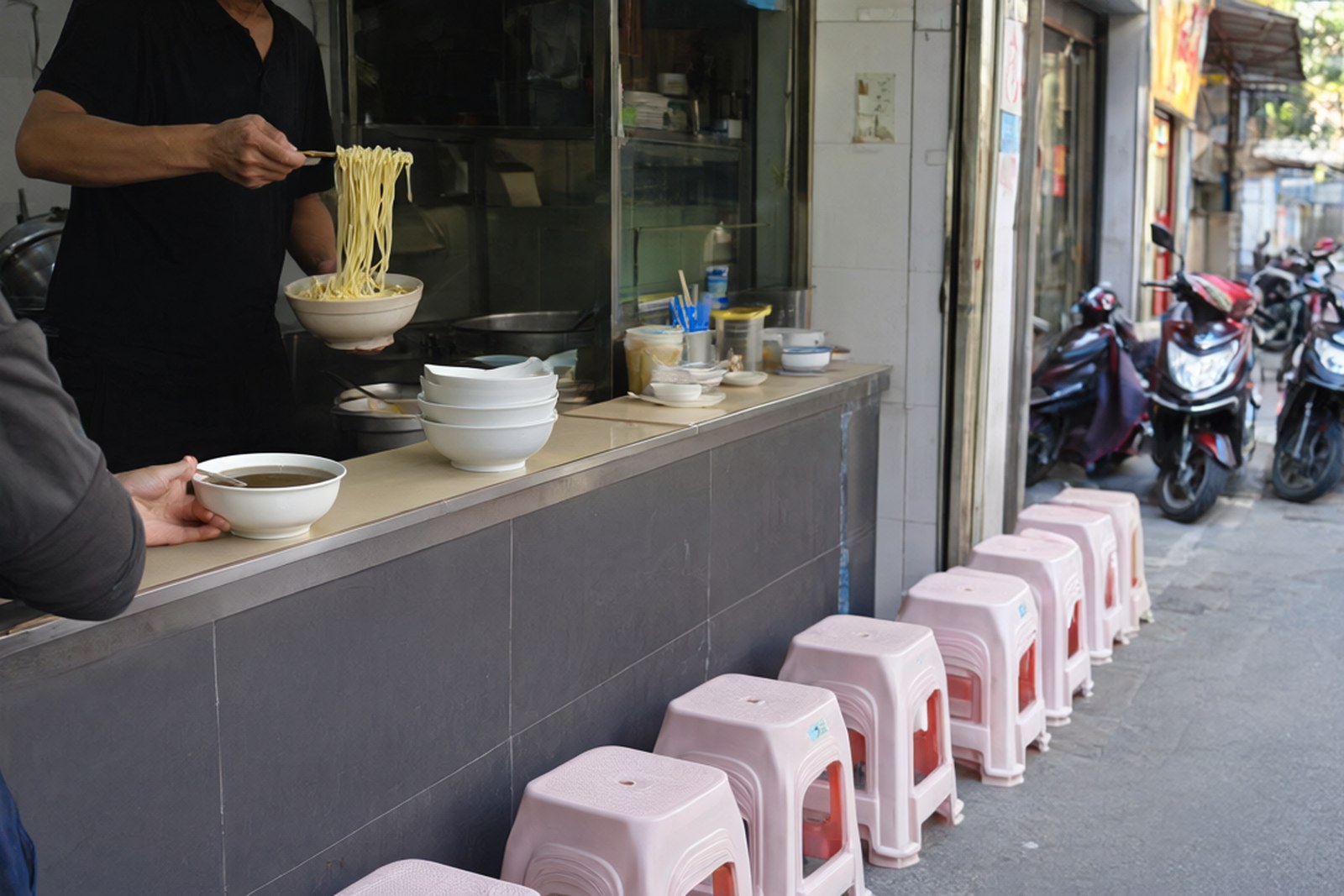
What thirty years buys is a set of decisions a shop making the same dish for six months does not have. The pea flour is bought in a grade and a colour, and a shop that has run one order long enough knows which sacks to refuse. The dough is mixed warm and rested, and the resting decides whether the noodle tears when it is lifted. The pot is wide and shallow and the noodle is boiled in open water rather than broth; what comes out is drained, and the seasoning goes in the bowl, with the pork fried separately in a wok and the cabbage wilted in the same fat. The noodles are built for the people who came off an industrial shift: not refined, not precious, eaten in fifteen minutes by somebody with a bus to catch.
The district is a chapter that closed while the shop stayed open. On 7 November 2025 the Chongqing municipal government published 渝府发〔2025〕15号, abolishing Yubei District together with 江北区 Jiangbei and creating 两江新区 Liangjiang New Area; the five northern towns of Dawan, Tongjing, Daxing, Xinglong and Cizhu went to 北碚区 Běibèi Qū Beibei District, while Lianglu stayed inside the new area. Lianglu is where the district government itself used to sit, on 义学路 Yìxué Lù Yixue Road, and it is a working town of a kind the airport made: the national first batch airport-economy pilot zone, an industrial belt either side of 空港大道 Kōnggǎng Dàdào and 双龙大道 Shuānglóng Dàdào, and a rail line serving both terminals. The noodle did not travel to the airport and the airport did not take over the noodle. The sign outside still says Yubei.
Words and Names
龙氏机场豌豆面 Lóng Shì Jīchǎng Wāndòu Miàn the Long family airport pea noodles, a shop in 两路 Liǎnglù Lianglu trading about 30 years and named among the former Yubei District’s snacks as 两路的机场豌豆面 “the airport pea noodles of Lianglu”. 豌杂面 Wānzá Miàn pea-and-minced-pork noodles, a legume-flour noodle and NOT the wheat-noodle 小面 Xiǎomiàn of Yuzhong District; 绿豆汤 Lǜdòu Tāng mung-bean soup, the sweet cold chaser served alongside. 渝北区 Yùbèi Qū Yubei District, the former northern district of Chongqing Municipality, abolished 7 November 2025, with Lianglu now inside Liangjiang New Area and its five northern towns in 北碚区 Beibei District. 重庆江北国际机场 Chongqing Jiangbei International Airport, in service since 22 January 1990.
What the Locals Know
The regulars judge the shop on four things and none of them is the chilli. The noodle is lifted, not scooped: if it holds together on the skimmer and folds into the bowl as one mass, the dough is right, and if it drains in a thin stream it is not. The pork is fried in a wok until it catches, and the colour, a dark brown with a crisp edge, tells you the wok was hot before the meat went in. The cabbage is wilted in the same fat and arrives with some bite still in it, which means the wok was not crowded. And the mung-bean soup is not a decoration: it is taken in alternation with the noodles, cold between hot. The other half of the local knowledge is when to come, and it is the opposite of what a visitor assumes. This is a lunch trade and an early-evening trade, heaviest between the airport’s shift change and the afternoon, and a table arriving at eleven on a Sunday will find no queue and a bowl that has been sitting.
flowcloud would say that the Long family airport pea noodles in Lianglu are a district trade that outlived the district – 豌杂面 pea-and-minced-pork noodles made from legume flour and not the wheat 小面 of Yuzhong, eaten with a bowl of cold sweet mung-bean soup, sold over a counter to people eating in fifteen minutes, in a town that was the old Yubei District’s administrative seat. The shop has traded about 30 years; the airport has run since 22 January 1990, 21 km north-east of the city centre, and the two have stayed separate trades. On 7 November 2025 the municipal government abolished Yubei and Jiangbei to create Liangjiang New Area, with the five northern towns going to Beibei District and Lianglu staying inside the new area, which is why an old Yubei address is still the working address for a shop that never closed. No prices are quoted. All checked October 2026.
Where to find it: the pea-noodle counters along the main commercial streets of 两路 Liǎnglù Lianglu, the old administrative town of the former 渝北区 Yubei District and now part of Liangjiang New Area, roughly between 空港大道 Kōnggǎng Dàdào and 双龙大道 Shuānglóng Dàdào on the airport side of town. This is a counter-service lunch and early-evening trade, and the shop is not a destination in the way a market is, so go at the hour a line is told rather than the hour a map suggests. Line 10 serves the airport corridor with stations at both terminals, its first phase opened on 28 December 2017; from the terminal the noodle is a taxi or a bus ride into town, and from the town the airport is the same. No prices are quoted, and no shop is ranked – the trade in Lianglu is a row of counters and the choice is which has a queue. All checked October 2026.