
It is called a tea and it is eaten with a spoon. 擂茶 léichá, pounded tea, is a 安化 Ānhuà and wider Hunan tradition in which tea leaves are not brewed but ground — 擂 léi is the pestle-and-mortar verb, the same character used for grinding spices — and mixed with rice, peanuts, sesame, ginger and sometimes herbs into a thick, pale-green, faintly gritty liquid. Into a bowl of that is poured puffed rice, fried soybeans, and whatever else the household has, and the whole thing is eaten, not drunk, standing up in the kitchen or sitting down after a meal, and always by the bowlful. In 安化县 Ānhuà Xiàn it is offered to every visitor within ten minutes of arrival, and refusing is a project.
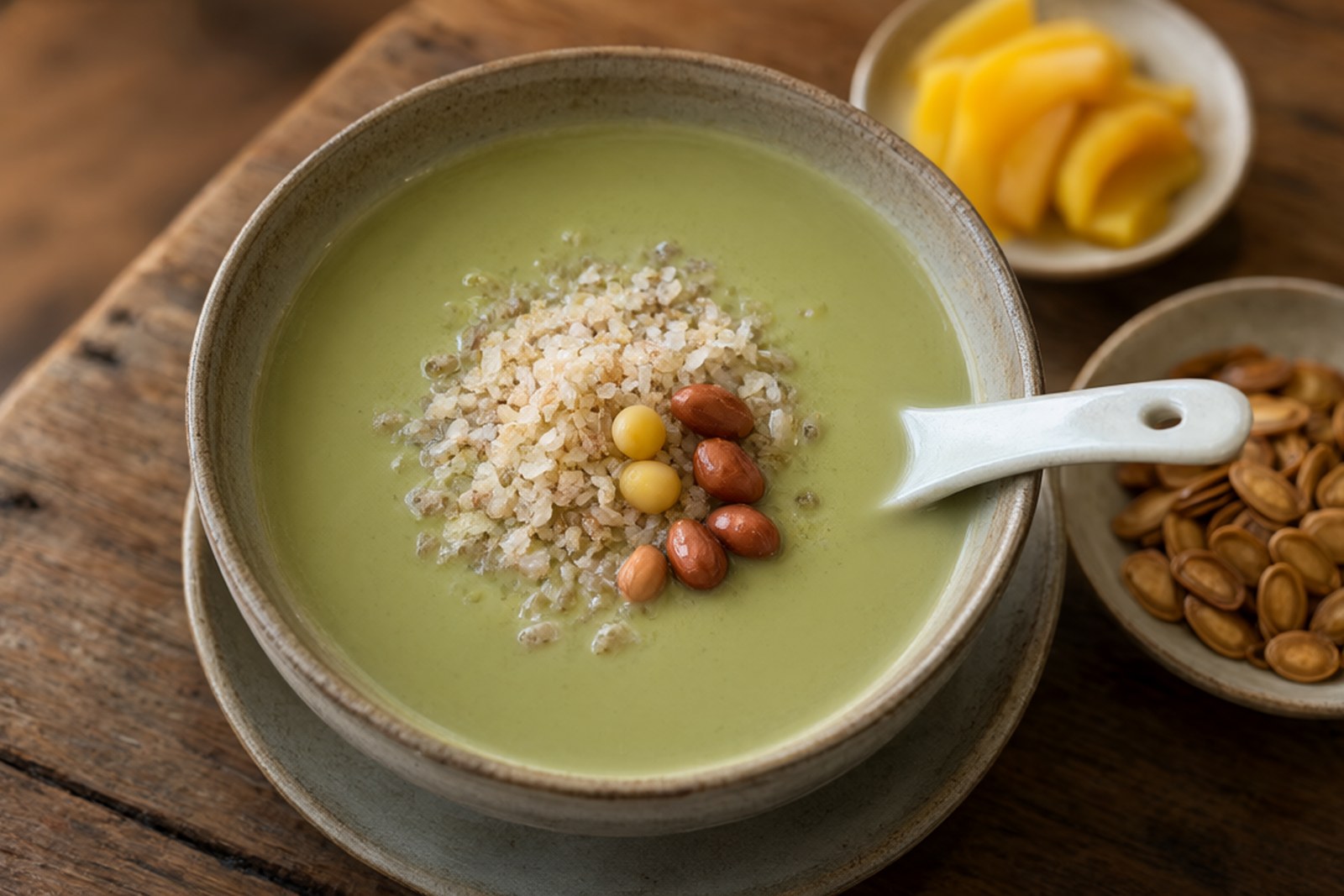
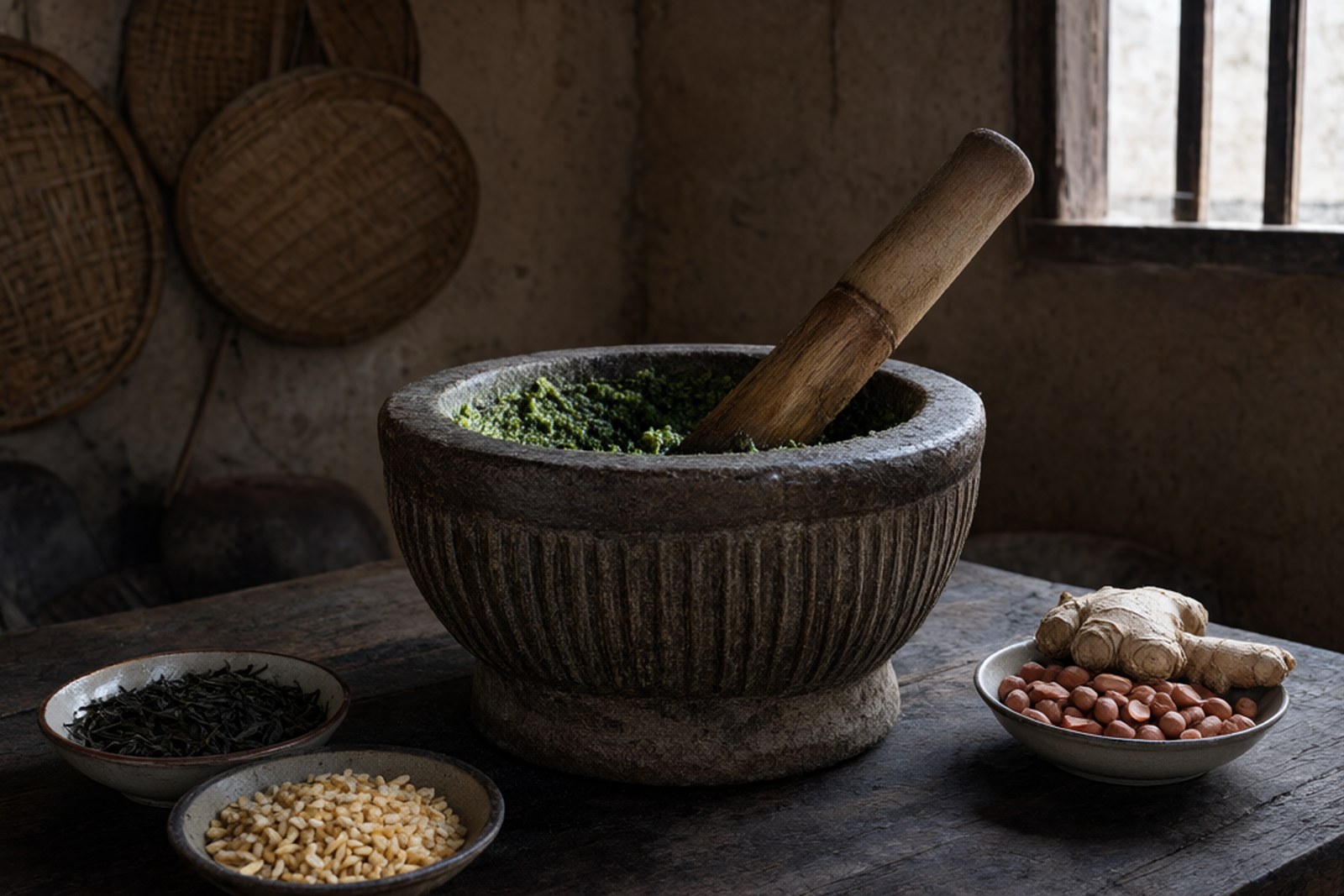
The sequence of making it is fixed enough to be a folk test. The tea leaves, usually a coarse green or a dark leaf, are soaked and put into a 擂钵 léibō, a heavy earthenware mortar with a ribbed inner surface, and ground with a 擂茶棒 léichá bàng, a hardwood pestle, until they are a paste. Then the other ingredients go in, one by one, in an order that differs from household to household and that everyone insists is the only correct one: ginger, then rice or rice flour, then peanuts, then sesame, each ground down before the next is added. Hot water is stirred in at the end to make a smooth, thick soup. The puffed rice and the fried beans go into the bowl dry and the liquid is poured over them at the table, so that they are still crisp on the first spoonful and softening by the last.
A Meal and a Welcome
There are two registers of 擂茶 in Anhua and it matters which you are being given. The 清擂茶 qīng léichá, the plain one, is a light savoury drink with only tea, ginger and a little rice, served in summer to cool and to settle the stomach; it is drunk from a bowl without ceremony. The 咸擂茶 xián léichá, the substantial one, is nearly a meal: it carries the peanuts and sesame and a full bowl of puffed rice, and it is served to guests, to work parties, and to anyone who has walked up the mountain. In the villages around 洞市 Dòngshì and the tea country to the west, a household will put out eight or ten small dishes beside it — pickled radish, dried tofu, smoked pork, fried pumpkin seeds — and the 擂茶 becomes the centre of a table rather than a cup in a hand. The traditional occasion for it is 打擂茶 dǎ léichá, the group pounding, which used to be done by women taking turns at the mortar while they talked.
Words and Names
擂茶 léichá is the dish and 擂 léi the act of grinding it. 擂钵 léibō is the ribbed earthenware mortar and 擂茶棒 léichá bàng the wooden pestle. 清擂茶 qīng léichá is the thin summer version and 咸擂茶 xián léichá the substantial one; 打擂茶 dǎ léichá is the communal making. 安化 Ānhuà is the county and 安化黑茶 Ānhuà hēichá, Anhua dark tea, the brick-tea industry it is famous for — which is a different drink entirely, brewed and sold by the tonne, and not to be confused with this. 炒米 chǎo mǐ is the puffed rice and 阴米 yīn mǐ the parched rice many households use instead.
What the Locals Know
Order it by asking whether the household is doing 清 or 咸, because it changes what you will get by a factor of three. The liquid should be thick enough to hold a spoon upright briefly and green rather than brown; a brown 擂茶 means the leaves were old or the grind was short. The puffed rice goes in last and at the table, and if it has been sitting in the liquid it will already be soft. Drink the first bowl plain to taste the tea and the ginger, then let the host refill, and expect to be given at least three bowls — the rule in most Anhua households is that a guest who stops at one has not been properly received. It is a country food and it is cheap, usually a few yuan a bowl in a market stall or free in a home; the 擂钵 itself is the expensive object, a good one costing a few hundred yuan.
flowcloud would say that lei cha is what a tea culture looks like when it decides that steeping is a waste of the leaf, since everything in the bowl is the plant and everything in the bowl gets eaten, and the mortar is the only machine involved.
Where to find it: the market stalls and farmhouse kitchens of 安化县 Ānhuà Xiàn, especially around 洞市老街 Dòngshì Lǎojiē, the old street in the west of the county, and in the towns along the tea road. Ask for 咸擂茶 if you want the meal and 清擂茶 in July if you want the drink, let the host pour, and do not turn down the second bowl.