
You smell it before you see it: smoke, then green pepper, then something faintly medicinal that turns out to be the black beans. The bowl is small, dark and unlovely — a rough ceramic mortar holding a mess of green and black paste, glistening with oil, with the skins of the chillies still visible in shreds. It does not look like a dish that could change your mind about anything. Then you put half a spoonful on rice, and the rice is gone, and you have another bowl of rice, and the bowl in the middle is empty. 安仁抖辣椒 Ānrén dǒu làjiāo — Anren shaken chilli — is the plainest thing on a Hunan table and, in the view of anyone from 安仁县 Ānrén Xiàn, the only one you truly need.
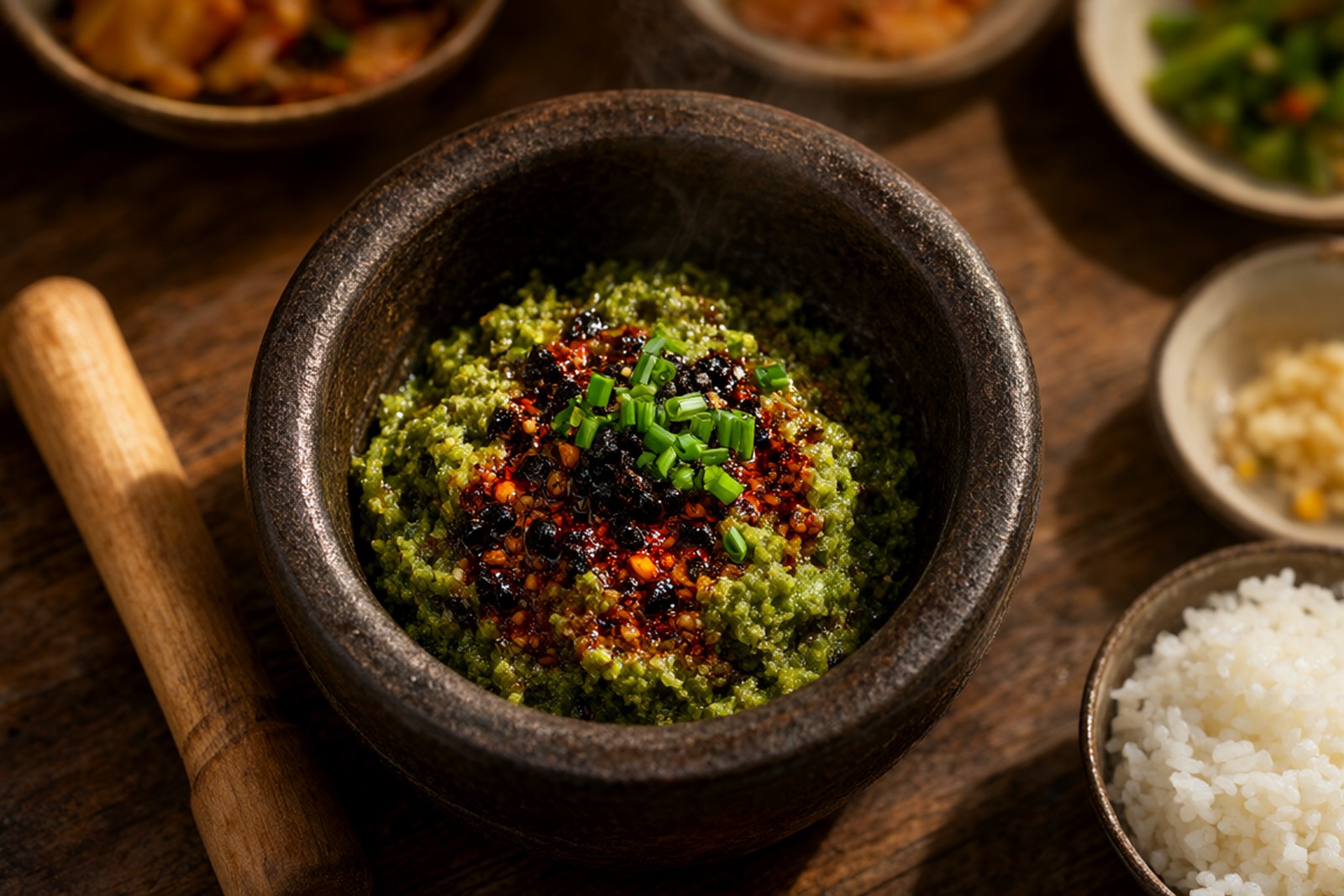
The name is the recipe, or most of it. 抖 dǒu is a verb that means to shake, to jerk, to flick — the motion you make with a wrist when you bring a bowl or a sieve down sharply and the contents settle. In the 湘南 Xiāngnán dialect it also means the particular aggressive pounding that stops just short of making a paste. The chillies are not chopped, not blended, but jolted against the walls of a stone mortar with a wooden pestle, and after forty or fifty strokes they have collapsed into a rough mash with texture left in it: some pieces the size of a fingernail, some the size of a grain of rice. You are eating the chilli as a substance, not as a seasoning, and that distinction is the whole dish.
What Makes It Work
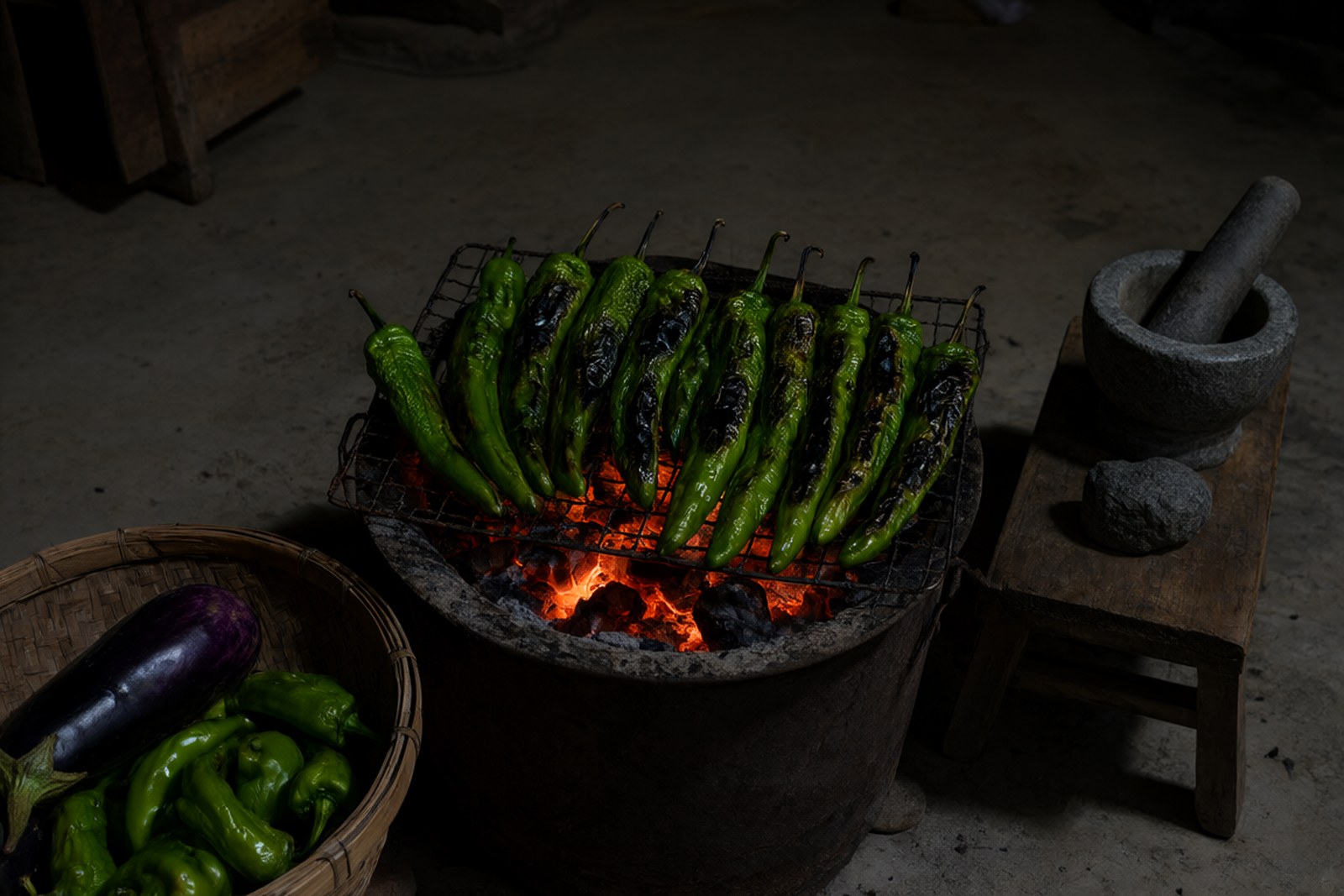
The chillies are grilled first, over charcoal, until the skins blister and blacken in patches. Any Hunan cook will tell you that’s what produces the taste, and what they mean is a specific chemical event: the heat ruptures the cells, drives off water, and caramelises a little of the sugar, so the pepper loses its raw green bite and gains a smoky sweetness that can stand up to oil. Over-fry them and they turn bitter; under-fry them and the mash tastes like a salad that has been beaten up.
Then black beans. 豆豉 dòuchǐ, fermented black soybeans, are the umami engine of the whole region, and Anren’s version is strong and slightly funky. They go into the mortar with the still-warm chillies and get broken against them, so that the bean paste and the chilli juice emulsify. Garlic, either raw or lightly pounded. Salt. And then the step that makes it survive on the table for a week: hot oil poured over the top, which cooks the surface, seals in the aroma, and turns the whole thing glossy.
The garnish is negotiated. Some households add shredded 茄子 qiézi, aubergine grilled alongside the peppers until the flesh collapses. Others add a little 腊肉 làyān ròu, cured pork, or dried shrimp. Purists regard all of it as distraction, and when the mash is served next to something heavy — jar-braised pork, or a bowl of fatty pork noodles — they are demonstrably right.
Words and Names
抖 dǒu is the key character and the hardest to translate: it is in 发抖 fādǒu, to shiver, and in the everyday instruction to shake a sieve or flick ash off a cigarette. 擂 léi, to grind or pound, is used for the same dish in other counties, so 擂辣椒 and 抖辣椒 name the same bowl with different verbs: the first is heavier and produces a finer paste. 豆豉 dòuchǐ is fermented black soybean, and 安仁 Ānrén is the county — the characters mean “peace” and “benevolence”, a combination some local schools have been milking for six hundred years.
What the Locals Know
This is a summer dish in origin, because summer is when the chillies are heavy on the plant and the appetite is gone. It is simultaneously a winter dish, because that is when it is served beside cured meats and rich stews that need cutting through. The county has a further claim that it repeats at every opportunity: 安仁 is known as 南国药都 nánguó yàodū, the medicine capital of the south, on the strength of its herb trade, and a bowl of mashed chilli with a great deal of ginger in it is presented as a medicinal preparation rather than a condiment. Whether or not you buy that, the version with extra ginger and less oil genuinely does clear a head cold.
Two practical notes. First, the mash is much better the day after it is made, once the oil and the chilli juice have settled into each other; a bowl made to order and eaten immediately is sharper and less interesting. Second, it keeps in the refrigerator for about a week, and it improves. Locals make a large batch in the pestle on Sunday and eat it across the week.
flowcloud would say that Anren mashed chilli is the cheapest possible test of a cook’s honesty: there is nowhere to hide, no sauce, no garnish, nothing but whether the peppers were properly charred and the beans properly fermented.
Where to find it: 安仁县 Ānrén Xiàn is a county of the 郴州 Chēnzhōu hinterland, two hours northeast of the city, and the mash appears on every table there, including breakfast. In the city itself, look for a small 家常菜 jiācháng cài — home-style — restaurant with a stone mortar visible in the window; the ones that prepare it per order rather than scooping it from a tub are worth the extra ten minutes.