
Granny’s Dongshan Mutton
The first thing you notice is that the fire is not gas. It is a shallow clay brazier of black charcoal, carried to your table and set down between the stools, and it burns with a bright open flame for the first few minutes before settling into a slow orange glow that will last the whole meal.
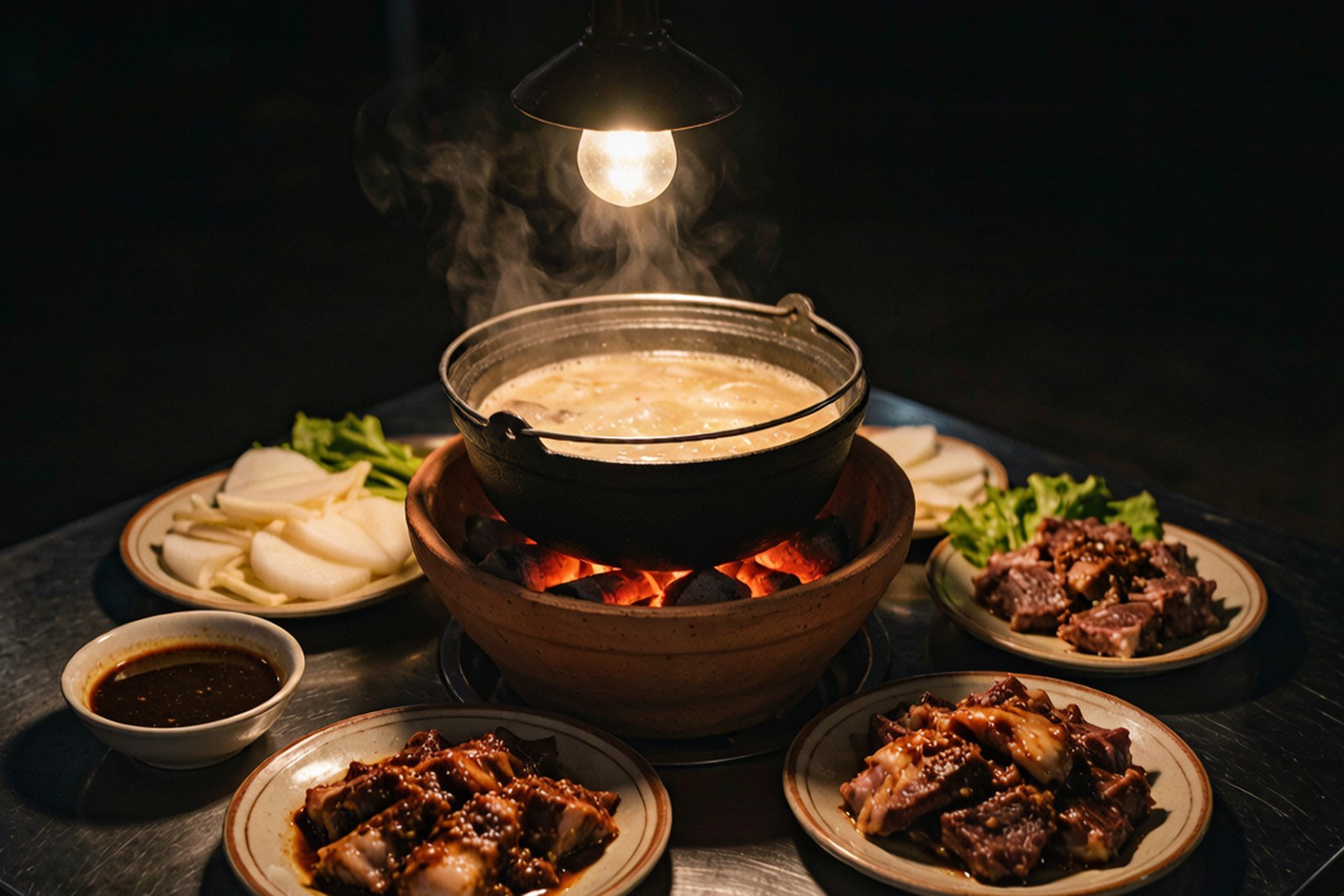
On top of it goes a pot of broth made from goat bones and goat meat, simmering, slightly opaque, salted harder than you would salt it yourself. Around it, the dishes arrive: a plate of raw meat, thick-cut and dark from the marinade; a plate of cold sliced meat with the skin left on; liver, cut into slabs; tofu skin; radish; sweet potato leaves. And a small bowl of the house dipping sauce, which is sour and sweet and has chilli in it somewhere, and which nobody has ever been able to get the recipe for.
The owner is a woman in her seventies. She has run this place for forty years. If she is there when you sit down, she will come over, turn your meat in the pot, tell you when it is ready, and possibly tell you off for wanting to order more before you have finished what is on the table. She is one of the reasons to eat here and I am not going to pretend otherwise.
Forty Years on the Second Floor
阿婆东山羊肉店 (Apo Dongshan Yang Rou Dian) — “Granny’s Dongshan Mutton Shop” — sits on the second floor of what used to be 老鸿港海鲜批发市场 (Lao Honggang seafood wholesale market) on 胜利路 (Shengli Road), in the western part of Sanya near the bay. The market itself has moved on. The address has not: the shop stayed in the building it grew up in, which is why you will find yourself climbing a concrete staircase past closed roller shutters to eat in a room that has the atmosphere of a very old canteen.
Forty years is the figure the food writers use and it is not disputed; when a reporter from 人民日报 visited, the shop was described as “a forty-year-old Hainanese speciality”, and elsewhere as having been trading for thirty-five when the piece was written. Either way, she opened it in the 1980s, in what was then a much smaller and rougher city, and she has been doing the same thing ever since.
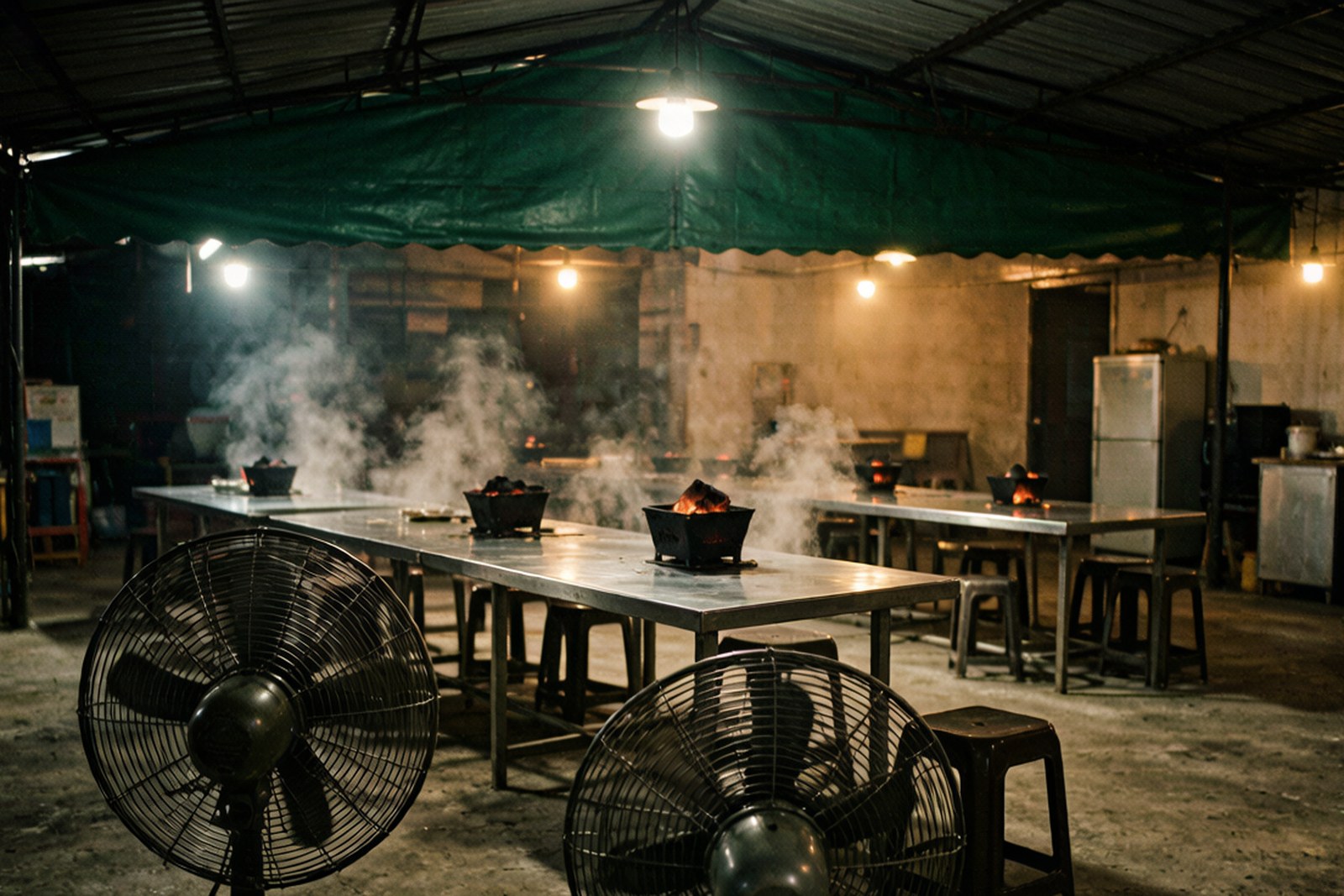
The room is a 大排档 (da pai dang) in the old sense: dark green canvas awnings, steel tables, plastic stools, stand-up fans on the floor because the air does not move. There is a wall of photographs behind the counter — mostly the owner with people you have seen on television, which tells you the place has been talked about for a long time. Nobody in the room is dressed for dinner. On a summer evening the whole thing is slightly uncomfortable, and it is exactly the right way to eat this dish, which is a winter dish cooked by people who have never had a winter.
东山羊, the Fourth of the Four
海南四大名菜 — the four famous dishes of Hainan — are 文昌鸡 (Wenchang ji, chicken), 加积鸭 (Jiaji ya, duck), 和乐蟹 (Hele xie, crab) and 东山羊 (Dongshan yang, mutton). Three of them are named after towns: 文昌, 加积, 和乐. The fourth is named after a mountain.
东山岭 (Dongshan Ling) is a small mountain in 万宁 (Wanning), on the east coast, about an hour and a half up the motorway from Sanya. The goats that graze it are the point: they are black, small, and they climb. Their diet is famously wide — the story is that they eat the wild herbs and plants that grow on the rock, and the local claim is that the vegetation is why the meat has none of the rankness that goat has almost everywhere else.
The last part is the honest reason this dish exists, so it is worth stating flatly: 东山羊 does not taste like goat. The fat under the skin is mild and faintly sweet, the meat is fine-grained and gives up none of that hard, woolly smell that people who dislike goat are actually objecting to. If you have been avoiding goat for years, this is the one to try, and if it still tastes like goat to you, you may simply be one of the people who taste it — a real thing, about a third of people, and not your fault.
How It Is Cooked, and How to Order It
The kitchen does very little, which is the point, and the menu is a single page that lists 羊 and variations on 羊.
生羊肉片 (sheng yang rou pian) — raw mutton slices, and the single most important order on the table. They arrive thick-cut, not the paper-thin rolls of a Beijing hotpot, and they are dark because of the marinade: starch, Sichuan pepper, white pepper, and something else the shop does not say. The starch keeps the meat from losing its juices in the pot and the pepper does the work of removing any remaining gaminess. Drop them in, wait — and be patient, because this is not a thin slice, it is going to take longer than you think — and then lift them out. What comes out is tender in a way that surprises people, and clean on the surface, without the thick sauce coating that ruins cheap stir-fries.
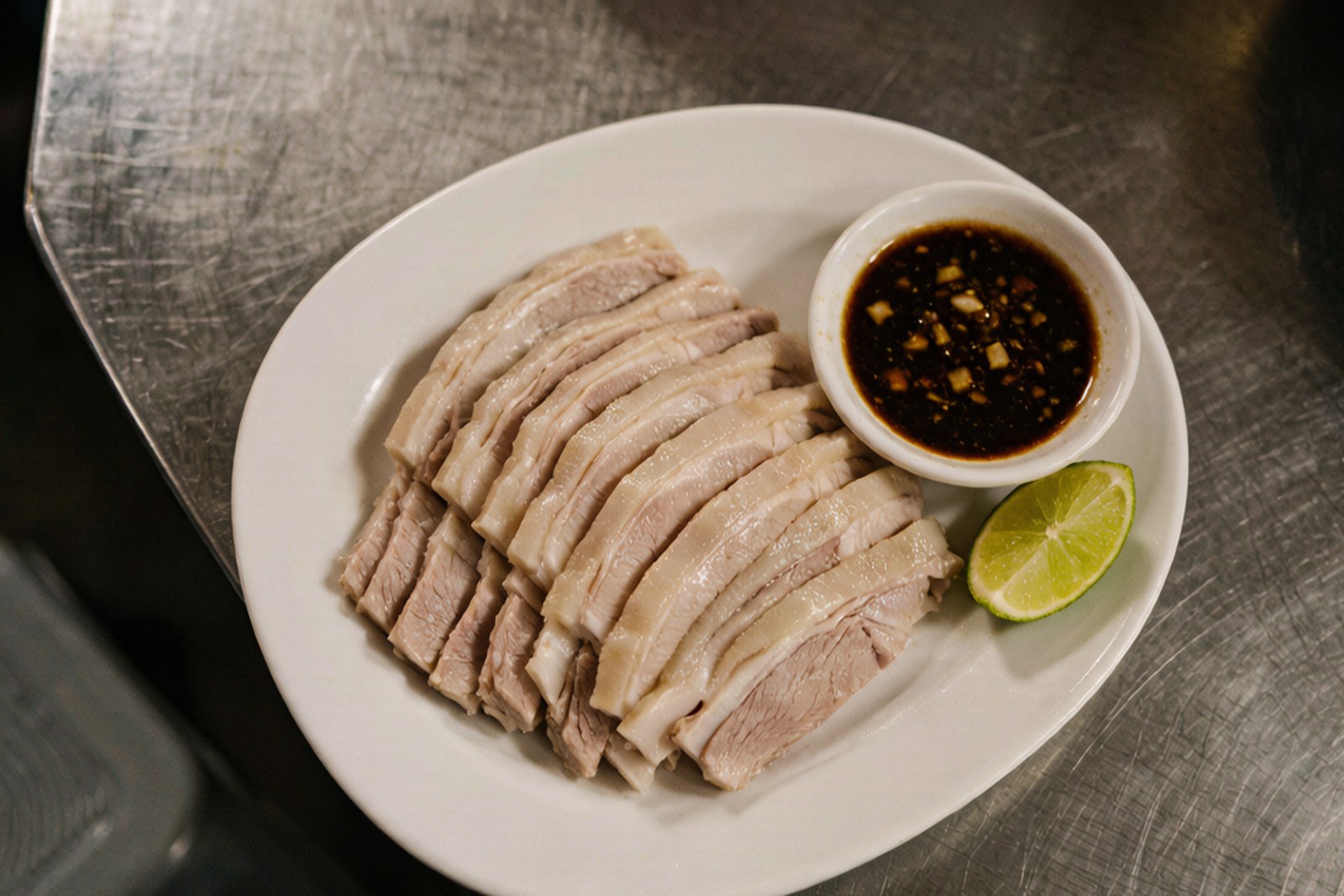
白切羊肉 (bai qie yang rou) — cold white-cut mutton, skin on, thickly sliced. This is the same technique as the chicken, applied to an animal that resists it. No gaminess, a good proportion of fat to lean, and a real bite to it. The shop will tell you not to dip it. They are right; eat a few slices plain before you go near the sauce, so that you know what you are eating when you do.
羊骨煲 (yang gu bao) — the mutton bone casserole, the big-ticket item, and the one you should probably not order. Not because it is bad — it is excellent, and the broth you get as a result of ordering it is the best thing in the shop — but because it arrives with an enormous quantity of meat on the bone and takes a long time to reach the point where it is worth eating. The shop’s own advice, delivered with some force, is that you should cook it down until it comes away from the bone, which is a half-hour proposition. Two or three people, several hours, and a genuine appetite: order it. A couple on a first visit should not.
羊肝 (yang gan) — liver, cut in large flat pieces and pan-fried on both sides at high heat, served still pink in the middle if you are quick. This is the offal to order if you only order one.
The vegetables come after, and they matter more than they sound: 腐皮 (tofu skin), 萝卜 (radish), 地瓜叶 (sweet potato leaves). Cook them in the broth that has been enriched by everything else and they become the best version of themselves. The first portion of greens comes free; the second is charged.
The broth is the thing you will remember — goat bone and meat, simmered hard and salted heavily, and at the end of the meal it tastes of everything that has been cooked in it. Ask for a bowl of rice if you want to be full. Or just keep drinking it.
What the Locals Know
Go for a late lunch. The shop opens around noon and again in the evening, and the room fills from six. Noon on a weekday is a different, calmer restaurant, and the owner has time to cook your meat for you.
Order less than you think, and add later. This is the house rule, enforced personally. Two people: one 锅底 (guo di, the broth base, about twenty yuan), one 生羊肉片, one 白切羊肉, and two vegetables. That is a full meal and it will cost around a hundred and eighty yuan for two.
Do not skip the 锅底. It is charged as a small per-person fee and it is the foundation of the entire meal. There is no version of this where you eat mutton without it.
Use the sauce, then stop using the sauce. The dipping sauce is sweet, sour, chilli-laced, and closer to a Thai condiment than a Chinese one, which is not a coincidence — the coastal trade routes ran both directions. It is delicious. It also hides the meat. Alternate.
Take the charcoal seriously. The brazier gets very hot and stays hot. Keep your hands above the table, and mind children.
Bring cash or be sure of your app. It is a market stall that grew up and became a small institution; the payment situation is not always as smooth as a shopping-mall restaurant’s.
Do not come in the middle of a summer afternoon. There is no air conditioning and the fans do their best. Cooler weather, or after dark, is the right time.
A Note on the Name
阿婆 (a po) is a grandmother, and specifically a grandmother of the small, matter-of-fact kind — not 娭毑 in the Changsha dialect, and not the formal 奶奶 of standard Mandarin. In Hainan it is what you call an old woman you know and like, and it is what her customers have called this woman for four decades, to the point that the shop is named after it and nobody I could find uses her real name at all.
东山羊 is the meat: goat from 东山岭 in 万宁. 羊肉店 is a mutton shop.
So the sign says, exactly and only: granny’s mountain-goat shop. Four characters, or nearly — no surname, no founding year, no motto, no claim to authenticity, no mention of the fact that this is one of the four dishes Hainan is known for. Compare it with the shop two streets away that will tell you it has been authentic since 1998. Both are honest. Only one of them has stopped needing to say anything.
四十 years of black charcoal, one dish, one woman who will tell you when your meat is ready. In a city that has spent the last twenty years rebuilding itself around visitors, that is closer to a historical monument than anything with a ticket window.
flowcloud would say that you can tell what a place really eats by looking for the restaurant that has refused to change its fire — and that a granny in her seventies still burning charcoal on the second floor of a dead market, because gas would cook the mutton wrong, is the whole of Hainan’s cooking in one room.
Where to find it: 阿婆东山羊肉店 (Apo Dongshan Mutton Shop), 老鸿港海鲜批发市场 2楼 (Lao Honggang market, second floor), 胜利路 (Shengli Road), 天涯区, Sanya — the market has relocated but the shop has not, so go by the name of the old building rather than its current tenants; near the western end of 三亚湾 (Sanya Bay). Lunch from about 12:00 to 14:00 and dinner from about 16:00 until 21:30. Order the 锅底 (guo di) plus 生羊肉片 (sheng yang rou pian) and 白切羊肉 (bai qie yang rou); two people should not order the 羊骨煲 (yang gu bao). Add 羊肝 if you eat liver. About 180 yuan for two. Go at lunch, when she has time to cook your meat, and take the dipping sauce seriously and the charcoals more seriously.