
Baiguan Loofah, Zhuzhou’s Summer Vegetable
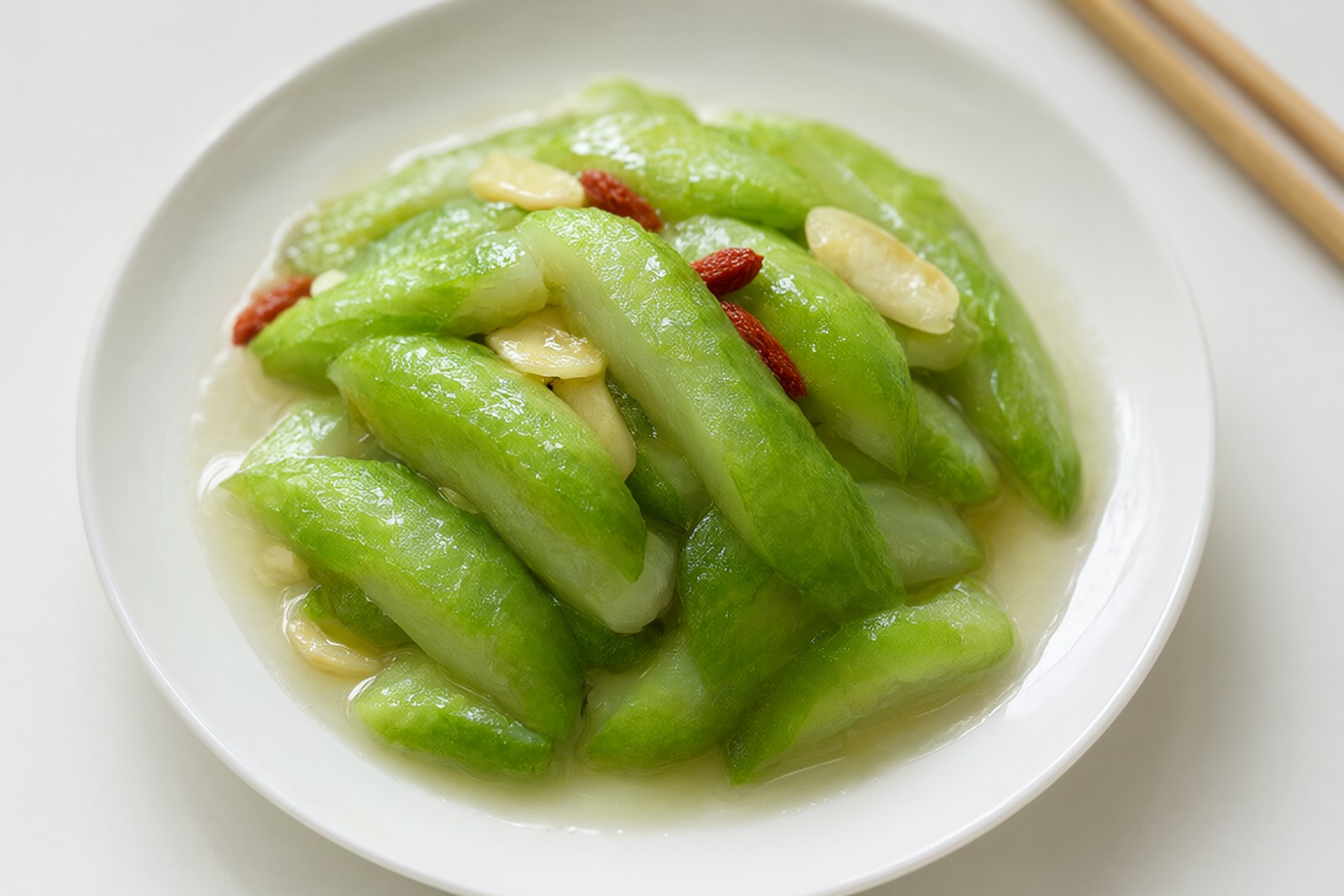
The odd thing is the colour. Stir-fried loofah in most of China goes grey-brown the moment it hits the oil and gives up a puddle of dark water; this one comes out pale jade, slightly translucent, still bright, with a broth at the bottom of the plate that is clear rather than murky, and the taste is sweet in a way that needs no help — no sugar, no stock, no chicken powder, just garlic. 白关丝瓜 Báiguān sīguā, the Baiguan loofah, is a vegetable grown in one town on the edge of 株洲 Zhūzhōu, and it has, in a little over a decade, acquired the full set of Chinese quality marks: geographical indication certification in 2020, national agricultural product indication in 2021, a gold medal at the Central China agricultural fair in 2023, national protected product status in 2025, and a place on the national list of exceptional new agricultural products in 2026 — the first product from the whole of Zhuzhou to be so listed.
白关镇 Báiguān Zhèn is in 渌口区 Lùkǒu Qū, on the flat land south of the city, and it has been growing loofah for something close to four hundred years — the local saying, 白关十里铺, 丝瓜万家甜 Báiguān shílǐ pù, sīguā wàn jiā tián, describes ten li of fields whose loofah sweetened ten thousand households. What has changed is the science. The soil is a red-yellow sandy loam high in organic matter, the climate is warm and humid, and the local variety that developed here has two characteristics that laboratories can measure: about half the crude fibre content of an ordinary loofah, and two to three times the vitamin C.
The fibre number is the important one, because it explains the cooking behaviour. Less fibre means the flesh holds water differently, does not collapse as fast under heat, and does not oxidise to grey. That is the whole reason the vegetable is prized: 烹饪后嫩白如玉, 久炒不黑 — tender and white as jade after cooking, and it does not go black however long you fry it. A restaurant in Zhuzhou will therefore cook it very simply, which is the mark of a vegetable that is confident: peeled, cut into chunks, thrown into a hot wok with sliced garlic and a pinch of salt, ninety seconds, out. The plate is sweet, faintly grassy, and clean.
The industry around it has grown fast. Planted area is approaching ten thousand mu with annual output of about fifty-five thousand tonnes and a whole-chain value around six hundred and sixty million yuan, supplying supermarkets in more than thirty cities and exporting to the United Kingdom, Germany and Australia. In November 2022 a thousand seeds of the local variety went into orbit aboard 神舟十五号 Shénzhōu 15 for a space-breeding programme, and the municipal agricultural institute has been working on the returned material ever since — which makes 白关丝瓜 one of the very few vegetables in China whose pedigree includes a spacecraft. There is even a loofah mooncake and a loofah zongzi, which are exactly as strange as they sound.
Words and Names
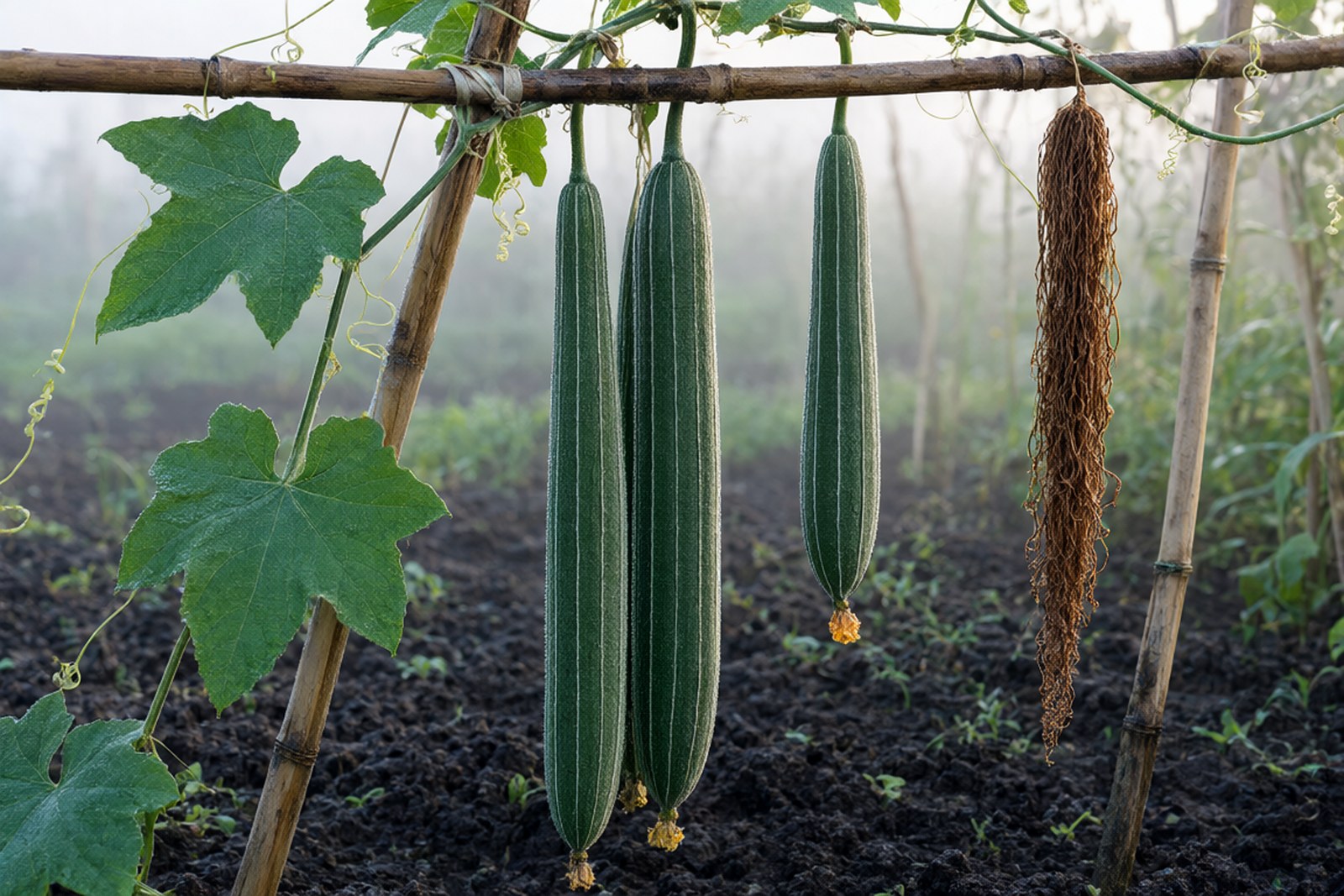
丝瓜 sīguā, “silk gourd”, is the standard name for the edible loofah, and it is the young fruit that is eaten; left to mature and dry, the same plant becomes 丝瓜络 sīguā luò, the fibrous sponge that the world knows as a loofah. 白关 Báiguān, “white pass”, is the town.
The claim to the name is legally protected and locally enforced, which matters more than it sounds: 白关丝瓜 Báiguān sīguā grown fifty kilometres away in the same province is a different vegetable, and the town’s growers will say so. The protected origin covers twenty villages within 白关镇 Báiguān Zhèn.
What the Locals Know
Buy it in summer and eat it that day. Loofah loses sweetness within a day of picking, and the whole point of the Baiguan variety is a quality that does not survive a fridge.
Peel it lightly. The skin of a young Baiguan loofah is thin enough that scraping rather than peeling preserves the firm outer layer that keeps the flesh from collapsing.
Cook it with garlic and salt only. Adding soy, oyster sauce or stock is the standard mistake. The vegetable is sweet; sauce is interference.
Watch the stem end. The freshest ones have a bright green stem scar and no softness. Once the end goes brown the sweetness is gone.
Where to Eat It
In season, June to September, in the restaurants of 株洲 Zhūzhōu city and 渌口区 Lùkǒu Qū, where it appears as 清炒丝瓜 qīngchǎo sīguā for ¥18–35. In the town itself there are farm restaurants and the annual 白关丝瓜节 Báiguān sīguā jié, a festival held since 2021 with tasting menus by chefs from the province’s better restaurants. In markets it sells for ¥6–15 per half kilo in season — expensive for a vegetable here, and worth it.
flowcloud would say that a town which spent four hundred years growing a better loofah, and then sent a thousand of its seeds into orbit, has taken a very Chinese route to the future: first the soil, then the paperwork, then the spacecraft.
Where to find it: 白关丝瓜 (Báiguān sīguā), 白关镇 (Báiguān Zhèn), 渌口区 (Lùkǒu Qū), 株洲市 (Zhūzhōushì), 湖南 (Húnán). In season June to September; market price ¥6–15 per 500g; a restaurant plate of 清炒丝瓜 (qīngchǎo sīguā) ¥18–35. Cook it with garlic and salt only, and eat it on the day it is picked.