
The last hundred metres of the 成渝古道 Chéngyù Gǔdào Chengdu-Chongqing old post road climb out of the town below the hill, and the smell reaches you before the shopfront does: sweet wood smoke over chaff, then cured fat, then tea. 九龙坡区 Jiǔlóngpō Qū Jiulongpo is the south-west district of Chongqing Municipality, and this page is about the town at its southern foot, 白市驿 Báishìyí Baishiyi, the first station on that road. This is not a duck-ranking page and not a hotpot page; it is one cured bird, the road that carried it, and the craft that keeps it.
The station explains everything else. Baishiyi sat where the road out of Chongqing toward Chengdu crossed open ground, and by the counting of the local gazetteers and the company’s own history it was the first of the road’s stations; a yamen for the post was established here in the Kangxi nineteenth year, 1680. Travellers stopped because the road made them stop, and the taverns that served them needed food that travelled well and kept in a warm climate. The classical record is already in the county gazetteer: the 1937 edition, compiled by a team led by 向楚, lists 白市驿之熏鸭 Báishìyí zhī xūnyā – Baishiyi’s smoked duck – as earning thousands a year. The couplet that grew out of it – 板鸭下美酒 bǎnyā xià měijiǔ, pressed duck with good wine – is the district’s own phrase for the pairing.
The origin of the bird is a matter of three floors, and this page keeps them apart. On the craft floor, the company’s account traces the recipe to the early Tongzhi years of the Qing, when a local butcher visiting Chengdu saw a restaurant air-drying white ducks and reproduced the method on his return. On the legend floor, printed as folklore, the duck reaches back further: a story in the national collection of Chinese folk tales in which locals carrying produce to a rebel army in the seventeenth century salt a duck, prop it open with bamboo slats, and are praised for it so much that the bird is named on the spot. Either way the result is a method, not a date.
The craft is taught as seven characters, and the sequence is a production line: 相 xiàng assessing the bird, 屠 tú slaughter, 划 huá opening, 腌 yān salting, 绷 bēng trussing, 烘 hōng drying, 熏 xūn smoking. The opening is counted – 十八刀 shíbā dāo, eighteen cuts: one along the breast bone, eight to each side spreading the bird out, one to part the wishbone, the cuts required to come out ruler-flat. The trussing is the step that names the product: two fresh bamboo slats are crossed from the collarbone down to the leg, opening the bird’s front into a fan and spreading the legs out with it, and the whole shape – the local saying runs, 白市驿板鸭——干绷 Báishìyí bǎnyā, gānbēng – is the joke, a thing puffed up beyond its real size.
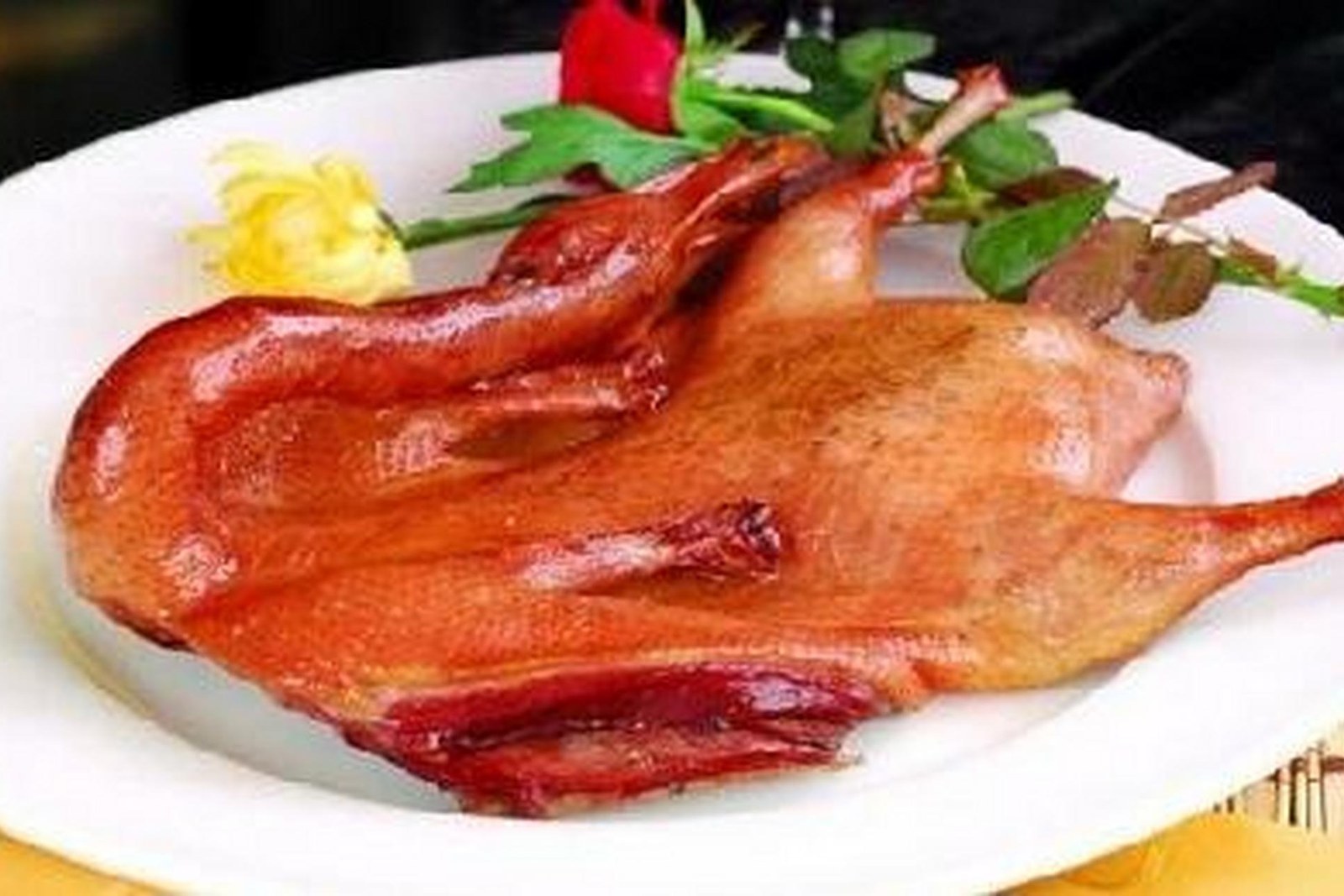
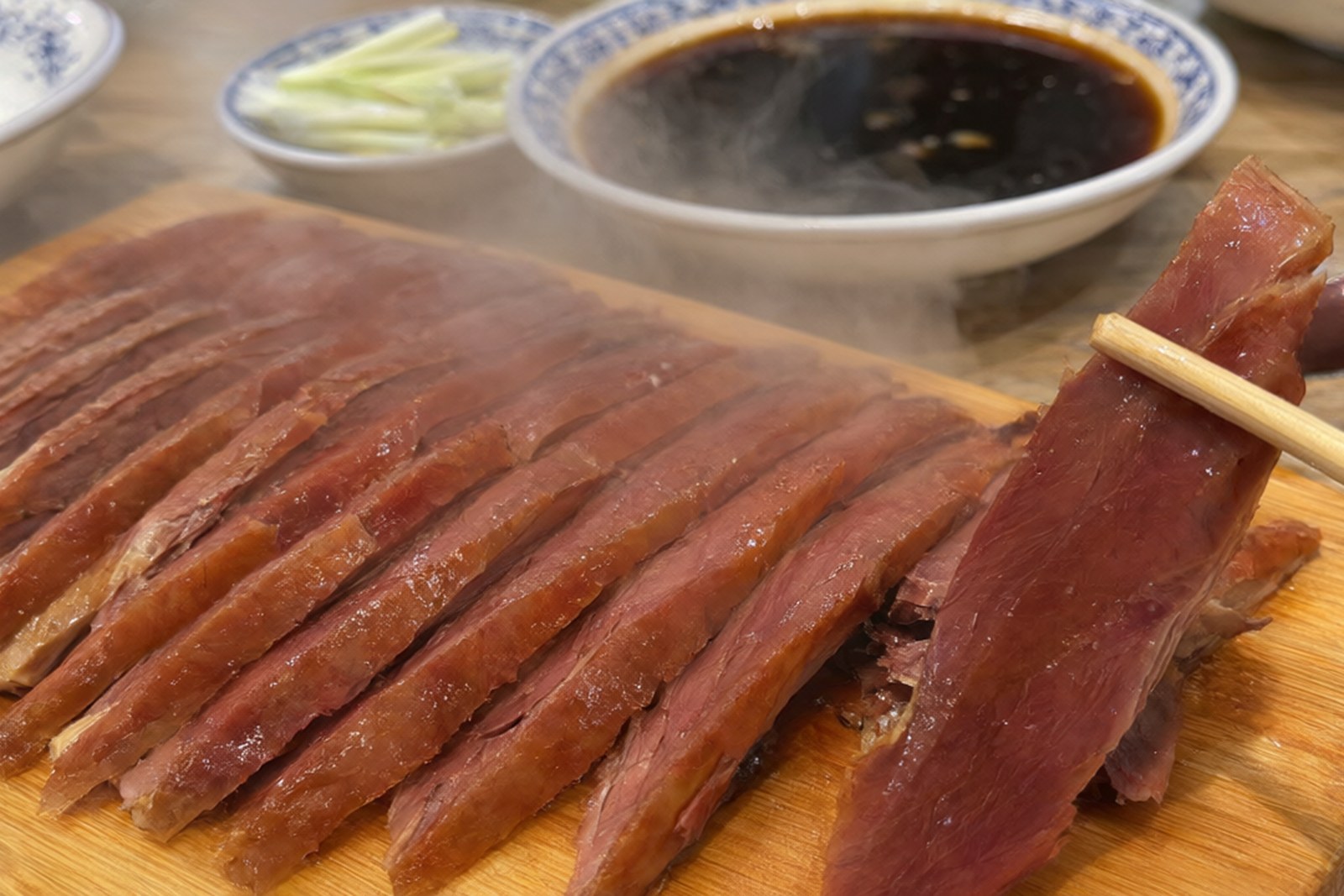
The drying is a room, the smoking is a pit, and the smoking is the step that separates this bird from Chongqing’s other cured ducks. The dried bird goes flat on a rack over a lit pit and takes chaff smoke – rice husks, not wood chips, not a flame – with steady heat and no open flame, turned by hand throughout; the company’s own materials put the smoking at forty to fifty minutes. What comes out is not a red cured meat and not a cold salted duck: the surface is an even brown with a gloss, the meat is described in the trade as rose-red, and the smell is smoke over something already salted and dried rather than the sweet of a young bird. It is a cooked-then-cured object, which is why it will steam on the table and also travel in a paper box.
What follows from the road is the sales history, not the recipe: the wartime government moved to Chongqing, the bird went onto official banquet tables and into gift baskets, and when the airfield down the hill opened in June 1940 and began carrying wartime passengers the duck went out with them as a gift. The honours are modern and documented: the recipe is on the municipal intangible-heritage register, filed in 2011, with the inheriting craftsman named to that register two years later, and the brand carries the time-honoured trade status.
Words and Names
白市驿 Báishìyí Baishiyi, the first station on the Chengdu-Chongqing old post road, a yamen established in 1680; 成渝古道 Chéngyù Gǔdào the old post road between the two cities. 板鸭 bǎnyā the cured, spread-open bird, pressed duck in English. 相屠划腌绷烘熏 xiàng tú huá yān bēng hōng xūn the seven characters of the craft, assessing through smoking. 十八刀 shíbā dāo “eighteen cuts”, the opening of the bird. 干绷 gānbēng the name of the trussing, and the local saying built on it – pressed duck puffed up like a thing blown up. 谷壳熏 gǔké xūn smoking over rice chaff. 中华老字号 Zhōnghuá Lǎozìhào the time-honoured trade brand status, held by the product.
What the Locals Know
Local knowledge here is a set of cutting tests, not a set of shops. The bird is bought by smell before it is bought by eye – if the smoke is thin and the fat smells raw, it came off the pit early, and no curing hides that afterwards. A good bird is even in colour from shoulder to leg, with the breast opened enough that the fan shape stands on its own two slats rather than leaning; that fan is the whole test, and it is why the saying exists. Locals use the two parts differently: the leg and the breast are eaten fresh, steamed, with the smoke coming off in the room, while the thinner sections are the ones that go into a gift box.
flowcloud would say that Baishiyi’s pressed duck is a post-road food before it is a delicacy – the first station on the Chengdu-Chongqing road, where travellers stopped and taverns needed something that travelled, and where “pressed duck with good wine” became the local phrase for the pairing. It is parked, not pressed: opened in eighteen cuts, salted by hand, trussed open on two crossed bamboo slats from collarbone to leg into the fan the local saying calls 干绷, dried, then smoked over rice chaff for the better part of an hour. The 1937 edition of the county gazetteer already lists its cured duck as earning thousands a year, and since 2011 its craft has been on the municipal intangible-heritage register. All figures checked October 2026.
Where to find it: the Baishiyi cured-duck shops in 白市驿 Báishìyí Baishiyi town, 白市驿街道 Báishìyí Jiēdào Baishiyi subdistrict, 九龙坡区 Jiǔlóngpō Qū Jiulongpo District, Chongqing Municipality – on and around the old post road’s main street in the town centre, a stop on the metro line 1 extension toward Bishan. The bird is sold whole or in parts and is a cooked product: it can be eaten as it comes, or steamed at home. No shop is ranked and no prices are quoted.