
Bamboo Tube Rice
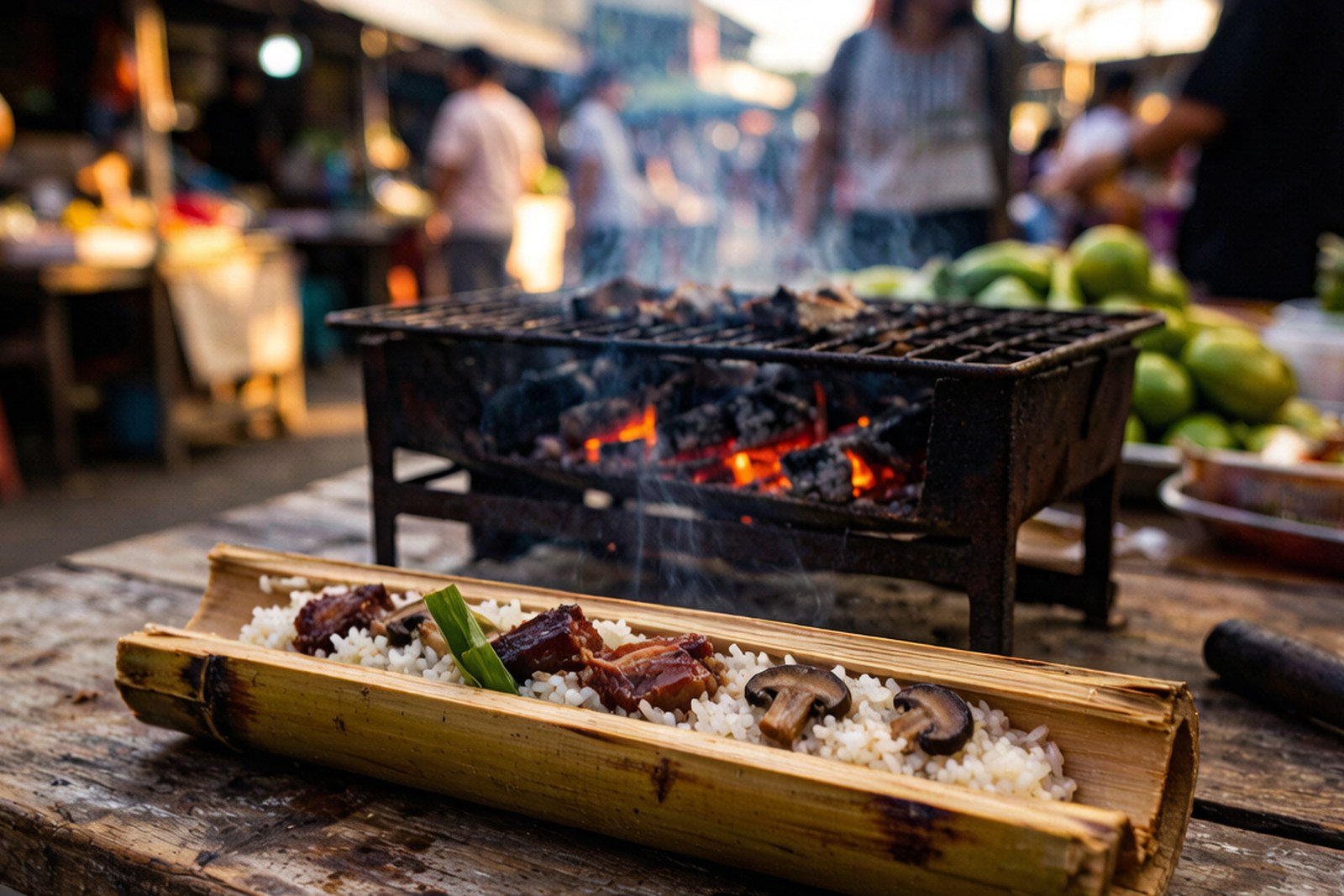
He split the green bamboo with one stroke of a cleaver and the smell came out before the steam did — rice, pork fat, shiitake, and underneath it all the sharp green breath of fresh bamboo. The rice inside had taken the shape of the tube, a pale cylinder threaded with dark cured pork and mushrooms, and the inner wall of the bamboo had gone soft enough to scrape off with the chopsticks. I ate it with my fingers in a mountain village in central Hainan while a charcoal grill smoked behind me, and I understood why nobody here bothers with plates.
This is 竹筒饭 zhútǒng fàn, “bamboo tube rice,” a dish that exists wherever there is bamboo and a need to eat on the move. In Hainan it belongs to the 五指山 Wǔzhǐshān uplands and the Li and Miao villages around them, where bamboo is cut for the fence, the water pipe and the cooking pot in the same afternoon.
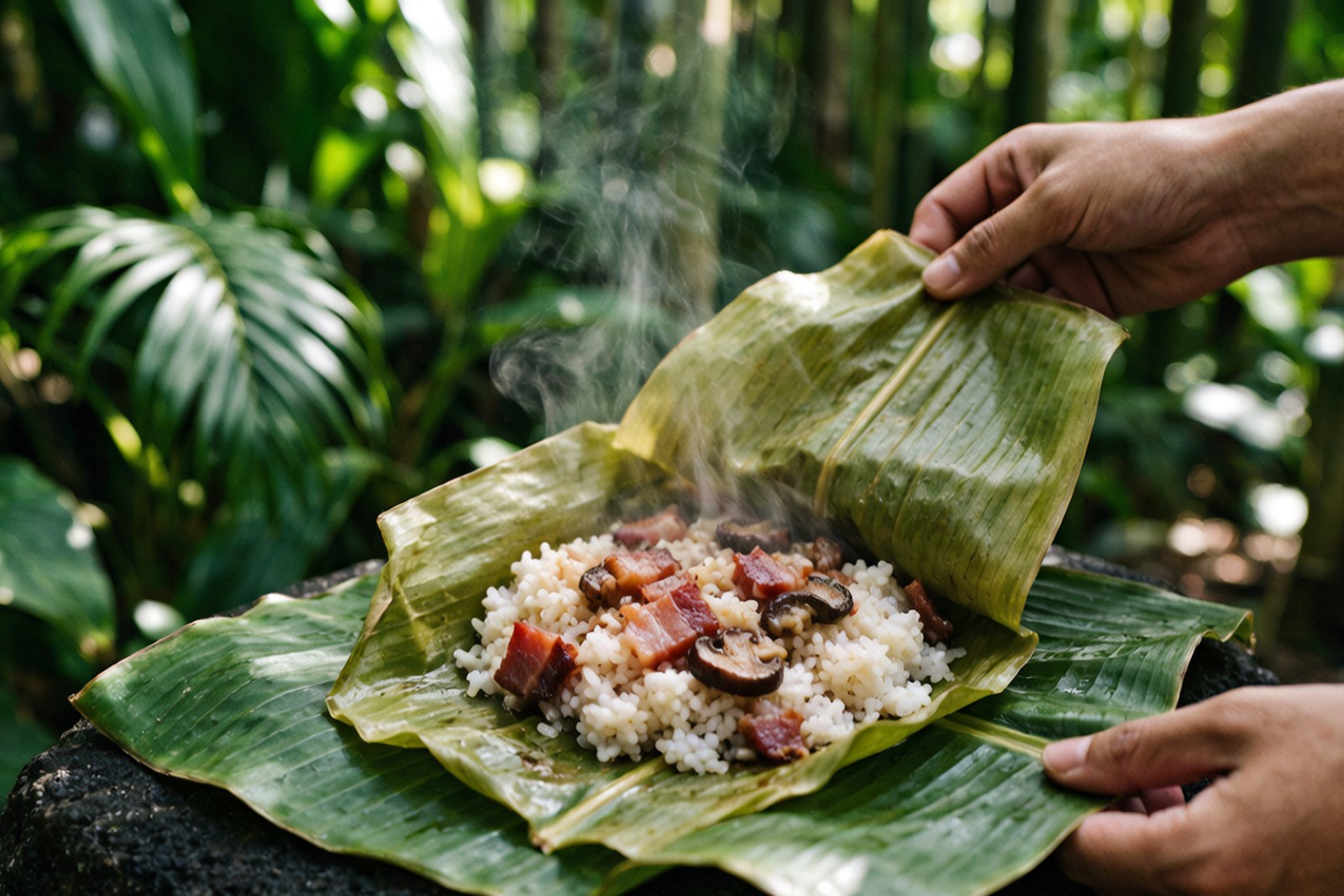
The Craft
It starts at the grove. You want a young, green 青竹 qīngzhú — thin-walled, high in moisture, and thin enough that the heat of the fire reaches the rice through it. The tube is cut between nodes so that one end is naturally sealed, then a slit or a small opening is made at the top and the mixture is packed in.
The rice is glutinous, 糯米 nuòmǐ, soaked first, then tossed with diced cured pork belly, dried shiitake, sometimes taro or peanuts, a little soy and salt. The tube is filled to about three-quarters — the rice needs room — then topped up with water, stopped with a plug of banana leaf or a roll of bamboo, and laid over charcoal. Cooked on a slow fire for forty minutes to an hour, the tube is turned so it chars evenly rather than burning through.
The bamboo does two things at once. It is a pressure vessel, so the rice steams in its own moisture and never dries out. And it is a flavouring: the inner membrane releases a green, faintly sweet sap that perfumes the whole tube. The tell that it is done is the sound — the water inside stops hissing.
Serve it by splitting the tube lengthwise and peeling it back like a wrapper. The first inch of rice against the wall is the best.
What It Is Not
This is not the Thai 竹筒饭 of the tourist islands near the mainland, which is usually just sticky rice with coconut milk, more sweet than savoury. The Hainan version is a meal, heavily cured-porky and savoury, closer to a claypot rice in spirit. It is also not the version sold at the foot of the scenic-area cable car, which is steamed ahead of time and reheated — the bamboo has stopped giving anything by then.
Words and Names
竹筒 zhútǒng is “bamboo tube” — 竹 zhú bamboo, 筒 tǒng tube or cylinder. 饭 fàn is rice or a meal. In the Li villages of 五指山 Wǔzhǐshān the dish is spoken of in the local tongue as something closer to a-bo, but on the menu in any town it will be written 竹筒饭, and every cook knows what you mean.
What the Locals Know
Watch it being cut. If the tube is not split in front of you, the rice was cooked earlier and reheated.
Eat the inside of the tube. The soft inner wall, 竹衣 zhúyī, is scraped out with the chopsticks — it is not trash.
The charred end is the good end. Rice nearest the blackened base has the strongest bamboo flavour.
Order it with 山兰酒 shānlán jiǔ. The Li upland rice wine cuts the pork fat exactly right.
Best in the mountains, not on the coast. The bamboo has to be fresh; coastal stalls rarely have a grove nearby.
flowcloud would say that a good cook wastes nothing, not even the pot.
Where to find it: Bamboo tube rice, 竹筒饭 zhútǒng fàn, is upland food, so look for it in the 五指山 Wǔzhǐshān area of central Hainan and in the Li and Miao villages of 保亭 Bǎotíng and 琼中 Qióngzhōng. The cleanest versions come from village grills rather than restaurants: seek out stalls with a live charcoal bed and a bundle of fresh green tubes beside it. A tube runs roughly 20 to 40 yuan depending on what is packed inside, and a picnic set of four with mountain vegetables makes a full lunch for two or three people. In the towns around 五指山市 Wǔzhǐshānshì ask for 竹筒饭 with 山兰酒 shānlán jiǔ (upland rice wine) and you will eat the way the growers do.
We are still eating our way through Bamboo Tube Rice. Guides are on the way.