
Sanya Authentic Baoluo Noodles
The bowl comes out of a kitchen no bigger than a wardrobe, and the first thing that reaches you is not the smell of the broth but the smell of the pepper — a dry, warm, faintly medicinal heat that Hainanese cooks get from white pepper by the spoonful, not by the pinch. Then the bowl lands: a deep mound of thick round rice noodles, pale and glassy, sitting in a clear soup with a slick of oil on the surface, and on top of that the toppings that make it 十全 (shi quan) — “ten complete”.
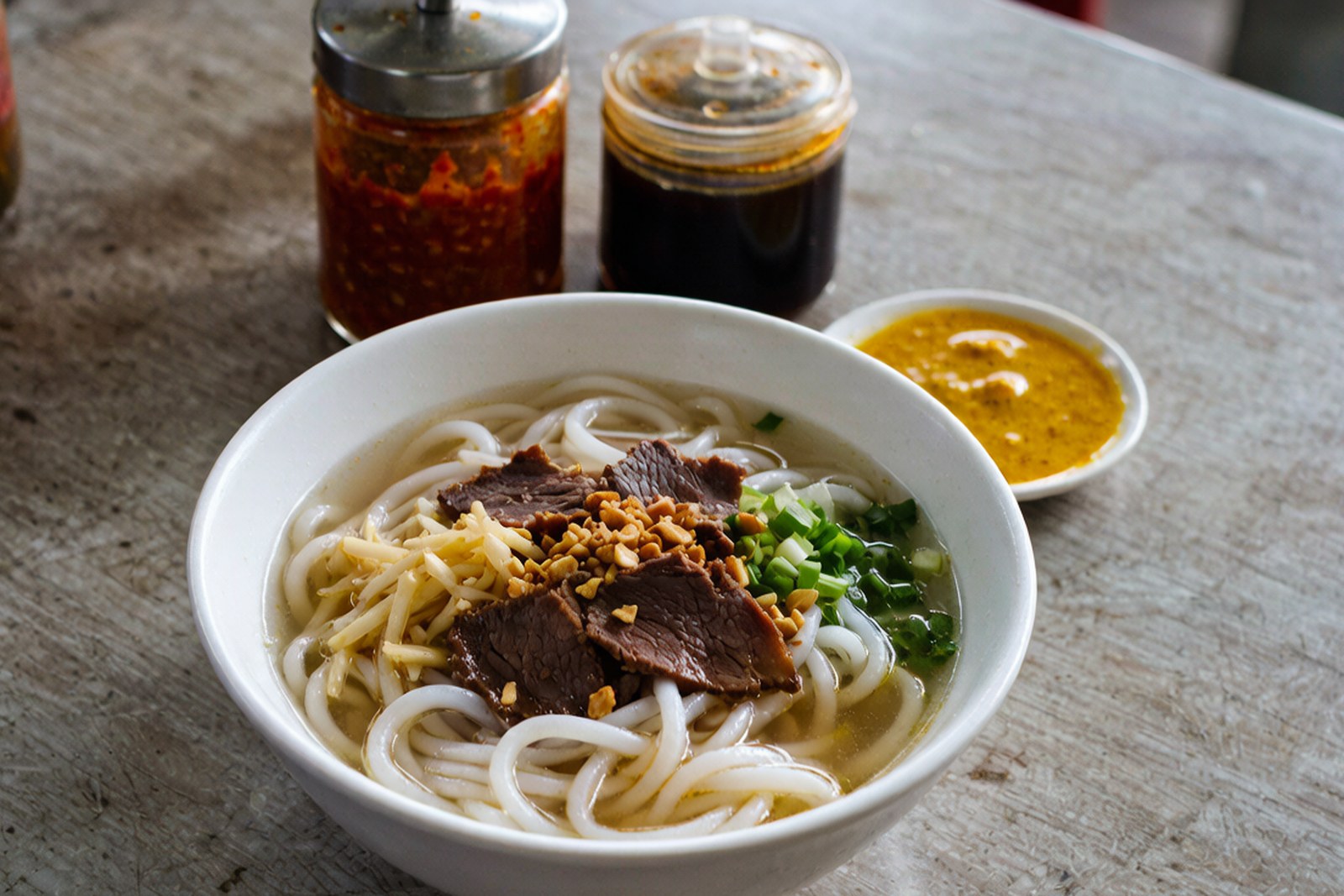
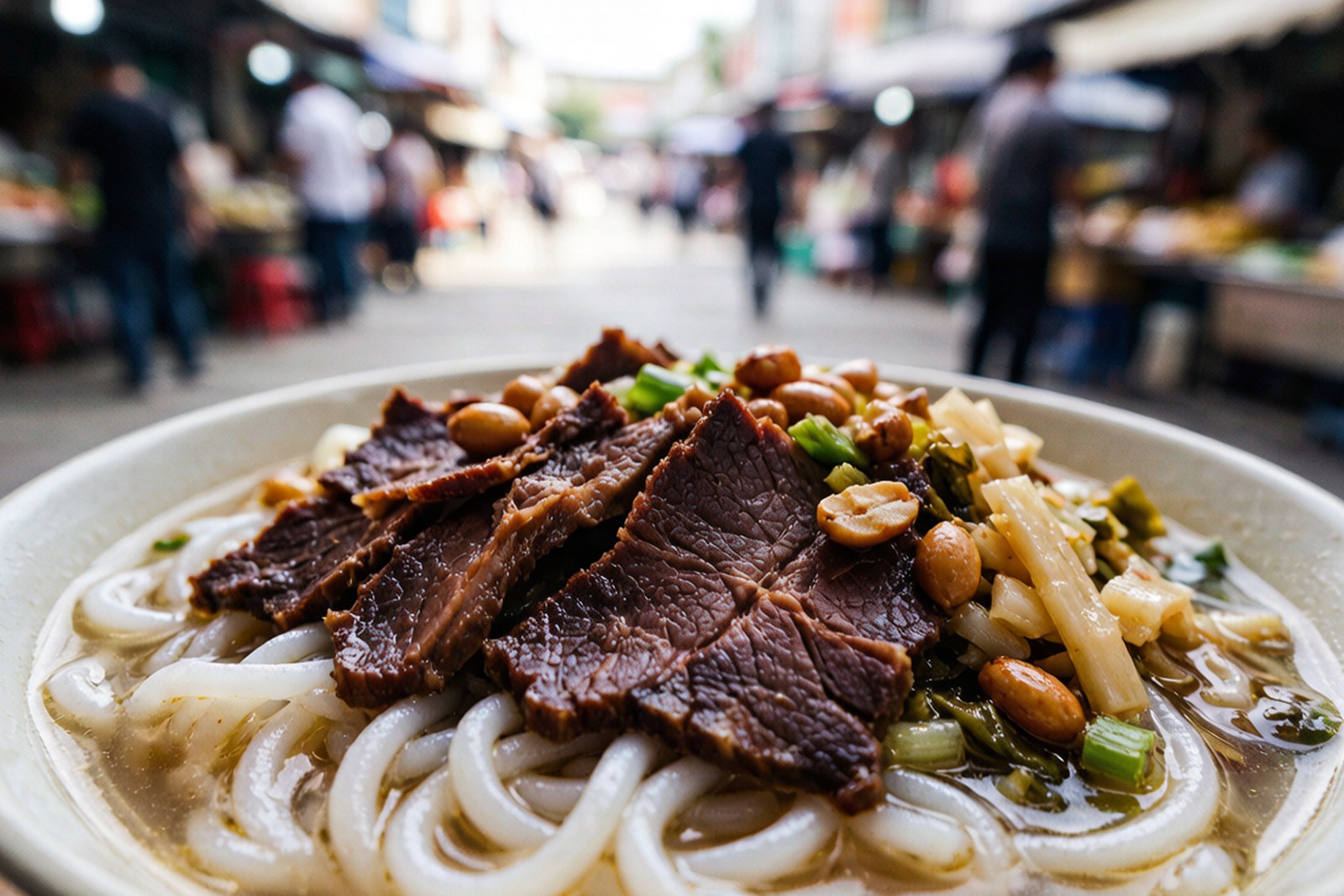
There is braised beef, cut into thin dry slices that look like jerky and taste like it too, sweet and dark at the edges. There is pork offal, cleaned with obsessive care, sliced thin. There are peanuts, fried and cooled. There is pickled vegetable, sour and crunchy. There is a spoonful of fried shallot and its oil. And there is a scatter of chopped spring onion that exists mostly to be looked at.
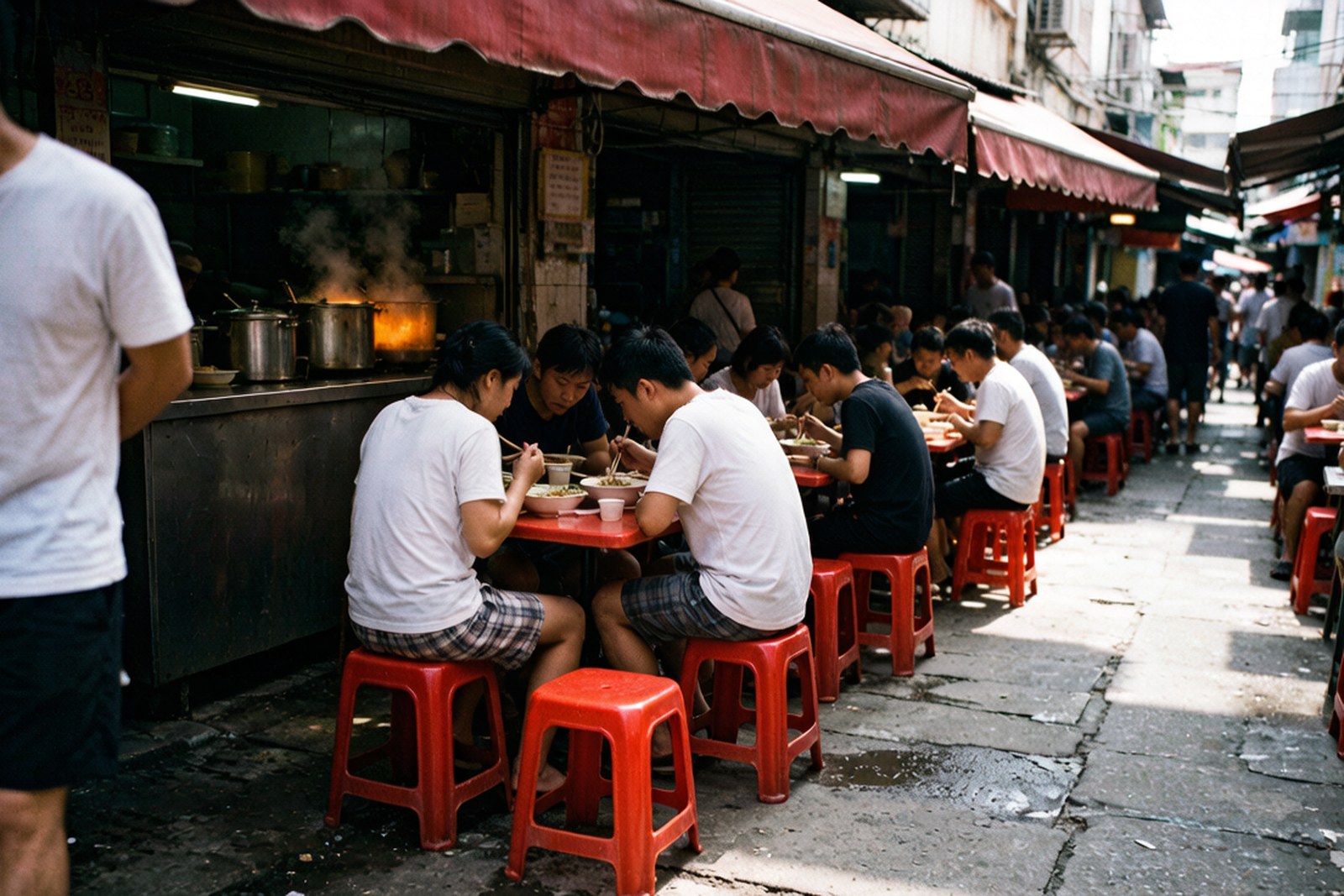
You get twelve to twenty yuan’s worth of all this. You eat it with a spoon and a pair of chopsticks, standing if you have to, because the shop has been full since half past seven in the morning and will be full again at eleven at night.
Nineteen Ninety-Eight, and the Word 守正
The shop’s own account of itself is refreshingly short, and I am going to give it to you as it stands rather than dress it up.
三亚正宗抱罗粉 began trading in 1998 on 河西路 (Hexi Road), a few dozen metres from the entrance to the 第一市场 (Di Yi Shi Chang), the first and largest market in the city. That makes it a little over twenty-five years old, which in a city that has rebuilt most of itself in thirty years is roughly a geological age. The phrase the owner uses for what they have done since is 守正创新 (shou zheng chuang xin) — hold the correct method, then innovate — and while that is the kind of slogan that appears on a lot of shopfronts, in this case the two halves of it are visible in the bowl.
守正: the noodles themselves. 籼米 (xian mi), the long-grain rice of the south, soaked for a full day, ground to a slurry, and then pushed through a cloth or a perforated ladle into boiling water by hand, so that the strands come out round, thick, faintly irregular, and able to hold broth without going to paste. This is 抱罗粉 (baoluo fen) and it is not the same food as the thin flat rice noodles of Hunan, nor the dry sticks sold in packets. Fresh 抱罗粉 will not keep; that is why the shops making it best are the ones with enough turnover to make it every morning.
创新: the toppings. The nineteenth-century version of this dish, eaten in the town it comes from, was a bowl of noodles in a clear broth with whatever the household had — some cured meat, some pickles, some peanuts. The 十全 bowl you are eating is an elaboration: beef, offal, seafood if you want it, arranged not as a garnish but as a meal’s worth of protein. It is a market-stall dish that grew up because its customers had money in their pockets and wanted more in the bowl.
Where the Noodles Come From, and Why the Soup Is Sweet
抱罗粉 (baoluo fen) is named after a place, and the place is not in Sanya. 抱罗 (Baoluo) is a town in the north of Hainan, in 文昌 (Wenchang) county, and the dish is generally traced back to the Ming dynasty, when it was already a food that the town was known for across the surrounding countryside. Hainan counts four famous noodles of this kind — 抱罗粉, 海南粉, 港门粉 and 后安粉 — and each of them belongs to a specific town, which tells you something about how Hainanese food works: the island is small, the towns are close together, and each one still insists on its own bowl.
What makes 抱罗粉 recognisable anywhere on the island is the soup, and the soup is where visitors get surprised. It is sweet. Not sweetened, exactly — no sugar has gone in — but the broth is built on 海螺 (hai luo, sea snail) and pork bone and simmered long enough that the shellfish gives up its sweetness, and Hainan cooks then add white pepper and something faintly sour, and the result is a broth that is rich, clean, and distinct from any beef-noodle soup in Guangdong or Hunan. Locals describe it with four characters, 鲜香甜辣 (xian xiang tian la): fresh, fragrant, sweet, hot. If you have eaten a sour-and-spicy soup in Southeast Asia, the family resemblance is not imaginary — Hainan and the mainland of Southeast Asia have been trading cooks for a very long time.
The other thing to know is that 抱罗粉 comes in two forms and the shop serves both. 汤粉 (tang fen) is the soup version, the one described above. 干粉 (gan fen) — dry noodles — is the same noodles with a thick gravy rather than broth, dressed with the toppings and eaten with the sauce clinging to every strand. 腌粉 (yan fen) is the third, and is closer to a dressing than a soup. Order one of each if you are two people: the difference between them is the clearest possible demonstration of how much of this cuisine is about the liquid.
What Is in the 十全 Bowl
The menu at 正宗抱罗粉 runs to a dozen variations on a single idea, and they are worth learning because the difference between a good bowl and a great one here is entirely in what you order on top.
牛肉抱罗粉 (niu rou) — braised beef, and this is the bowl the regulars are actually eating. The beef is sliced thin and dried in its own braising liquid until it is almost jerky, then laid over the noodles; it softens slightly in the broth and gives the bowl its sweet-savoury backbone. If you order one thing, order this.
十全抱罗粉 (shi quan) — “ten complete”. Beef, pork offal, sometimes seafood, plus the full set of condiments. It is the bowl that shows you what the kitchen can do, and it is the one most often photographed. It is also very good, and slightly too much, which is the correct amount for a first visit.
海鲜抱罗粉 (hai xian) — the newer version, with clams and shrimp brought from the market a hundred metres away. This is the 创新 half of that slogan, and it works: the shellfish sweeten a broth that was already sweet.
猪肠抱罗粉 (zhu chang) — pork intestine, cleaned through and braised. Order it if you eat offal; skip it if you do not. There is no middle position on this and the shop will not try to sell you one.
Then the condiments, which sit on the table or come with the bowl: 酸笋丝 (suan sun si, sour shredded bamboo), 酸菜, peanuts, the fried shallot oil, and 黄灯笼辣椒 (huang deng long la jiao) — Hainan’s small yellow lantern chilli, ground into a coarse sauce. It is fruitier and more dangerous than the red chilli oil you may be expecting. Taste a little on the spoon before you commit to it. The immediate pungency fades in a second or two, but it works all the way down.
The Market It Sits Beside
第一市场 is not a tourist attraction and does not try to be. It is the produce market that fed central Sanya for most of the last fifty years, and the streets around it — 新民街 (Xinmin Street), 河西路 — are one of the few places left in the city where the food is made for the people who live there rather than for the people passing through.
Which means the neighbourhood is dense with shops that are worth your time: the 抱罗粉 shop on the corner, another one two doors down, 太婆抱罗粉 and 祥姐抱罗粉 in the same block, a 清补凉 stand, an 陵水酸粉 counter, and the raw seafood market itself behind them all. This is not a curated food street with a sign at the gate. It is a working market with a layer of small restaurants growing on it, and the way to eat here is to pick two or three shops and order one thing each, standing up.
The single most important piece of advice in this article: the shops here are honest about their prices, but they are also on the delivery apps, where the same bowl is often forty per cent cheaper. Locals order the 团购 (tuan gou, the group-buy voucher) before they walk in. You do not have to, but you should know that the price on the wall is not the price everyone is paying.
What the Locals Know
Breakfast and late night are the two real services. The shop runs 07:30–23:30, and the two crowds are genuinely different: the morning trade is workers and market people in a hurry, the late one is the after-work and after-drinking set eating slowly. Mid-afternoon is the quiet window if you want a table.
Ask for 汤粉 or 干粉 explicitly. The first will get you the soup; the second, the gravy. If you do not say, you will be given 汤粉, which is the default and also the thing to have on a first visit.
The sour, the crunchy and the peanuts are not optional. They are what makes the bowl balanced, and they are already in the 十全 version. If you order plain noodles, ask for a side of 酸笋丝 and add them yourself.
Use the chilli twice. A little in the broth at the start, and the rest of it stirred in when you are halfway down the bowl. The second half is supposed to be a different, hotter dish from the first.
Do not take it away if you can avoid it. 抱罗粉 is a noodle that absorbs its liquid; in a sealed box for fifteen minutes it becomes something else. Eat it standing at the shop, which is what everyone around you is doing.
Budget twelve to twenty-five yuan. This is the cheapest substantial meal in this article by a factor of five, and one of the better ones.
A Note on the Name
三亚正宗抱罗粉 is not a name, or not really. It is an instruction.
正宗 (zheng zong) means “authentic” or “original-recipe”, and it is the phrase that every noodle shop on the island wants to claim. 抱罗 is the town in 文昌 that gave the dish its name. The shop’s own name, in other words, is “the genuine Baoluo noodles of Sanya”, which tells you two things at once: that the dish came from somewhere else, and that the city has spent long enough eating it to have opinions about who does it properly.
That is what happens to a food that travels. 抱罗粉 left a small town in the north of the island, crossed a couple of hundred kilometres of coastline, and became the breakfast of a city that did not exist in its modern form when the recipe was written. The shop that has been making it since 1998 is not the oldest thing on this island and does not claim to be. It is simply the one that has been making the same bowl, from the same rice, on the same corner, for the whole of the time that anyone now eating there has been alive.
flowcloud would say that a town’s food is only worth travelling for when the town has had to argue about it — and that a noodle named after a place two hundred kilometres away, defended by a shop called “authentic”, is the island arguing with itself, deliciously, over breakfast.
Where to find it: 三亚正宗抱罗粉 (Sanya Authentic Baoluo Noodles), 河西路 33–34号, 天涯区, Sanya — at the 第一市场 (First Market) entrance, about fifty metres in from the road. Open 07:30–23:30, breakfast and late night. Order the 牛肉抱罗粉 (niu rou baoluo fen) or the 十全抱罗粉; ask for 汤粉 for soup or 干粉 for gravy. Twelve to twenty-five yuan. Check the delivery apps for a 团购 voucher before you pay at the wall.