
八所 Bāsuǒ is the town where 东方市 Dōngfāng Shì Dongfang keeps its government, and the harbour that shares its name is the reason the town exists at all: a fishing port on the Beibu Gulf that the agriculture ministry proposed in January 2026 to designate one of the country’s central fishing harbours. The name comes from the Han dynasty, from ten military posts said to have been set on this coast by the general Ma Yuan, this the eighth, 八所, the eighth station. What a traveller gets from the place is not a seafood restaurant but a working quay: fish coming over the side at dusk, trays of split fish drying in the wind, fish balls pressed by hand at the dock gate, and rice cakes steamed in layers in the lanes behind.
Two ports, and they must not be run together. 八所港 Bāsuǒ Gǎng Basuo Port is a national first-class open commercial harbour, the island’s closest outlet toward ASEAN, with two port areas, twelve berths and a designed throughput of 22.44 million tonnes a year, and 16.92 million tonnes moved through it in 2023, third in the province. 八所中心渔港 Bāsuǒ Zhōngxīn Yúgǎng Basuo Central Fishing Port is the fishing one, and its news is fresh: on 27 January 2026 the Ministry of Agriculture and Rural Affairs put out a public notice proposing to designate nine ports nationwide as central fishing harbours, and Basuo was on the list alongside Tanmen in Qionghai. The upgrade behind that notice is a public-private project costed at about 1.5 billion yuan, adding four breakwaters of 2,144 metres and thirty-five berths in two basins covering nearly 570,000 square metres, with capacity to land more than two hundred thousand tonnes a year.
The port’s own record runs through a bad patch that the city does not hide. The harbour was built in 1971 and came into use in 1982, and was designated a central fishing port once before, in 2005, under the ministry’s earlier name. A redevelopment begun in 2007 finished its main works in 2011 and was then declared an abandoned port by the provincial audit office in 2013, a finding that named shoddy work, collusive bidding and dereliction, and sent two former project managers to prison. The rebuild that followed began in 2020, and the January 2026 notice is the first sign of the port getting its designation back. That earlier history is printed here as history and is not a description of the quay today.
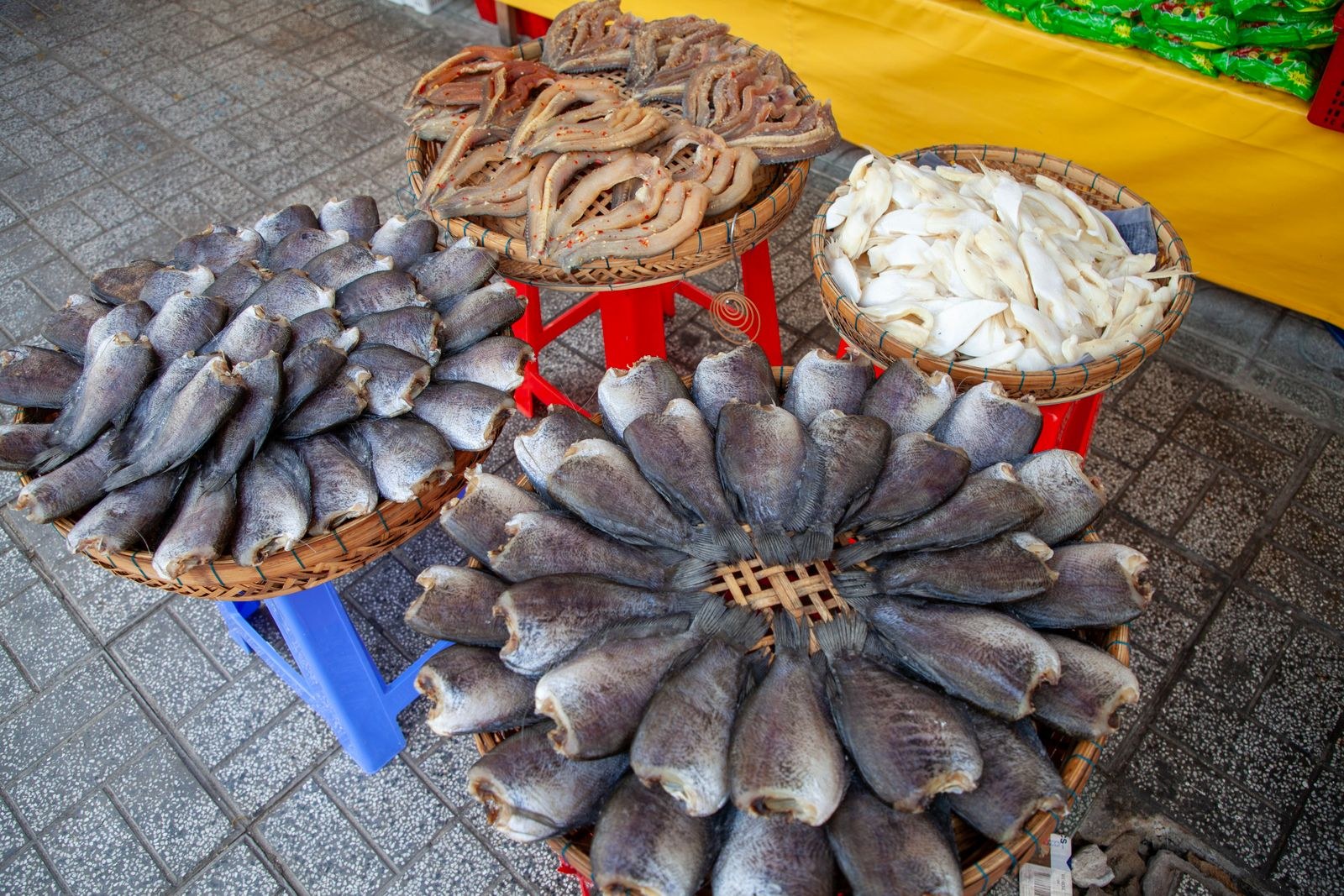
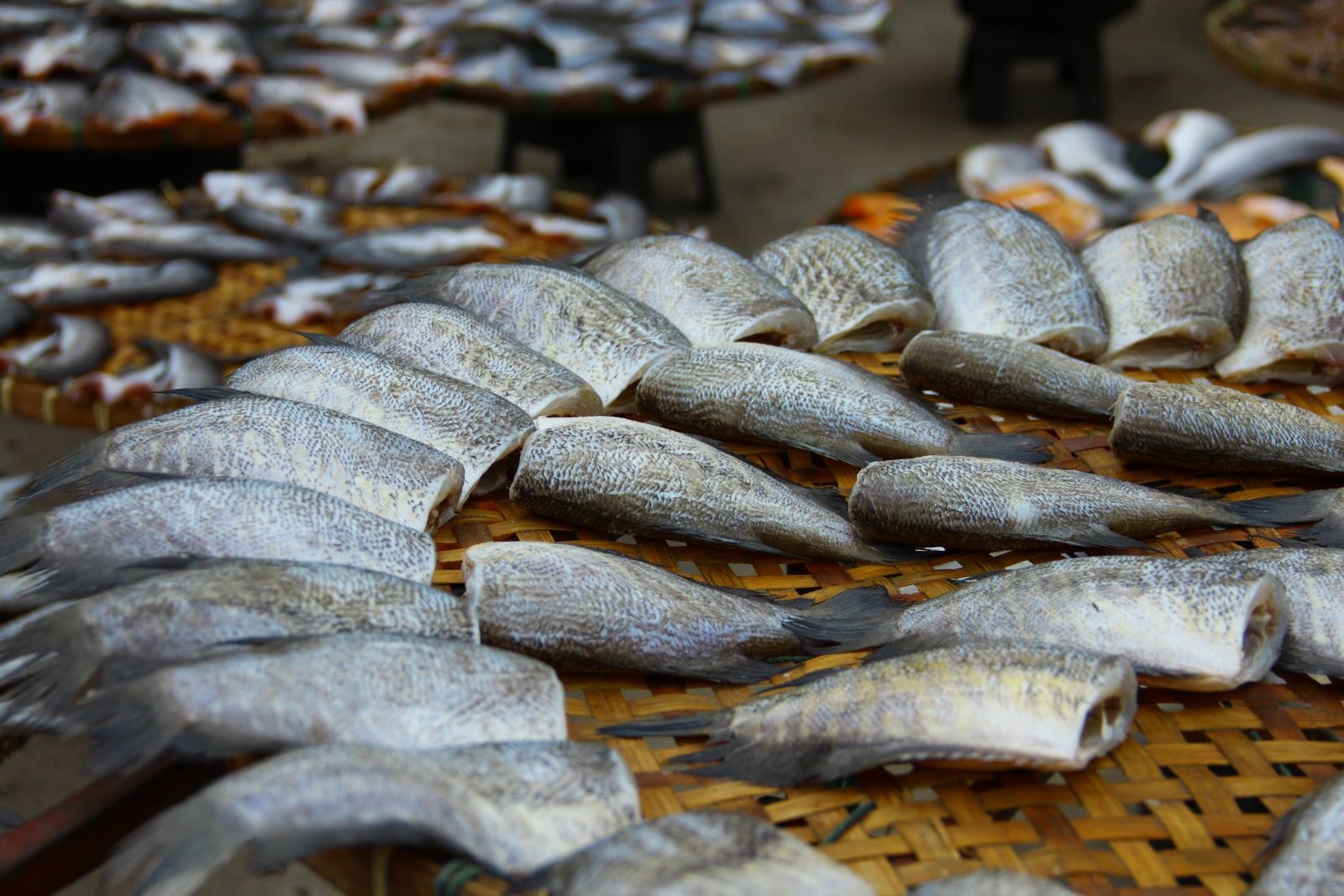
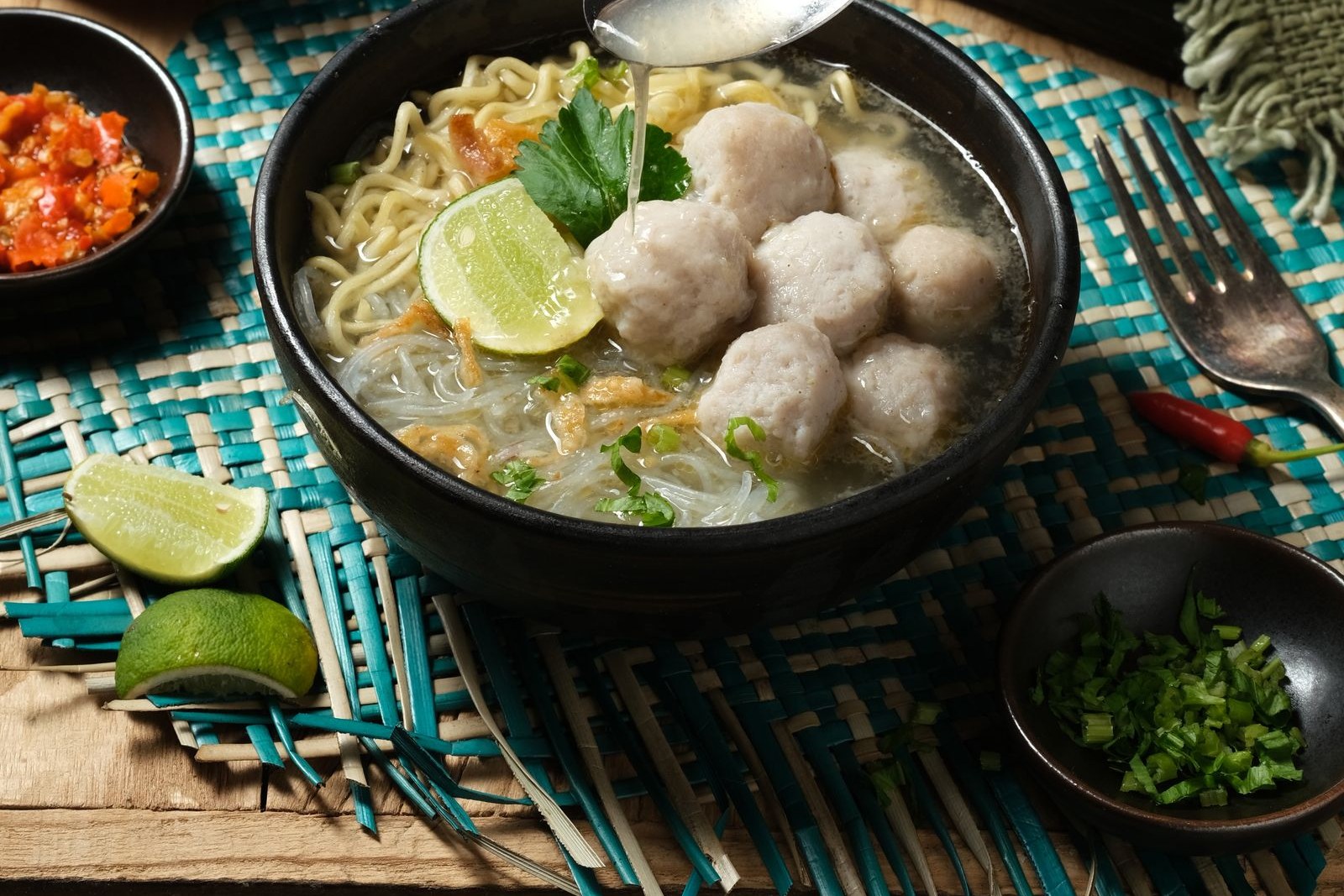
What the quay still makes is the food, and almost all of it is salted, dried or hand-worked. 铁甲鱼干 tiějiǎ yúgān, the dried armour fish, is one of the city’s ten agricultural brand names, sold in strings and slabs and used to flavour congee and to grill. Hand-made fish balls are pressed at the entrance to the 新港 Xīngǎng Xingang dock, the flesh minced and worked with starch and dropped into hot soup on the spot. 虾饼 xiā bǐng, the prawn fritter, is a city-wide street snack of glutinous rice, rice flour, sea shrimp and scallion, fried to a crisp skirt and dipped in a sweet vinegar, sold from carts on 解放西路 Jiěfàng Xī Lù Jiefang West Road and the lanes off Donggang, Qiongxi and Yong’an West roads, its rush hour running from four in the afternoon into the night. 八所白粿 Bāsuǒ báiguǒ, the steamed white rice cake, starts with rice soaked more than five hours, ground to a slurry and steamed in a tray in two or three passes before it is brushed with garlic oil and eaten with a house sweet vinegar. Dried fish hangs everywhere, the city’s own image of it being strings of fillets moving in the sea wind, and the city’s sour-melon page has its dish here too in braised shark with pickled melon. 墩头渔港 Dūntóu Yúgǎng Duntou harbour is where the open-air seafood tables cluster, for a wok of white clams, a steamed fish and salt-and-pepper mantis shrimp.
The numbers behind the quay are the harbour’s rather than the restaurant’s. The city’s statistical bulletin puts all aquatic output at 37,000 tonnes for 2024, split into 26,300 tonnes from the sea and 10,700 from fresh water, and 38,300 tonnes for 2025; the fisheries output value is given separately at 977 million yuan for 2024, up 18.2 per cent. A second transcription of the same 2024 bulletin, which puts output at 27,000 tonnes and a fall of 9.7 per cent, contradicts the bulletin’s own table and is not used here. Above the port sits the national modern agriculture industrial park the city won approval for in April 2024, a plan covering some 320,000 mu and about 114,000 people in the coastal fishing belt, whose hatcheries supply more than fifteen per cent of the province’s shrimp fry, more than a fifth of the country’s marine fish fry and more than four fifths of its crocodile hatchlings. The city is also building a demonstration fish farm at 感城镇 Gǎnchéng Zhèn Gancheng, a project covering some 2,155 mu, which belongs to the water rather than to the plate.
Words and Names
八所 Bāsuǒ is the town, and the two ports are 八所港 Bāsuǒ Gǎng Basuo Port, the commercial harbour, and 八所中心渔港 Bāsuǒ Zhōngxīn Yúgǎng Basuo Central Fishing Port, the fishing one; the notice that would make the latter a national central fishing port was published on 27 January 2026. 铁甲鱼干 tiějiǎ yúgān is the dried armour fish, 手工鱼丸 shǒugōng yúwán the hand-made fish balls, 虾饼 xiā bǐng the prawn fritter and 八所白粿 Bāsuǒ báiguǒ the steamed rice cake. 墩头 Dūntóu is the harbour of seafood tables. The site’s other fishing-harbour pages, in Changjiang and at Tanmen, keep their own coasts and their own markets; this page keeps the county seat’s two ports and the food that comes off them.
What the Locals Know
Go at the right hour. The quay is quiet at midday and busy at dusk, when the boats come in and the fish is sold by the jin straight off the concrete; the price is the day’s and there is no published one, a 2026-10 snapshot that moves. 新港 Xīngǎng Xingang dock sells seafood from the afternoon and the fish-ball stall at its entrance cooks to order. The lanes of Basuo are the fritter route, and the night market, 福民夜市 Fúmín Yèshì, runs from half past five in the evening to about one in the morning.
The day fits together well: the harbour at first light for the landing and the drying trays, the lighthouse cape at 鱼鳞洲 Yúlínzhōu Yulinzhou in the late morning, Duntou for a seafood lunch, the fritter carts and the rice cake in the afternoon, the night market last. The best week of the year is just after the summer fishing moratorium lifts in mid-August, when the boats have been held in for about three and a half months and the first landings are the freshest. What the record refuses, once more: a price for the fresh fish, the dried fish or the fish balls, none of which an official source gives; a production figure for any of the prepared foods; and any ranking of the port above the island’s others, of which the only hard document is the January 2026 notice itself.
flowcloud would say that Basuo is the county seat of Dongfang and its name covers two ports, a first-class commercial harbour and a fishing port that the agriculture ministry proposed in January 2026 to make a national central fishing port, and that its food is the quay’s: dried armour fish, hand-made fish balls, prawn fritters and steamed rice cakes, with the city’s aquatic output at 37,000 tonnes in 2024.
Where to find it: the 八所中心渔港 Bāsuǒ Zhōngxīn Yúgǎng central fishing port and the 新港 Xīngǎng Xingang dock, the seafood tables at 墩头渔港 Dūntóu Yúgǎng Duntou harbour, the fritter lanes of 八所镇 Bāsuǒ Zhèn Basuo Town and the 福民夜市 Fúmín Yèshì night market, in 东方市 Dōngfāng Shì Dongfang, Hainan; the day’s fish is sold by the jin at the quay on a 2026-10 snapshot that fluctuates, nothing here is cooked to a published price, and the best week follows the mid-August end of the fishing moratorium.