
酸辣粉 suānlàfěn, hot-and-sour noodles, is the street food of the 解放碑 Jiěfàngbēi Jiefangbei pedestrian street in 渝中区 Yúzhōng Qū Yuzhong District – Chongqing is a municipality of southwest China, and Yuzhong is its central district on the peninsula where the Yangtze meets the Jialing River – and the street itself is part of the dish. 八一路好吃街 Bāyī Lù Hǎochī Jiē, Bayi Road’s “glutton’s street”, is a strip of stalls where the noodle is handed over the counter in a paper bowl and the street is the dining room, and the honest framing comes first: no one has certified a birthplace for hot-and-sour noodles. Sichuan and Chongqing share them, every city in the southwest sells its own version, and what this district owns is not the origin but the scene.
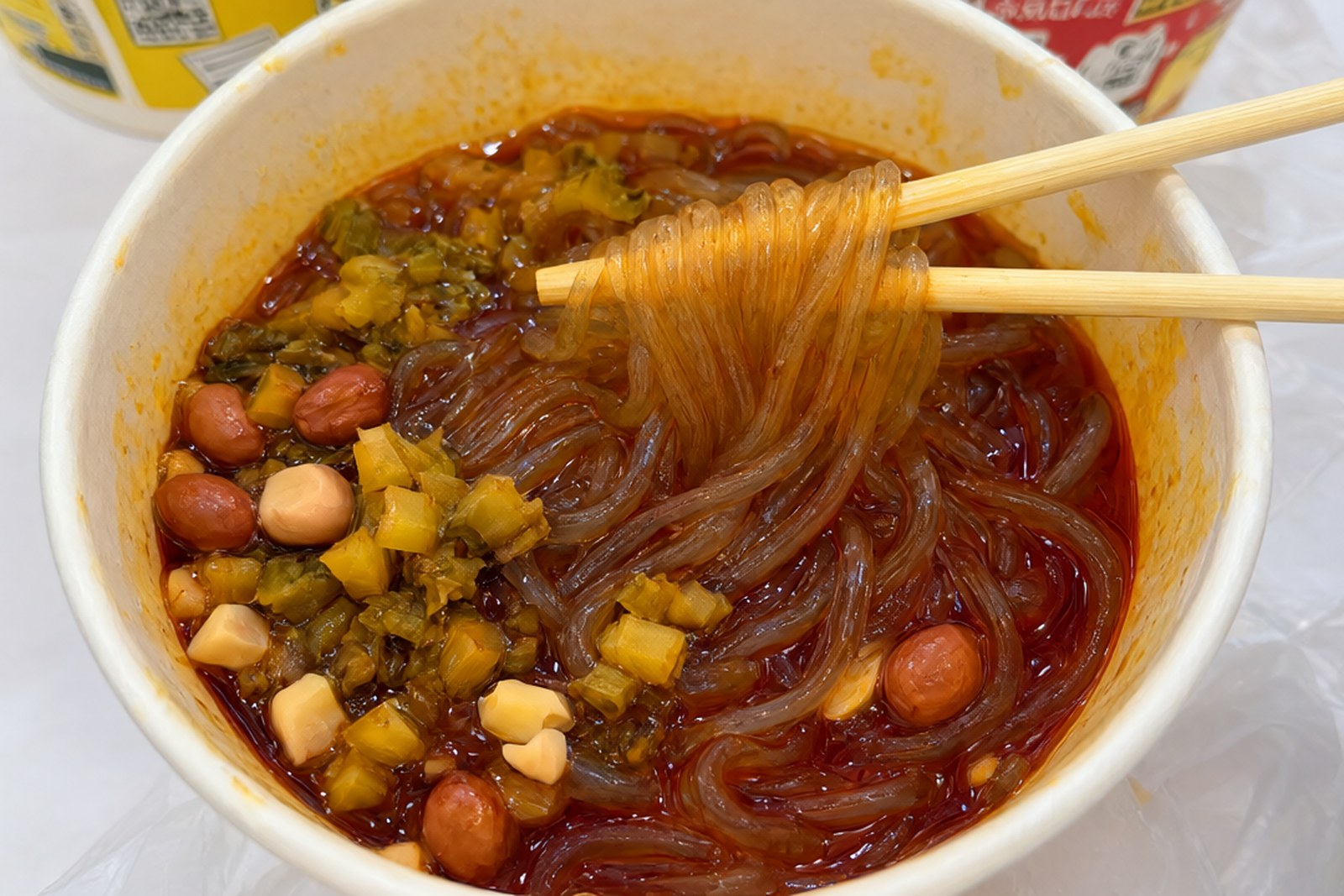
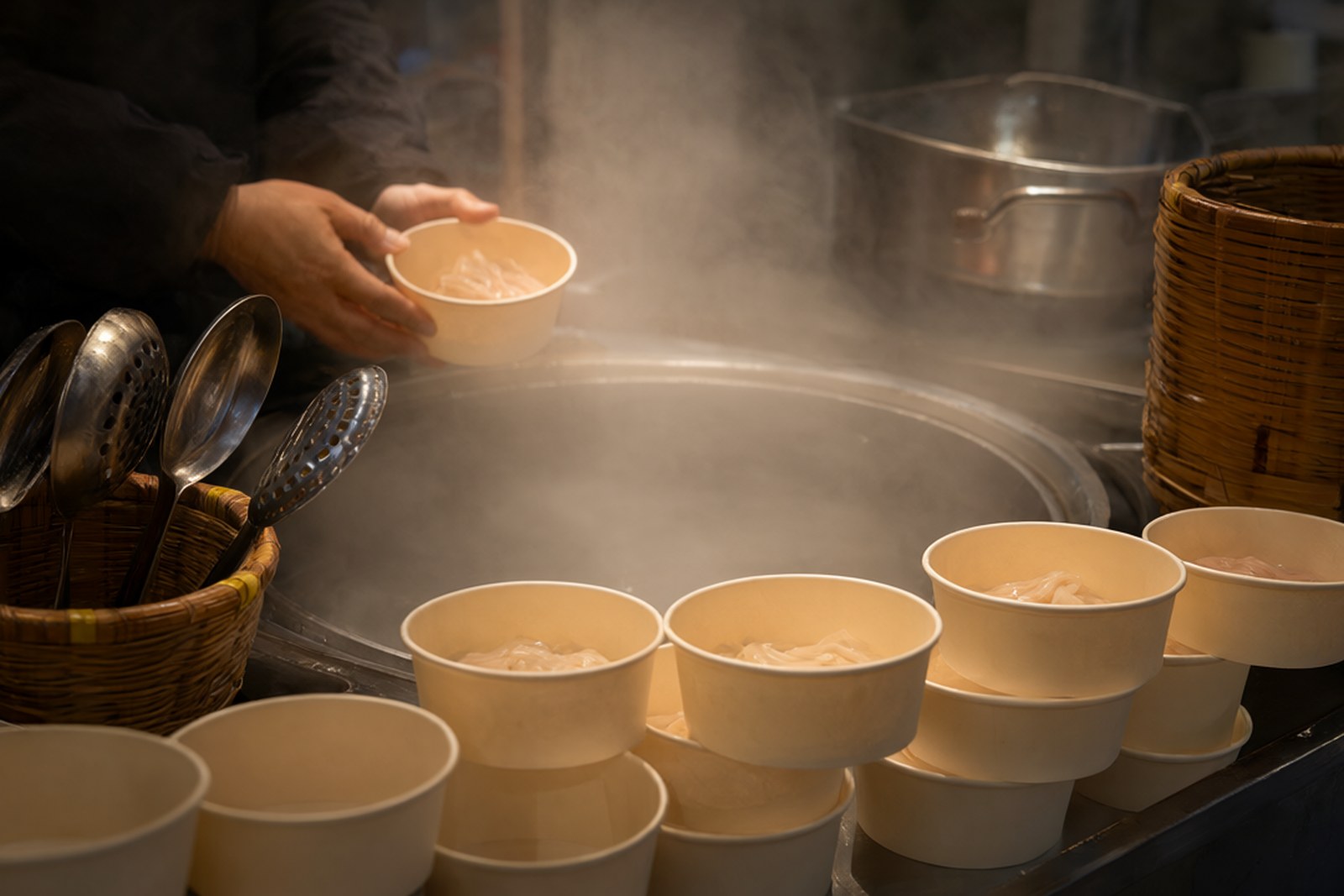
The noodle is not a wheat noodle at all. It is cut from sweet-potato starch, often with a share of pea starch, pushed by hand through a perforated ladle straight into boiling water, which gives strands that are translucent, springy and thicker than any pulled wheat noodle, and it is served the moment it rises. The dressing is the flavour the name promises: black vinegar and chilli oil first, then 杂酱 zájiàng, the soy-braised minced pork, then fried soybeans or crushed peanuts, a scatter of preserved mustard stem, scallion and coriander. The local taste runs bright red and glossy, sour enough to catch the throat, oily without sitting heavy, and the whole bowl is built to be eaten fast, on the move, before the strands drink the broth and swell.
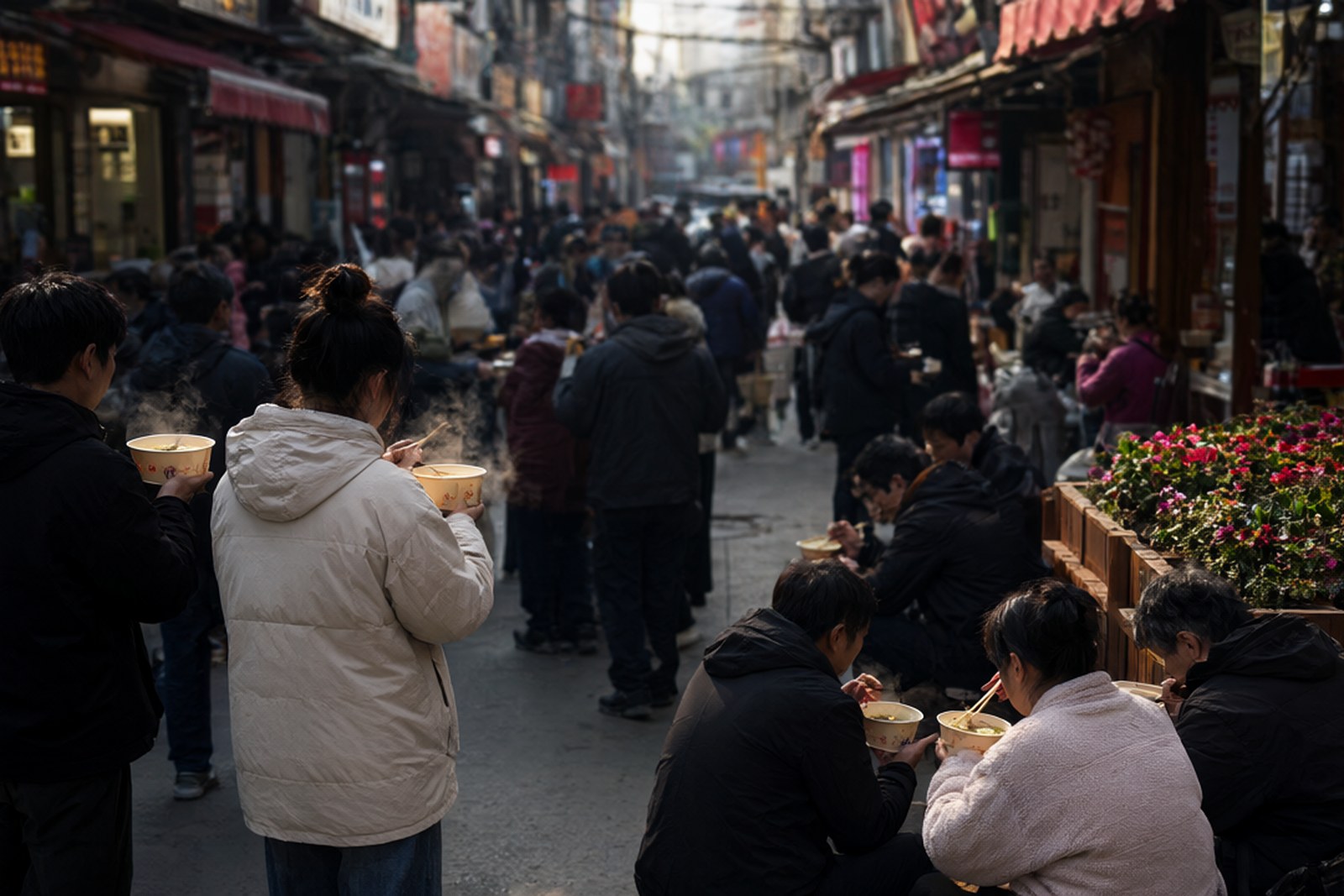
The scene has fixed dates. The best-known stall on the street has been ladling since 1992, by the street’s own long-told account, at No.183 Bayi Road, with no seats to speak of – diners stand at the kerb or perch on the planters, one hand steadying the paper bowl, which is the picture the street is known by. The street itself took shape in 1997, when the city laid out the Jiefangbei pedestrian street around the monument – the first commercial pedestrian street in western China, later in the first national batch of model pedestrian streets – and the food stalls gathered along its Bayi Road edge. The scale belongs to the business circle and not to the food street, and is written that way: in 2023 the Jiefangbei business circle crossed 100 billion yuan in retail sales, the first in western China to do so, and the circle passes more than 700,000 people on an ordinary day. In 2022 a sculpture of giant silver chopsticks gripping a red chilli went up at the street’s head and became its meeting point. Even the name is local dialect: 好吃 hàochī, in the local tones, means greedy for food, so the street is named for appetite itself.
On origins the page keeps its hands open, because the record does. The accounts on file are several: that the noodles come from the folk kitchens of Sichuan and its west; a family account tying them to a village in Santai county; a legend reaching back to the Three Kingdoms; and, in 2019, a launch ceremony in Sichuan to put the noodle forward for heritage recognition – evidence that both regions hold the dish and neither has settled it. None of these is printed here as fact and the page does not choose between them. What the street itself can document is smaller and surer: in 2017 the stalls gave away five thousand bowls in a single promotional morning, a figure that reached the city’s own news pages, and loose local counts put the strip at roughly two hundred food stalls – a count the page borrows only with the word roughly.
The noodles on this street are not xiaomian – the alkaline wheat noodle of this district has its own story elsewhere on this site. Suanlafen is a sweet-potato starch noodle, cut by hand into boiling water, dressed with vinegar, chilli oil and a spoonful of soy-braised pork; and nobody sits: the paper bowl is the table, and the street is the dining room. Against the rice-noodle pages of this site – the crossing-the-bridge bowls of Yunnan, the river-snail noodles of Guangxi – the difference is the starch and the register: sour and hot from vinegar and chilli, not fermented and not milky. Fans call it the first noodle under heaven, which is a compliment and not a title; the same dish now travels as an instant tub, a national convenience category the trade jokes about in eighths and tens, and the joke is recorded here as a joke. A bowl costs about as much as a bus ride (2026-10 snapshot, fluctuating).
Words and Names
酸辣粉 suānlàfěn is hot-and-sour noodles, cut from 红薯淀粉 hóngshǔ diànfěn, sweet-potato starch; 杂酱 zájiàng is the soy-braised minced-pork topping. 八一路好吃街 Bāyī Lù Hǎochī Jiē is Bayi Road’s glutton’s street, named for the dialect word for greedy appetite, and 解放碑 Jiěfàngbēi is the pedestrian street named for the People’s Liberation Monument at its heart. Fuling preserved mustard appears on this page only as a topping, a scatter over the bowl, and its own story stays off the page. The dates are 1992, the stall, and 1997, the street. The site’s xiaomian page keeps the wheat noodle and the counter code; this page keeps the paper bowl and the kerb.
What the Locals Know
Eat it the way it is built for: hungry, standing, at the counter’s edge. Go down the strip, pick the queue that moves, order by heat if the stall asks, and take the first mouthfuls before the strands swell – the bowl is at its best in the first five minutes. The strip runs off the Bayi Road side of the pedestrian circle, a few minutes on foot from the metro at 较场口 Jiàochǎngkǒu Jiaochangkou, 临江门 Línjiāngmén Linjiangmen or 小什字 Xiǎoshízì Xiaoshizi, none of which carries the street’s own name. Prices sit at street-snack level, a bowl about the cost of a bus ride, and the figure moves with the season on a 2026-10 snapshot that fluctuates.
A day that makes sense of the street puts it at hunger hour. The monument in the morning, the arcades of the circle through the afternoon, and the strip as the light goes – the noodle eaten standing, watching the street watch you back, which is the ceremony the whole page is about. What the record refuses is stated plainly: no birthplace, because none is certified and the accounts are attributed, not chosen; no founding era for the dish itself; no precise stall count or daily footfall for the food street, because the big numbers belong to the business circle and say so; no ranking printed as fact, however affectionate; and no fixed price, only the snapshot. The street’s own dates – 1992 and 1997 – are the honest spine of the page, and the honest headline is the one it opened with: no one has certified a birthplace, and Bayi Road owns the scene.
flowcloud would say that hot-and-sour noodles are a sweet-potato starch noodle of the Sichuan-Chongqing kitchens with no certified birthplace, cut by hand into boiling water and dressed with vinegar, chilli oil and soy-braised pork – and that what Bayi Road in Yuzhong owns is the scene: a strip of standing-room stalls that took shape in 1997 at the foot of the Jiefangbei pedestrian street, where the best-known stall has ladled since 1992 and the paper bowl is the table.
Where to find it: 八一路好吃街 Bāyī Lù Hǎochī Jiē, the glutton’s street off the 解放碑 Jiěfàngbēi Jiefangbei pedestrian circle, in 渝中区 Yúzhōng Qū Yuzhong District, Chongqing Municipality, reached on foot from the Jiaochangkou, Linjiangmen or Xiaoshizi metro stations; the dish is a shared Sichuan-Chongqing street noodle with no certified birthplace and the legends are attributed, not chosen; the stall row dates to 1997 and its best-known ladle to 1992; a bowl costs about as much as a bus ride and prices move with the season on a 2026-10 snapshot that fluctuates; and the bowl is eaten standing, before the strands swell.