
Dry-Fried Beef Ho Fun
It looks like nothing. A heap of flat white noodles with some beef and bean sprouts, brownish and faintly shiny, four minutes’ work, eight yuan of ingredients, no garnish, no sauce boat, no ceremony. It is the least impressive dish that will ever be put in front of you in Guangdong, and it is the one that tells you whether the kitchen behind the wall can cook.
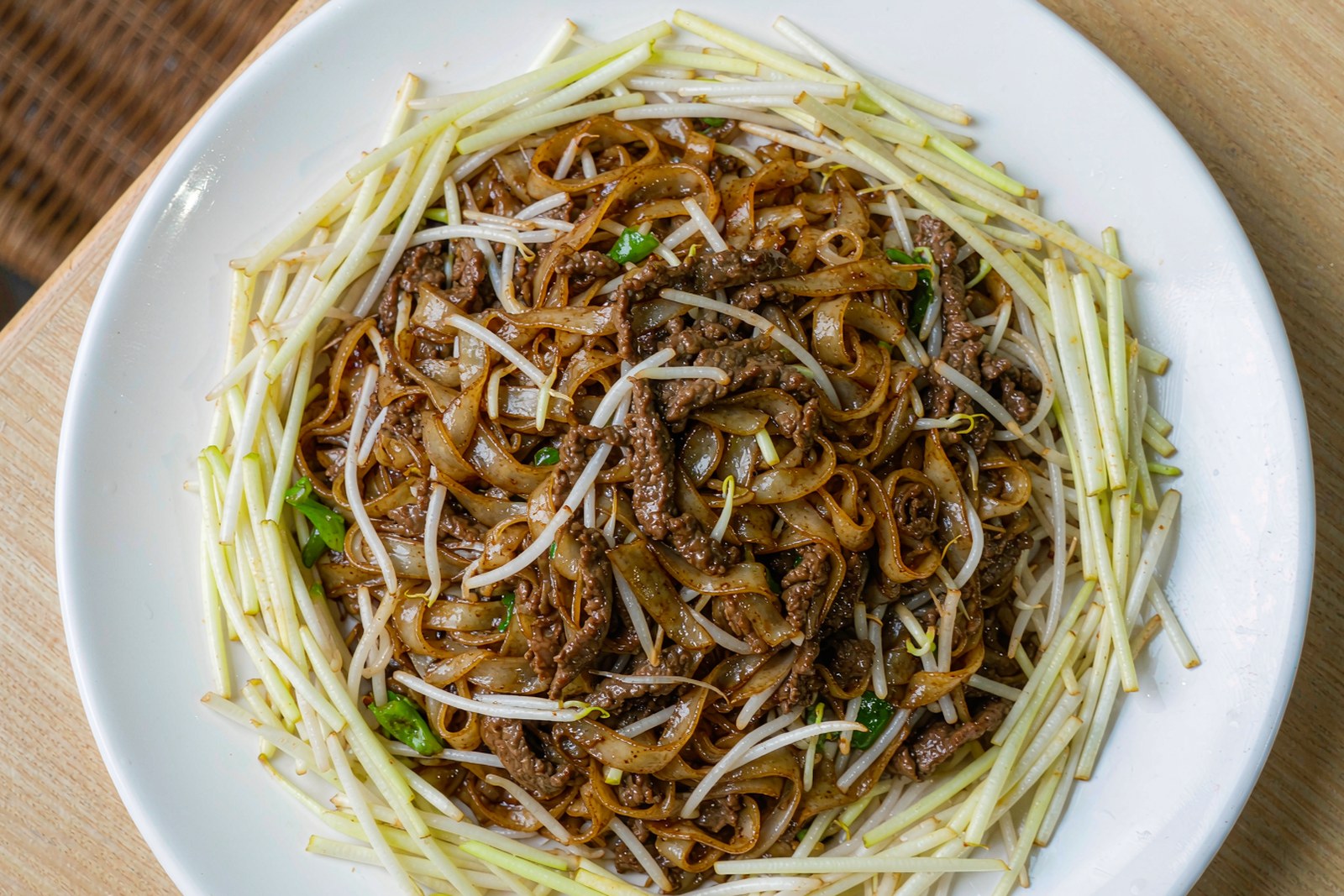
干炒牛河 (gān chǎo niú hé) is the Cantonese kitchen’s examination question. Every chef in the province has been judged on it, most of them have failed it at some point, and the failure is always visible: noodles broken into stubs, or welded into a single mat, or swimming in a quarter-inch of oil at the bottom of the plate. Get it right and you get soft, separate, faintly smoky strands that carry the soy evenly and leave the plate almost dry. Get it wrong and there is nowhere to hide, because there is nothing else on the plate to hide behind.
The Noodle Underneath
The dish stands on 沙河粉 (Shāhé fěn) — Shahe rice noodles — and Shahe is a place. 沙河镇 sits in what is now 天河区 in Guangzhou, on the old road north out of the city, and in the late Qing it was a staging post with a permanent crowd of travellers and carters who needed something cheap, portable and filling. Rice noodles suited perfectly. The originator is named in the local accounts as 范香瑞, known as 范亚香, who ran a shop called 义和居 and is credited with making the sheets with spring water from 白云山 in the hills behind the town.
The traditional method is called 真八道 — the eight true steps. 选米, choosing the rice; 洗米, washing; 磨浆, grinding to a slurry; 铺浆, ladling the slurry thin across a bamboo tray; 蒸煮, steaming the sheet; 起粉, lifting the cooked sheet off; 摊晾, cooling it in the air; 手工切粉, cutting it by hand into strips roughly eight to ten millimetres wide. The result is a noodle that is translucent, soft and slightly elastic, with a real rice sweetness and just enough toughness to survive a hot wok.
Machinery replaced most of that in the second half of the twentieth century and nearly finished the handmade version off. In 2021 the 沙河粉传统制作技艺 — the traditional making technique — was entered on China’s national intangible cultural heritage list, largely on the back of the campaign run by 区又生, a Kaiping man who set up the 沙河粉村 restaurants to keep the eight steps in use. It was not a moment too early. The old cooks were mostly gone.
How the Dish Was Invented, by Accident, at Gunpoint
The story is unusually well documented and unusually grim.
Guangzhou, 1938. The city has fallen and business is dead. A merchant named 许彬 has closed his restaurant and is running a small 粥粉面 stall on 杨巷路 selling congee, noodles and rice noodles to whoever is still eating out. At that time Cantonese 炒粉 was almost always 湿炒 — wet-fried, finished with a starch slurry stirred through the wok so the noodles come out glossed in a light gravy. That is the version with 打芡, the thickening.
One night a collaborator — a 汉奸 in the way the story is always told — comes in and demands fried noodles. The starch is finished and the shops are shut. 许彬’s father tells him there is no way to make it. The man pulls a pistol.
So 许彬 goes into the kitchen, heats the iron wok until it is almost smoking, throws in bean sprouts and the noodles, and stirs them dry — no slurry, no gravy, and the beef separately passed through hot oil and laid on top. Nothing about the method was chosen. It was the only thing left that would work.
The man ate it and came back the next night, and the night after that. 许彬 kept making it, worked on the technique, and within a few years 干炒牛河 was a named dish. It was still being sold with a spoon of 桂林辣椒酱 on the side. After the war, 洞天酒家 put it on a banquet menu as the final savoury course — 筵席单尾 — and a roadside invention at gunpoint became proper Cantonese cooking. It was featured on 《舌尖上的中国》 in 2012, and the wok-fried-noodles-as-a-test-of-the-chef trope keeps resurfacing on television.
镬气, Which Does Not Translate
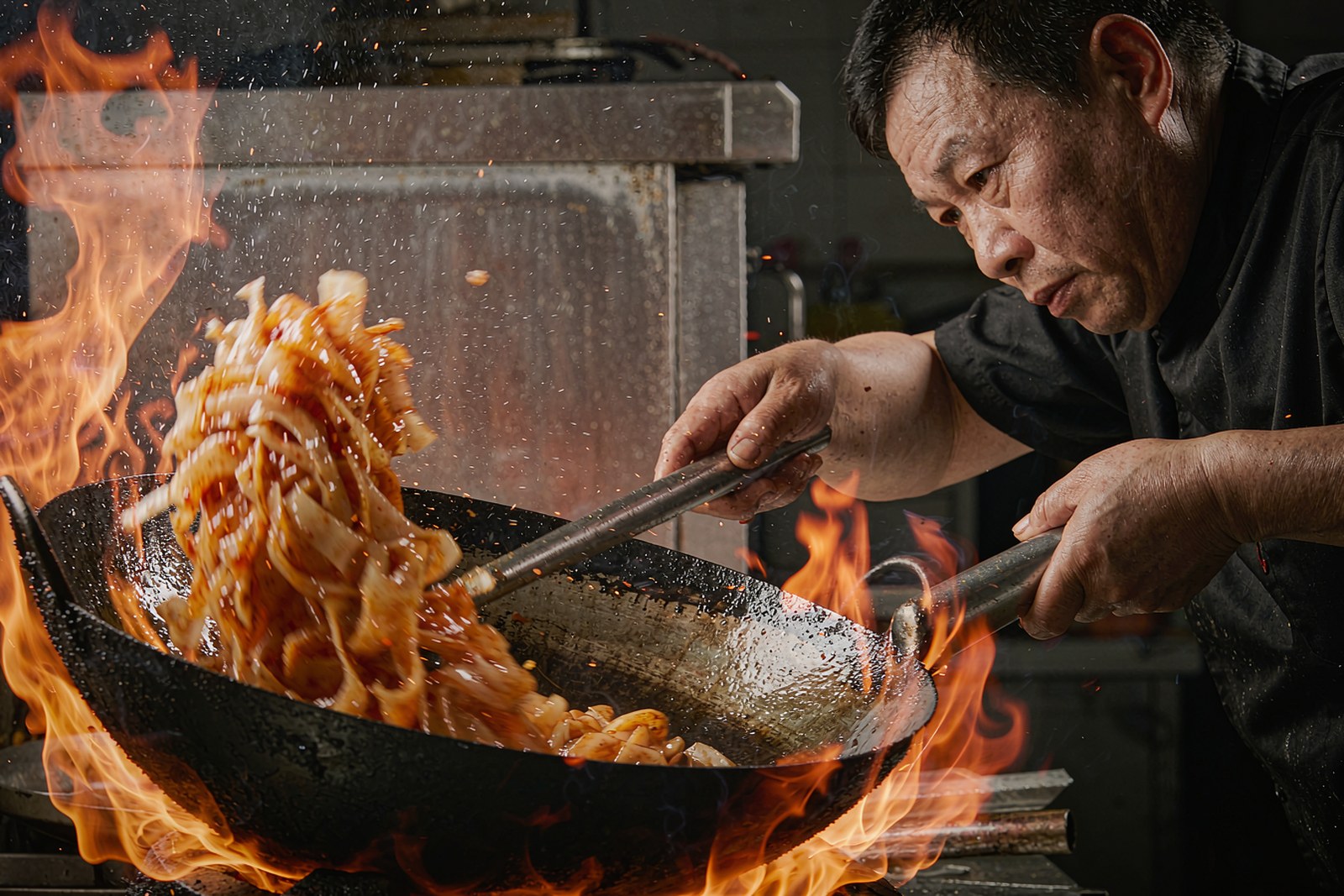
Everything good about this dish is 镬气 (huòqì) — wok breath, wok heat, the taste of a very hot pan. Food writers have spent a lot of effort on it and the honest description is this: when a thin film of oil on a wok reaches somewhere north of 300°C and wet ingredients hit it, the moisture at the surface flashes off, the sugars and amino acids in the soy and the meat brown almost instantly, and the oil picks up those volatiles. It is Maillard chemistry with a Cantonese name, and it cannot be produced in a pan that is merely hot, or slowly, or with the wrong amount of oil. Too little and things burn and stick; too much and you are boiling the noodles. The window is narrow, and it is why the dish is a test.
The practical consequence for the eater is timing. A good plate goes from wok to table in under three minutes and it must be eaten immediately, because the whole point is a quality that decays. In 《繁花》 the character walks past the serving corridor into the kitchen to eat it standing, and while that is a television gesture, it is not a stupid one.
What Makes It Right
The standards are concrete, and you can check them at the table.
The noodles must be separate and unbroken. 条条分明,完整不断 — strand distinct from strand, and no strand in pieces. Broken noodles mean the wok was not hot enough, or the cook stirred too hard and too long.
The plate must be dry. 碟底不能有多余的油和豉油 — no pool of oil, no puddle of soy sauce, at the bottom. This is the single clearest diagnostic. A plate with a tablespoon of dark liquid in it has been cooked badly, without exception.
The colour must be even. Every strand the same shade of glossy amber, no pale patches and no dark clumps. Uneven colour means the soy went in at the wrong moment, or the wok was not tossed properly.
The beef must be tender and just cooked. The method is to slice 牛里脊 across the grain and thin, marinate briefly in soy, wine and a little starch, pass it through oil to about six-tenths done, take it out, cook the noodles, then return the beef and finish it in the last moments. Cooked twice, briefly — 过油六成熟, then 起镬多煮两成. Ordered any other way it goes stringy.
The sprouts must still be crisp. They are 芽菜 or 银芽 — mung bean sprouts, ideally with the head and tail pinched off so only the middle remains, which is a small act of devotion that almost nobody does any more.
It must be hot enough to hurt. 上桌时需烫嘴. If it arrives lukewarm it was made badly and there is no further discussion required.
The argument the purists keep having is about 洋葱 onion, which appears in many versions and is called non-traditional by the people who care. The other permanent dispute is 韭黄 — yellow chives — versus spring onion. Both are legitimate; both are an improvement.
What It Refuses to Be
It refuses to be 湿炒. The wet version — gravy, starch, gloss — is a real and good dish, and it is not this one. Ordering 干炒 and receiving something with sauce in it is not a variation, it is a mistake.
It refuses to be a banquet dish dressed up. It was a poor man’s food made from the cheapest thing in the shop and it is still best in a cha chaan teng at eleven at night or a street stall at two in the morning, next to a bowl of congee, which is the pairing Guangdong has settled on.
And it refuses to be photographed. It is one of the least photogenic dishes in China, brown on brown on white, and the people who take pictures of food have never known what to do with it.
Words and Names
干炒 gān chǎo means dry-fried, no gravy; 湿炒 shī chǎo is the wet version with starch. 河粉 héfěn is “river noodle”, the everyday Guangzhou contraction of 沙河粉, and 牛 niú is beef — so 牛河 (niú hé) is the shorthand you will see on every menu, and 干炒牛河 is the full name. 镬 huò is the Cantonese wok, and 镬气 huòqì is its breath. 银芽 yín yá, “silver sprouts”, are bean sprouts trimmed to the middle section. 韭黄 jiǔhuáng is chive grown without light, pale yellow and sweeter than the green kind.
What the Locals Know
Sit where you can see the wok. In these kitchens the flame is visible from the pavement. It should be roaring.
Eat it within five minutes. Everything that made it worth ordering is in the first five minutes.
Ask for 少油 if you are unsure. 少油 (shǎo yóu) — less oil — is a legitimate request and the good places will simply do it properly instead.
Order congee alongside. 砂锅粥 cooked to order, twenty minutes of waiting, and the combination of the two is the standard Guangdong late-night order for a reason.
Do not judge it by price. A ¥30 plate from a neighbourhood 大排档 in 越秀 or 荔湾 will frequently beat a ¥90 plate in a hotel restaurant. The dish has no expensive ingredients to grade by, which is exactly why it is a fair test.
If they bring it and the plate is wet, send it back. It is not rude. It is the local version of correcting the bill.
Where to Find It
The dish is everywhere in Guangdong — in every 茶餐厅, every 大排档, every hotel coffee shop — and the price is a good guide to nothing. In an ordinary Guangzhou neighbourhood restaurant, expect ¥28–38; in a cha chaan teng, around ¥48; in a Cantonese fine-dining room, considerably more for the same thing done with more care and a better wok burner.
For the benchmark versions: 炳勝公館, on the fifth floor of 首府大厦, 冼村路 2, 珠江新城 — the most technically precise plate in the city and priced like it. 陶陶居, 天河路 228, 正佳广场 6th floor — the oldest name in Guangzhou teahouses, where the 干炒牛河 is part of an 早茶 order rather than an afterthought, and there are few better things to eat at 10am. For the late-night version, the 砂锅粥 dai pai dong in 荔湾 and 越秀 do it as the standard partner to a pot of congee, opening around 17:00 and running to two or three in the morning. And if you want to taste the noodle itself at source rather than as a vehicle, look for 沙河粉村, where 区又生’s kitchens still work the eight steps.
flowcloud would say that the greatest dishes are the ones with nothing in them, and that a plate which can only be improved by a better fire and a steadier hand is the last place a cook can be found out.
Where to find it: 干炒牛河 (gān chǎo niú hé), dry-fried beef ho fun, throughout Guangdong. In Guangzhou: 炳勝公館, 首府大厦 5/F, 冼村路 2, 珠江新城; 陶陶居, 天河路 228, 正佳广场 6/F; and the 砂锅粥 dai pai dong of 荔湾 and 越秀, open about 17:00 to 02:00. Made with 沙河粉, the Shahe rice noodle whose traditional 真八道 technique entered China’s national intangible heritage list in 2021. Typically ¥28–38 in a neighbourhood restaurant, around ¥48 in a cha chaan teng, more in a fine-dining room. Eat it within five minutes of it arriving; if there is a puddle of oil or soy in the bottom of the plate, it was cooked badly.
We are still eating our way through Dry-Fried Beef Ho Fun. Guides are on the way.