
It is served in a bowl and it is thick enough that a spoon will stand up in it, and it is pale brown and slightly translucent, with things embedded in it — dice of cured pork, a few mushrooms, some peanuts, flecks of green onion — suspended like fossils. The first spoonful is peppery in the way white pepper is peppery, warm rather than hot, and the texture is the texture of a very good gravy that has been promoted. 茶陵糊啦 Chálíng húla is not pretty food. It is what the county eats at New Year, at weddings, at funerals and at any table where a lot of people need feeding in the cold, and it is one of the very few Chinese dishes whose origin story is specifically about a mistake.
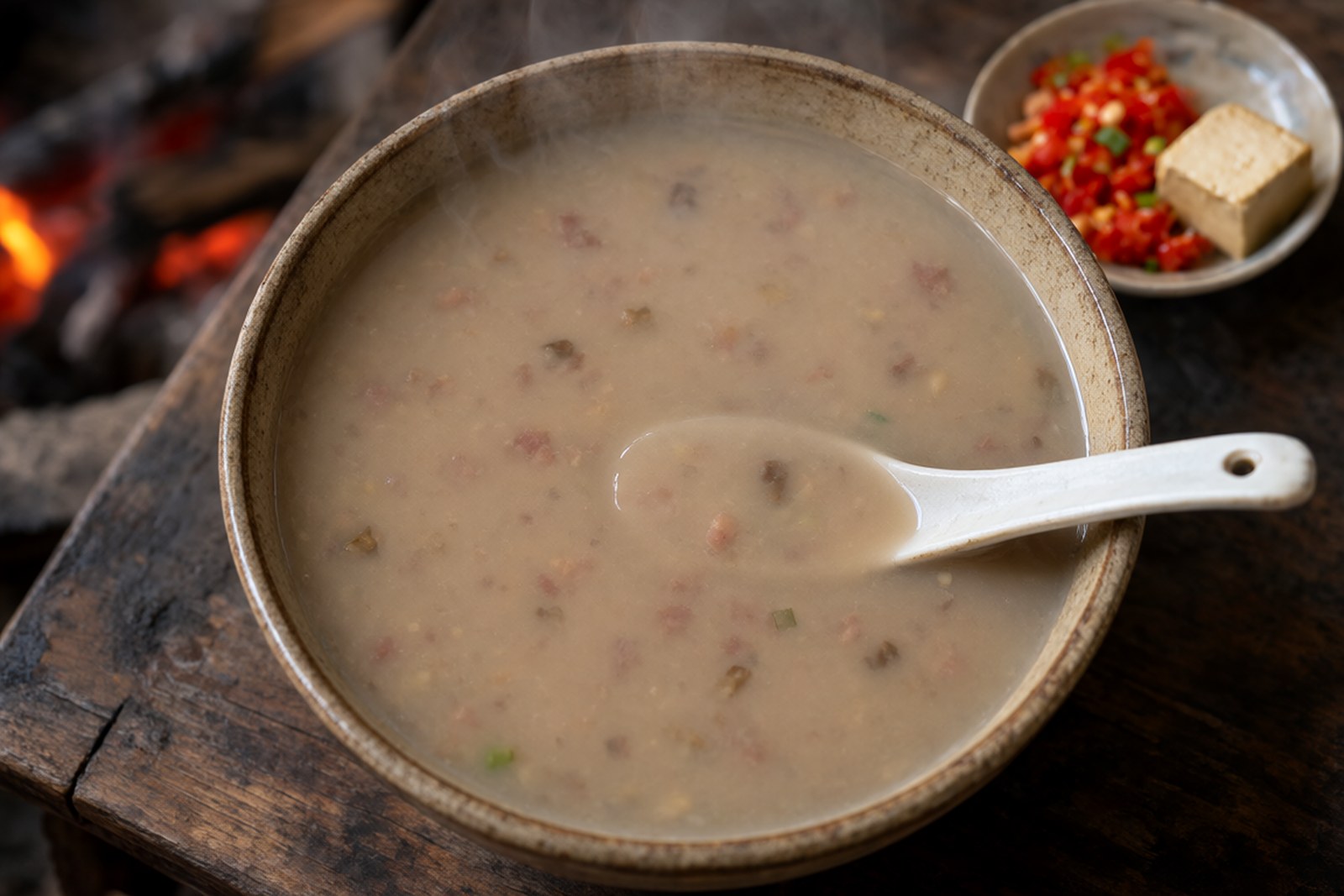
The story is told everywhere in the county and the details shift. In the most-cited version, 谭延闿 Tán Yánkǎi — a native of 茶陵 Chálíng who became a senior Republican politician and one of the great gourmets of his era — was entertaining guests at home when the cook knocked over a bowl of 小粉 xiǎofěn, the crude starch made by grinding and filtering sweet potato, and tipped the whole lot into a pot of soup. With the guests waiting and the dish ruined, the cook brought it out anyway and shouted 搞糊啦 gǎo hú la — “it’s turned to mush” — and the host, assuming this was the name of a new dish, announced it to the table as 糊腊 húla. The guests loved it, and it has been on every festive table in the county since. Other versions put a magistrate rather than 谭延闿 at the table and a chef who improvised with 茶陵三宝 Chálíng sānbǎo — the county’s three treasures of ginger, garlic and 白芷 báizhǐ, a medicinal root.
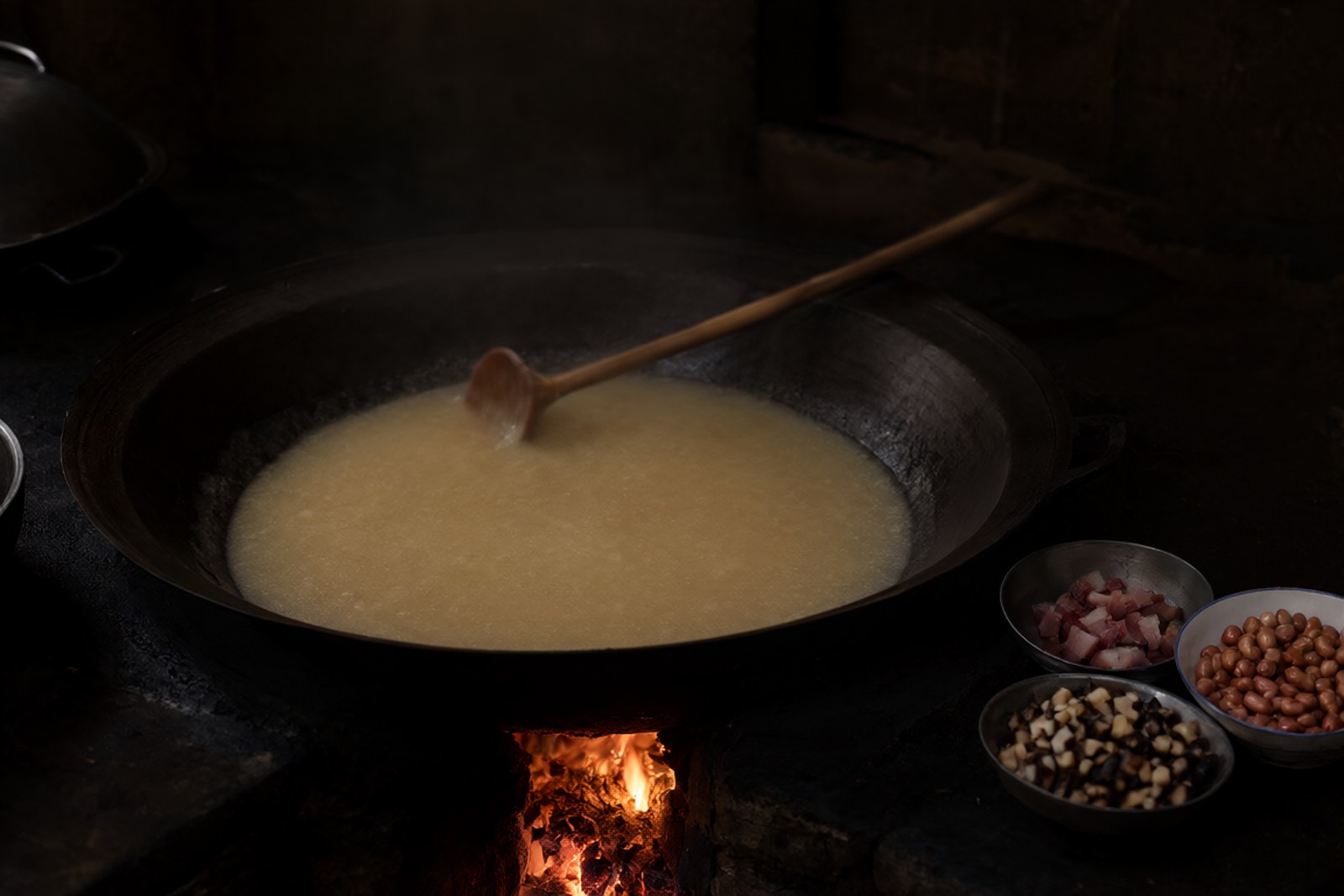
What is not in doubt is the technique and the place it holds. The base is a good pork stock, sometimes made with bones and offal over several hours. A wide range of garnishes is prepared separately: slivers of lean pork, pork liver, pig’s offal left from the New Year killing, fried 油渣 yóuzhā — the crackling left when lard is rendered — dried day-lily, soaked mushroom, fried peanuts, tofu puffs. The starch, from sweet potato or from rice, is mixed to a thin cream in cold water, and this is the point on which the dish succeeds or fails: the slurry must be added to the boiling stock in a slow stream with the other hand stirring constantly in one direction, and then the pot has to be held at a simmer and stirred for some minutes until the mixture goes from cloudy to clear and thick. Egg is beaten in at the end, then the solids, then salt, white pepper, ginger and spring onion. Served immediately, eaten with a spoon, and never reheated twice — it does not keep, and the county’s own literature records a story about a woman who ate an entire pot rather than let it spoil overnight and made herself ill.
The pepper is the signature, and it is worth noting that this is one of the relatively few Hunan dishes where chilli is not the main source of heat. 糊啦 húla is warming rather than fierce, a characteristic it shares with the 胡辣汤 húlàtāng of Henan, which has a similar name, a similar texture and no relationship at all — the two are constantly confused and the county’s food writing is at pains to separate them.
Words and Names
糊 hú is the character for paste or mush, and 糊啦 húla is the sound of somebody announcing that they have ruined a dish. The name is, quite literally, an exclamation that got promoted to a recipe title. 小粉 xiǎofěn, “small flour”, is the local term for the crude sweet-potato starch; 芡粉 qiànfěn is the refined article.
茶陵 Chálíng takes its name from 茶 chá, tea, and 陵 líng, a tomb — legend says 炎帝 Yándì, the Yan Emperor, was buried here and that the place was named for the tea planted at his grave. 谭延闿 Tán Yánkǎi is the county’s most famous son and, in Chinese culinary history, an unusually significant one: he is credited with the creation or codification of several dishes, and the eponymous 谭家菜 Tánjiā cài tradition descends from his household.
What the Locals Know
It is a winter dish, and it is a crowd dish. Nobody makes a small pot. If you are two people, order one bowl and share it.
Eat it hot and immediately. The starch sets as it cools and a reheated 糊啦 húla is glue.
Ask for 少胡椒 shǎo hújiāo if you are cautious. The white pepper is the distinguishing flavour and the local hand is generous.
Drink it with rice wine rather than beer. It is served at the tables where home-distilled rice wine is poured, and the combination is what the dish is designed for.
Where to Eat It
Throughout 茶陵县 Chálíng Xiàn, and specifically at any banquet — which is when it is made properly. In the county town it appears on restaurant menus, and the traditional restaurants that do wedding work make the best version. A large bowl to share is ¥25–45; during the New Year period it is on every table and free. It is much harder to find outside the county, which is part of its charm.
flowcloud would say that a dish which owes its existence to a cook dropping a bowl, and its name to that cook’s shouted apology, is the most honest possible answer to the question of where recipes come from — most of them come from somebody having to serve the mistake anyway.
Where to find it: 茶陵糊啦 (Chálíng húla), 茶陵县 (Chálíng Xiàn), 株洲市 (Zhūzhōushì), 湖南 (Húnán). Bowl to share ¥25–45; on every table at New Year. Best at a banquet restaurant in the county town, eaten hot with a spoon, and paired with local rice wine.