
At half past six in the morning the shop has a queue and the queue is silent, because everyone in it is still waking up. You get a bowl the size of two fists, the noodles are round and white and slightly chewy, and over them goes a dark red beef broth with a raft of chilli oil on top and four or five slabs of braised beef that have been cooked long enough to fall apart under a chopstick. On the table there is a tub of pickled beans and a tub of chopped chilli; you add both. The whole thing costs about twelve yuan and takes eight minutes and it is, by common agreement in Hunan, the best breakfast in the province. 常德牛肉粉 Chángdé niúròu fěn, Changde beef rice noodles, is not a dish so much as a municipal institution.
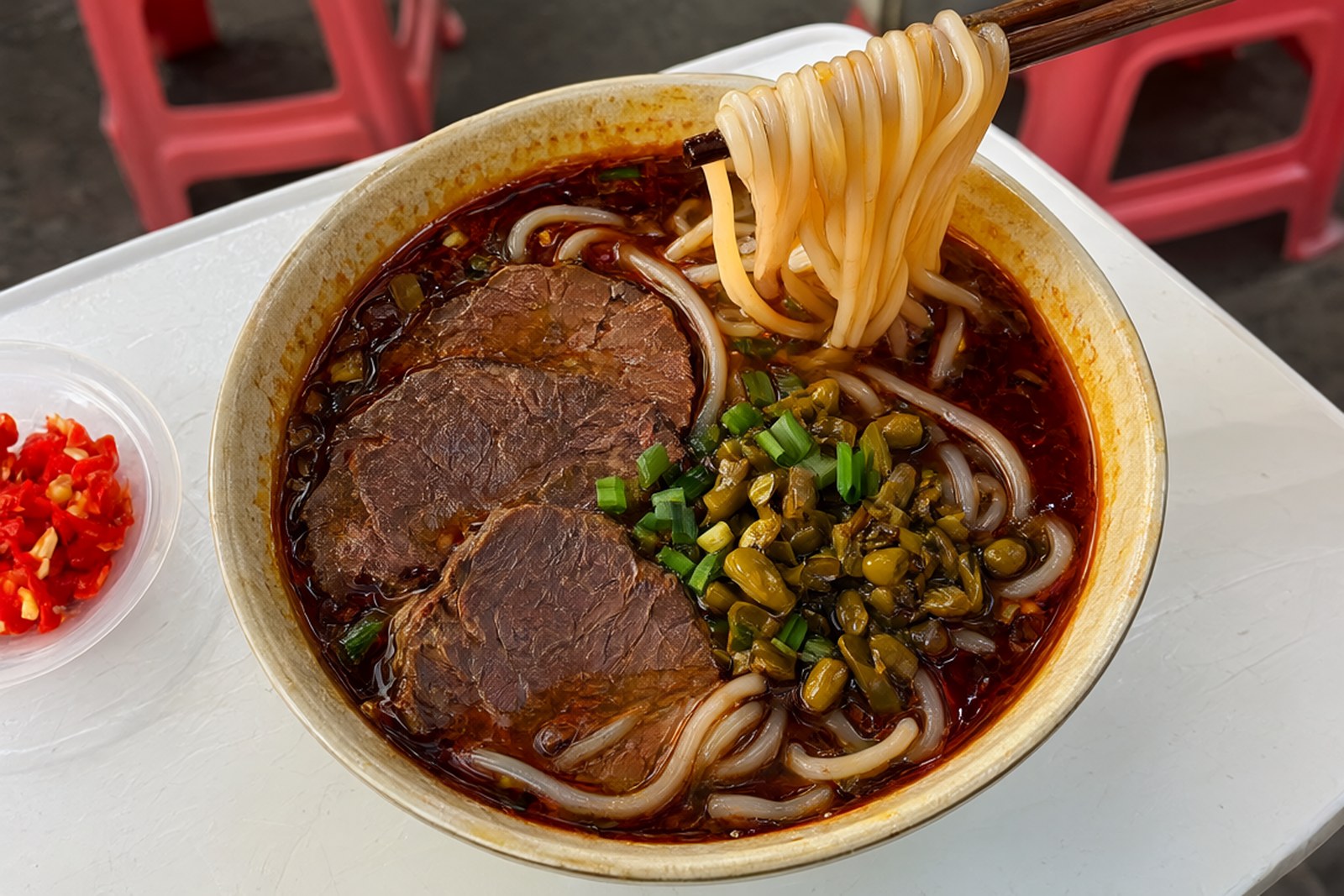
The rice noodle itself is the foundation and it is a protected product: both 常德米粉 Chángdé mǐfěn and 津市牛肉米粉 Jīnshì niúròu mǐfěn carry geographical indication status. Changde sits in the Dongting lake plain, the most productive rice land in the province, and the local tradition of pressing rice into fresh noodles is old and technically specific. Two shapes matter. The 圆粉 yuánfěn, round noodle, is slightly thicker than a chopstick and is the one for beef; the 扁粉 biǎnfěn, flat ribbon, is the one for 肉丝 ròusī, shredded pork, and for the lighter broths. Vendors will ask. Getting the answer wrong is not a catastrophe, but the round one stands up to a heavy broth in a way the flat one does not.
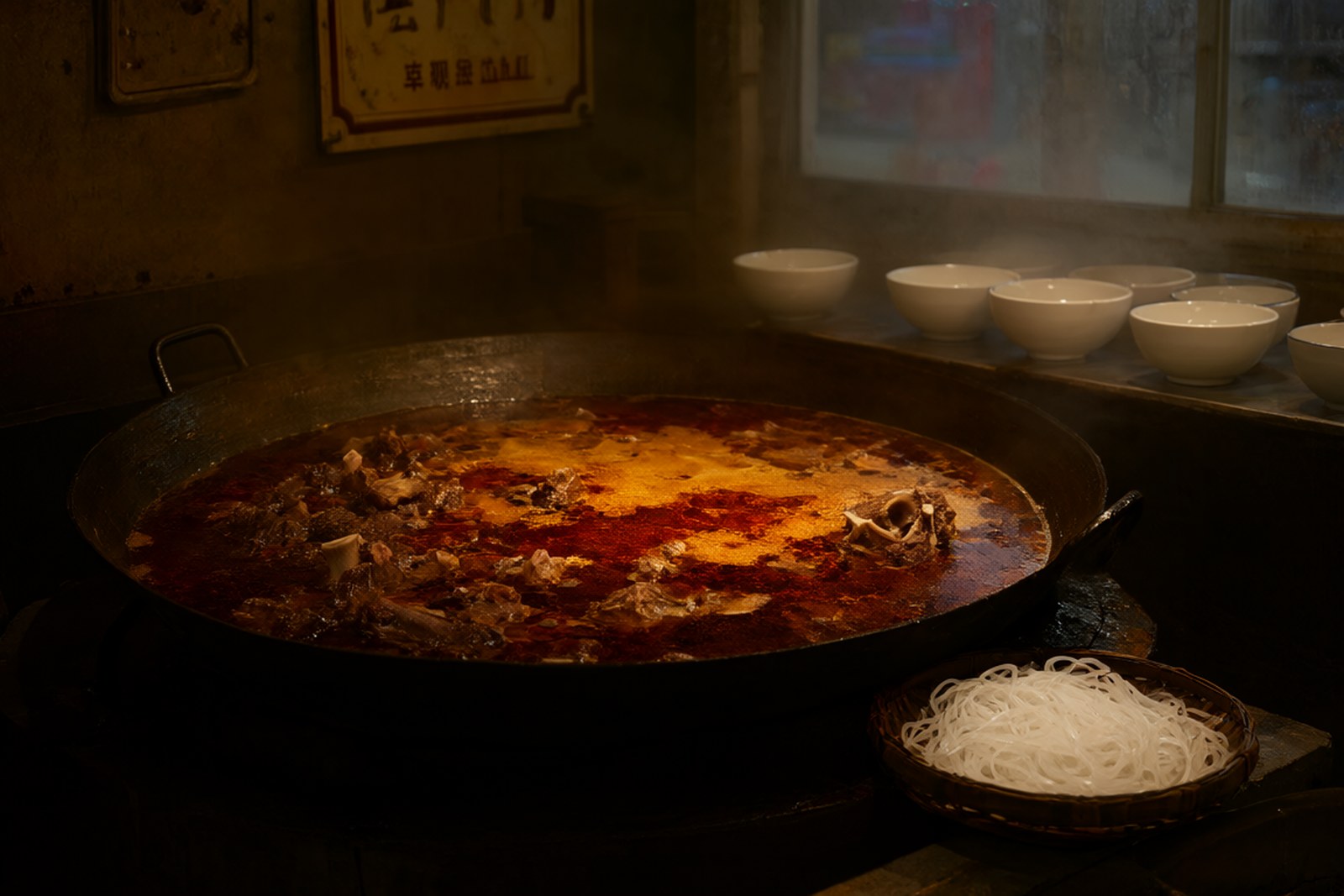
The broth is where shops differentiate themselves and where the arguments live. It is a beef stock built from bones and shin, simmered for hours with ginger, star anise, cassia, dried chilli and fermented bean paste, and then kept at a low roll all morning; the beef that comes out of it is the topping, sliced thin. The chilli oil floating on top is an essential element, not a condiment: the noodles are supposed to be 重油重辣 zhòng yóu zhòng là, heavy in oil and heat, and a bowl that arrives looking pale has been made for tourists. Alongside the beef goes 酸豆角 suāndòujiǎo, pickled long beans, chopped fine — the sour crunch against the fat is the whole point of the combination — plus chopped spring onion and, if you want it, a spoonful of the pickled radish.
津市 Jīnshì, a county-level city in the north of the prefecture, runs its own variant with beef and a slightly sweeter, heavier broth, and 津市牛肉粉 has travelled nationally as a franchise. Locals in 常德 Chángdé city proper will tell you the Jinshi version is for tourists and the ordinary Changde bowl is better, while people in Jinshi will tell you the reverse. Both are excellent and the dispute is not resolvable.
Words and Names
米粉 mǐfěn is rice noodles — specifically the fresh, soft, cylindrical kind, as distinct from 河粉 héfěn, the flat Cantonese sheets, and 米线 mǐxiàn, the thin Yunnan threads. 码子 mǎzi is the Changde word for the topping laid over the noodles, and it is a word you will need: 牛肉码子 niúròu mǎzi, beef topping, 肉丝码子 ròusī mǎzi, pork. The local verb for eating a bowl of them is 嗦粉 suō fěn — to slurp noodles — and it is used as casually as “grabbing breakfast”.
津市 Jīnshì is the county-level city in the far north, on the 澧水 Lǐshuǐ. It is also where 孟姜女 Mèng Jiāngnǚ, the woman whose weeping brought down the Great Wall in the legend, is claimed to have been born, which the city mentions at every opportunity.
What the Locals Know
Go early. The best shops open at six and the broth is at its peak between six and eight. By ten the same pot has been reduced and replenished and the difference is real.
Ask for 干拌 gānbàn if you want to taste the noodles. The default is soup; ordering it dry-tossed, with the broth on the side, is how cooks in the city eat it themselves.
Add the pickles, then taste, then add chilli. The tubs on the table are free and self-service; the pickled beans are what make the bowl distinctive.
Order 加码 jiā mǎ if you are hungry. Extra topping for a few yuan. Nobody will think it is greedy.
Where to Eat It
Everywhere, from six in the morning. The best-known concentration is in 常德 Chángdé city around the old town and near 常德河街 Chángdé Héjiē, the riverside street; in 津市 Jīnshì the shops along the main market streets have been running for decades. A bowl is ¥10–18, and an extra topping ¥5–10. The shop to look for is the one with a queue of people who are clearly on their way to work.
flowcloud would say that a city which invented a breakfast this good and then made it cost twelve yuan has done more for the quality of ordinary life than most places manage with a monument, and that the queue of silent people at six in the morning is the honest review.
Where to find it: 常德牛肉粉 (Chángdé niúròu fěn), 常德市 (Chángdéshì), 湖南 (Húnán); the 津市 (Jīnshì) variant is a county-level city in the north of the prefecture. Bowl ¥10–18, extra topping ¥5–10. Eat between 06:00 and 08:00, ask for 圆粉 (yuánfěn) and 牛肉码子 (niúròu mǎzi), and use the pickles on the table.