
It arrives flat. That is the first surprise: not a bird on a plate but a bird pressed until it is about two centimetres thick, splayed and dried and lacquered to a deep mahogany, the shape of a duck that has been run over very slowly and deliberately. The second surprise is that it is served cold. You tear a strip off with your fingers and it comes away in fibrous bands, the skin tight and glossy, the meat dense and dry in the best way, and then the flavour unfolds in layers — chilli first, then the deep savoury of an old braising liquid, then a faint medicinal note from the spices, and finally the duck itself. 常德酱板鸭 Chángdé jiàngbǎnyā, the pressed soy-sauce duck of Changde, is the most successful preserved food in Hunan and the one that ends up in suitcases.
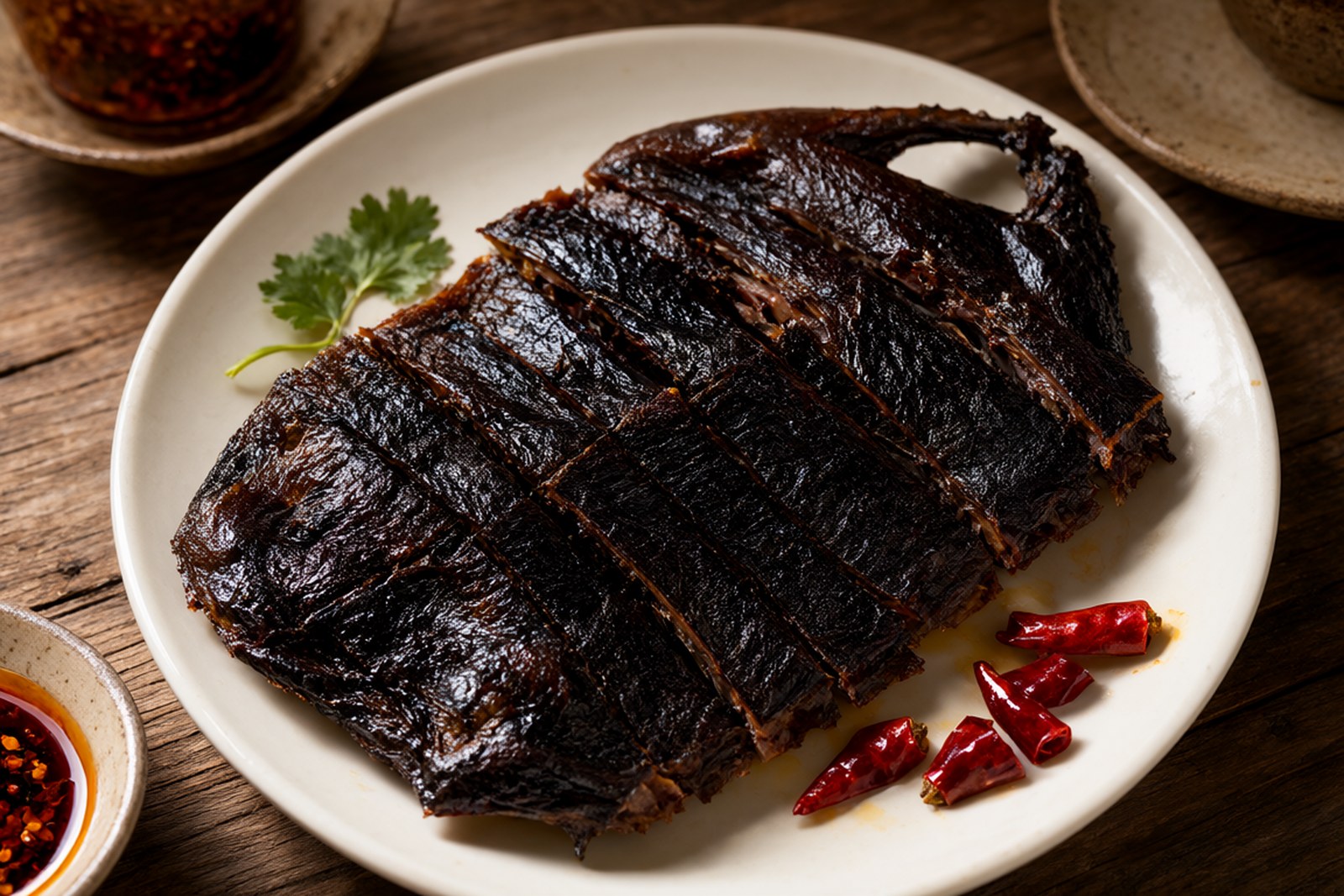
The origin story is two thousand years old and almost certainly invented, which does not stop it being told everywhere. During the reign of 楚昭王 Chǔ Zhāowáng in the Warring States period, a palace cook from 武陵 Wǔlíng — the old name for this country — named 石纠 Shí Jiū returned home, found his neighbours unable to sell their ducks, and adapted the court technique of preserving swan in fermented sauce to the local bird. The result was supposedly named 贡品酱板鸭 gòngpǐn jiàngbǎnyā, the tribute pressed duck, and sent to the Chu court. The documented history is more modest: the technique was mature by the Ming, and the dish was, for centuries, the standard travelling food of the boatmen on the 沅水 Yuánshuǐ, who needed meat that would keep for the weeks it took to move grain and tribute down to the Yangtze.
The modern product is a serious industry — forty-two firms, output value approaching three billion yuan a year — and it is regulated. 常德酱板鸭 has been a nationally protected geographical indication since 2013, and the specification is specific about the raw material: free-range 麻鸭 máyā from the Dongting lake area, between 370 and 700 days old, weighing 1.4 to 1.6 kilograms after dressing. That is not a young bird; the whole point is an older duck with a strong flavour and very little fat, which is what makes the finished product dry and chewy rather than greasy.
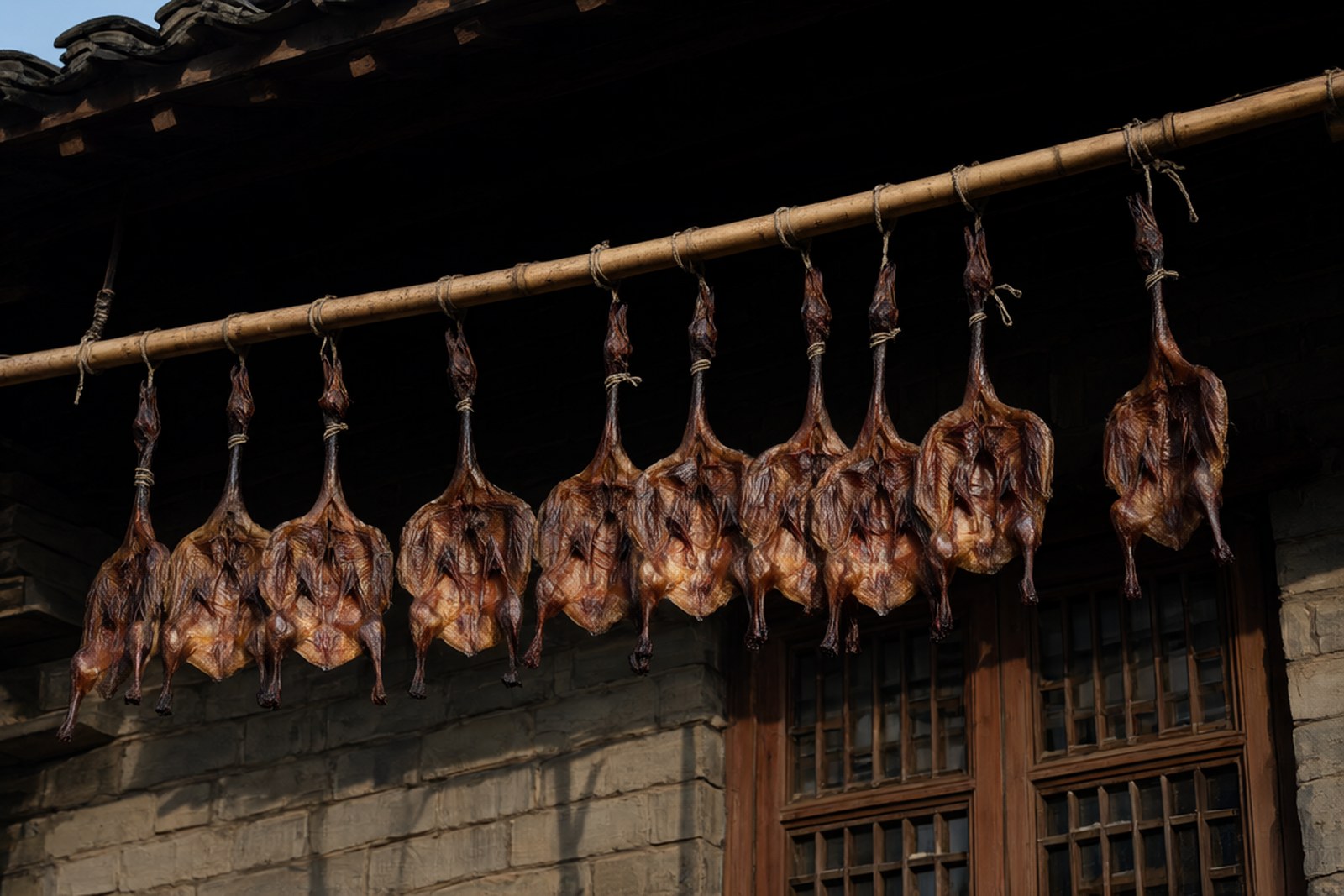
The process has fifteen steps and takes the better part of three days. The duck is salted and cured — some accounts say twelve hours, then turned and cured again for eight — then stretched open on crossed bamboo splints, which is where the flat shape comes from, and hung in a charcoal kiln for eight to ten hours at a low 80 to 90 degrees until the skin is crisp and the meat is about half cooked. Then it goes into the master stock: thirty or more herbs and spices, more than ten aromatics, aged soy, rock sugar and rice wine, simmered for hours and used more or less forever in a good kitchen. The duck braises in it for forty to ninety minutes, is hung up again, and is finally glazed by pouring the reduced stock over it and brushing the skin with sesame oil.
Words and Names
酱 jiàng is the word for the whole family of fermented soybean pastes and the technique of cooking in them; 板 bǎn means board or plank, and here it means pressed flat. 酱板鸭 therefore translates, roughly, as “soy-sauce board duck”, which is not appetising and is entirely accurate. The same technique applied to goose gives 酱板鹅 jiàngbǎn’é, and in recent years it has been applied to almost everything else.
武陵 Wǔlíng is the old name of the Changde region and the name of the modern urban district, 武陵区 Wǔlíng Qū. It is also, confusingly, the name of a famous essay about a fisherman finding a hidden valley, which is set in this part of the country — see 桃花源 Táohuāyuán six articles along.
What the Locals Know
Eat it cold. This is not a suggestion. Warm it and the flesh goes soft and greasy and the whole architecture of the thing collapses; the texture that makes it famous only exists at room temperature.
Break it up with your hands. Sliced into strips with a cleaver is how it is sold, but tearing it is how it is eaten, and the fibres separate along the grain.
Keep the bones. They are cooked through and full of the braising liquid; chewing them is normal here.
Buy it vacuum-packed at the end of a trip. It travels for weeks unrefrigerated, which is why it is the standard gift. The brands with the longest history are the ones with shops on 常德河街 Chángdé Héjiē, and there is a museum devoted to it there.
Where to Eat It
Anywhere in Changde, and increasingly everywhere in China. Buy it by weight in the market or as a sealed packet — a whole duck is ¥40–90 depending on brand and size — and eat it as a cold dish with beer, sliced onto rice, or shredded into a bowl of congee. The 常德酱板鸭博物馆 Chángdé jiàngbǎnyā bówùguǎn on the river street is part shop, part explanation, and worth twenty minutes.
flowcloud would say that a food invented for boatmen who needed meat to last a month, and which now travels the country as a luxury snack in vacuum plastic, has completed the most respectable possible arc for a preserved food — from necessity to pleasure, without losing the dryness that started it.
Where to find it: 常德酱板鸭 (Chángdé jiàngbǎnyā), 常德市 (Chángdéshì), 湖南 (Húnán). Buy at the market or the 常德酱板鸭博物馆 (Chángdé jiàngbǎnyā bówùguǎn) on 常德河街 (Chángdé Héjiē). Whole duck ¥40–90. Eat it cold, tear it with your fingers, and buy a vacuum pack for the flight home.