
卤鹅 lǔ é is the goose that belongs to 潮州 Cháozhōu, and to understand why a proud, handsome bird would be boiled in a dark soy braise and sold cold from a shop counter, you have to understand something about the old city and its food. Along the whole south-east coast of Guangdong the goose is a festival bird, roasted or braised and given as a gift, and in 潮州 it is the 卤鹅 above all – not a roast, not a red-braised shoulder, but a goose that has been simmered whole in a deep, dark, soy-and-spice braise until the flesh has absorbed the darkness and the skin has taken on a translucent amber glaze. It is the centrepiece of the city’s table, carved cold in front of you at the front of every 卤鹅店 lǔ é diàn.
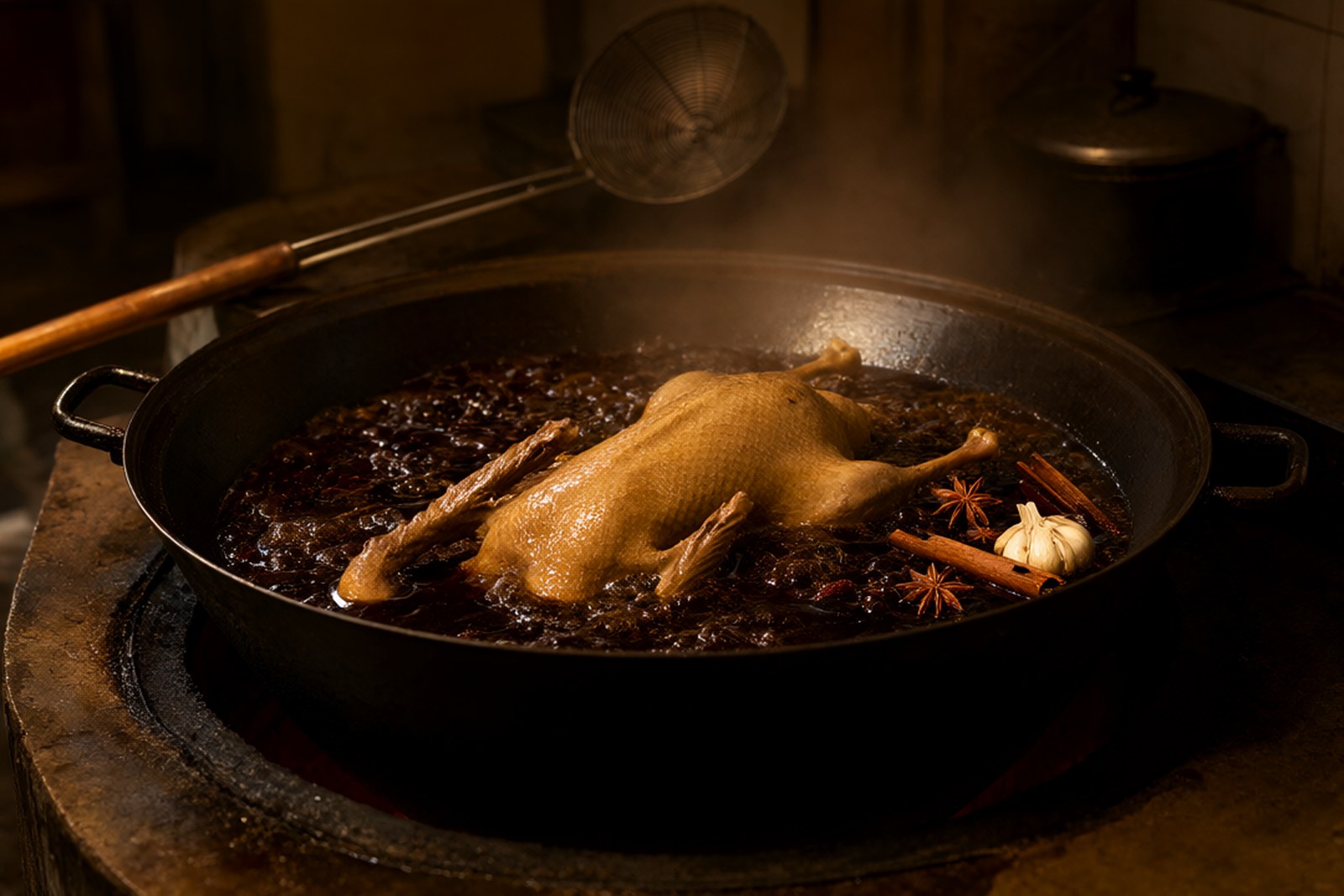
The braise is the whole art, and every shop guards its own. It is built on soy sauce, the light and the dark together, and a sack of aromatics – 八角 bā jiǎo, star anise, 桂皮 guì pí, cinnamon, 草果 cǎo guǒ, 甘草 gān cǎo, liquorice, and 香茅 xiāng máo, lemongrass, plus a big lump of rock sugar to round the salt and a sediment of 老卤 lǎo lǔ, the aged master braise that a good shop has been topping up and reusing for years and years. The goose is first blanched, then lowered into the simmering pot and cooked gently, turned and basted, until a chopstick pushes cleanly through the thigh. It is then lifted out, allowed to rest, and hung or set to cool, because 卤鹅 is served cold or at room temperature, never hot.
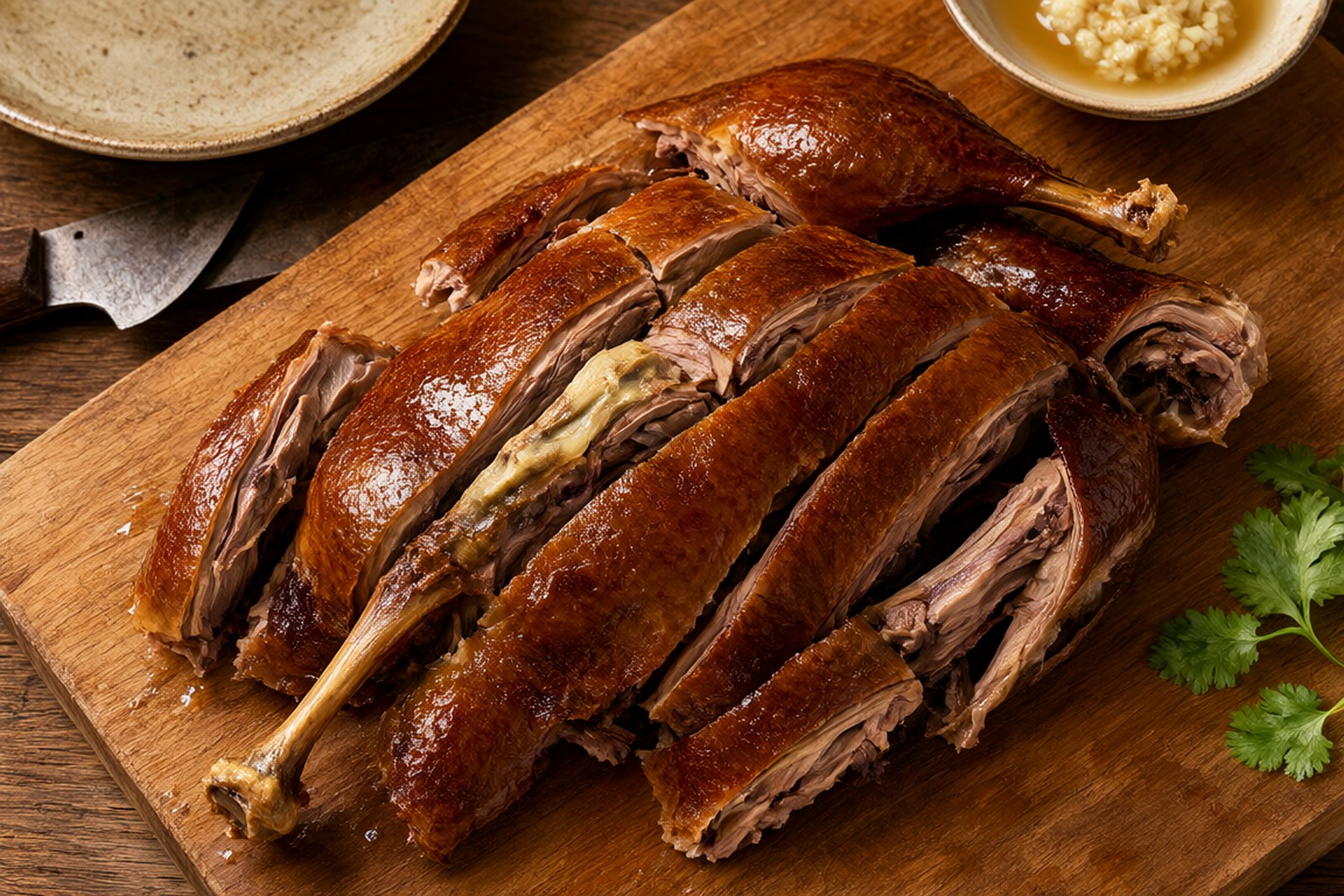
What you buy is a choice of cuts. The breast is lean and the most delicately flavoured; the wing and the leg carry more of the dark, gelatinous skin; and the 鹅肝 é gān, the liver, and the 鹅掌 é zhǎng, the web-footed foot, are considered the prizes. The shop lays the meat on a board, hacks it into neat slices with a heavy cleaver, and you eat it with a dip of 蒜泥白醋 suàn ní bái cù, mashed garlic in pale vinegar, which cuts the richness, and often a scatter of 芫荽 yuán suī, coriander. In a 潮州 meal the 卤鹅 is the dish that anchors a spread of 打冷 dǎ lěng, the cold cooked foods, and a good shop will sell it by weight to take home. It is food that tastes of age, of the accumulated braise, and of a city that has been simmering the same pot for a very long time.
Words and Names
卤 lǔ is the braise, the soy-and-spice bath, and 卤鹅 lǔ é the braised goose; 卤水 lǔ shuǐ is the braising liquid itself, sometimes called the master stock. 老卤 lǎo lǔ is the aged braise a shop keeps topping up. 八角 bā jiǎo is star anise, 桂皮 guì pí cinnamon, 草果 cǎo guǒ and 甘草 gān cǎo the other aromatics, 香茅 xiāng máo lemongrass. 鹅肝 é gān is the liver and 鹅掌 é zhǎng the foot. 蒜泥白醋 suàn ní bái cù is the garlic-and-vinegar dip, 打冷 dǎ lěng the cold cooked foods of a 潮州 spread, and 潮州 Cháozhōu the city this goose belongs to.
What the Locals Know
Buy the 卤鹅 cold, not hot; that is how the shop sells it and how the flavour sits. Ask for a mix of cuts rather than a single one, because the lean breast and the gelatinous wing and leg are different eats. Take the 鹅肝 if it is offered, as it is the richest bite. The 蒜泥白醋 dip is not optional, so use it. In the old city, the best-known shops sell out in the morning and shut by the afternoon, so go early. And it makes a better picnic, taken with rice and a plate of the other 打冷, than it does as a hot main course.
flowcloud would say that a people who took a stately bird and chose to keep it in a dark, simmering bath of age-old stock, then serve it cold and sliced, understood that excellence is often a matter of patience rather than of fire, and that the flavour of a braise is the flavour of time itself.
Where to find it: the 卤鹅店 shops of 潮州 old town, especially along 上水门街 Shàng shuǐ mén jiē and around 牌坊街 Pái fāng jiē, where the counters are stacked with hanging geese from early morning. A portion by weight runs ¥30 to ¥80 depending on the cut; a whole goose is ¥150 to ¥300. 潮州 is a direct train from 深圳 (about two hours) and a drive of roughly four hours from 广州, and 潮汕站 Cháoshàn zhàn on the high-speed line is the nearest rail gateway.