
红桃粿 hóng táo guǒ is the peach-shaped pink rice cake of 潮州 Cháozhōu, and it is the food the city both eats and worships with. A 粿 guǒ is, in the widest sense, a cake or a pudding made from rice, and the 潮州 people make an entire universe of them – 粿 guǒ of many colours, shapes and fillings, each tied to an occasion. But the 红桃粿 is the one that stands above the rest: a deep pink, peach-shaped skin stuffed with salted glutinous rice, steamed, and usually browned lightly in a pan before it is served. It appears at New Year, at the festivals, at the ancestor rites, and on the table whenever a family gathers, and to a 潮州 person it is as much a symbol as a food.
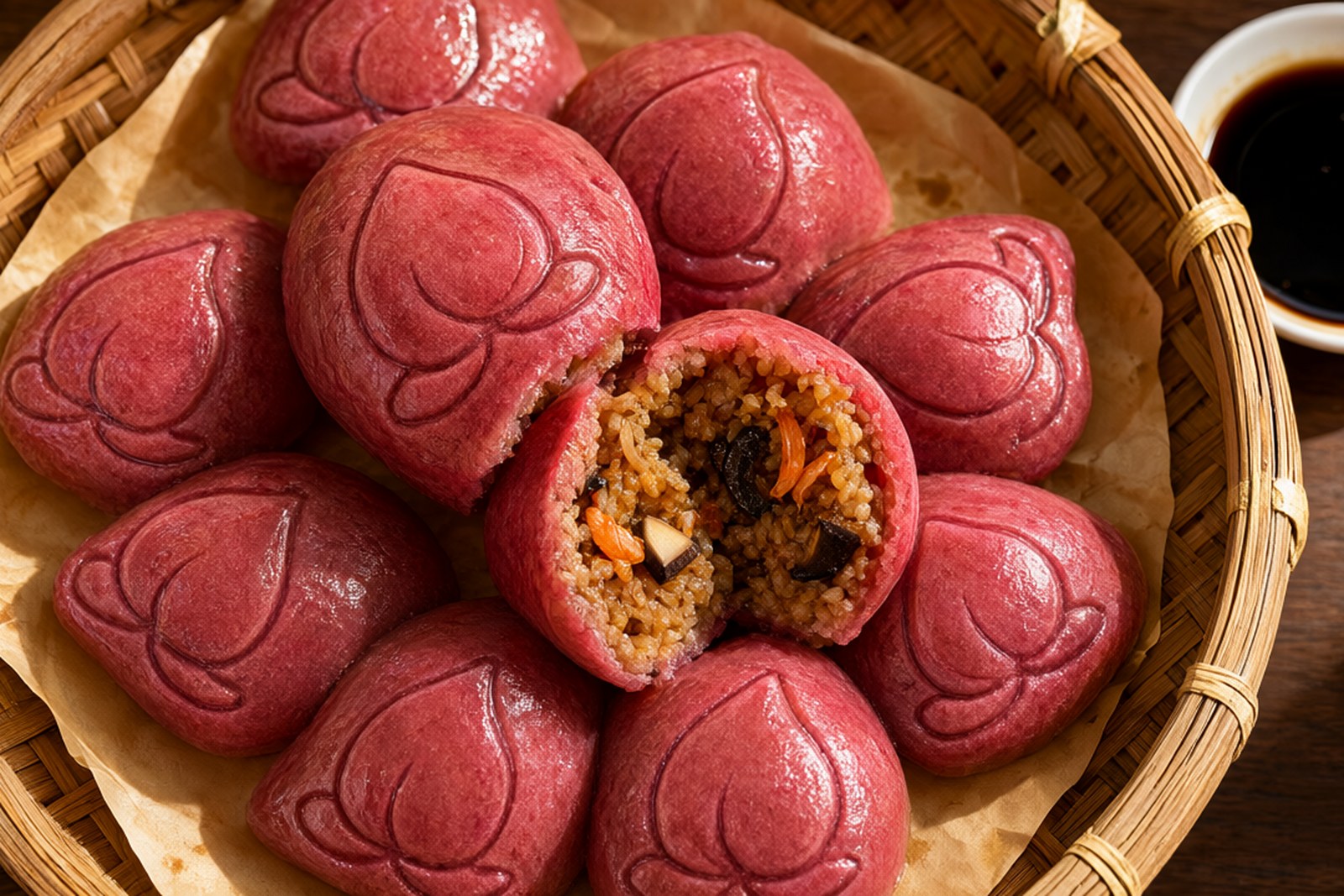
The shape is not arbitrary. The peach is a Chinese symbol of long life, and the 红桃粿 is made as an offering to the ancestors and the gods, to wish for a long and healthy life for the family. The pink colour, too, is deliberate: a pale pink to a deeper red, made by mixing a little food colouring or a natural red into the rice-flour dough, and the brightest pink is used for the most celebratory occasions. The skin is a dough of glutinous rice flour that has been scalded and kneaded until smooth, and each cake is pressed into a wooden mould that stamps a peach shape and sometimes a pattern onto the top, so that when it comes out of the mould it carries a little relief decoration, the way a mooncake does.
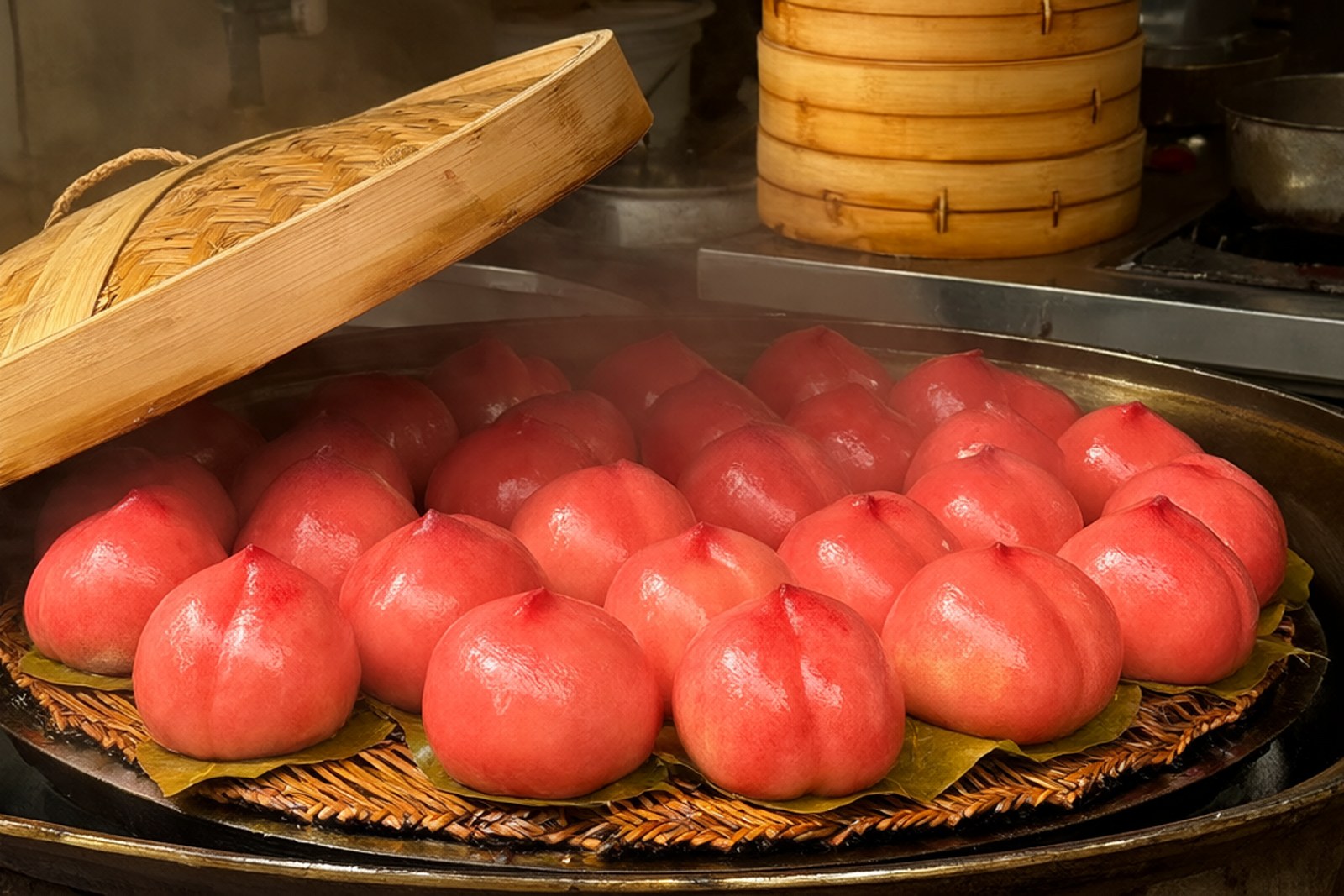
The filling is the savoury heart. Glutinous rice is steamed, then stir-fried with 香菇 xiāng gū, shiitake mushrooms, 虾米 xiā mǐ, dried shrimp, sometimes a little 腊肉 là ròu, cured pork, and a seasoning of soy, five-spice and white pepper, so the filling is a salty, fragrant, slightly chewy sticky rice. A spoonful is wrapped in the pink dough, the dough is pressed into the peach mould, the cake is knocked out, and it is steamed until set. Then, the way 潮州 people actually eat it, it is often pan-fried until the outside crisps and browns, so you get a crackling crust against the soft sweet-savoury middle. It is eaten by hand, often with a little chilli or garlic sauce, and it is the kind of food that is made in batches and shared.
Words and Names
粿 guǒ is the broad word for a rice cake or pudding; 红桃粿 hóng táo guǒ is the peach-shaped pink one. 桃 táo is the peach, a symbol of long life, and 红 hóng is red or pink. 香菇 xiāng gū is shiitake, 虾米 xiā mǐ dried shrimp and 腊肉 là ròu cured pork. Glutinous rice is 糯米 nuò mǐ. 潮州 Cháozhōu is the city; the cakes are made in a wooden 粿模 guǒ mó, the mould that stamps the peach shape.
What the Locals Know
The best 红桃粿 are the ones with a thin, crisp skin and a generous, well-seasoned filling, so buy from a shop that makes them fresh that morning rather than one that sells them cold from a counter. Eat them pan-fried, for the crust, and with a little chilli or garlic dip. The pinkest ones are for the most celebratory occasions; a paler one is an everyday version, and neither is a different food. They are at their best in the days around New Year and the 元宵 Yuán xiāo festival, when the whole city seems to be making them. And they keep and re-steam well, so a box to take home is a sensible purchase.
flowcloud would say that a cake shaped like a peach of longevity, dyed in the colour of celebration, and filled with a salty, savoury heart, is a people’s way of folding a wish for a long life into something you can hold in your hand and eat, and that the best of a culture is often carried in a rice cake.
Where to find it: the 粿 shop stalls of 潮州 old town, around 牌坊街 Pái fāng jiē and the morning markets, where the moulded pink cakes are stacked on bamboo trays. A single cake is ¥3 to ¥8, and a box of a dozen is ¥30 to ¥60. They are made fresh through the day and sell out around the festivals, so buy early. 潮州 is reached by the high-speed rail to 潮汕站 Cháoshàn zhàn, about two hours from 深圳.