
Char Siu
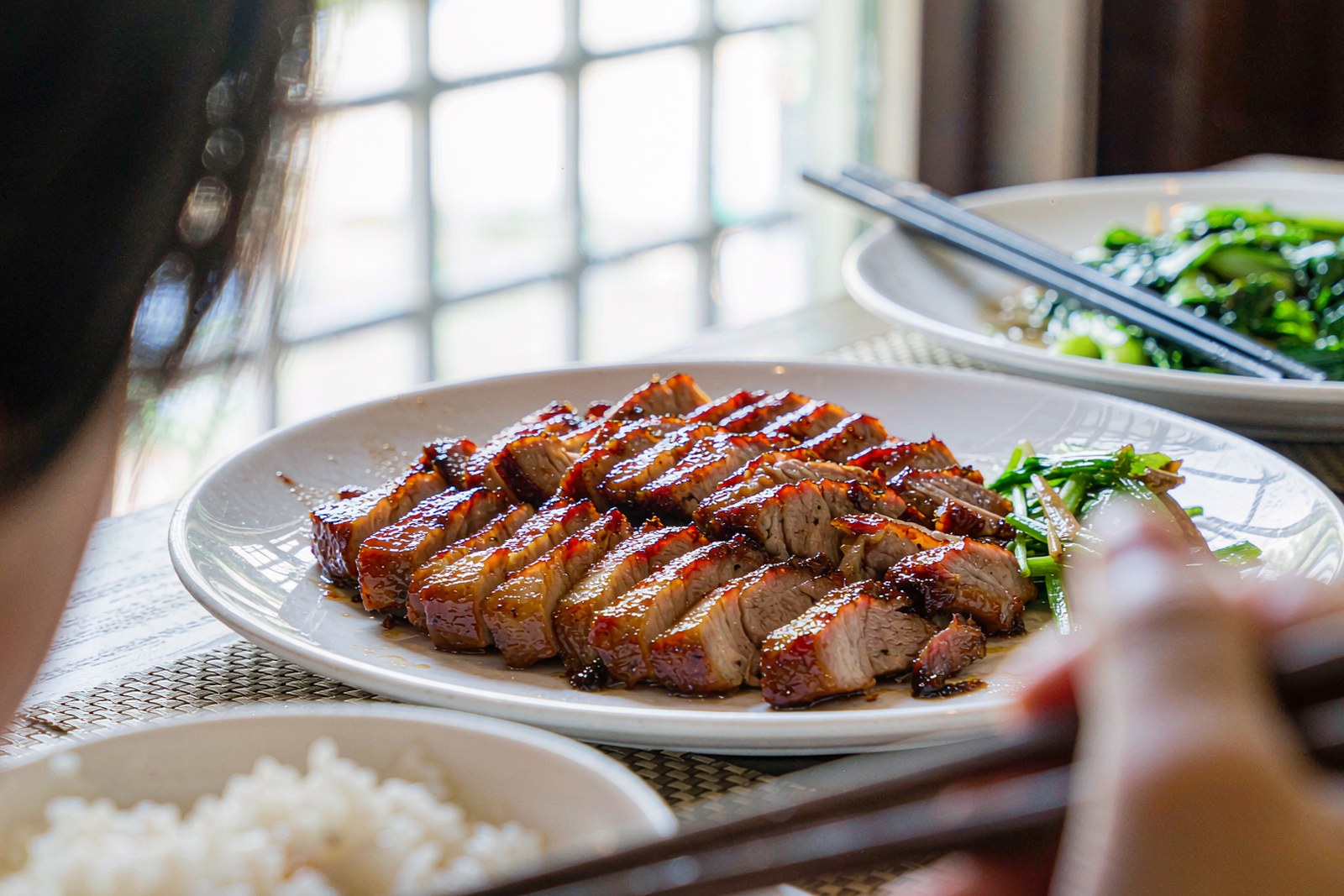
The red lantern of the roast shop glowed on the corner, and behind the glass the pork hung in glistening mahogany strips, fat edges caramelized to a dark ruby. I pointed, the slicer went to work, and a plate landed with rice and a ladle of the pan juices. The first bite was sweet, then smoky, then the fat melted and I understood why people in Guangdong dream about this meat. This is 叉烧 chāshāo, the barbecue pork that flavors the whole cuisine.
叉烧 chāshāo means “fork-roasted,” from the old practice of skewering seasoned pork on long forks and holding it over an open flame. The method comes from the 粤 Yuè roast-meat tradition of Guangdong, refined in the shop houses of 广州 Guǎngzhōu over the 19th and 20th centuries. It matters here because 叉烧 is the province’s all-purpose flavor: it is eaten plain, tucked into 包 bāo buns, folded into 炒饭 chǎofàn fried rice, and laid over noodles. Wherever Cantonese food travels, 叉烧 goes first.
The Craft
The cut is usually 梅头 méitóu (pork shoulder or collar) or 五花 wǔhuā (pork belly) for a fattier version, chosen for marbling that bastes the meat as it cooks. The marinade is the signature: 海鲜酱 hǎixiānjiàng (seafood sauce), 蚝油 háoyóu oyster sauce, 玫瑰露酒 méiguī lùjiǔ rose wine, honey, five-spice, red fermented bean curd 南乳 nánrǔ, and a little 红曲米 hóngqūmǐ red yeast rice for the famous red color.
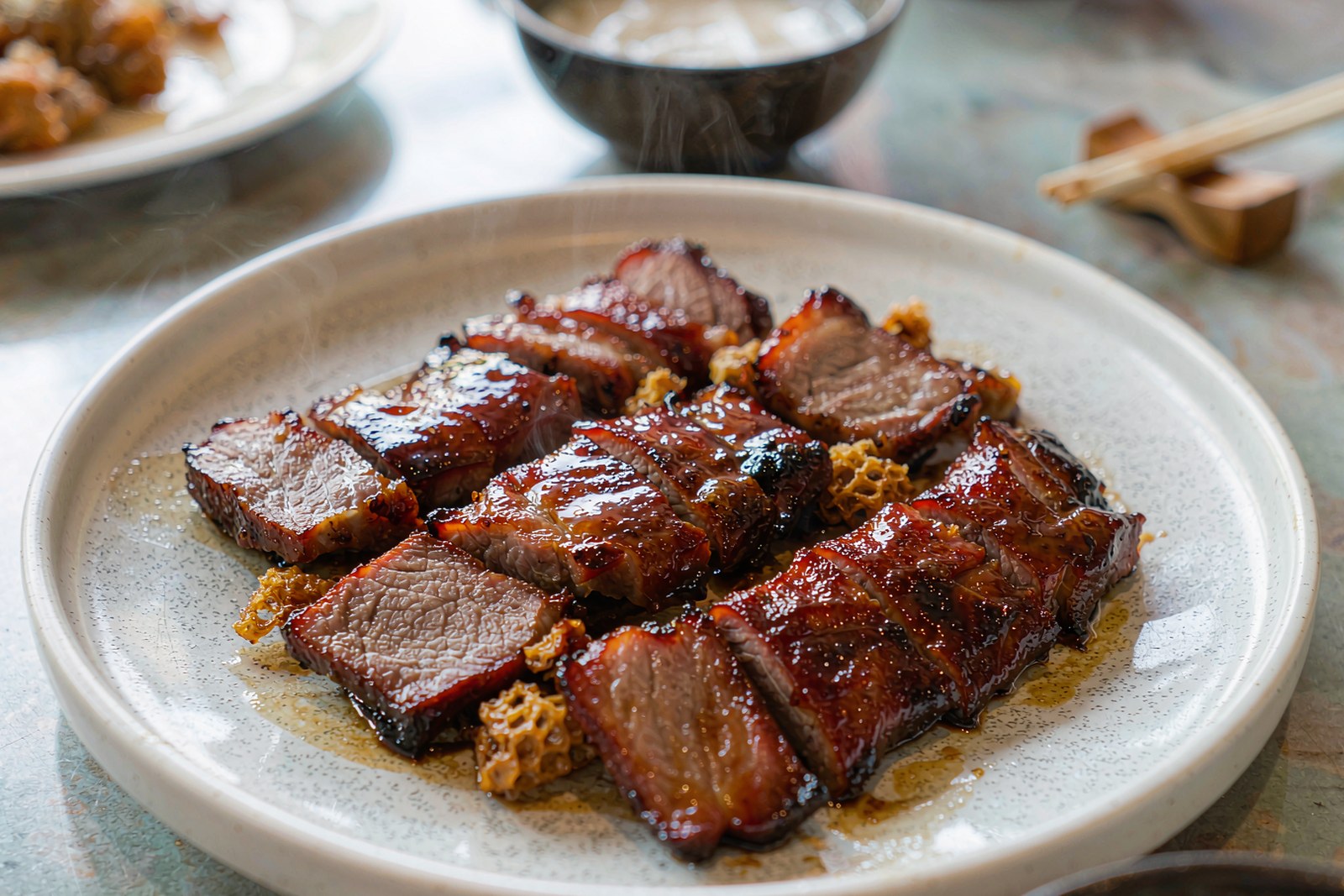
The pork is marinated overnight, then roasted on hooks in a hot oven or over 荔枝木 lìzhīmù lychee charcoal, brushed with honey or maltose two or three times so the outside builds a lacquered, slightly burnt crust. The center stays tender and faintly pink. A skilled cook balances 肥 féi (fat) and 瘦 shòu (lean); the 半肥瘦 bun1 féi4 sau3 (“half-fat half-lean”) cut is the one connoisseurs ask for.
How to Eat It
Order it by the piece with rice and the pan drippings, or as 叉烧包 chāshāo bāo (steamed buns) and 叉烧饭 chāshāo fàn (rice plate). Always ask for 半肥瘦 bun1 féi4 sau3 unless you want it dry. The 蜜汁 mìzhī (honey sauce) version is sweeter; the 脆皮 cuìpí (crisp-skin) version is roasted harder for a candied edge. In Guangdong every 烧味 siu1 mei6 shop has its own marinade, and regulars have a favorite within walking distance of home.
Words and Names
叉烧 is 叉 chā “fork” and 烧 shāo “to roast,” literally “fork-roast,” spoken in Cantonese as caa1 siu1. The red comes from 红曲 hóngqū red yeast, not dye, in traditional shops. The same 烧 shāo appears in 烧鹅 shāo’é (roast goose) and 烧肉 shāo ròu (roast pork belly), the whole 烧味 siu1 mei6 family. A 叉烧 chāshāo described as 靓 leng3 is again the highest local compliment.
What the Locals Know
Ask for 半肥瘦 bun1 féi4 sau3 all-lean 叉烧 chāshāo is dry and a little sad.
Eat the burnt edges the 焦 jiāo crust is the best part, sweet and smoky.
Try it in a bun 叉烧包 chāshāo bāo is the dim sum standard for a reason.
Know your shop every 烧味 siu1 mei6 stall guards a secret marinade.
Go before noon the first roast of the day is the juiciest.
flowcloud would say that the sweetest meat is the one that spent the night waiting to be burned.
Where to find it: Char siu, 叉烧 chāshāo, is sold at every 烧味 siu1 mei6 (roast-meat) counter in Guangdong, with the deepest version in Guangzhou and 香港 Xiānggǎng. Order 叉烧饭 chāshāo fàn (rice plate) or 叉烧包 chāshāo bāo (buns) at any 茶餐厅 chá cān tīng (tea cafe) in 越秀 Yuèxiù or 荔湾 Lìwān, asking for 半肥瘦 bun1 féi4 sau3 honey-glazed. A rice plate runs roughly 25 to 45 yuan, and a basket of buns about 18 to 28 yuan.