
The noodle is a sheet of rice before it is a noodle, and the sheet is the point. 陈村粉 Chéncūn fěn is named after 陈村 Chéncūn, a town south of 佛山 Fóshān, and it is made by pouring a thin slurry of ground rice onto a stretched cloth over a boiling pan, steaming it for a minute until it sets translucent, then lifting the cloth and peeling the sheet off in one piece. The sheet is thinner and more elastic than the ordinary 河粉 héfěn of the Cantonese kitchen, and because it is so thin it can be folded, rolled or cut into ribbons without tearing. In Chencun it is served for breakfast, either in a clear broth or dressed at the table with soy sauce, hot oil and a scatter of spring onion, and its quality is judged almost entirely on the texture of the sheet.
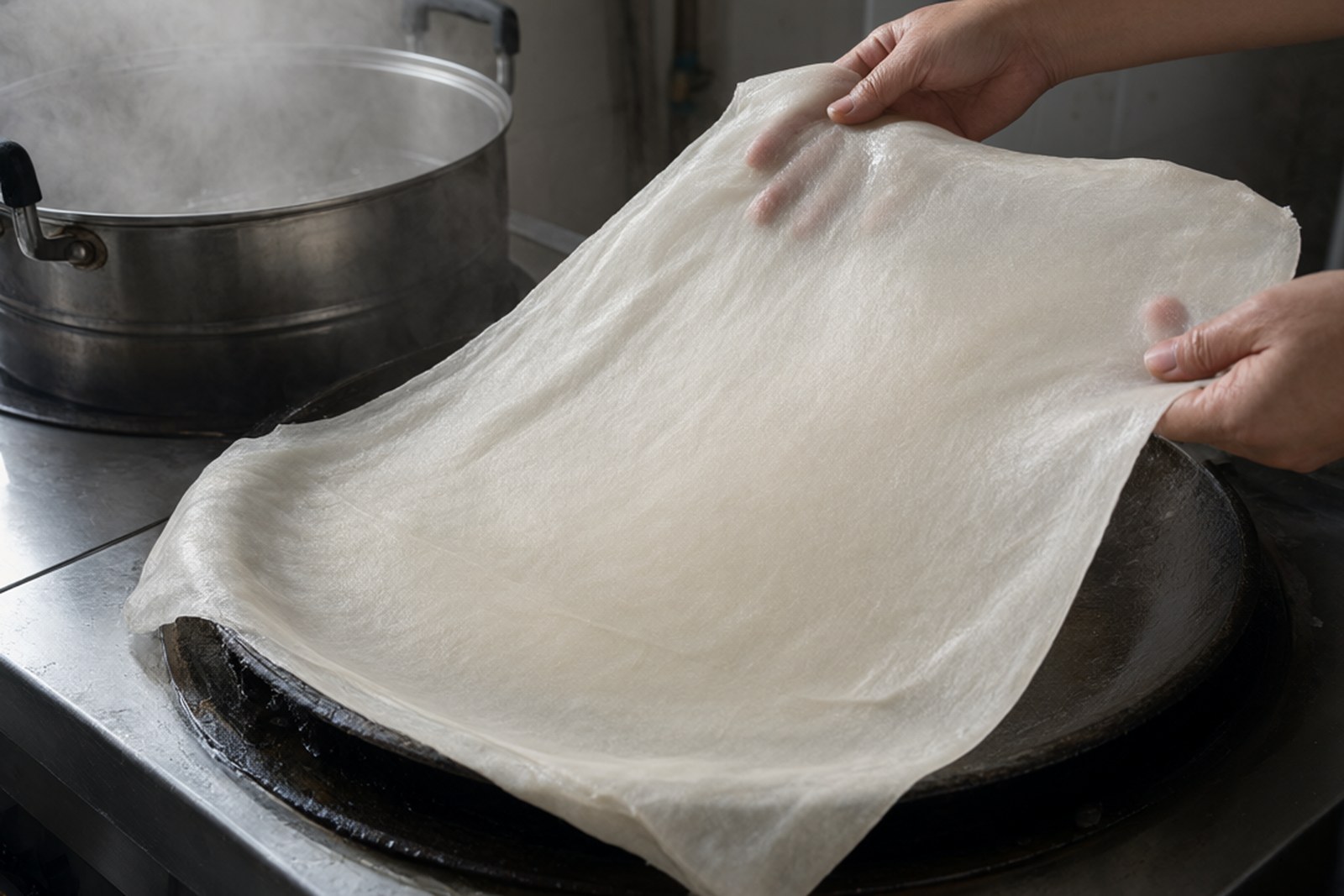
What makes the local version distinct is the rice. The traditional recipe uses a single local variety, soaked overnight and ground with water in a stone mill, and the batter is used without much adjustment beyond the occasional spoon of older, slightly fermented slurry that gives the sheet a faint tang and a better fold. Nothing is added to strengthen it: no wheat starch, no cornflour, no gum. The consequence is that the noodle is fragile and must be made and eaten the same day, which is exactly why the dish has never travelled well and why the best bowls are still found within a few kilometres of the town. A shop that makes its own sheets will have the cloth frames and the steaming pans out where you can see them.
Two Ways to Eat It
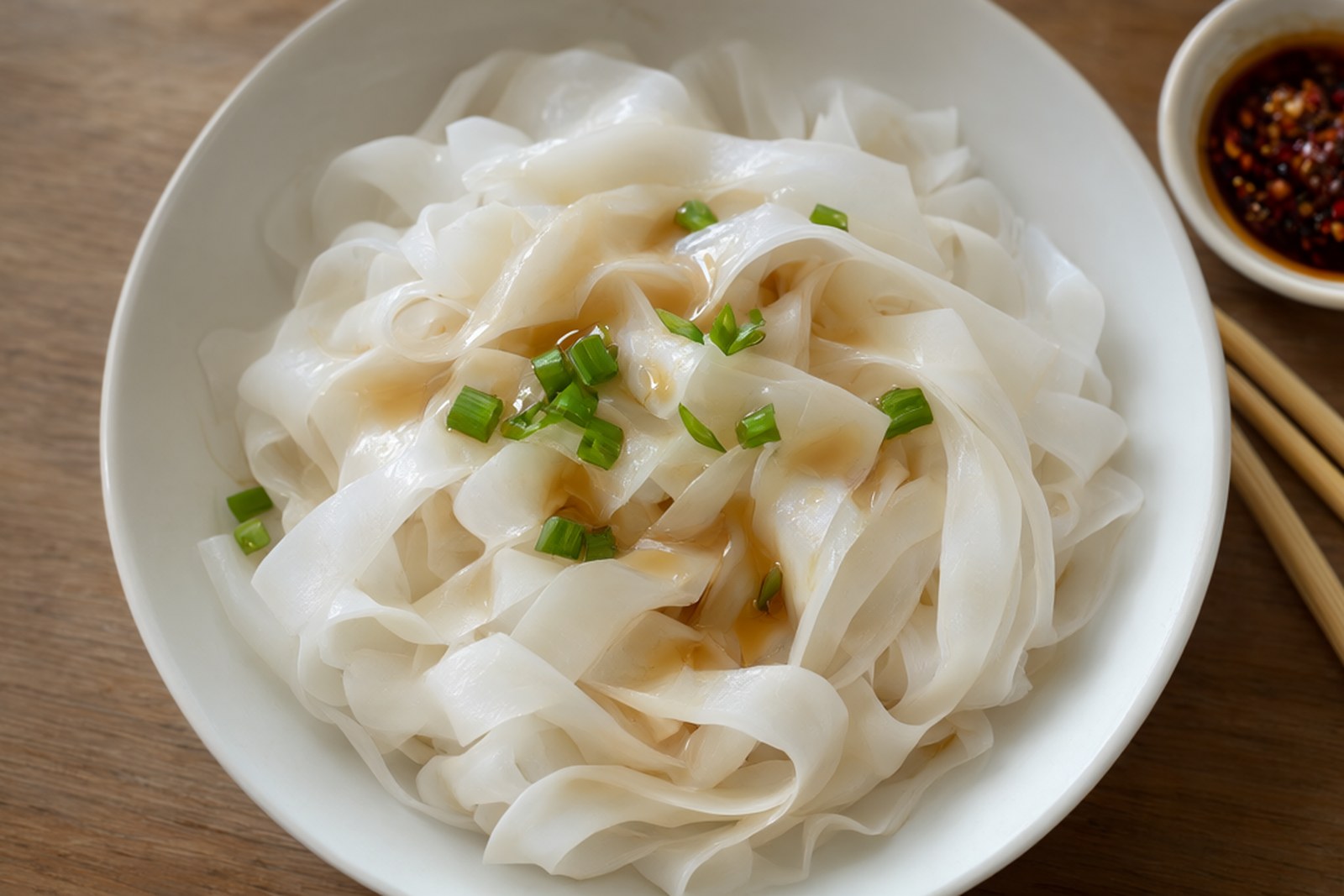
The cold-dressed version, 凉拌陈村粉 liángbàn Chéncūn fěn, is the simpler one and the harder to get right. The ribbons are cooled, piled in a bowl, and dressed with light soy, a little sugar, sesame oil and hot oil poured over chopped garlic and spring onion to release the aroma. Because nothing is cooked further, the noodle is the whole dish, and a sheet that is too thick or too cold tastes of nothing. The hot version, 汤陈村粉 tāng Chéncūn fěn, is dropped into a light pork or chicken broth for a few seconds and served with 牛腩 niúnǎn, braised beef brisket, or 猪手 zhūshǒu, braised pig’s trotter, and the sauce from the braise is spooned over the noodle as well as the broth.
A third form worth knowing about is 炒陈村粉 chǎo Chéncūn fěn, the noodle fried in a hot wok with 韭黄 jiǔhuáng, yellow chives, and a little soy, which is the hardest of the three because a sheet this thin breaks under a careless spatula. All three are usually on the same menu, and locals order according to the hour: the dressed version in the morning, the fried one at night.
Words and Names
陈村粉 Chéncūn fěn is the noodle, 陈村 Chéncūn the town and 粉 fěn the general word for a rice noodle or a noodle made from a starch slurry. 河粉 héfěn is the ordinary Cantonese flat rice noodle, 沙河粉 shāhé fěn the Guangzhou version, and 粿条 guǒtiáo the Chaoshan one; all three are cousins and none of them behaves quite like a genuine Chencun sheet. 凉拌 liángbàn means dressed cold, 汤 tāng soup, 炒 chǎo stir-fried. 牛腩 niúnǎn is beef brisket, 猪手 zhūshǒu pig’s trotter, 韭黄 jiǔhuáng yellow chive, 蒜蓉 suàn róng chopped garlic and 生抽 shēngchōu light soy.
What the Locals Know
Go in the morning. The sheets are steamed in the small hours, and by early afternoon a shop that started at dawn will have run out or will be using stock steamed the previous day, which you can taste. Ask whether the noodle is made on the premises; the answer is usually obvious from the cloth frames hanging in the back. Order the dressed version first, plain, so that the sheet is the thing you are judging, and only then try the braised toppings. Note that 陈村粉 is a breakfast and lunch dish in most shops, and the good ones shut when they sell out rather than at a fixed hour. Prices are low, roughly ten to twenty-five yuan a bowl, and there is no relationship between price and quality: the best is often the cheapest.
flowcloud would say that Chencun rice noodle is a dish that cannot be faked at a distance, since it is one ingredient made at one thickness by one method and there is nowhere for a shortcut to hide.
Where to find it: the noodle shops of 陈村 Chéncūn itself, a short drive south of central 佛山 Fóshān, where several families still steam sheets over cloth, and the breakfast shops of 禅城 Chánchéng and 顺德 Shùndé that buy from them daily. Look for cloth frames and steam in the front of the shop, order 凉拌 first, and go before noon.