
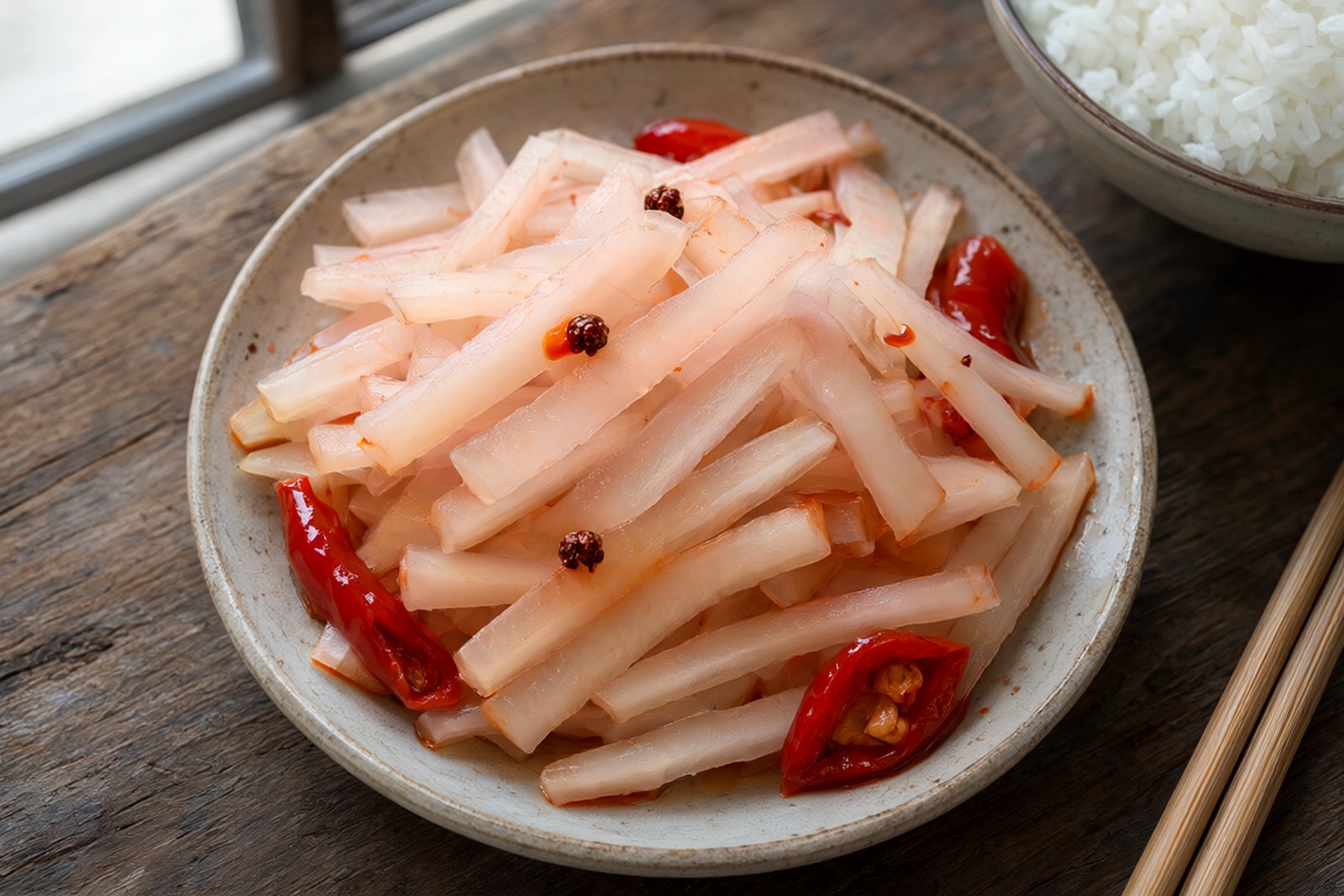
It is a radish, dried in the sun, salted in a crock, and eaten with everything. 辰溪酸萝卜 Chénxī suān luóbo is pale, translucent, faintly speckled with chilli, and it tastes of sour, salt and a slow sweetness that comes out of the vegetable itself once the water is gone. It is served in a small dish beside a bowl of rice noodles at breakfast, chopped into a stir-fry at noon, and eaten out of the jar by children in the afternoon. On its own it is not a dish. As the thing that makes other food edible, it is nearly a religion in this part of Hunan.
辰溪 Chénxī is a county on the middle 沅水 Yuánshuǐ, upstream of 沅陵 Yuánlíng and about an hour by road from 怀化 Huáihuà. The river made it a market town and the hills behind it made it a place that eats pickles, because the frost-free season is long and the vegetable garden produces more radish than anybody can eat fresh. 辰 chén is the river’s old name — 辰水 Chénshuǐ — and 溪 xī is a stream; together, “the stream of Chen”. The county is also, in the local telling, the home of 辰河戏 Chénhé xì, a form of river opera sung by boatmen with a high, carrying voice, which is exactly what you would expect from people who spent their lives working in earshot of the far bank.
What Makes It Work
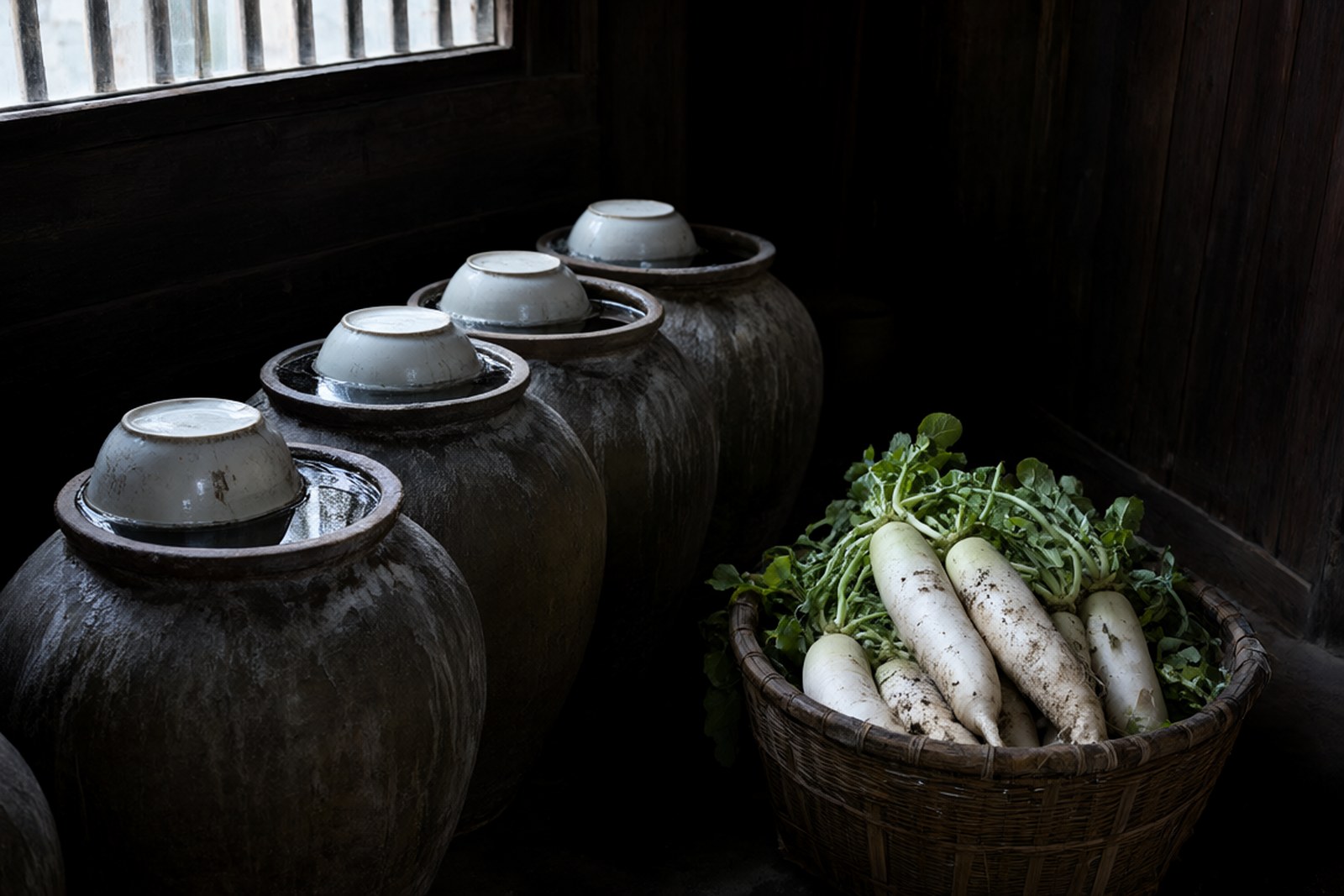
The radish is a white winter radish, large and dense. It is cut — into slabs, into sticks, into thin crescents, the shape varying by household — and spread out in the sun for a day or two, until it has lost enough water to bend without snapping. Then it is packed in salt, weighted, and left for a few hours more so that the last of the bitter liquid comes out. The dressing is where the families diverge: chilli flakes or fresh chopped chilli, 花椒粉 huājiāofěn, sugar, rice vinegar, sometimes a spoon of 甜酒 tiánjiǔ — fermented glutinous rice — and, in the version most often sold in the markets, a red tint from 红曲 hóngqū, fermented red rice, which is itself a big local product. The jar stands for three days and then keeps for months.
The flavour is not the aggressive sourness of a vinegar pickle. Sun-drying first concentrates the radish’s own sugars, so the sourness arrives with a sweet undertone and the texture stays crisp instead of going soft. That is the trick, and it is why 酸萝卜 suān luóbo from this county travels: the technique is not complicated, but it depends on a dry autumn, and 辰溪 Chénxī has one.
Words and Names
酸 suān is sour, and in Hunan it means a specific thing — fermented, cured, or pickled, and the taste of home rather than of vinegar. 泡菜 pàocài is the brined kind, 腌菜 yāncài the salted kind, 酸萝卜 suān luóbo the radish. 红曲 hóngqū, red yeast rice, is the mould-fermented rice that gives Hunan and Fujian food its deep red colour, and 辰溪 is one of its centres; it is the same ingredient that colours 祁阳曲鱼 Qíyáng qūyú two counties east.
The 沅水 Yuánshuǐ itself is worth a note, because it is the river that made all of this possible. It is the second-largest tributary system of Dongting Lake, navigable for hundreds of kilometres upstream, and for two millennia it was the only practical route between the Sichuan-Guizhou basin and the Yangtze — a fact that made 洪江 Hóngjiāng rich, 沅陵 Yuánlíng administrative, and every river town on its banks a market for salt, timber and pickles.
What the Locals Know
Eat it with noodles at breakfast. A bowl of 米粉 mǐfěn and a dish of 酸萝卜 suān luóbo is the standard breakfast of the county, and the pickle is not an accompaniment, it is half the meal.
Buy it by weight from a market stall, not in a sealed packet. The jars in the wet market are made by the person selling them; the vacuum-packs are made for tourists and are sweeter and softer.
Ask for 微酸 wēi suān if you are not used to it. The full-strength version is genuinely sour and locals will happily sell you the milder jar.
Take it home in a jar with liquid. It keeps for months in the fridge and is the single most useful thing to bring back from this prefecture.
Where to Eat It
The pickle itself is cheap — ¥10–20 for a kilogram jar in the market, less if you bring your own container. In 怀化 Huáihuà city, pickle stalls with this name are on most streets and nearly all of them are the same product with different amounts of sugar. The county town, 辰阳镇 Chényáng Zhèn, is on the 沅水 Yuánshuǐ and reachable by road from 怀化 in about an hour; there is also a station on the old 湘黔 line. Order a breakfast noodle and let the owner choose the pickle for you.
flowcloud would say that a cuisine’s real signature is rarely its banquet dish, and that a county which has spent three hundred years perfecting the thing you put on the table without thinking about it knows something most restaurants never learn.
Where to find it: 辰溪酸萝卜 (Chénxī suān luóbo), 辰溪县 (Chénxī Xiàn), 怀化市 (Huáihuàshì), 湖南 (Húnán). Market jars in the county town ¥10–20 a kilogram. Eat it with breakfast noodles, ask for 微酸 (wēi suān) if the full sourness is new to you, and take a jar home.