
重庆火锅 Chóngqìng huǒguō, which English renders as Chongqing hotpot, is a tallow pot: beef fat is the broth itself, red with chilli and flower pepper, and the pot is the meal, with no course before it and none after. Chongqing is a municipality of southwest China, and Yuzhong is its central district on the peninsula where the Yangtze meets the Jialing River; the two rivers wrap the district on three sides, and on the wharves where boatmen and trackers once hauled barges against the current the pot is said to have been born. The wharf at 朝天门 Cháotiānmén Chaotianmen is now a plaza and a cruise terminal, but the pot it launched is the largest single thing on the city’s table: a craft on the municipality’s intangible-heritage list, an industry of tens of thousands of restaurants, and since 2025 the subject of the country’s first local law written for one dish.

Every account of the pot’s origin agrees on the essentials – a wharf, porters, discarded offal and beef tallow; they disagree only on which wharf. The district’s own account takes the Chaotianmen story: butchers slaughtered cattle by the water and threw the offal away, and the boatmen and trackers took it back to their sheds and boiled it in a fierce broth of chilli, flower pepper and tallow until the cheapest meat in the city became the most wanted. The China Cuisine Association’s account, relayed through the national press, starts the tripe hotpot with the street stalls of the late Qing and early Republic that sold 水八块 shuǐ bā kuài, the “eight watery pieces” of offal divided on a plate, and puts the first proper tripe-hotpot house on the slaughterhouse street of 南纪门 Nánjímén Nanjimen around the mid-1920s, where the Ma brothers boiled tripe in red broth. A third study, by the writer Li Jieren in 1947, put the birth across the river in Jiangbei. All three are printed here as they stand, because the place is a disputed detail while the shared story – offal made palatable at the water’s edge – is the part the city owns.
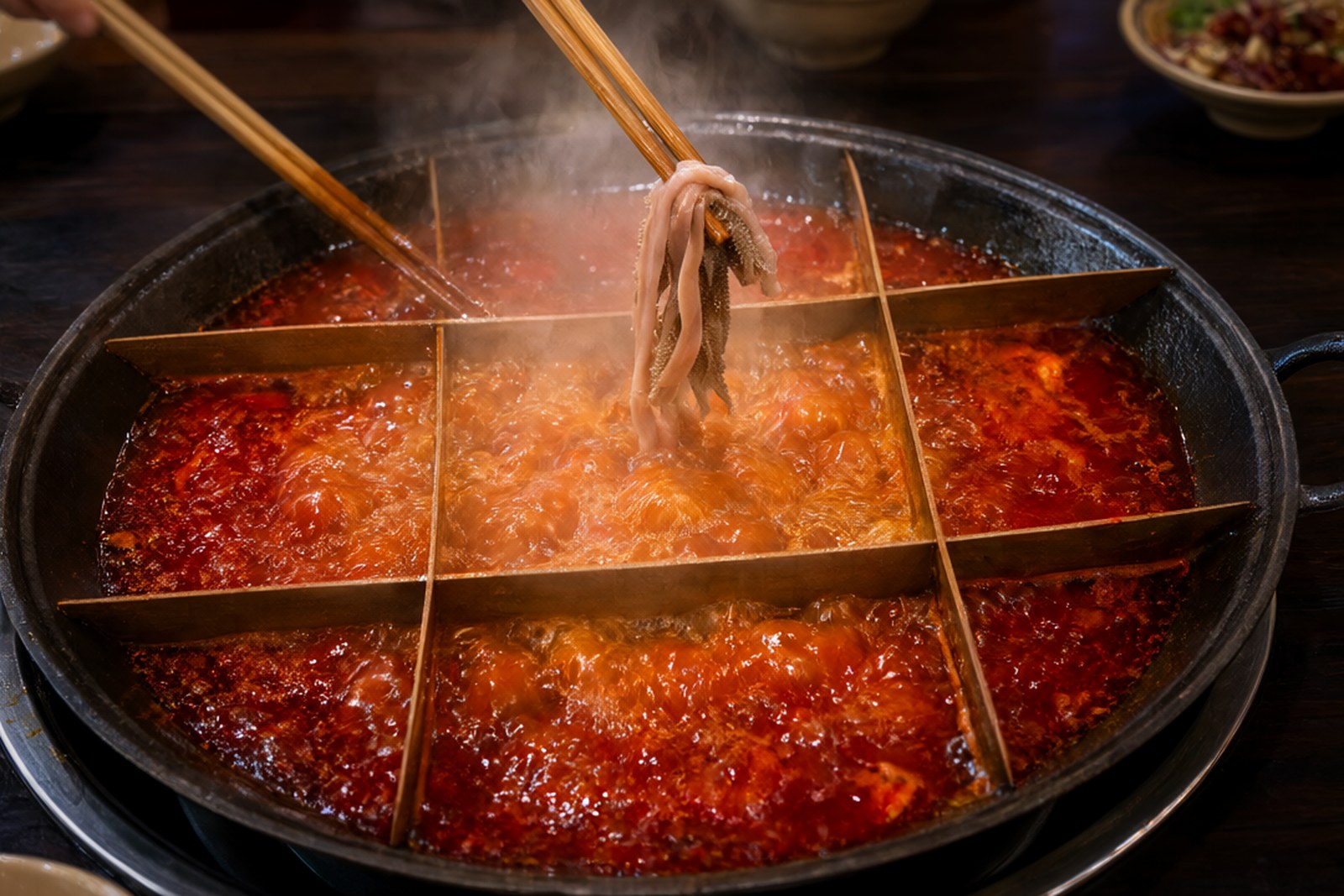
What the peninsula can claim with less dispute is the step from the carrying pole to the table. In 1934 a small restaurant inside the old city served hotpot seated for the first time, moving it off the street stall and replacing the divided iron basin with small copper pots, and through the 1930s named houses opened along the peninsula’s streets. The divided pot itself survived as the 九宫格 jiǔgōnggé, the nine-grid pot: by the older account each diner claimed a grid and paid by the piece eaten, a wharf-side way of sharing one pot among strangers, and by the reading food writers give it today the grids hold three heats – the centre at a full boil for tripe and duck intestine, the cross grids for meatballs and blood curd, the corners at a simmer for brains – a usage carried by tradition rather than by any written standard. In 2016 the city voted the hotpot first among its ten cultural symbols; in 2019 the technique of making it entered the municipality’s intangible-heritage list.
The pot is now the heaviest line on the city’s ledger. Figures published at a press conference of the municipality’s People’s Congress in April 2026, standing at the end of 2025, count about 16,800 hotpot-related enterprises and some 38,000 hotpot restaurants across Chongqing, nearly 900,000 people working in them, a consumption income of 82.3 billion yuan – a third of everything the city spends on eating out – and a full value chain worth 330 billion yuan, with the ingredient industry alone carrying 28.54 billion yuan of output above the designated size. That is the only production set used here: an earlier count taken for 2024 moves in the other direction, the divergence is a change in statistical method rather than in the trade, and the two sets are not merged and not printed side by side. The peninsula holds its share. On 19 December 2025, when the municipal commerce commission and the district government laid a giant ring of hotpot tables across the Chaotianmen plaza for a ten-thousand-person hotpot festival, the district’s mayor put Yuzhong at more than 50 known hotpot brands and some 2,000 restaurants – a count from 2015 had put it nearer 3,000, and each figure belongs to its own year. The newest fact is legal: in November 2025 the draft of the Chongqing Municipality Regulations on Promoting Hot Pot Industry Development, the country’s first local law for the hot pot industry, was explained to the municipal People’s Congress standing committee, and in April 2026 the finished text was announced at a press conference; the draft points the trade toward an evaluation system, time-honoured-brand applications and a hotpot museum.
Eating it has a grammar. The dipping bowl is the 油碟 yóudié, sesame oil over raw garlic, a cooling moat for food that leaves the broth at lava heat. As the local saying goes, tripe needs 七上八下 qī shàng bā xià, “seven ups and eight downs” – a couple of seconds in, a second out, seven or eight times – and that is a folk count, not a technical standard. The base itself is fried into tallow from a couple of dozen ingredients, broad-bean paste, Shizhu chillies, Hanyuan flower pepper and Yongchuan fermented beans among them, by the trade’s own telling; and the houses set into the old air-raid shelters, a habit the wartime years left behind, were made famous again by a film, which is as far as this page follows the cinema. One argument in the trade is honest about itself: the old-style pot was refreshed with 老油 lǎoyóu, tallow broth strained and re-clarified and carried to the next night, while most houses now cook on single-use broth, and the two camps argue whether the change cost the pot its depth – this page records the argument and takes no side. Nor is this page the site’s other hotpots. Chongqing hotpot is a tallow pot, not a clear one: the beef fat is the broth, the nine-grid divider is a relic of wharf-side sharing, and the raw material began as the offal the butchers threw away. The beef-hotpot page elsewhere on this site, Chaoshan’s, is the opposite idea – a clear bone broth and cuts timed by the second; the coconut-chicken pot of Hainan boils its chicken in coconut water; the vinegar pot of Zhanjiang seasons its broth sour – three family-table pots against one city’s red soup that only gets stronger as the night goes on. And the blood curd here is a pot ingredient, not the Nanjing soup it sits in elsewhere on this site. Xiaomian, the noodle of this district, keeps its own page: a two-minute bowl eaten standing at a counter before work; hotpot is the meal the whole city sits down for, and this piece never re-enters the noodle shop.
Words and Names
重庆火锅 Chóngqìng huǒguō is Chongqing hotpot, also called 毛肚火锅 máodù huǒguō, the tripe hotpot. 牛油 niúyóu is beef tallow, the broth itself; 九宫格 jiǔgōnggé is the nine-grid pot; 油碟 yóudié the garlic-and-sesame-oil dipping bowl; 老油 lǎoyóu the re-clarified old broth of the old-style pot against 一次性锅底, the single-use broth most houses now pour. At the table, 毛肚 máodù is tripe, 鸭肠 yácháng duck intestine, 黄喉 huánghóu the aorta, 脑花 nǎohuā brains, 血旺 xuèwàng blood curd and 耗儿鱼 hào’eryú filefish. 水八块 shuǐ bā kuài is the old wharf name for the eight divided pieces of offal, and 七上八下 qī shàng bā xià the tripe count of the local saying. 中国火锅之都 is China’s Hot Pot Capital, the title a national cuisine association gave the city in 2007. The site’s three other hotpot pages keep their own broths; this page keeps the tallow one.
What the Locals Know
A house is chosen by smell and queue rather than by list, and the old lanes below the pedestrian circle are where the wharf style survives. The order is the base first – most houses pour a red broth whose heat runs in named grades, and the mildest of them is still serious – then the oil dish, then by the plate, tripe and duck intestine for speed, the slow things for the end of the night. A typical local hotpot dinner is a mid-range meal rather than a splurge, and no official price is published anywhere, so no figure is printed here; per-person numbers read online on a 2026-10 snapshot fluctuate with the season and the house. The houses around 较场口 Jiàochǎngkǒu Jiaochangkou, one stop from the circle on the metro, and the 十八梯 Shíbātī Shibati lanes below it are the addresses the wharf story still lives in.
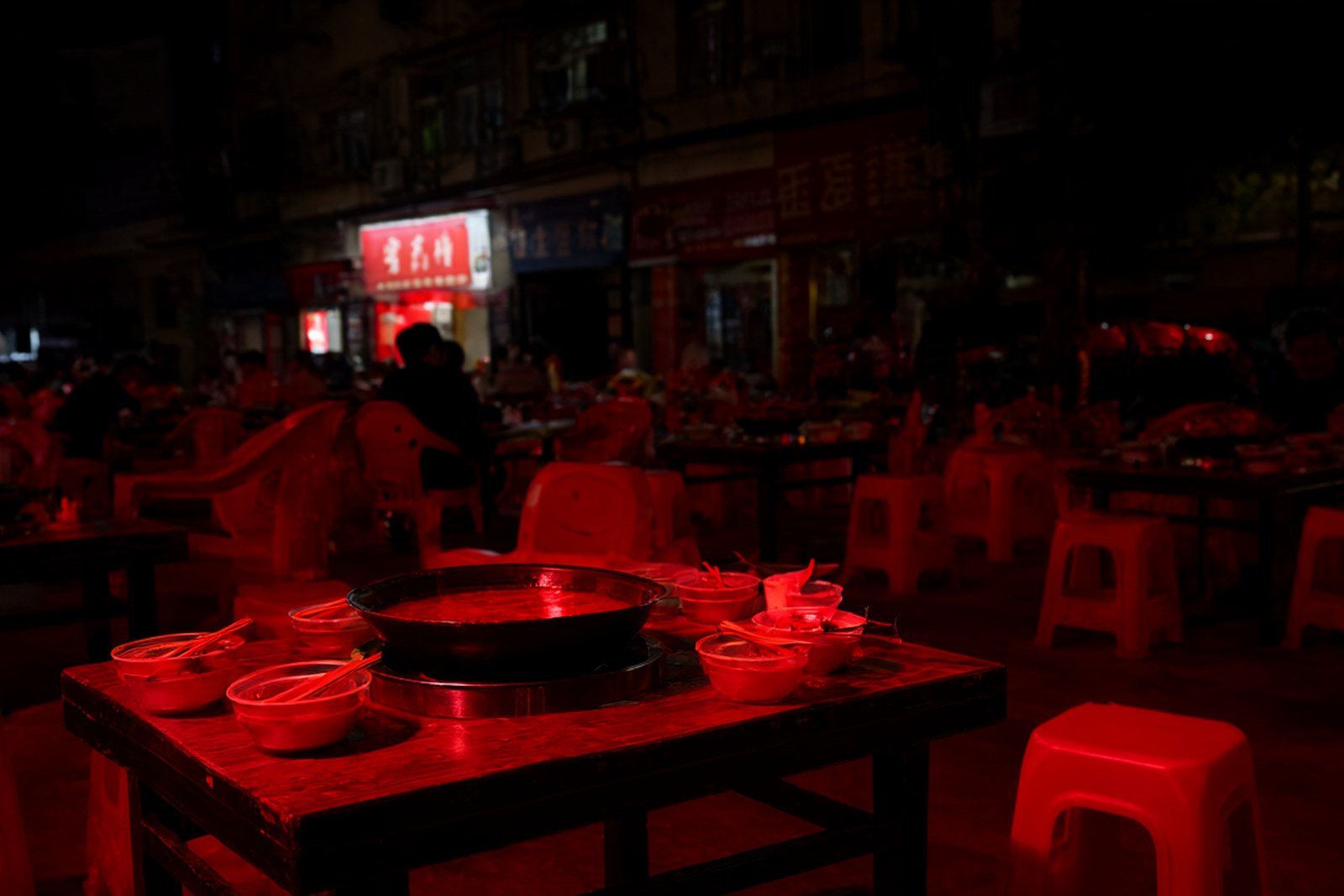
A day that makes sense of the page puts the rivers first and the pot last. The confluence in the morning, when the two waters still run side by side, the lanes of the lower city through the afternoon, and the table at night, when the grid is boiling and the street outside is a wall of the same red light. What the record refuses is stated plainly: the three origin accounts are printed as three and no single birthplace is asserted; the heritage year is 2019 and no earlier date is used; the 2024 industry set is not printed beside the end-2025 one; the exact seconds of the tripe count stay inside the saying; the old-oil argument gets no verdict; and no house name and no per-head price appears as fact.
flowcloud would say that Chongqing hotpot is the tallow pot of the wharves – boatmen and porters boiling discarded beef offal in a fierce red broth at the river gates of the peninsula, with every origin account agreeing on the essentials and disagreeing only on which wharf – a craft on the municipality’s intangible-heritage list since 2019, an industry of some 38,000 restaurants and a 330-billion-yuan value chain at the end of 2025, and the subject of the country’s first local law for a single dish.
Where to find it: the hotpot houses around 较场口 Jiàochǎngkǒu Jiaochangkou and the 十八梯 Shíbātī Shibati lanes, and along the rim of the 解放碑 Jiěfàngbēi Jiefangbei pedestrian circle, in 渝中区 Yúzhōng Qū Yuzhong District, Chongqing Municipality, with the confluence wharf of 朝天门 Cháotiānmén Chaotianmen at the river’s edge; the origin accounts are three and stay three, the technique has been on the municipality’s intangible-heritage list since 2019, a typical local dinner is a mid-range meal and prices move with the season on a 2026-10 snapshot that fluctuates, and the nine-grid pot, the oil dish and the seven-ups-and-eight-downs saying are the grammar of the table.