
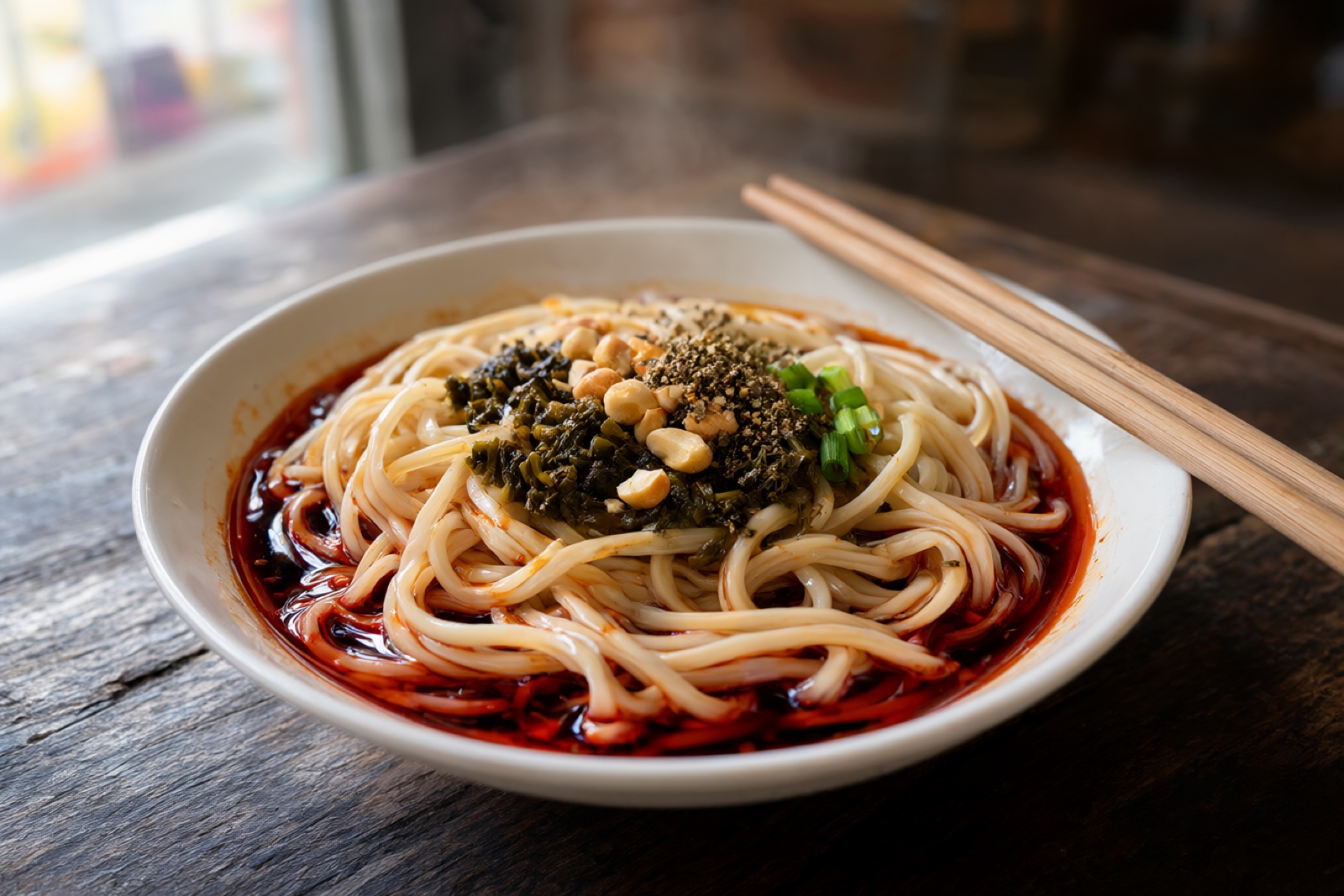
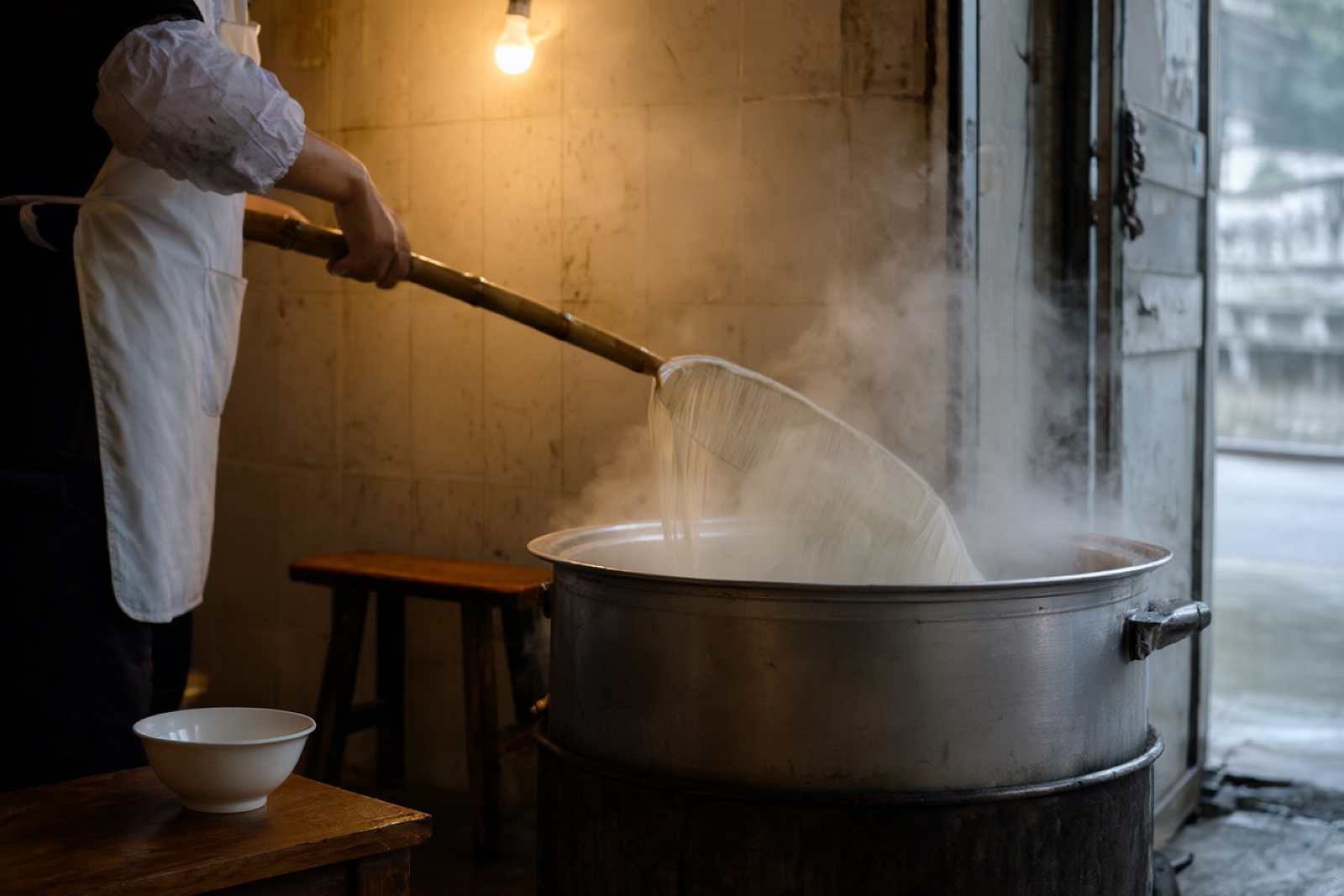
At half past six the street is still the colour of wet slate and the noodle shop is the only thing in it properly awake. There is a pot the size of a small bathtub, a column of steam going up into the cold, and a woman with a bamboo strainer who has already served forty people. What she puts down in front of you is not beautiful. A shallow porcelain bowl, a smear of dark red oil at the bottom, a tangle of pale noodles, a scatter of chopped green onion — and nothing else you would call an ingredient.
You stir it once. The whole bowl turns red. What comes up is chilli that has been fried rather than boiled, and above it the cold, faintly electric brightness of Sichuan pepper. This is 重庆小面 (Chóngqìng xiǎomiàn), and in this city a very large number of people will tell you, without irony, that the day does not properly start without it.
The name, which almost everyone gets wrong
小面 translates as “small noodles”, and the obvious reading — a small portion — misses the point. 小 here marks the bowl as plain. No topping. Nothing ladled over the noodles except the seasonings already sitting in the bottom of the bowl.
That word carries a specific history. Chongqing had no 小面 before the war. In the late Qing and early Republic the meatless bowl was just called 素条 or 素面 — plain noodles — and it was poor food, eaten standing up at a stall by people who had somewhere to be. Then the capital moved here in 1938, the population of the city roughly doubled, and the traders and officials arriving up the river from the lower Yangtze brought with them their own idea of what a bowl of noodles was: 大面, “big noodles”, with a proper 浇头 spooned on top, meat or fish or tripe, and a portion to match. Against that, the local bowl of noodles with nothing on it was small. 小面. The word stuck, and by 1947 there was a shop in this city trading under the name 小面馆 — the first one anyone has a record of.
So the “small” in 小面 is not about how much you get. The portion is, in fact, usually 二两, two liang, about a hundred grams of noodles, and it is sufficient. The smallness is in what is missing — and the entire personality of the dish is that nothing is missing at all.
The bowl is older than the word
The noodles are not. The plain bowl is older than the name by at least eleven centuries.
In the Tang dynasty, 杜甫 (Du Fu) — who spent two years in 夔州, today’s 奉节县 (Fèngjié Xiàn) out on the eastern edge of this municipality — wrote about 槐叶冷淘, noodles made with the juice of sophora leaves, chilled and eaten in summer. Whether or not that is the same bowl we are talking about, the local tradition likes the connection, and it is not absurd: by the Ming dynasty the Three Gorges region was already producing 夔面, a dried wheat noodle traded up and down the river. In 1808, the thirteenth year of the Jiaqing reign, Chongqing got its first named noodle house — 天星楼面馆 — and the trade stepped off the street corner and into a room with a sign on it.
What was still missing was the alkaline noodle. 碱水面 (jiǎn shuǐ miàn) is fresh wheat dough made with an alkaline solution — traditionally 蓬灰, the ash of a desert plant — and the alkali changes the dough at the level of the protein: it stiffens the gluten, keeps the noodles from going soft in hot water, and gives them that faintly yellow cast and a springy, almost rubbery bite that holds up under a heavy dressing. It is the single technical reason a Chongqing bowl tastes the way it does, and everything else in the bowl was built on top of it.
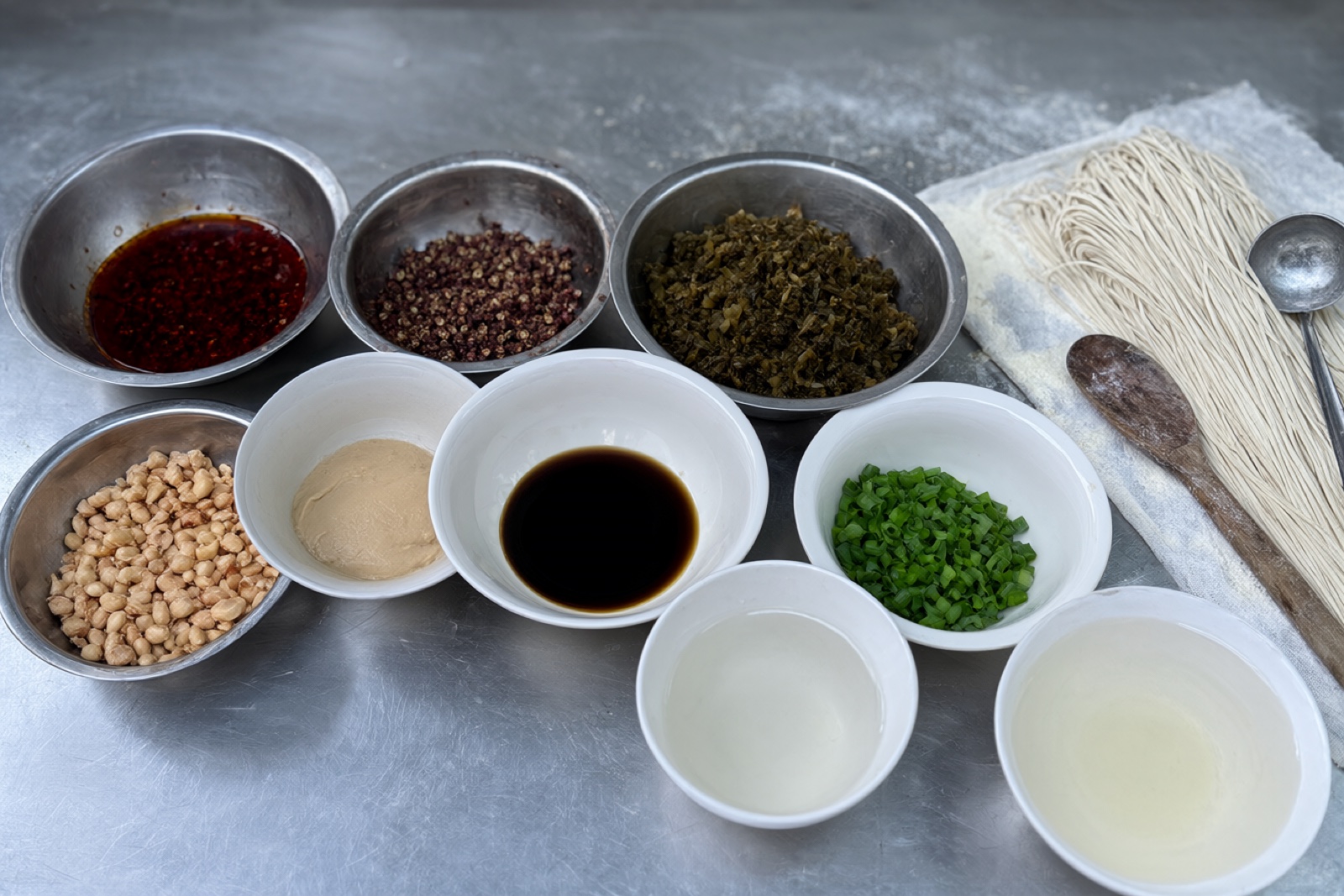
By the time the word 小面 appeared, the full architecture of the dish was already in place, and it has barely moved since. The city’s own authorities finally wrote it down in 2022, in a local standard for shop operation, and the official definition is worth reading simply because it is so long: fresh noodles of flour, food-grade alkali and water; seasonal green vegetables; boiled hard in a large flame; dressed with soy sauce, MSG, lard, chopped preserved mustard tuber, ginger water, garlic water, crushed roasted peanuts, chilli oil (or not), ground Sichuan pepper (or not) — a dozen or more seasonings — with or without a topping; characteristic of 麻辣鲜香, numbing, hot, fresh and fragrant, or clean and mellow. A definition that has to say “or not” twice in one sentence is a definition written by people who know their customers.
Twelve things in the bottom of a bowl
调味 is the whole craft and it happens before the noodles. A cook builds the bowl in a fixed order — 先液后油再撒料, liquids first, then the oil, then the dry things scattered last — and the sequence is not decoration. The liquids (soy sauce, vinegar, ginger water, garlic water) have to be underneath, because the hot oil has to land on them and bloom.
油辣子 (yóu làzi), chilli oil, is the soul of the bowl. The city takes it seriously enough to have legislated it. Under the 2016 《重庆小面烹饪技术指南》, the first technical guide the municipal commerce commission issued, the chillies must be bright-skinned and thick-fleshed, toasted in a dry iron pan, cooled, pounded, and then hit with vegetable oil heated to between 160°C and 190°C — with the chilli to oil ratio fixed at 1 to 2.5–3.0. Get the oil too hot and the chilli scorches and goes bitter. Too cool and you have made a red paste with no fragrance in it. The whole difference between a good bowl and an inedible one happens in about fifteen seconds of pouring.
The chilli itself is usually 石柱红 (Shízhù hóng), from 石柱土家族自治县 in the southeast of the municipality — high in capsanthin, so it colours the oil a deep, almost lacquered red, and hot without being brutal. The numbness comes from 花椒 (huājiāo), and the best of that comes from 江津 (Jiāngjīn), on the upper Yangtze, where the pepper is prized for a floral, lasting tingle rather than a flat bite. 芽菜 or 榨菜 gives the salt and the crunch. Lard gives the body — a proper 小面 is greasy in a way that a modern kitchen would find faintly shocking, and it is right. Ground roasted peanuts and a little sesame paste for depth. Ginger water and garlic water because raw ginger and raw garlic would be too aggressive. Chopped green onion, 0.3 to 0.5 centimetres according to the same 2016 guide, which is a measurement no cook in this city has ever taken but which tells you how seriously the standards body was taking its afternoon.
And then the timing. The guide recommends eating your noodles at between 65°C and 75°C, and within two minutes of them leaving the water. Two minutes. In practice this is not a recommendation so much as a description of what happens anyway: the bowl is dressed for exactly as long as it takes the noodles to cook, and then it waits for nobody. A 小面 that sits is a 小面 that has swollen and gone slack and lost the point.
The code you recite at the counter
Ordering is a small oral exam, and getting it right is the difference between the bowl someone designed and a bowl that merely tastes like noodles. Nobody says “plain, please”. They say this:
- 二两 (èr liǎng) — two liang, roughly a hundred grams. 三两 if you are very hungry, 一两 if you are not.
- 提黄 (tí huáng) — “lift the yellow”. Pull the noodles out of the water while the centre of the strand is still yellow, i.e. a good deal firmer than al dente. Regulars ask for this because the dressing is heavy and a softer noodle collapses under it.
- 干溜 (gān liū) — dry, tossed. Almost no broth, so the seasonings cling directly to the noodle instead of diluting into soup. The most intense version of the bowl, and for a first 小面, the one I would order.
- 加青 (jiā qīng) — extra greens. The bowl normally comes with a small handful of whatever leaf the season offers, blanched in the same water; this asks for more of it, which cuts the oil.
- 免青 (miǎn qīng) — hold the greens entirely. There are people who will not have anything in the bowl that was not seasoning.
- 重辣 / 少辣 (zhòng là / shǎo là) — more oil, or less. And 少麻 (shǎo má) for less of the pepper tingle.
- 加个蛋 (jiā gè dàn) — add a fried egg. Not standard, not frowned upon.
You can also ask for a topping and stop calling it a 小面 strictly. 豌杂面 is pea-and-minced-pork, 牛肉面 is beef, 肥肠面 is pork intestine, 杂酱面 is the meat sauce alone. The city treats all of them as 小面 in the loose sense — the same bowl, the same dressing, plus something — and the purists at the counter will tell you the only true test of a shop is the plain one.
What the Locals Know
- The honest measure of a shop is its 素小面. Anyone can hide a mediocre dressing under braised beef. Order it plain, 干溜, the first time.
- Breakfast, not lunch. The pot is best between about 7 and 9 in the morning, when the chilli oil is fresh, the greens have not been sitting, and there is a queue of people in work clothes who will push past you if you dawdle.
- Watch the bowl being built, not the noodles being boiled. The noodles are the same in every shop. The dressing is the only variable that matters, and it happens in front of you.
- A good shop is unlovely. Tiles, a steel counter, low stools, a roll of paper on a spike. Renovation is not a signal of quality here, and often the reverse.
- Two minutes. If the bowl reaches you and you talk for five minutes first, you have wasted the only thing that was ever going to be perfect.
- Numbness is the point, not the heat. If you only taste chilli, you have been given a bowl built for people who do not know better.
Where the bowl is best kept
The reference shop — the one I send people to, and the one that has been doing this longer than most of the city’s restaurants have existed — is 花市豌杂面 (Huāshì Wānzá Miàn) in 渝中区 (Yúzhōng Qū), the old peninsula between the two rivers, a few minutes’ walk from the 解放碑 monument in the middle of the commercial district. It takes its name from the flower market it opened beside — 鲁祖庙花市 (Lǔzǔmiào Huāshì) — and the shop has been trading for more than twenty-five years, which in a city that rebuilds itself every decade is roughly geological.
It is a 豌杂面 shop, not a plain-noodle shop, and you should know what that means before you go. The 豌豆 (wāndòu) are yellow peas stewed until they lose their shape and go sandy, collapsing into the dressing as you stir. The 杂酱 (zájiàng) is minced pork fried until the fat renders and the meat goes dark and grainy, with actual grains of meat still in it rather than the smooth paste other cities call the same thing. Put the two together and you have a bowl that is the plain 小面 with a great deal more weight behind it, and the shop will happily 干溜 it for you, which is how it should be eaten. The dressing underneath is the standard dozen — lard, chilli oil, soy, vinegar, spring onion, ginger and garlic water, sesame, ground Sichuan pepper — and the whole thing is assembled in front of you at a pace that suggests the cook has done it a hundred thousand times, because he has.
Expect to pay around ¥15 to ¥20 a person, which is more than a plain bowl of noodles costs elsewhere in the city and considerably less than a bowl of anything else in the neighbourhood. There are several branches in the district now, and the hours drift between them — roughly 7:00 in the morning until somewhere between 8:00 and 9:00 at night. The original seat is the one at 青年路 77号 (Qīngnián Lù 77), opposite the office tower of the Marriott, with others on 民生路 (Mínshēng Lù), one of them a short walk from exit 3 of 临江门 (Línjiāngmén) metro station on line 2. It gets crowded, it is not comfortable, and it is not meant to be.
What it became
For most of the twentieth century this was a local secret, and a cheap one. Then the city started counting. In 2016 the technique was entered on Chongqing’s municipal intangible cultural heritage list; in 2020 the name 重庆小面 was registered as a geographical indication; in 2021 大渡口区 (Dàdùkǒu Qū) was approved as the site of a municipal 小面 industrial park, which has since brought together more than sixty companies and upwards of forty brands; in 2023 the first food production licence specifically for 重庆小面 was issued, which made it, formally, a food category of its own. In February 2026 the industry held its third annual brand conference and used the occasion to publish a standard for chilli heat — because of course it did.
The scale is genuinely hard to take in. By 2024 the city counted more than 84,000 小面 shops selling something in the region of thirteen million bowls a day, and the whole chain — growing, milling, packing, shipping, exporting — is now measured in the tens of billions of yuan a year and is aimed, by 2027, at five hundred billion. The bowl has gone abroad too: instant 小面 ships to more than thirty countries, a milder version sells by the tens of thousands of units a month in Southeast Asia, and a television documentary about it has been watched on Netflix several million times. There is a 小面 museum in the city. There is a 小面 festival, most recently in Paris and Tokyo.
None of which changes the thing itself, which is still twelve seasonings in the bottom of a cheap bowl, assembled in ninety seconds, eaten standing up by seven o’clock. The industry grew around it. The bowl did not grow.
The word
小面 is a small, ordinary word that turned out to hold a great deal. It began as a shrug — the plain one, the cheap one, the one without anything on it — and it has ended up being the name of the city’s breakfast, its most exported product, and the one bowl a Chongqing person will argue about with a stranger on a bus. 麻 (má) and 辣 (là), numbing and hot, are the two halves of the local character as people here describe themselves: not one without the other, and not a great deal of patience for anyone who wants them toned down. Order it 提黄, 干溜, and eat it in two minutes. That is the whole instruction.
flowcloud would say that the first bowl is confusing and the third is a habit, and that somewhere between the two you stop noticing the chilli and start noticing the pepper, and the city has you. It is a breakfast, not a meal, and it is gone in five minutes, and you will think about it all morning.
Where to find it: 花市豌杂面 (Huāshì Wānzá Miàn) — 渝中区青年路77号 (No. 77 Qingnian Road, Yuzhong District, Chongqing), opposite the Marriott office tower in the Jiefangbei district, with further branches on 民生路 (Minsheng Road), including one about 280 m from exit 3 of 临江门 (Linjiangmen) station on metro line 2. Open roughly 7:00–20:00 at the original shop and to 21:00 at 民生路; around ¥15–20 per person. Metro line 2 to 临江门 (Linjiangmen) or 较场口 (Jiaochangkou). Order the 豌杂面 干溜 — dry, tossed — and if it is your first, ask for 提黄 as well. Branch addresses and opening hours shift; check before you set out.