
Morning comes to 磁器口 Cíqìkòu Ciqikou as it has for a thousand years: steam off the bamboo steamers, wet flagstones under the fig trees, the Jialing flashing below. Chongqing is a municipality of southwest China, and 沙坪坝区 Shāpíngbà Qū Shapingba is one of its districts, the west-bank quarter of the city’s core – and this page eats at the district’s oldest table, the porcelain-port town on the river, on the town’s own all-day clock: market mornings, midday queues, back-lane afternoons. The whole snack ecology is the menu; the famous blood-curd pot keeps a page of its own.
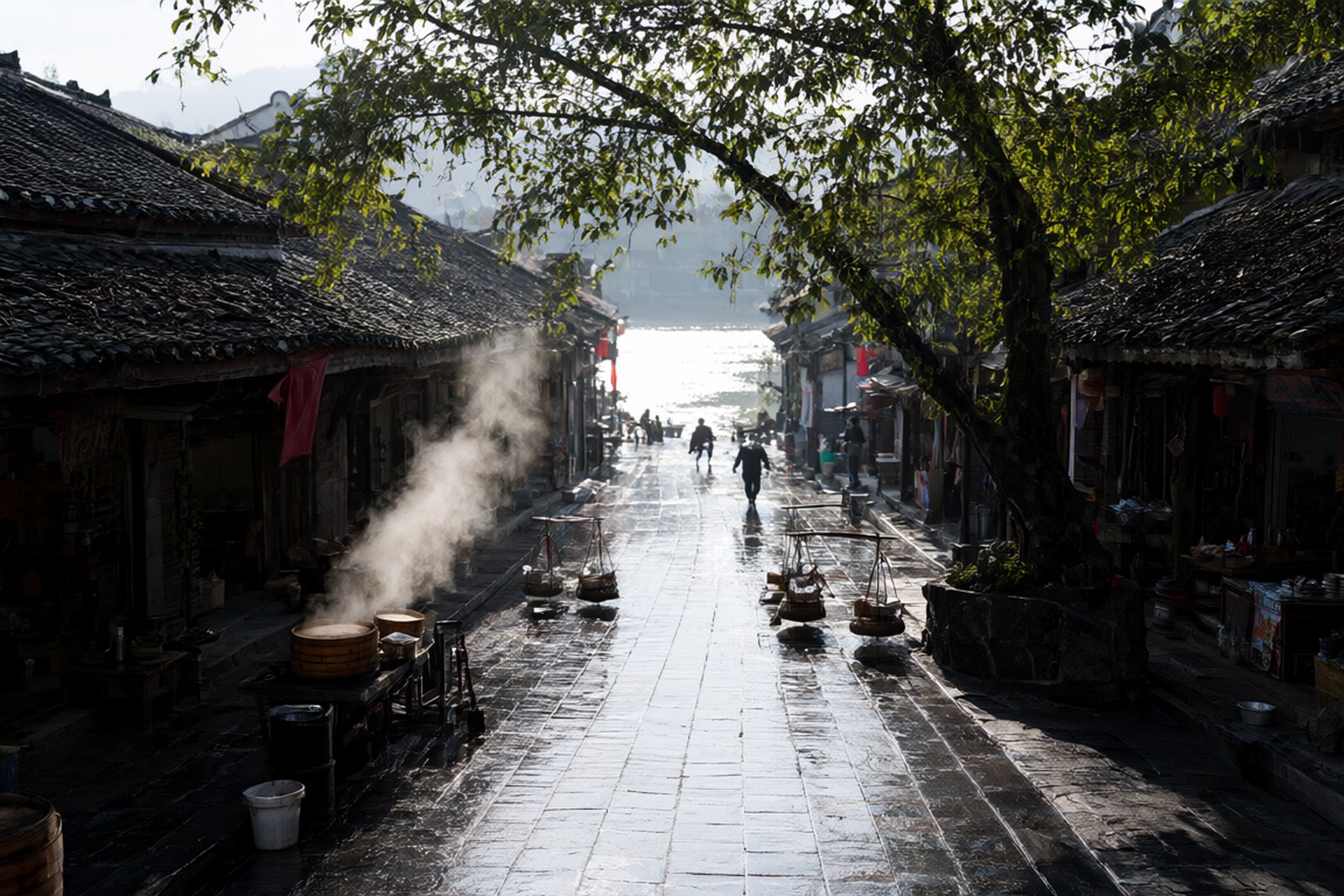
The founding is official record: the district histories place the town’s beginning in the Xianping years of the Song dynasty – 998 to 1003 – under its earliest name, 白岩场 Báiyánchǎng Baiyan Chang. The name is a trade’s story: the story goes that in the Kangxi years of the Qing, settlers from Fujian surnamed 江 Jiāng Jiang fired blue-and-white porcelain at kilns on the slopes and shipped it from this wharf, and the port took the name 磁器口 – the porcelain port. The wharf coined its own boast, 白日里千人拱手,入夜后万盏明灯 – by day a thousand hands salute you, by night ten thousand lamps are lit. The classic geography runs 一江两溪三山四街 yī jiāng liǎng xī sān shān sì jiē, one river, two creeks, three hills, four streets; the fabric is catalogued too – Baolun Temple standing since the Song Zhiping years, nine lanes and some 670 traditional buildings, by the archive chronicle’s 2025 accounting.
The legend floor sits above the record floor, and this page keeps them apart. The story goes that the fugitive Ming Jianwen emperor hid at Baolun Temple, and the town traded its name for a while to 龙隐镇 Lóngyǐn zhèn Longyin – the story is the story, the temple’s Song founding is the record. What matters for a food page is what the years never interrupted: the market ran through every century. The recent works extended the town rather than raised it: in 2024 the scenic area counted 18.435 million visits, by the city press’s 2025 accounting, and the protected quarter grew nineteen-fold when the blocks around it joined in. The back-lane programme turned nearly 30,000 square metres of rear lanes to new use and settled 39 composite tenants; the street office’s own 2025 annual report adds a “360 Bowls” dining cluster of ten certified kitchens and 42 local brands, with new commercial floors due on Golden Bi main street by mid-2026 – street-level single-source figures of their own year, checked October 2026. Expansion, then; “revival” is another street’s word, and this page declines it.
The pantry is the wharf’s bequest: a port that shipped salt, porcelain and spice kept the provisions trade on its stone lanes, and the snack canon grew out of what the boats carried. The district chronicles name the “three old treasures” – 老三宝 lǎo sān bǎo: the blood-curd pot whose genealogy keeps its own page, 软烩千张 ruǎn wò qiānzhāng soft-braised tofu sheets, and 椒盐花生 jiāoyán huāshēng salt-and-pepper peanuts – and the river ballad crowns the peanut: for salt-and-pepper peanuts, Ciqikou leads the line. The tofu sheets are the craft showpiece – nine stages and twenty-eight hand operations, layers thin enough to read light through; the heritage files trace the lineage to a maker born in 1891, 李开心 Lǐ Kāixīn Li Kaixin, and the craft entered the district intangible-heritage list in 2012. The peanuts are slower: small fat nuts simmered through spice broth, dried, then finished over a low kiln fire. And the twists: the Chen family’s fried dough twist is the stand the main street queues for – by the city paper’s 2024 profile the family worked a shoulder pole from 1998; the hand craft runs eighteen stages, holds a Chongqing time-honoured-brand listing since 2011 and a municipal intangible-heritage entry since 2016, and the family’s older chronicle is told in irreconcilable versions this page leaves alone.
Words and Names
磁器口 Cíqìkòu is Ciqikou, “the porcelain port”, the wharf town on the Jialing founded in the Song Xianping years; 白岩场 Báiyánchǎng Baiyan Chang, its earliest name; 龙隐镇 Lóngyǐn zhèn “the town where the dragon hid”, its name in the fugitive-emperor legend; 宝轮寺 Bǎolún Sì Baolun Temple, standing since the Song Zhiping era. 老三宝 lǎo sān bǎo the “three old treasures”: the blood-curd pot, soft-braised tofu sheets, salt-and-pepper peanuts. 千张 qiānzhāng tofu sheets pressed a layer at a time. 椒盐花生 jiāoyán huāshēng salt-and-pepper peanuts, spice-broth simmered and kiln-dried. 陈麻花 Chén máhuā the Chen family fried dough twist, a Chongqing time-honoured brand (2011). 古镇十二巷 gǔzhèn shí’èr xiàng the “twelve lanes” extending the town’s scenes; 后巷 hòuxiàng the back lanes, their newest chapter.
What the Locals Know
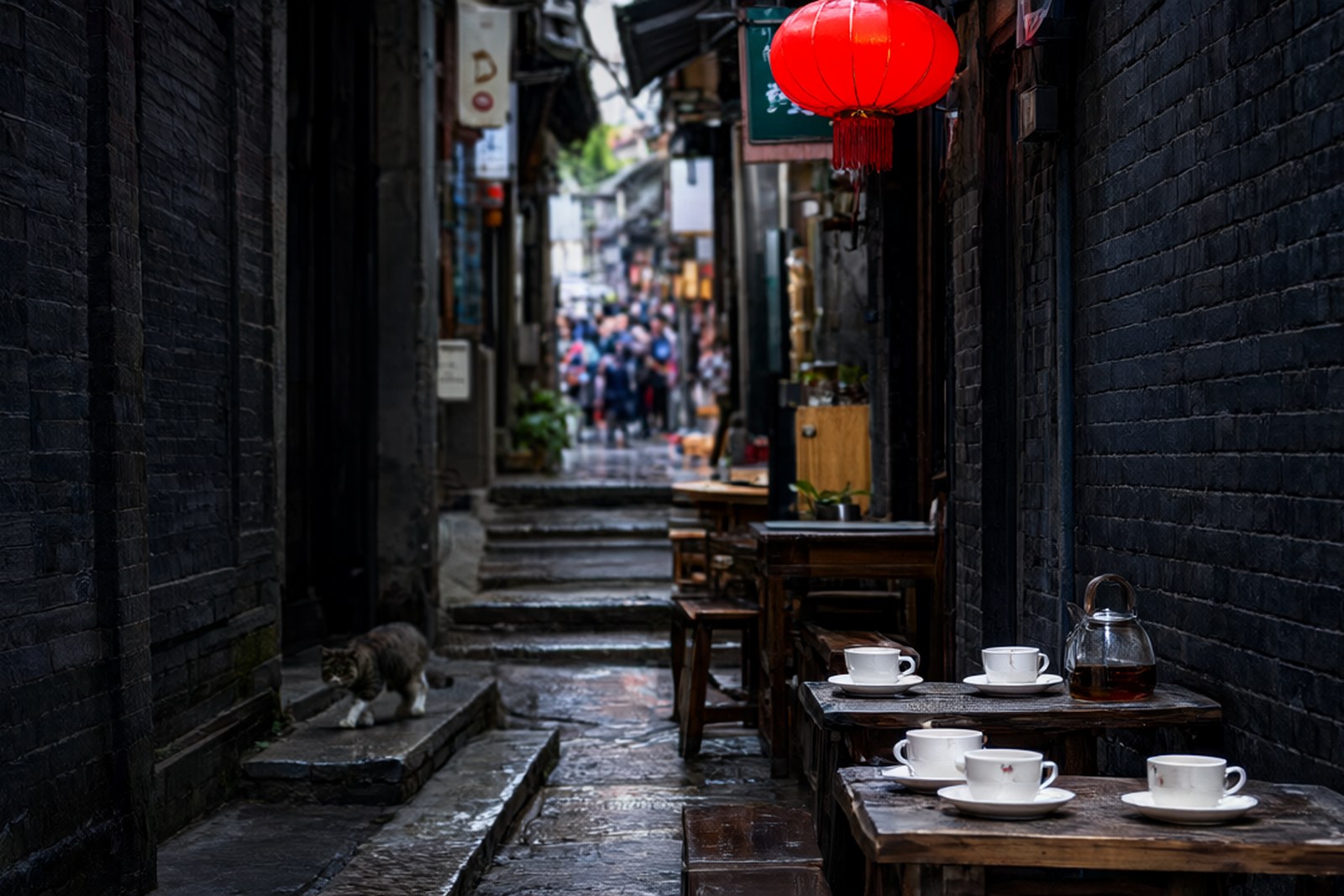
The route old Shapingba hands walk with guests has a private logic: the main street first, for the noise and the lanterns, then a turn into the back lanes for a table – the main street is for the camera, the lanes are for the mouth. Buying tofu sheets has a test: one sheet held to the light – even light means the day’s fresh pressing. Peanuts are bought warm off the kiln and carried to the river, where the last fraction of moisture softens them half a step – the locals’ measure of the right firing. The queues at the twist stand are mostly visitors; residents carry home loose strange-flavour broad beans and a paper sack of peanuts for the tea table.
flowcloud would say that Ciqikou is the town that never closed – founded in the Song Xianping years the official divisions place at 998-1003, renamed for the porcelain its wharf shipped, running its stone-lane market a millennium on: 18.435 million visits counted in 2024, the quarter grown nineteen-fold, and the pantry – tofu sheets of twenty-eight hand steps, the ballad-crowned peanuts, the queuing fried dough twists – still trading as the wharf taught.
Where to find it: 磁器口古镇 Cíqìkòu Gǔzhèn Ciqikou Old Town, main entrance at 磁南街 Cínán Jiē Cinan Street 1, 磁器口街道 Cíqìkòu Jiēdào Ciqikou subdistrict, 沙坪坝区 Shāpíngbà Qū Shapingba District, Chongqing Municipality; metro line 1 to Ciqikou station. The town is free to enter and runs all day; the back lanes adjoin the main street with no separate ticket. A sightseeing ferry links the town wharf downriver to the Hongyadong bank – named here once, as geography. No single shop is recommended: the treasures are categories of the town, not storefronts, and the named twist stand is commercial history. Prices run at street-food scale and none are quoted; the figures above come from 2024-2026 public reporting, checked October 2026, and drift with the seasons.