
Claypot Rice
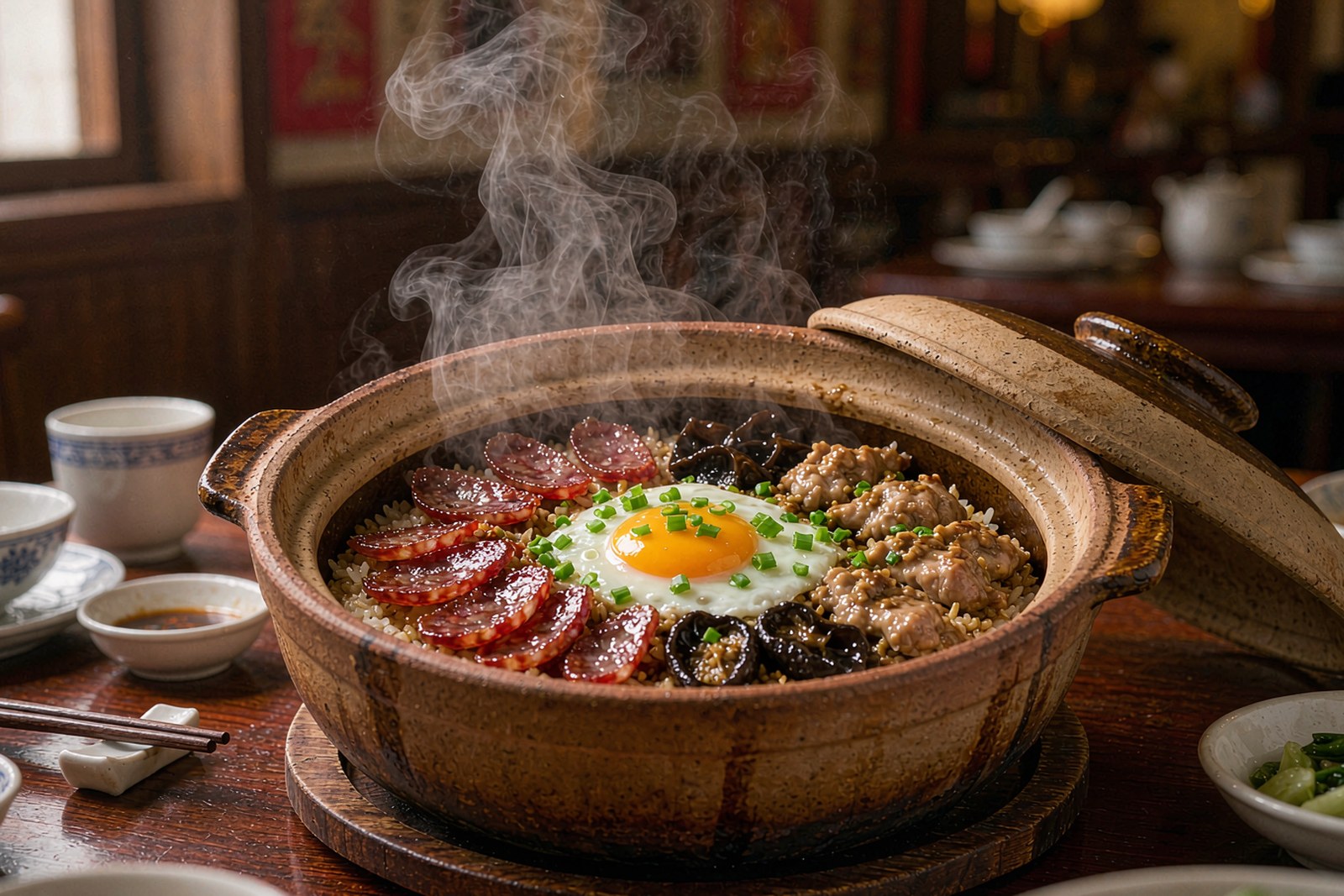
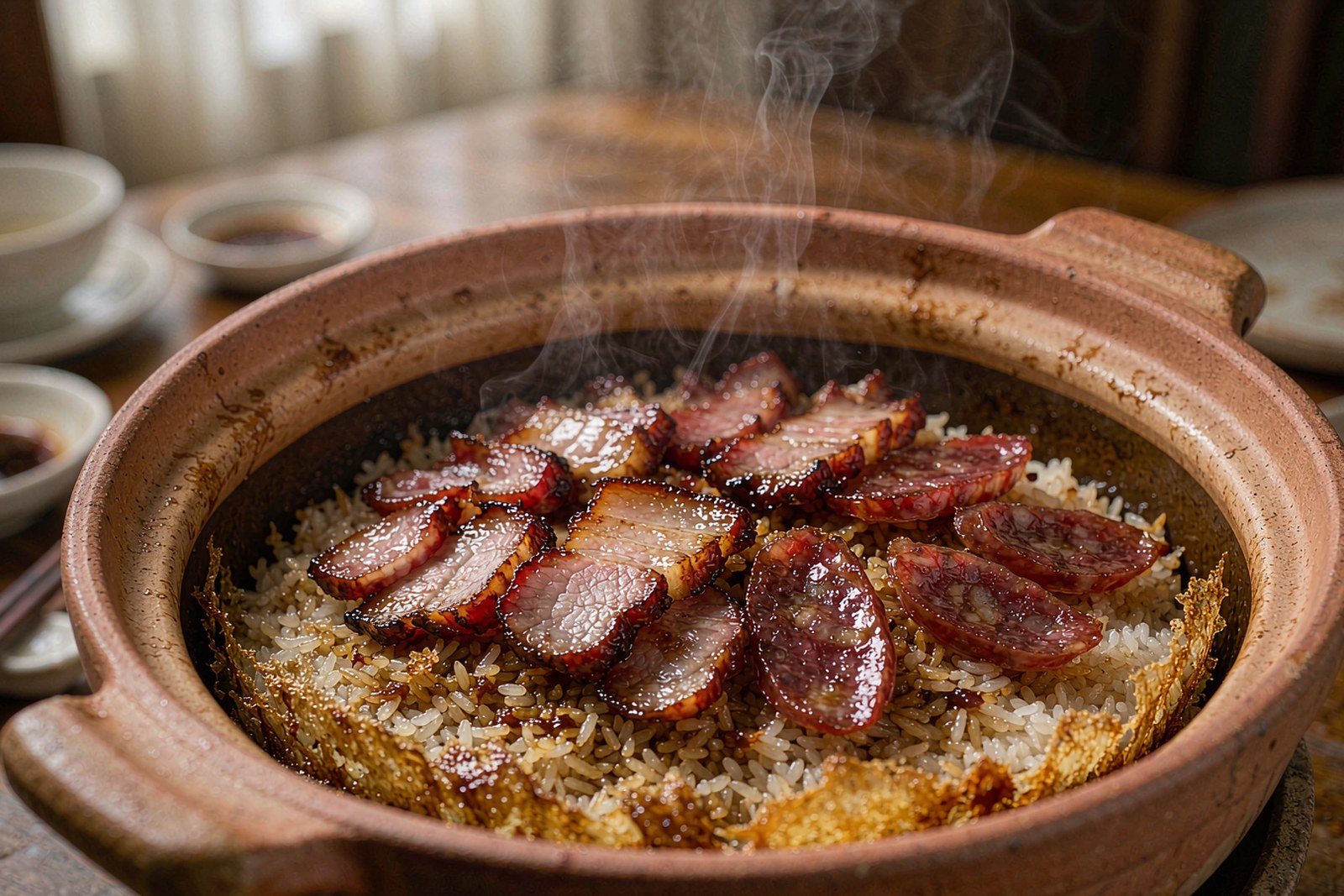
The pot came to the table hissing, a little chimney of steam off the lid, and the smell of scorched rice and cured meat poured out when I lifted it. Underneath the 腊肠 làcháng sausage and 滑鸡 wáh gāi silky chicken was a layer of rice with a crust the color of toast. I scraped it up with the spoon and it cracked like brittle, nutty and smoky. This is 煲仔饭 bāozǐfàn, the winter dish of Guangdong.
煲仔饭 bāozǐfàn means “small-pot rice,” from 煲 bāo a clay pot and 仔 zǎi “small child,” a term of endearment for the little vessel. The dish comes from the rural hearths of Guangdong, where farmers cooked rice and toppings together over a wood fire, and it became a city comfort in the 20th century. It matters here because the clay pot does what a rice cooker cannot: it chars the bottom into 饭焦 fànjiāo, the prized crust, and steeps the meat’s fat straight into the grains. The pot is the point.
The Craft
The cook rinses 丝苗米 sīmiáomǐ (a slender Guangdong rice) and puts it in the soaked clay pot with measured water, setting it over a fierce flame. As the rice nears done, the topping goes on: 腊味 làwèi cured meats, 滑鸡 wáh gāi marinated chicken, 排骨 páigǔ ribs, or 黄鳝 huángshàn eel. A lid goes on and the fire is dropped so the toppings steam while the bottom catches.
Just before serving, the cook drizzles 豉油 chǐyóu soy and a little 油 yóu oil down the inside edge, then sometimes cracks an 鸡蛋 jīdàn egg on top to set in the residual heat. The finished pot is brought still singing, and the diner stirs the topping, egg, and sauce through the rice, scraping the 饭焦 fànjiāo loose from the wall. A good pot leaves a full, unbroken crust you can lift in one sheet.
How to Eat It
Eat it straight from the pot while it sings, mixing the sauce in thoroughly. The 饭焦 fànjiāo at the bottom is the reward, so do not leave it. Order by topping: 腊味 làwèi (cured meats) is the classic, 滑鸡 wáh gāi the tender choice, 窝蛋 wō dàn (egg) the indulgent one. In Guangdong the dish is a cooler-weather ritual, and the best pots are fired over gas or charcoal one at a time, never rushed in a stack.
Words and Names
煲仔饭 is 煲 bāo “clay pot,” 仔 zǎi “small,” and 饭 fàn “rice,” spoken bou1 zai2 faan6. The same 煲 bāo appears in 砂煲 shābāo and any slow pot dish. The crust has its own name, 饭焦 fànjiāo (“rice burnt”) or 锅巴 guōbā in Mandarin, and Cantonese diners prize it so much shops compete on it. A 窝蛋 wō dàn topping means a raw egg nestled (“nested egg”) into the hot rice.
What the Locals Know
Listen for the sizzle a silent pot was pulled off too early, the crust never formed.
Scrape the 饭焦 fànjiāo the toasted bottom layer is the best part, do not waste it.
Mix the sauce in soy down the edge, then stir, do not pour it on top.
Order 腊味 làwèi in winter cured meats are the seasonal, classic topping.
Eat from the pot the clay keeps it hot; transfer to a bowl and it dies.
flowcloud would say that the best part of any meal is the part everyone else leaves behind.
Where to find it: Claypot rice, 煲仔饭 bāozǐfàn, is a Guangdong cold-weather favorite found at dedicated 煲仔饭 bāozǐfàn shops across Guangzhou and 佛山 Fóshān, especially in 荔湾 Lìwān and 越秀 Yuèxiù. Order 腊味煲仔饭 làwèi bāozǐfàn (cured-meat pot) or 滑鸡煲仔饭 wáh gāi bāozǐfàn (chicken pot), with 窝蛋 wō dàn egg if you like; a single pot runs roughly 28 to 55 yuan, eaten with the lid on until the last minute so the 饭焦 fànjiāo forms.