
Coconut Sticky Rice
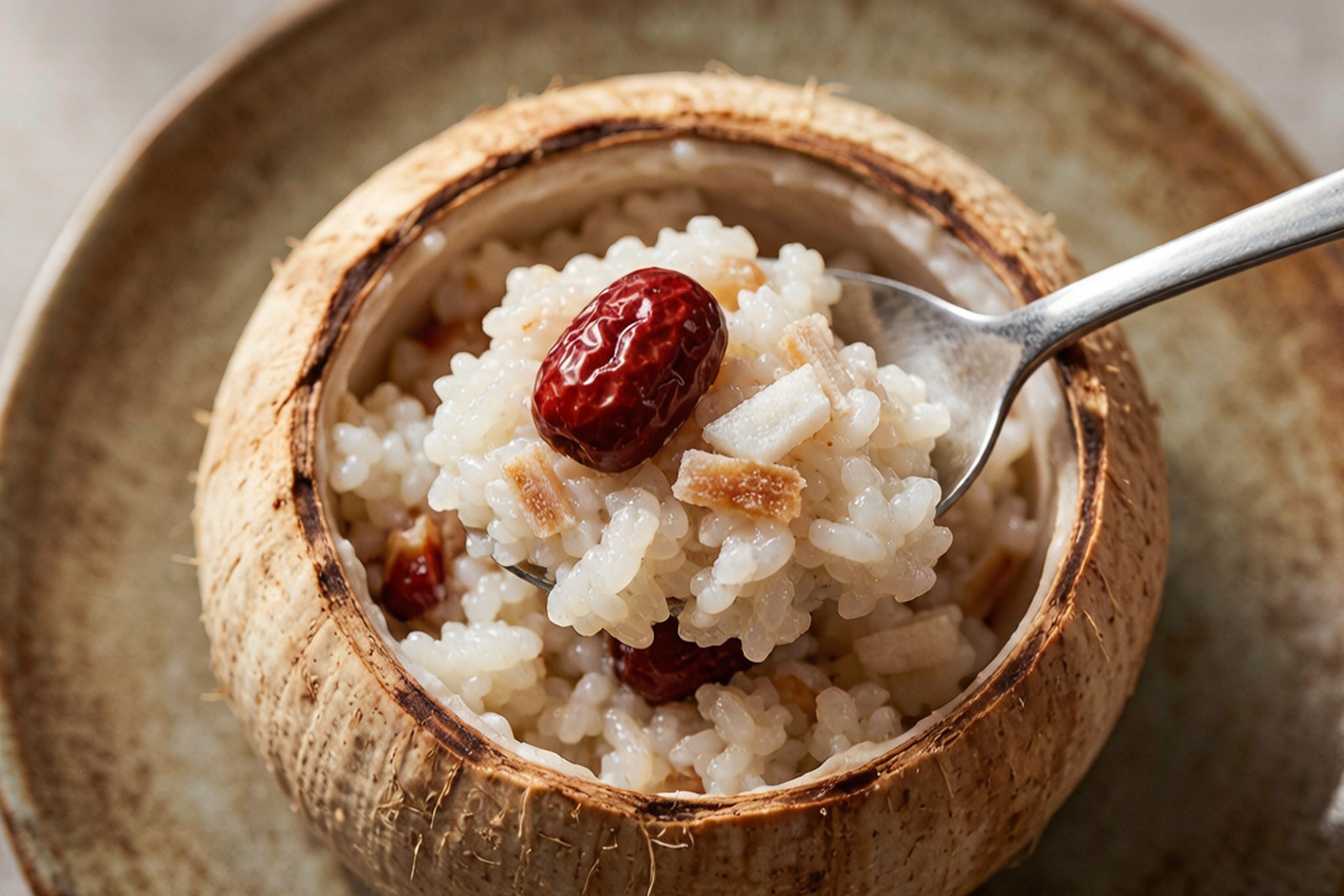
The woman at the stall handed me a coconut the size of my two fists, still warm, its top sawn off in a neat circle. I dug the spoon in and the rice came up creamy, faintly pink from red dates, studded with pale curls of coconut flesh. The first bite tasted of three things at once: the nutty sweetness of the shell it had been steamed inside, the chew of glutinous rice, and a soft briny tang underneath from the pinch of salt nobody tells you about. It was dessert and dinner in the same mouthful, and I ate it standing up on a Haikou side street while a scooter horn blared behind me.
This is 椰子饭 yēzi fàn, “coconut rice,” and in Hainan it is not a novelty — it is the old food of the island’s coconut belt, the strip of coast from Wenchang down through Qionghai where every household has a tree in the yard and a machete by the door.
The Craft
The technique depends on choosing the right coconut. You want a young 椰子 yēzi whose shell is still soft enough to saw and whose flesh is a thin, translucent layer rather than the hard white rubber of a mature one. The top is cut off with a saw or a heavy cleaver, and the water inside is poured out and reserved — it becomes part of the steaming liquid, which is why the dish tastes so roundly of coconut instead of merely of coconut milk.
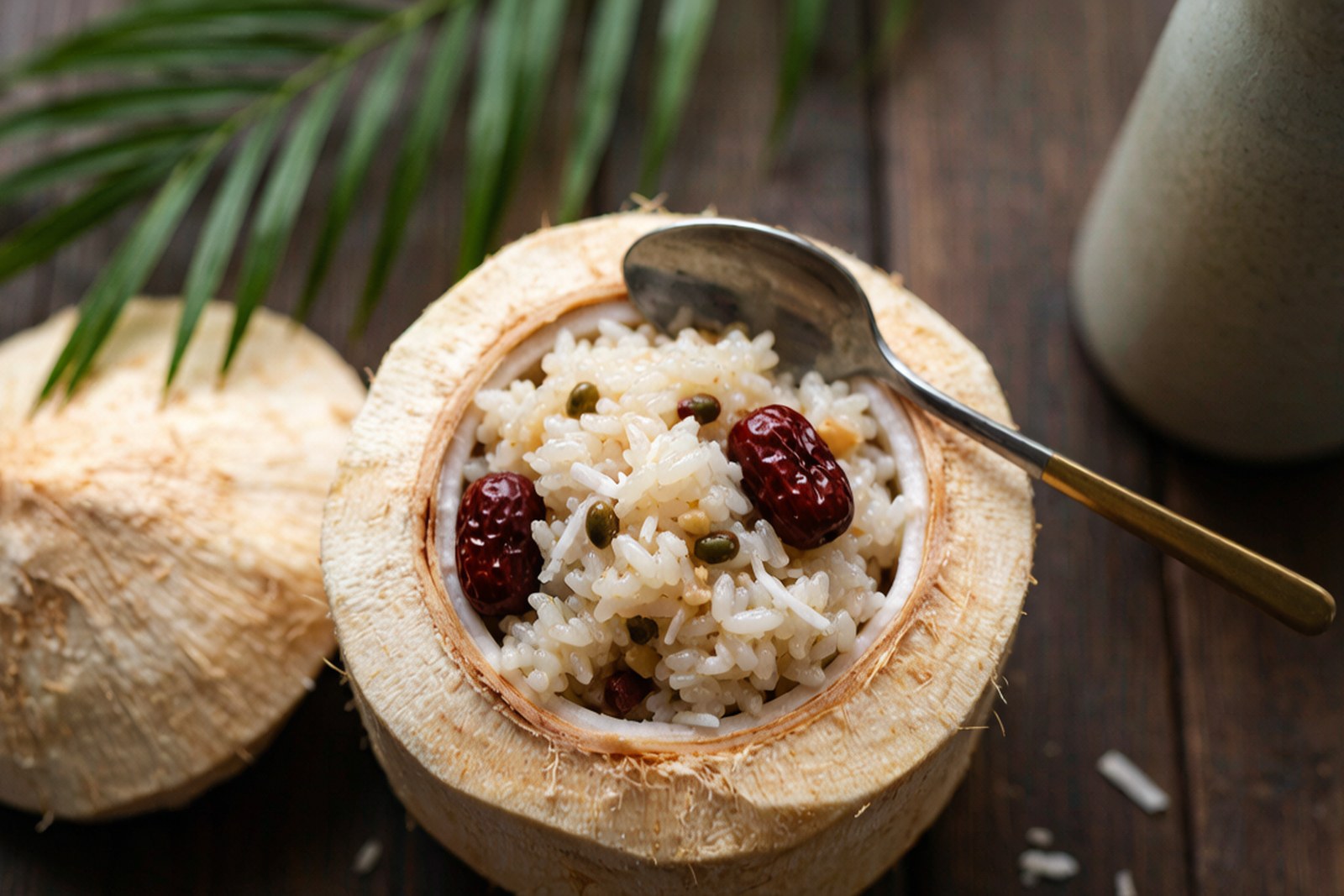
The glutinous rice, 糯米 nuòmǐ, is soaked for several hours, then mixed with sugar, a pinch of salt, red dates, and often a spoon of the young coconut flesh scraped out and sliced thin. The mixture is packed loosely into the shell, the reserved coconut water and a little thick coconut milk are poured over, and the whole thing is steamed for an hour or more. Cooking inside the shell is the entire point: the shell holds the steam in, the flesh gives up its fat into the rice, and the rice takes on a faintly smoky, green-sweet note you cannot get from a pot.
Some vendors go further and finish the stuffed coconut directly over charcoal until the outside blackens, which pushes the shell flavour right through the grain.
What It Is Not
This is not the Thai mango sticky rice you may be picturing, and it is not 八宝饭 bābǎofàn, the Chinese banquet rice pudding. Coconut sticky rice is plainer, less sugared, and eaten warm rather than cold. It refuses to be a restaurant dish — the shell is fragile, it does not travel, and it must be eaten the day it is steamed.
Words and Names
椰子 yēzi is the coconut, 饭 fàn the rice — but 饭 in Hainan often means “meal,” not just rice, so 椰子饭 literally names a whole meal cooked in a coconut. Older cooks call the palm 椰树 yē shù, and in Hainanese dialect the dish is spoken of with a word that sounds closer to ya-ji, the coconut palm itself.
What the Locals Know
Buy it warm. A coconut rice that has been sitting cold in a cabinet has already lost the shell aroma — ask for one from the steamer.
Eat the shell flesh. After the rice is gone, scrape the inside of the shell; that soft layer has absorbed the rice fat and is, by local consensus, the best part.
Ask for 少糖 shǎo táng (less sugar) if you want the coconut to lead; many stalls load it for tourists.
It is a breakfast food. In Wenchang and Qionghai it is sold from early morning, not as dessert.
One is enough for two. A single coconut holds a full bowl of dense glutinous rice; order one and share.
flowcloud would say that the best containers are the ones you eat afterwards.
Where to find it: Coconut sticky rice, 椰子饭 yēzi fàn, belongs to the coconut belt of eastern Hainan — Wenchang 文昌 and Qionghai 琼海 above all, plus the breakfast lanes of Haikou 海口. Look for stalls with a stack of freshly sawn coconuts and a steamer lid clouded with coconut steam; a whole coconut runs about 15 to 30 yuan and feeds two. In 文昌 Wénchāng ask for it alongside 文昌鸡 Wénchāng jī for a proper local meal, and in Haikou’s 骑楼 Qílóu old street district you will find it sold from carts in the early morning.
We are still eating our way through Coconut Sticky Rice. Guides are on the way.