
Cut one open and it bleeds orange. That is the first thing to know about 枞菌 cóngjùn, and it is also the thing that most reliably convinces a nervous visitor to eat it, because a mushroom that announces itself in carrot-coloured sap feels like a mushroom that has nothing to hide. Fried in a wok with 腊肉 lāròu, cured pork, a handful of green chillies and nothing else worth mentioning, it comes to the table firm, faintly resinous and unmistakably piney — a flavour that has no relation to the pale buttons you buy in a supermarket and that people in 湘西 Xiāngxī will tell you, correctly, cannot be bought anywhere else at any price.
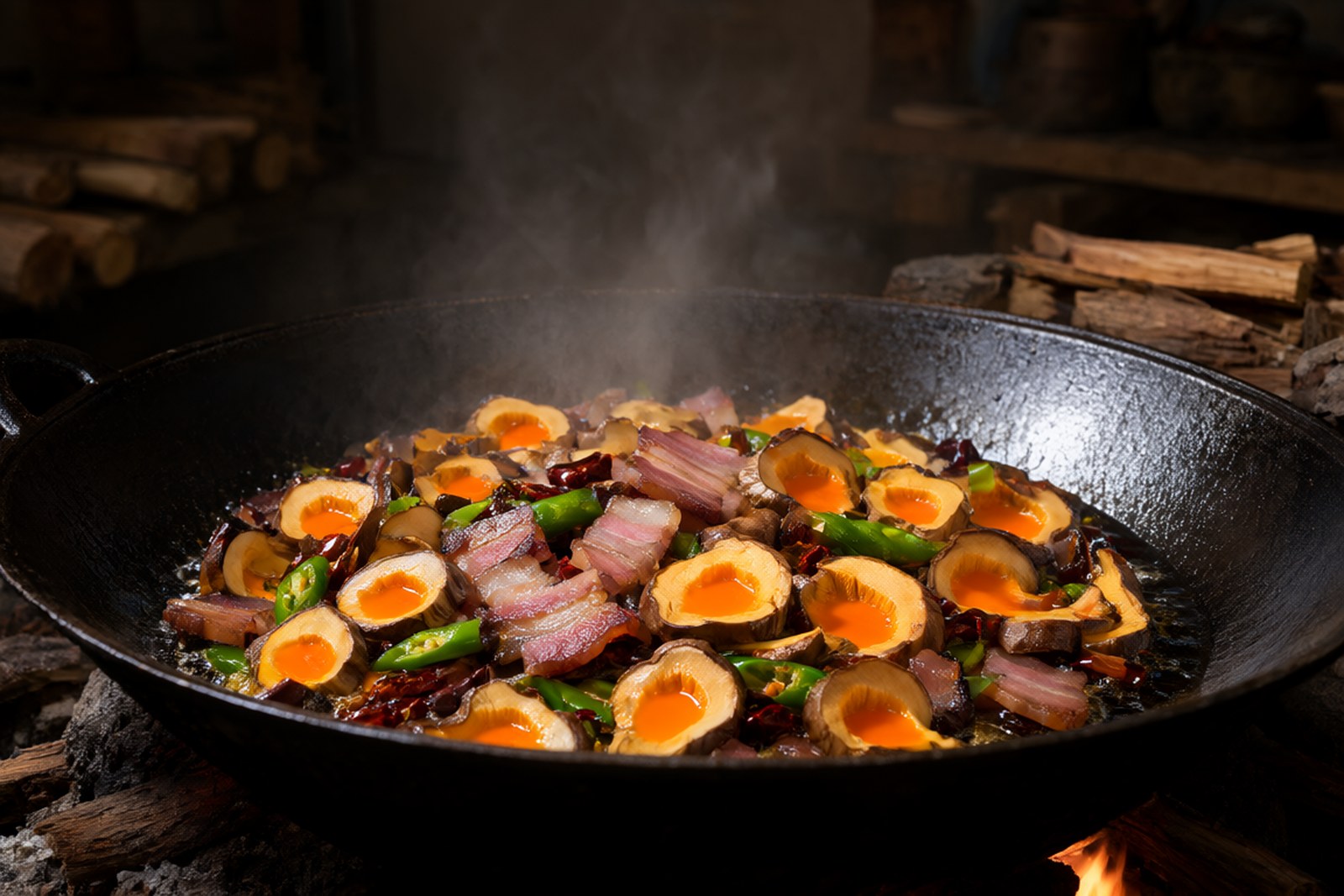
I ate the first plate of it at a roadside kitchen on the road up to 矮寨 Ǎizhài, in 吉首 Jíshǒu, 湘西土家族苗族自治州 Xiāngxī Tǔjiāzú Miáozú Zìzhìzhōu, in the company of a man who had picked the mushrooms himself that morning and who was deeply uninterested in my questions because he was busy eating. It was late September. In western Hunan, that is the correct month, and the correct month matters.
Two Seasons, One Mushroom
枞菌 cóngjùn is the local name for a milk cap — a 乳菇 rǔgū in the standard terminology, in English usually called the saffron milk cap — which grows in a partnership with pine trees. That partnership is the reason the mushroom cannot be farmed. The fungus lives threaded through the fine roots of the pines and gets its sugars from the tree; the tree gets minerals and water from the fungus. Take the mushroom out of the pine wood and it will not grow, not in a greenhouse, not in a shed, not with any amount of the most modern equipment. Every 枞菌 anybody has ever eaten was picked wild by somebody with a basket.
Which explains the season, and the price, and the slightly conspiratorial mood that comes over a town when the season opens. The mushroom fruits twice a year. The spring flush, 三月菌 sānyuè jùn, comes with the first warm rain in March and is brief. The autumn flush, 重阳菌 chóngyáng jùn, comes around the 重阳 Chóngyáng festival in the ninth lunar month — late September to October — and is the one people mean when they talk about the mushroom without qualifying it. A good year is a year with the right amount of rain. A bad year is a year with none, and in a bad year the price of 枞菌 in the market at 吉首 will go past what most people are willing to pay for a vegetable.
Three Ways It Is Eaten
With 腊肉 lāròu. This is the canonical dish and the one to order. The mushrooms are wiped, torn by hand rather than cut, and thrown into a hot wok with sliced cured pork that has already rendered its fat, plus 青椒 qīngjiāo or a few 干辣椒 gānlàjiāo. Two minutes, no sauce, salt at the end. The pork is there for the fat and the smoke; the mushroom is there to taste of the forest floor.
In soup with chicken. 枞菌炖鸡 cóngjùn dùn jī — an older bird, a slow simmer, a few slices of ginger, salt. It is the most delicate thing you can do with a mushroom this assertive, and what comes out tastes the way a pine wood smells after rain.
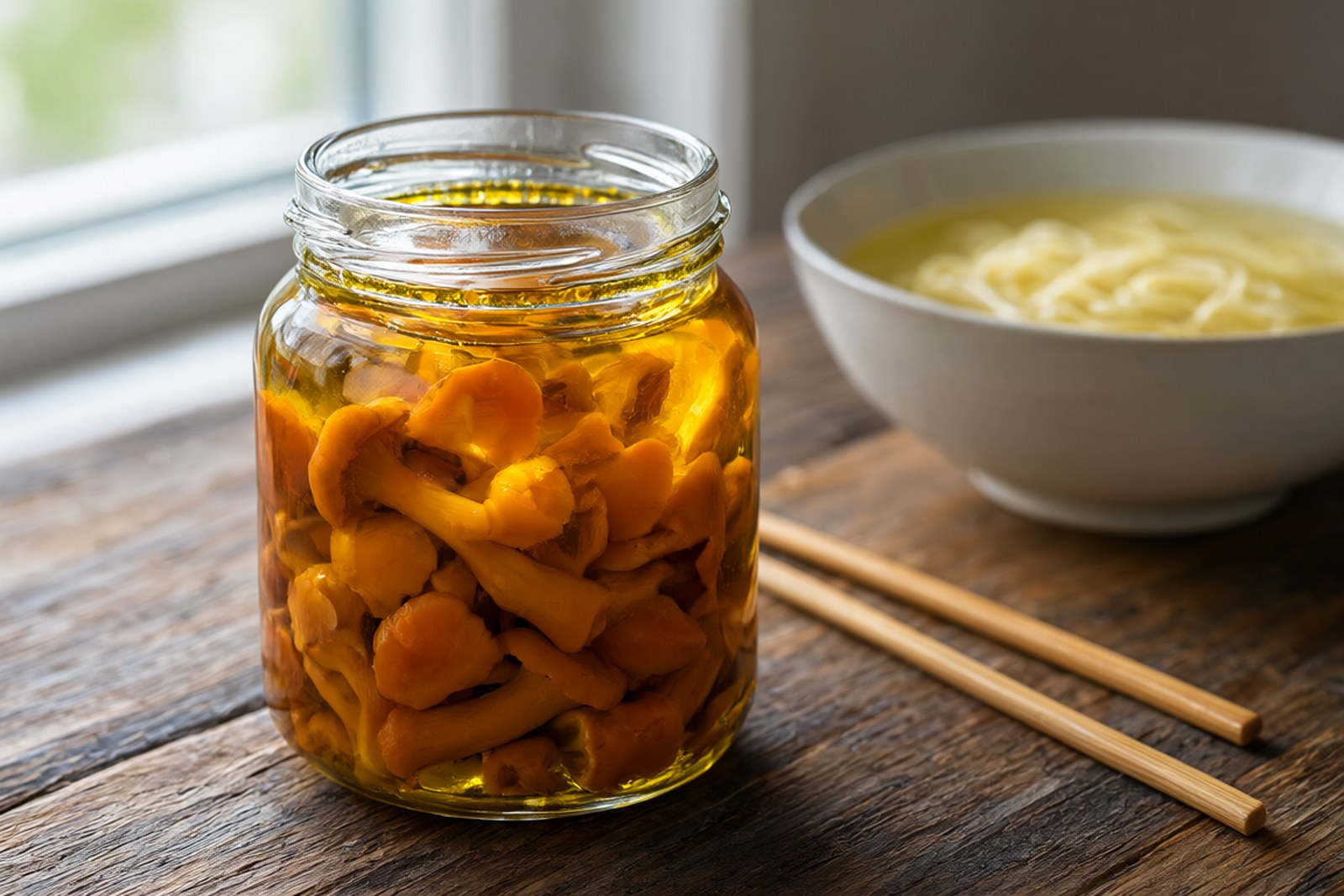
As 枞菌油 cóngjùn yóu. The mushroom is fried slowly in rapeseed oil with a little salt and chilli until the water is gone, then packed into jars. This is the most useful form, because it keeps for a year and because a spoonful of it over a bowl of plain noodles is one of the great small luxuries of Hunan. Every household in the prefecture with access to a pine wood makes some, and the ones you buy in shops are usually a pale version of what a family keeps for itself.
Words and Names
枞 cóng is a tree — the Chinese fir, and loosely any pine — so 枞菌 means, straightforwardly, “the mushroom of the pine”. 菌 jùn is the general word for fungus; it is written with the same character as the urban, laboratory 菌 jūn of 细菌 xìjūn, bacteria, which is a nice piece of linguistic recycling.
The same mushroom turns up under many names wherever there are pines. It is 松乳菇 sōngrǔgū in the standard dictionaries, 重阳菌 chóngyángjùn in much of Hunan for the festival it accompanies, 松树菌 sōngshùjùn further west, 雁来菌 yànláijùn in some places for the geese, and 谷熟菌 gǔshújùn in 云南 for the ripening rice. It is the same orange-bleeding thing everywhere. 湘西 Xiāngxī is the western half of 湖南 Húnán, “west of the Xiang river”.
What the Locals Know
Clean them with a damp cloth, never plunge them in water. The mushroom is a sponge. Rinse it and it will take on water and release it into the wok, and the dish will stew instead of fry.
Tear, do not slice. A torn mushroom holds the texture of the gills on the broken edge; a sliced one goes limp.
The orange milk stains everything. Fingers, tea towels, the edge of the sink. It also fades, and it is not harmful, but wear something you do not love.
Never buy a mushroom you cannot match to a name. 枞菌 is unmistakable to anyone who has been shown it once, but Hunan’s autumn woods also contain a number of milk caps and other fungi that will make you ill, and the fact that a seller has them in a basket does not mean they are the right ones. Foresters in the prefecture take greenish, purple-tinged forms of the same genus home and leave plenty else behind.
Buy the oil, not the dried mushroom. Dried 枞菌 is a poor ghost of the fresh version. 枞菌油 is the opposite: it is genuinely excellent and genuinely travels.
Where to Eat It
From late September into November, 枞菌 appears on the menus of 农家乐 and small restaurants all over 湘西, and the further from the city the better it tends to be. The places around 矮寨 Ǎizhài, 德夯 Déhāng and the valleys of 古丈 Gǔzhàng get theirs from the pine slopes above the villages. In 吉首 Jíshǒu itself the market near the bus station sells the raw mushroom in baskets by the jin from early morning, and half a dozen shops on the same street sell 枞菌油 in glass jars. Order the pork version first; buy a jar of the oil before you leave.
flowcloud would say that the reason this mushroom tastes the way it does is the same reason nobody has been able to farm it — that it is the product of a deal between a tree and a fungus that took several million years to negotiate, and that a plate of it is therefore closer to a piece of landscape than to a dish.
Where to find it: 枞菌 (cóngjùn), saffron milk cap, foraged from pine woods across 湘西土家族苗族自治州 (Xiāngxī), western Hunan — the best cooking is in the 农家乐 around 矮寨 (Ǎizhài), 德夯 (Déhāng) and 古丈 (Gǔzhàng). Two seasons: a short flush in March and the main one around 重阳 (Chóngyáng) in late September and October. 枞菌炒腊肉 runs ¥48–88 a plate, 枞菌炖鸡 ¥98–168 a pot depending on the bird, and a jar of 枞菌油 ¥40–80 from the market in 吉首 (Jíshǒu). Buy oil rather than dried mushroom, clean with a cloth rather than water, and go in October.