
It is called a rat and it contains no rat, and that is genuinely the whole naming story. 老鼠粄 lǎoshǔ bǎn is a rice noodle from 大埔县 Dàbù Xiàn in the far east of 梅州 Méizhōu, and the shape is what earned the name: short pieces of rice dough rolled by hand between the palms into little cylinders that taper to a point at each end, so that a bowl of them looks, at a squint, like a heap of small grey tails. The word 粄 bǎn is the Hakka term for any food made from a rice-flour dough, and it appears all over the Hakka country in words that have no Mandarin equivalent. Beyond the joke the dish is a straightforward pleasure: boiled rice noodles, tossed with pork lard, soy, minced pork and fried shallot, and eaten at breakfast or as a snack at any hour.
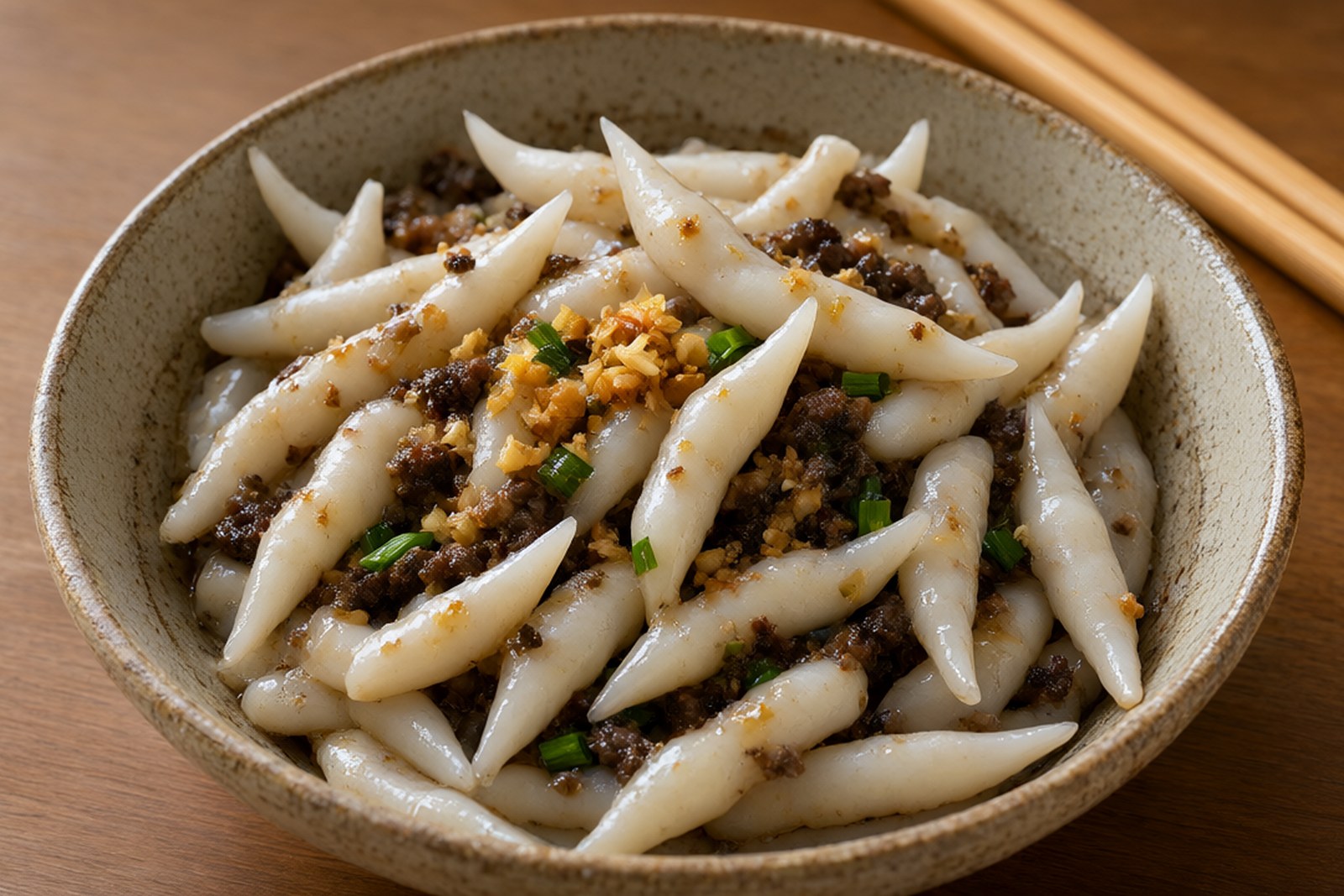
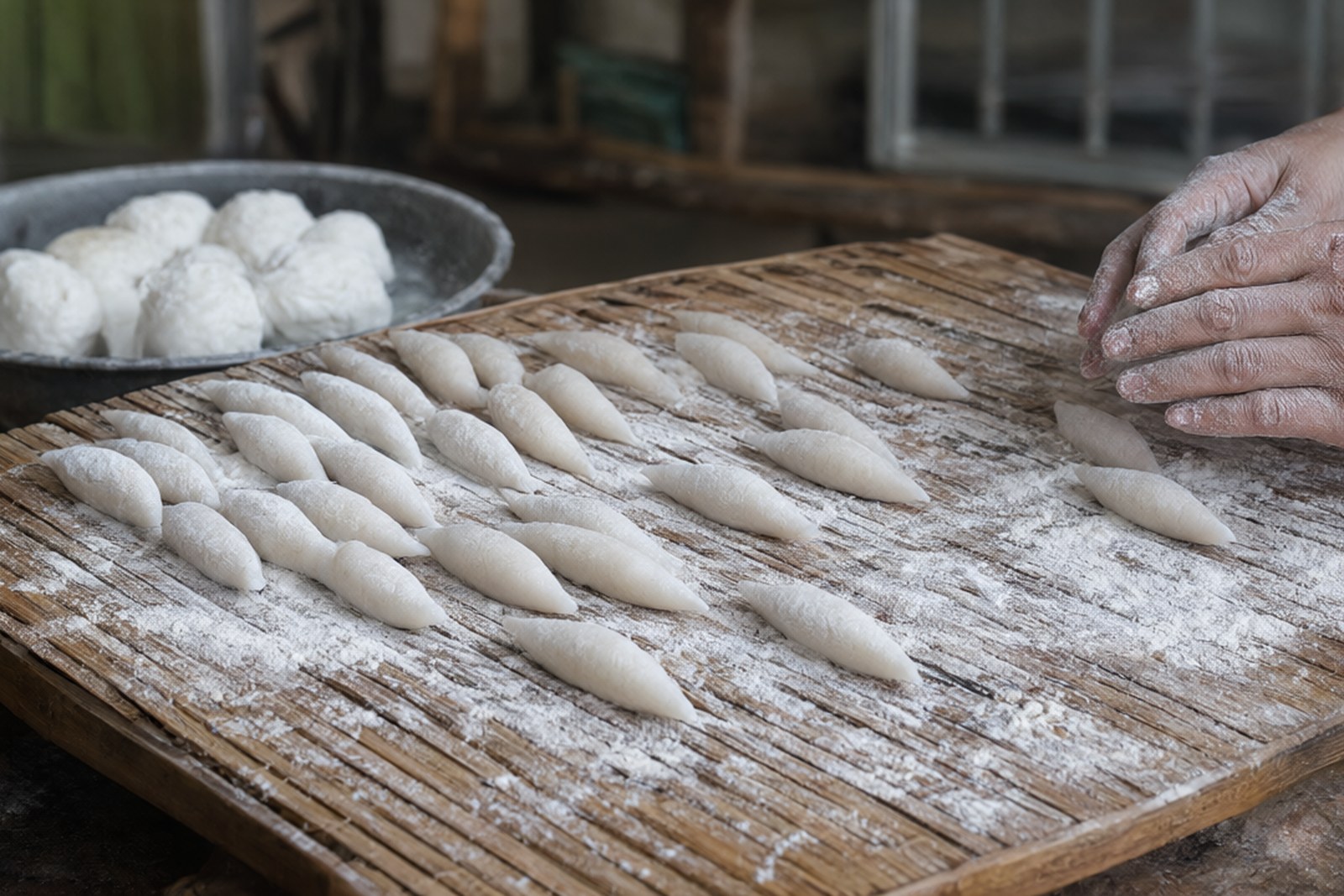
The shape is not decoration. Hand-rolled 老鼠粄 has a texture that machine-cut rice noodles cannot reproduce, because the rolling compresses the dough unevenly and leaves a slightly denser core, so the pieces stay springy through the boil instead of collapsing into paste. The tapered ends also matter in the mouth: they give each piece a thin edge that picks up sauce and a thick middle that resists the teeth. A bowl made from a single batch of dough will vary in size from piece to piece, and that variation is a sign of hand work rather than a fault.
The dough is 粘米 zhānmǐ, ordinary non-glutinous rice, soaked and ground to a slurry, then cooked or pressed until it can be handled. Nothing is added to it except water and a little salt; rice noodles need no gluten because the starch does the work. The pieces are boiled in plenty of water and lifted out while still firm, then dressed in the same family of ingredients as the rest of the Hakka breakfast table, lard, light soy, fried shallot, and often a spoonful of minced pork browned with a little 冬菜 dōngcài, the preserved vegetable typical of the region. Some households add 猪油渣 zhūyóuzhā, the crisp residue left from rendering lard, which is the closest thing the dish has to a signature.
Why Rats
The name is a piece of rural humour of the kind that runs through Hakka food names, and it belongs with 老鼠粄’s relatives around the province. The tail shape is the joke, and the joke is affectionate rather than off-putting; nobody in 大埔 finds the name strange, and the alternative name 珍珠粄 zhēnzhū bǎn, pearl noodle, is a later and much more polite invention for the tourist trade. The dish is old enough that the nickname has outlasted any memory of who coined it.
大埔 is the county that has kept the dish closest to its original form, and it is also the county with the densest concentration of fine old Hakka houses in Guangdong, which is not a coincidence. The rice for it grows on the terraces in the river valleys, the houses were built with money sent home from Southeast Asia, and the food is what the people who stayed behind made from what the valley gave them. A bowl of 老鼠粄 is a cheap illustration of a whole economy: rice from the terrace, lard from the pig in the yard, shallot from the garden, and a name that a family has been laughing at for two hundred years.
Words and Names
老鼠粄 lǎoshǔ bǎn is the dish: 老鼠 lǎoshǔ a rat and 粄 bǎn the Hakka word for a rice-flour cake or noodle, so the whole thing reads as rat cake. 珍珠粄 zhēnzhū bǎn, pearl noodle, is the politer alternative. 粘米 zhānmǐ is ordinary rice, as opposed to 糯米 nuòmǐ glutenous rice; 猪油 zhūyóu pork lard and 猪油渣 zhūyóuzhā the crisp left after rendering it. 冬菜 dōngcài is the preserved vegetable; 肉末 ròumò is minced meat and 葱花 cōnghuā chopped spring onion. 大埔 Dàbù is the county, and 湖寮 Húliáo its county town.
What the Locals Know
Ask whether the 粄 were rolled by hand or bought in, because the machine-made ones are unmistakably smooth and uniform and several shops use them. The dish is best eaten for breakfast, when the dough is fresh and the lard has just been rendered. If you want it as a snack in the afternoon, expect it to be drier, since the rice firms up after some hours. A bowl is six to fifteen yuan depending on how much pork goes on it, and a 大埔 shop will often offer 老鼠粄 and 腌面 side by side, which is the correct way to compare a rice noodle with a wheat one in the same sitting.
flowcloud would say that the rat noodle is the honest end of Chinese food naming, since it tells you what the thing looks like instead of what somebody wishes it tasted like, and it has survived several attempts to rename it into something elegant.
Where to find it: the breakfast shops of 湖寮 Húliáo, the county town of 大埔县 Dàbù Xiàn, and the lanes around the old 客家 Kèjiā houses at 百侯 Bǎihòu and 茶阳 Cháyáng, where several families still roll the dough by hand each morning. Buy a bowl plain first and add the fried shallot yourself, and ask for 猪油渣 if you want the version that the county eats rather than the one that gets served to visitors.