
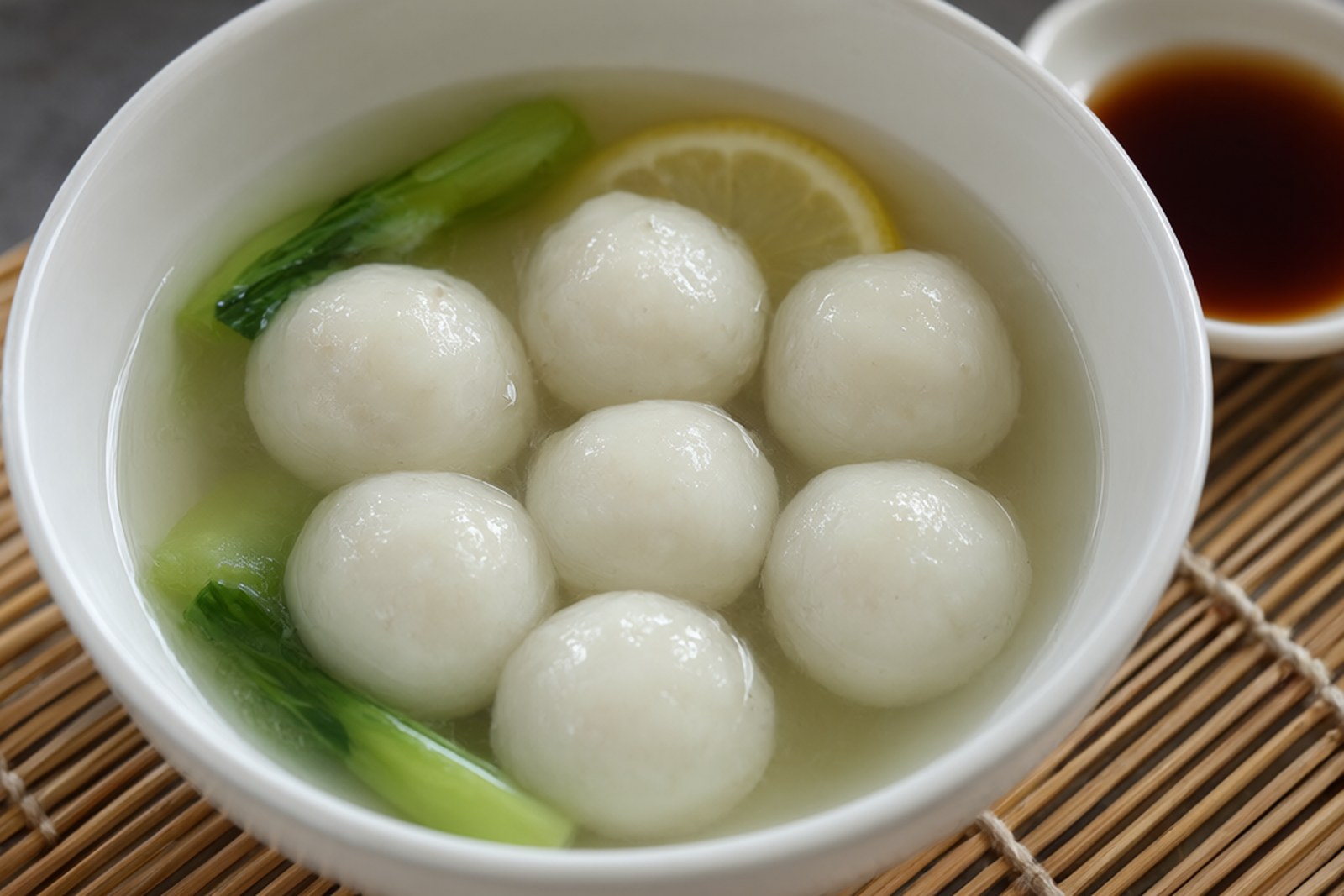
A fish ball from 达濠 Dáháo is white, faintly translucent, and springs back when you press it with a fingertip in a way that is closer to a marshmallow than to anything usually called fish. The district sits on the south bank of the harbour, and its fish balls are the ones that Shantou people name when they want to explain what the local standard is. There is no breadcrumb, no egg white, no flour paste and no filler of any kind in a traditional 达濠鱼丸 Dáháo yúwán. There is fish, salt, and the same pounded-protein technique that the region applies to beef, worked on fish that was still stiff with rigor when it came off the boat that morning. The result is a ball you can bite through cleanly, which tastes of the sea rather than of the fryer, and which holds its shape in a soup without turning into paste.
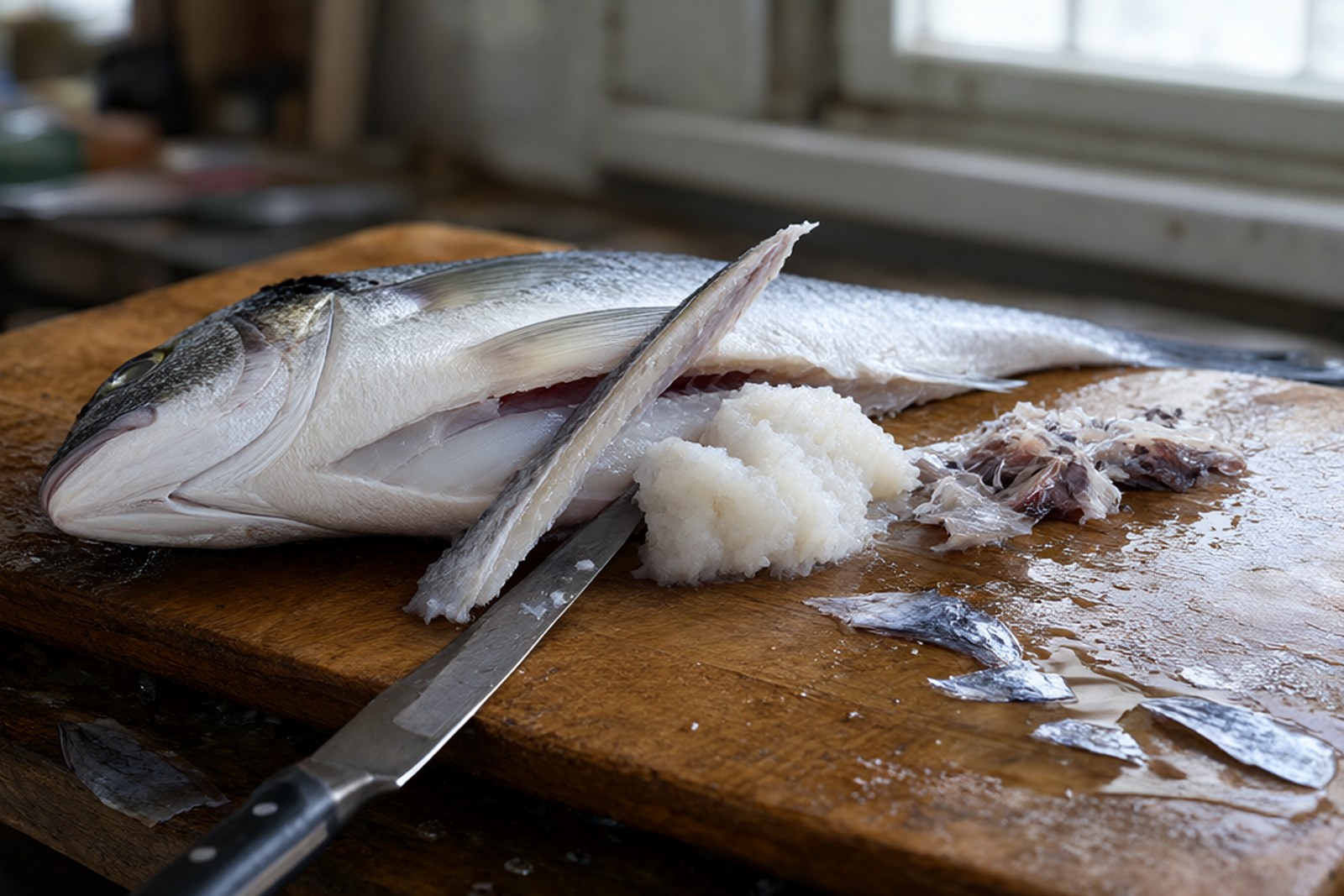
The fish most often used are the ones the local boats bring in close to shore: 那哥鱼 nàgē yú, a small lizardfish, and 马鲛 mǎjiāo, Spanish mackerel, along with 九棍 jiǔgùn and other modest white fish. None of them are expensive. What is expensive is the labour and the freshness, because the fish has to be filleted, skinned and boned while it is still cold and firm, and the flesh has to be pounded or machine-beaten within a couple of hours of landing. A fish that has been on ice for a day will not form the same elastic gel, and a maker cannot fix that with more salt. The whole trade in Dahao runs on that window.
Freshness as the Whole Method
What separates a Dahao fish ball from the fish balls sold everywhere in China as frozen pellets is not the recipe, because the recipe is three ingredients long. It is the time between the net and the mortar. Fish muscle begins to lose its ability to bind water within hours of death, and the enzymes that soften flesh start working, so a ball made from an eight-hour-old fish is measurably softer than one made from a fish that has just been killed. Shops in the district therefore do their buying in the early morning at the harbour, and the good ones sell out by midday. The everyday version is boiled and eaten in a bowl with 粿条 guǒtiáo or in a clear soup with a few greens, and the more elaborate version is 鱼丸汤 yúwán tāng, fish ball soup, which is a light dish whose entire quality rests on the balls.
There is a second, softer product made from the same fish and worth knowing about. 鱼面 yúmiàn is not a noodle made of wheat but a sheet of the same pounded fish paste rolled thin and cut into strips, which cooks in seconds and tastes of concentrated fish. 鱼饺 yújiǎo, fish dumplings, wrap a little pork filling in the same paste. All of them belong to the same family of dishes, and all of them depend on the fish being fresh rather than on the cook being clever.
Words and Names
达濠鱼丸 Dáháo yúwán is the dish and the district brand, and 达濠 Dáháo is now a sub-district on the south side of the harbour, reached by bridge or ferry from the city. 鱼丸 yúwán is the general word for a fish ball and 鱼蛋 yúdàn the Cantonese term used further south. 那哥鱼 nàgē yú is the lizardfish most often named as the best fish for the job, 马鲛 mǎjiāo is Spanish mackerel, and 九棍 jiǔgùn is another local white fish. 手打 shǒu dǎ means hand-beaten. 鱼面 yúmiàn is the fish paste cut into noodle strips and 鱼饺 yújiǎo the fish-paste dumping. 粿条 guǒtiáo is the flat rice noodle that usually accompanies them.
What the Locals Know
Buy them from a shop that is boiling them in the open, because you can see whether the balls are being turned out in small batches or pulled from a freezer bag. Test one before buying the rest: press it, and if it does not spring back, walk on. The correct way to cook them at home is in water just below a simmer for two or three minutes, with the lid off, and they are ready when they swell and rise. Do not salt the cooking water, because the balls are already seasoned. In the shops, order a bowl of soup with both fish balls and 鱼面 and ask for a squeeze of lime if it is offered, which cuts the richness. Expect to pay twenty to forty yuan for a takeaway portion and rather less per ball in bulk, and expect the best shops to shut when the morning’s fish is used up rather than at a fixed hour.
flowcloud would say that the Dahao fish ball is the least forgiving food in the region, because it is made of three things and two of them are the sea and the clock.
Where to find it: the shopfronts of 达濠 Dáháo, a short drive over the bridge from the city centre, where several family businesses have boiled the same recipe for generations, and the fish-ball counters in the wet markets of the old town. Ask for 达濠鱼丸 by name, and if you are buying to take away, ask whether they were made that morning.