
新村港 Xīncūn gǎng is not a town on the coast, it is a town on the water. The harbour is a sheltered bay on the south-east of 陵水 Língshuǐ, and on it float the 疍家 Dànjiā – the boat people of the South China coast, who for centuries lived and worked and died on their boats and never set foot on land except to trade and to bury. Most have moved ashore now, but the 渔排 yú pái, the rafts, remain, and they are a village of floating platforms strung together with ropes and planks, each one carrying a net-cage of fish, a small shelter, and in many cases a restaurant. You reach a 疍家 restaurant by taking a small boat out to a raft, stepping up onto a wooden platform over the water, and sitting down at a table that bobs a little under you while the fish that will be your dinner swim in a cage a metre from your elbow.
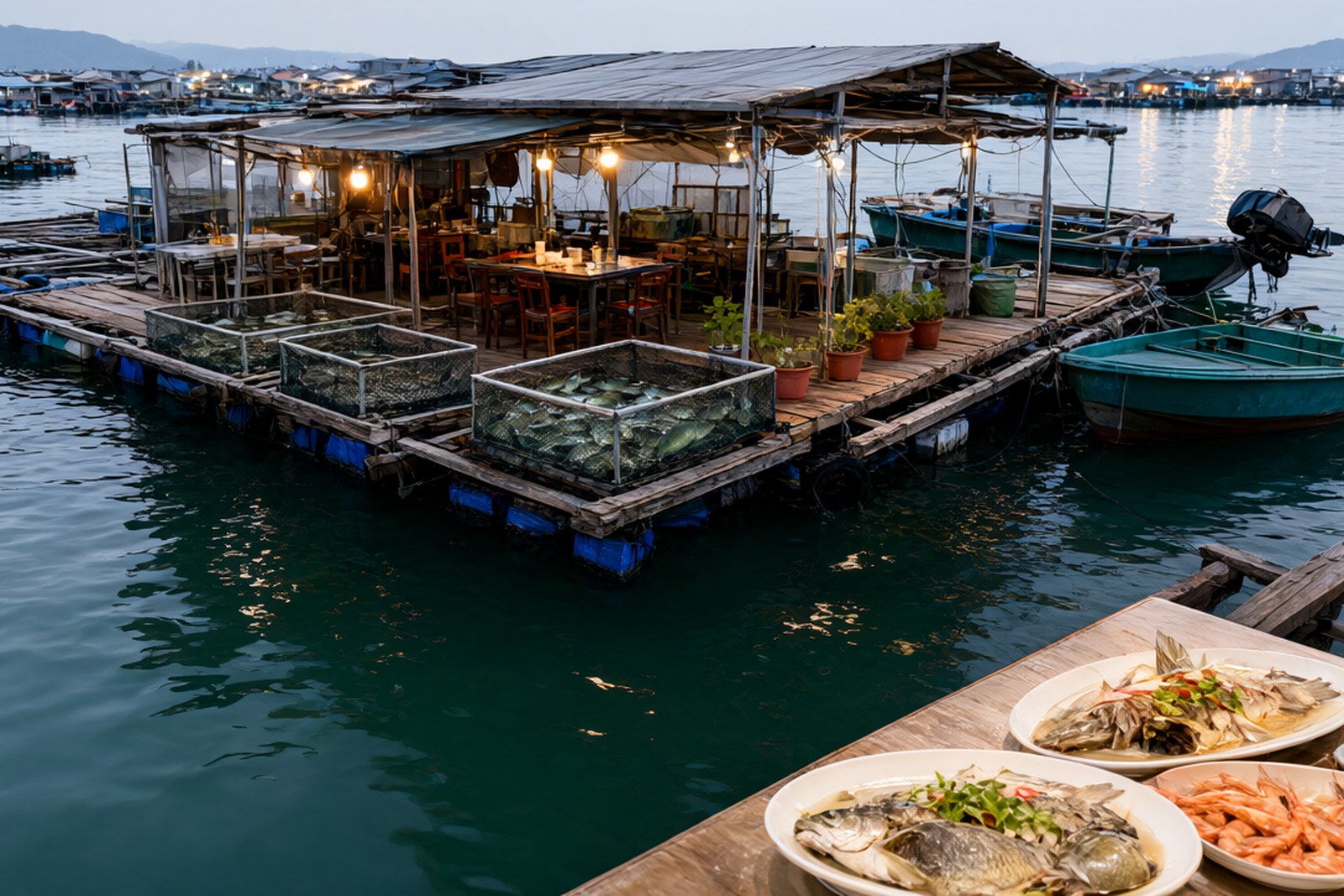
The 疍家 were farmers of the sea before they were cooks. A 疍家 raft grows a crop the way a paddy does, but the crop is fish: 金鲳 jīn chāng, golden pompano, 石斑 shí bān, groupers of several kinds, 军曹 jūn cáo, cobia, and 对虾 duì xiā, prawns, all raised in the hanging cages from fry to market size. The cages are why a 疍家 meal starts in the water next to your table. You pick the animal you want, the chef nets it, kills it in the open, and cooks it within the hour. Nothing is frozen, nothing is stored, and the fish tastes of the water it has just left. The default preparation is 清蒸 qīng zhēng, steamed with ginger and spring onion and finished with a splash of hot oil and soy, because a grouper or a pompano raised in moving seawater is sweet enough that any stronger treatment is a mistake.
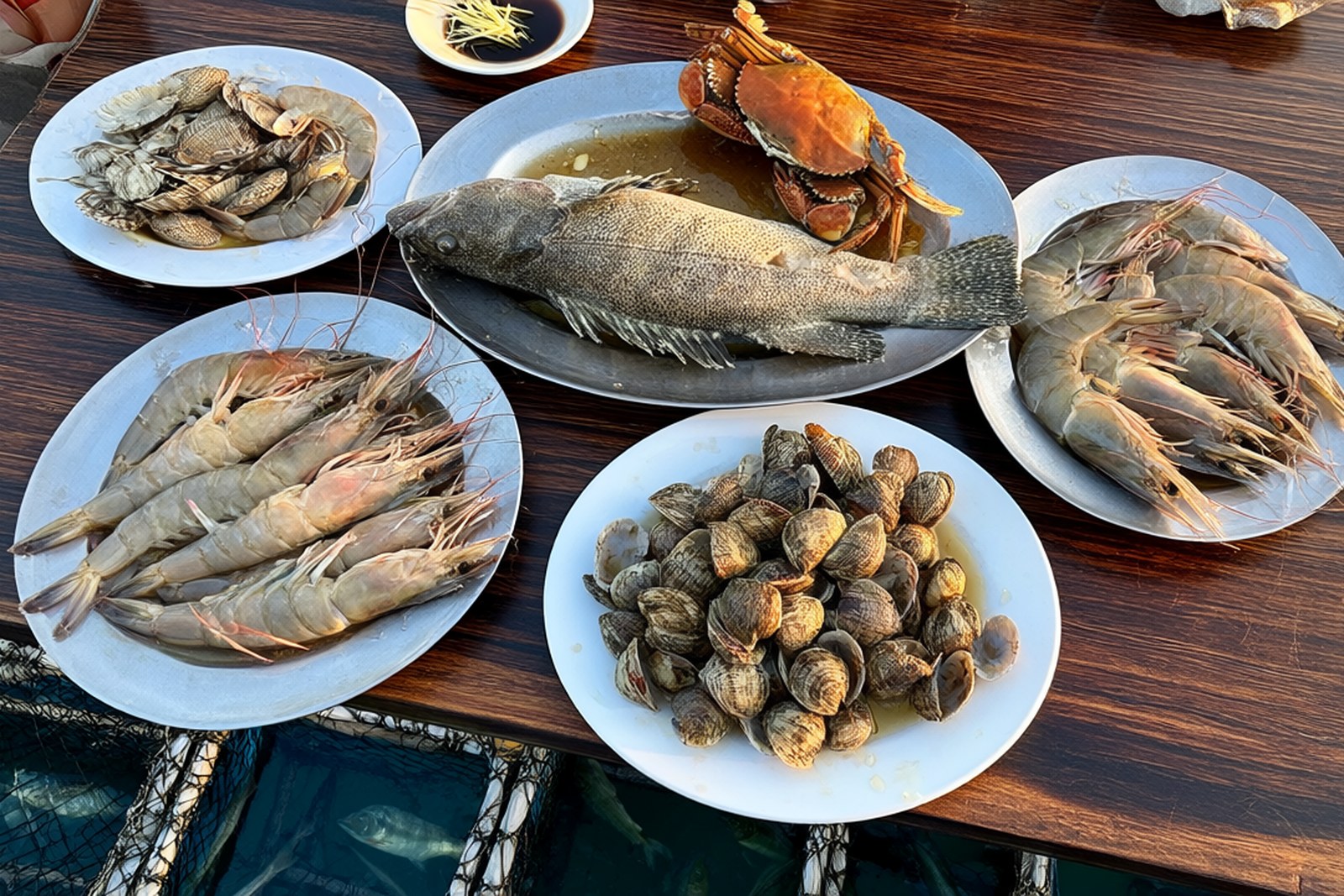
There is a particular pleasure in eating this. The cooking happens as you wait, on a single burner at the back of the platform, and the dish arrives on a table that rocks gently while the rafts around you rock too. Order a crab in season, a 腌蟹 yān xiè, the raw crab marinated with garlic and chillies that the 疍家 call the poor man’s sashimi; a pot of 鱼汤 yú tāng, the milk-white broth made from the fish heads and bones that are too good to waste; a plate of the day’s 贝壳 bèi ké, the clams and sea snails the women gather in the mangrove at low tide; and a bowl of 沙虫 shā chóng, the sea worm, 疍家 cooking’s answer to the razor clam, which frightens people at the table and is then devoured. Drink the local 椰子水 yē zi shuǐ, coconut water, straight from the nut, which is the drink every meal here comes with.
Words and Names
疍家 Dànjiā are the boat people, 渔排 yú pái the floating rafts they live and farm on, and 新村港 Xīncūn gǎng the harbour that holds them. 金鲳 jīn chāng is golden pompano, 石斑 shí bān grouper and 对虾 duì xiā prawns; 清蒸 qīng zhēng means steamed plain. 腌蟹 yān xiè is the marinated raw crab the 疍家 call their sashimi, 沙虫 shā chóng the sea worm, and 椰子水 yē zi shuǐ coconut water. 陵水 Língshuǐ is the county the harbour belongs to.
What the Locals Know
Go by boat from the pier and eat at a raft that is working, not one that has become a stationary restaurant: a real 疍家 raft has net-cages in the water around it and a smell of fish and wet rope. Choose your own animal from the cage rather than ordering from a menu, because that is the point of the place. Ask what came in on the tide that day and take it. Come at dusk, when the rafts light up and the fishing boats go out, but book ahead on a weekend or you will queue for the pier boat. And do not be afraid of the 沙虫; the 疍家 have been eating it for longer than anyone at your table has existed.
flowcloud would say that a village whose streets are made of rope and whose market is the sea knows something about provision that a town on terra firma has had to unlearn, and that dinner eaten on a platform that rocks with the fish you are about to eat is the nearest thing to an honest transaction there is.
Where to find it: the 疍家 raft restaurants of 新村港 Xīncūn gǎng, on the coast south of 新村镇 Xīncūn zhèn in 陵水黎族自治县. Take a boat from the 新村港码头 Xīncūn gǎng mǎ tóu pier; the crossing is five minutes and costed per head, roughly ¥10 to ¥20, and most rafts will collect you if you call ahead. A meal of steamed fish, prawns, a crab and a pot of soup for two runs ¥150 to ¥300 depending on the catch. 新村 is about forty minutes by car from 陵水 town and an hour and a half from 三亚, with buses running from both.