
Luojia Zongzi, Danzhou’s Own Pyramid of Rice and Pork
洛基粽 Luòjī zòng is the leaf-wrapped rice dumpling that 儋州市 Dānzhōu shì, on Hainan’s west coast, treats as its own, and it is the one the island’s families order when the fifth day of the fifth month comes round. The name is 洛基 Luòjī, a town just outside the city, and a 洛基粽 is a four-sided pyramid of glutinous rice packed around marinated pork and wrapped in the broad leaves of the 柊叶 zhōng yè, a plant of the ginger family whose leaf is used nowhere else in China for this purpose. It is boiled for hours rather than steamed, which is why a Hainan zongzi comes out heavy, dense and faintly green at the edges where the leaf has bled into the rice.
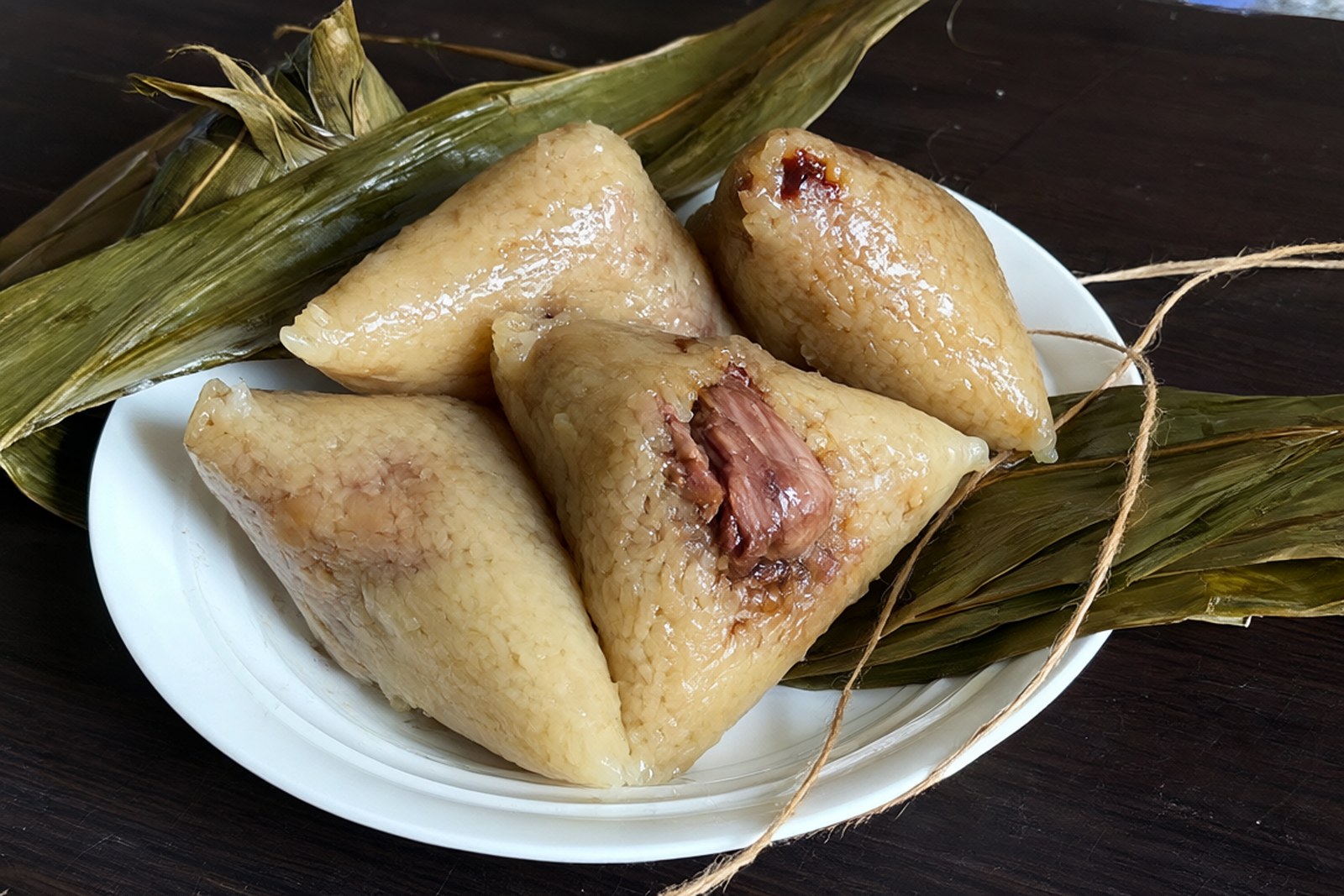
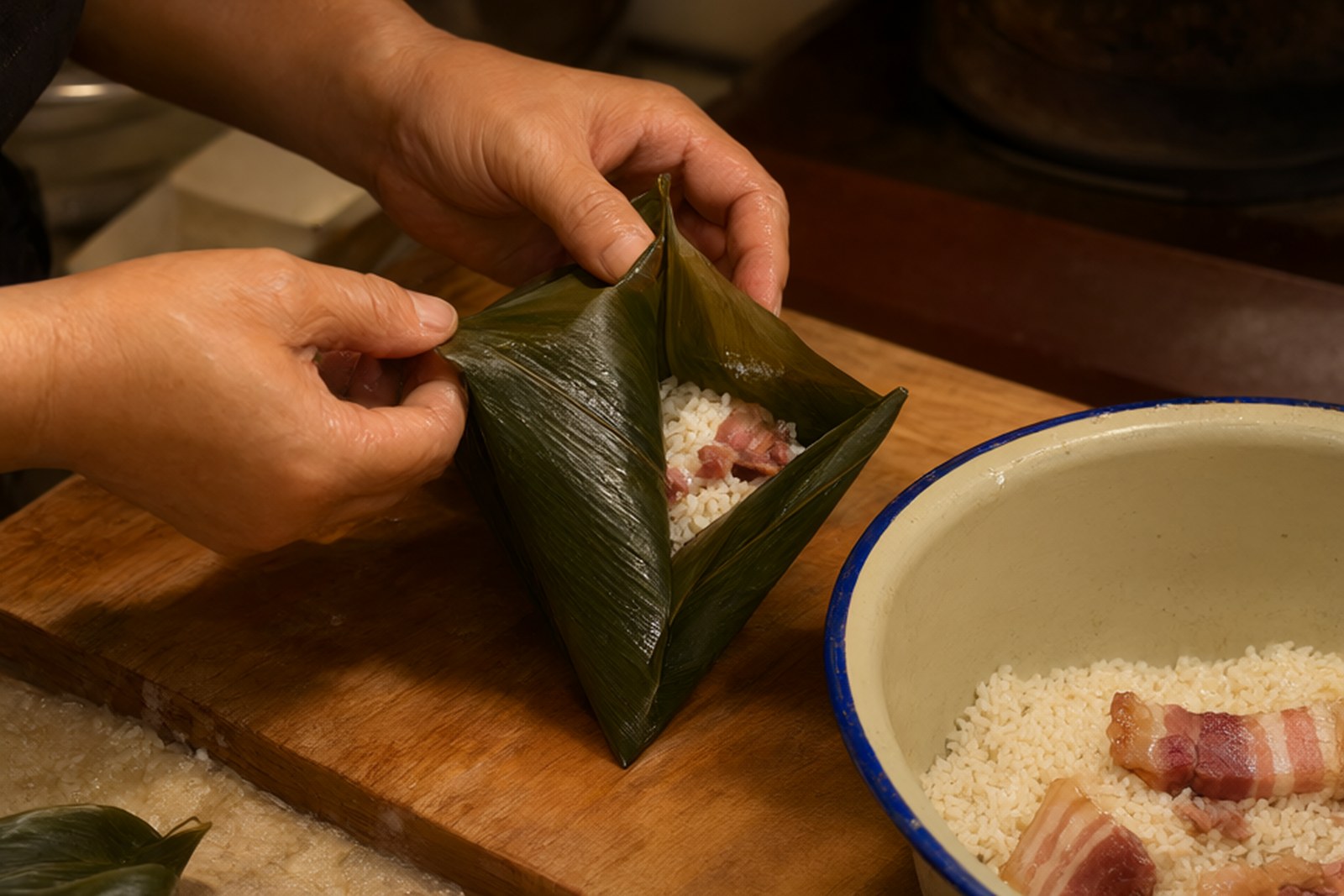
What separates it from the zongzi of the mainland is the wrapper and the shape. Where the south of China uses reed or bamboo leaf and folds a long triangular bundle, Danzhou uses 柊叶, a leaf wide enough to wrap a fist-sized pyramid in two pieces, and ties it with 咸水草 xián shuǐ cǎo, the salt-marsh grass that gives it a faintly savoury scent as it steams. The pyramid is built by folding one leaf into a cone, filling it, capping it with a second leaf and lashing the whole thing crosswise, so that the finished bundle has flat faces and sharp corners and no seam that a fingernail can find. It is a wrapping that takes a season of practice to do quickly.
Inside, the rice is glutinous and short-grained and presoaked, drained, and stirred with a little salt and sometimes a spoon of light soy so that the grains take on a pale amber rather than staying chalk-white. The filling is 五花肉 wǔ huā ròu, belly pork, cut into fat cubes and marinated overnight with 生抽 shēng chōu, light soy, 五香粉 wǔ xiāng fěn, five-spice, garlic and a little sugar. Some households add a salted duck yolk, a few 虾米 xiā mǐ, dried shrimp, or a scatter of 绿豆 lǜ dòu, mung bean, but the plain pork version is the one the town considers canonical, and the fat has to be visible through the rice when the bundle is opened or the whole thing is thought dry.
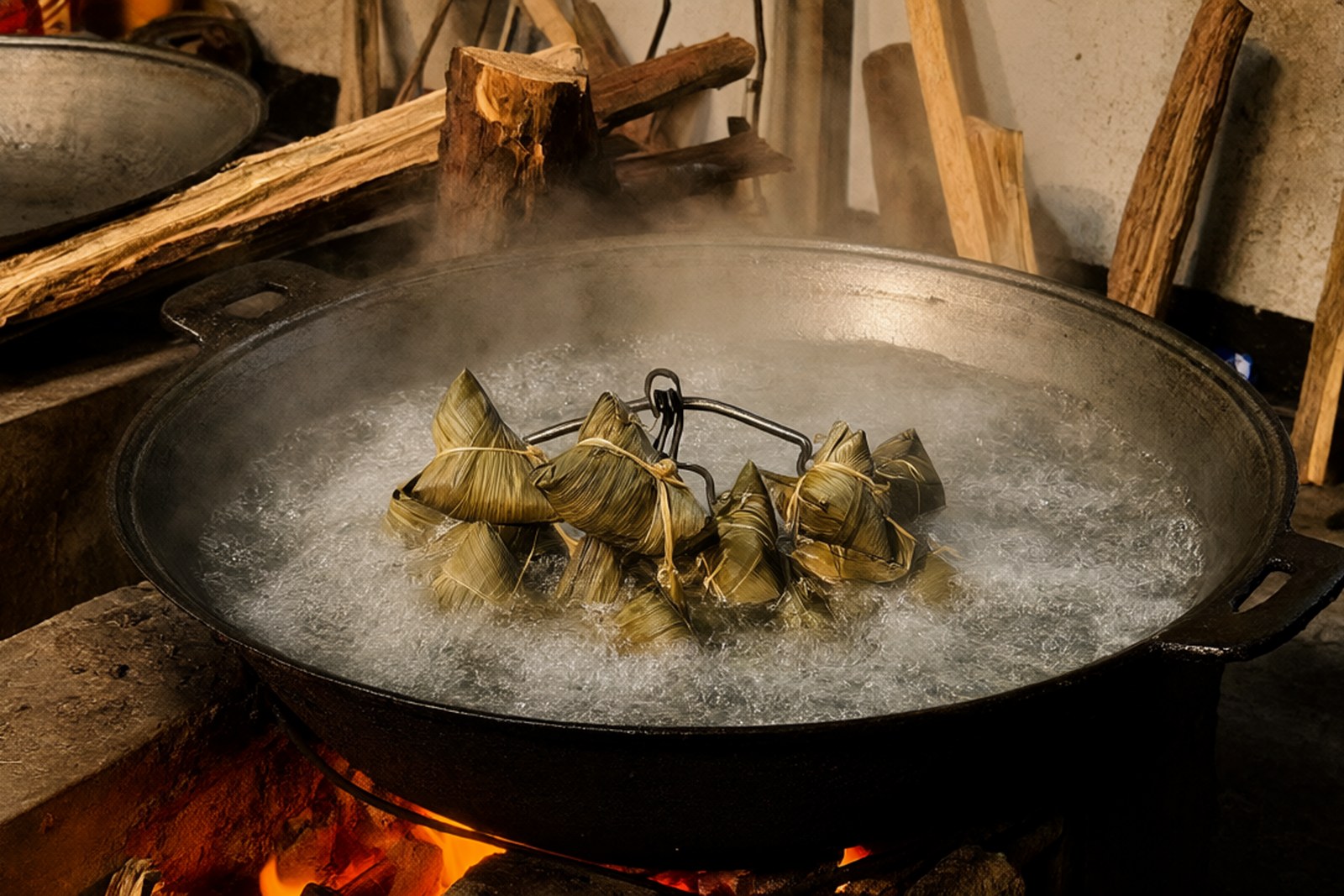
The boiling is a long, unhurried business and it is done in quantity. A 大铁锅 dà tiě guō, a wide iron pot, is set over a wood fire and half filled with water; the bundles are stood upright in it in tight rows, weighted so they cannot float, and left from six to eight hours, with water added as it evaporates. The longer boil is not for tenderness of rice alone: it is what drives the leaf’s aroma into the glutinous grains and turns the outer layer of rice a soft grey-green. A family will make a hundred at a time in the days before the festival, and the pot is often borrowed, since not every kitchen has one large enough.
Words and Names
粽 zòng is the leaf-wrapped rice dumpling, and 粽子 zòng zi the everyday word for it. 洛基 Luòjī is the Danzhou town the style is named for, and 儋州 Dānzhōu the city. 糯米 nuò mǐ is glutinous rice, 五花肉 wǔ huā ròu belly pork, 咸蛋黄 xián dàn huáng salted duck yolk, 虾米 xiā mǐ dried shrimp and 绿豆 lǜ dòu mung bean. 柊叶 zhōng yè is the broad wrapping leaf, 咸水草 xián shuǐ cǎo the salt-marsh grass used as string, and 大铁锅 dà tiě guō the wide iron boiling pot.
What the Locals Know
Eat it hot, unwrapped from the leaf at the table, because a Danzhou zongzi sets hard as it cools. Buy from a shop that is boiling, not one that is selling cold ones off a tray; the steam is the sign. Ask for 加蛋 jiā dàn, with yolk, if you want the richer version, and 纯肉 chún ròu if you do not. In the town of 洛基 itself the bundles are made on the roadside in the weeks around 端午 Duānwǔ, the fifth-month festival, and sold still warm; outside that season the same shops keep the pot going for the market trade, so it is a year-round food and not only a festival one.
flowcloud would say that a town which found one broad leaf, folded it into a pyramid that no nail can find a seam in, and then stood a hundred of them upright in an iron pot for eight hours over a wood fire, has decided that the slow way is the only way worth the trouble, and that the taste of the leaf in the rice is the receipt for the patience.
Where to find it: the 洛基 town roadside stalls and the wet markets of 儋州市, and the breakfast shops of 那大 Nàdà, the city centre, which sell them from the pot all morning. A single 洛基粽 runs ¥8 to ¥18 depending on whether it carries yolk, and a frozen box of six for the journey home ¥60 to ¥120. 儋州市 is reached by high-speed rail from 海口 in about fifty minutes and from 三亚 in about two hours, and 洛基 is a ten-minute drive west of 那大.