
Early morning at 弹子石 Dànzǐshí Danzishi belongs to the stairs: a watering truck hisses along the river road, a man carries a birdcage up steps that have counted the city’s mornings for two centuries, and the nine terraces of the old street stand empty above the water. Chongqing is a municipality of southwest China, and 南岸区 Nán’àn Qū Nan’an, its south-bank district, ends in the east at this elbow where the Jialing joins the Yangtze. The street that climbs here reopened in June 2018 with the old place names stitched back on, and this page eats its way up it – not a snack list, but the wharf’s own foods walking the wharf’s own stairs, the riverfront’s treaty-port depth left to its own page.
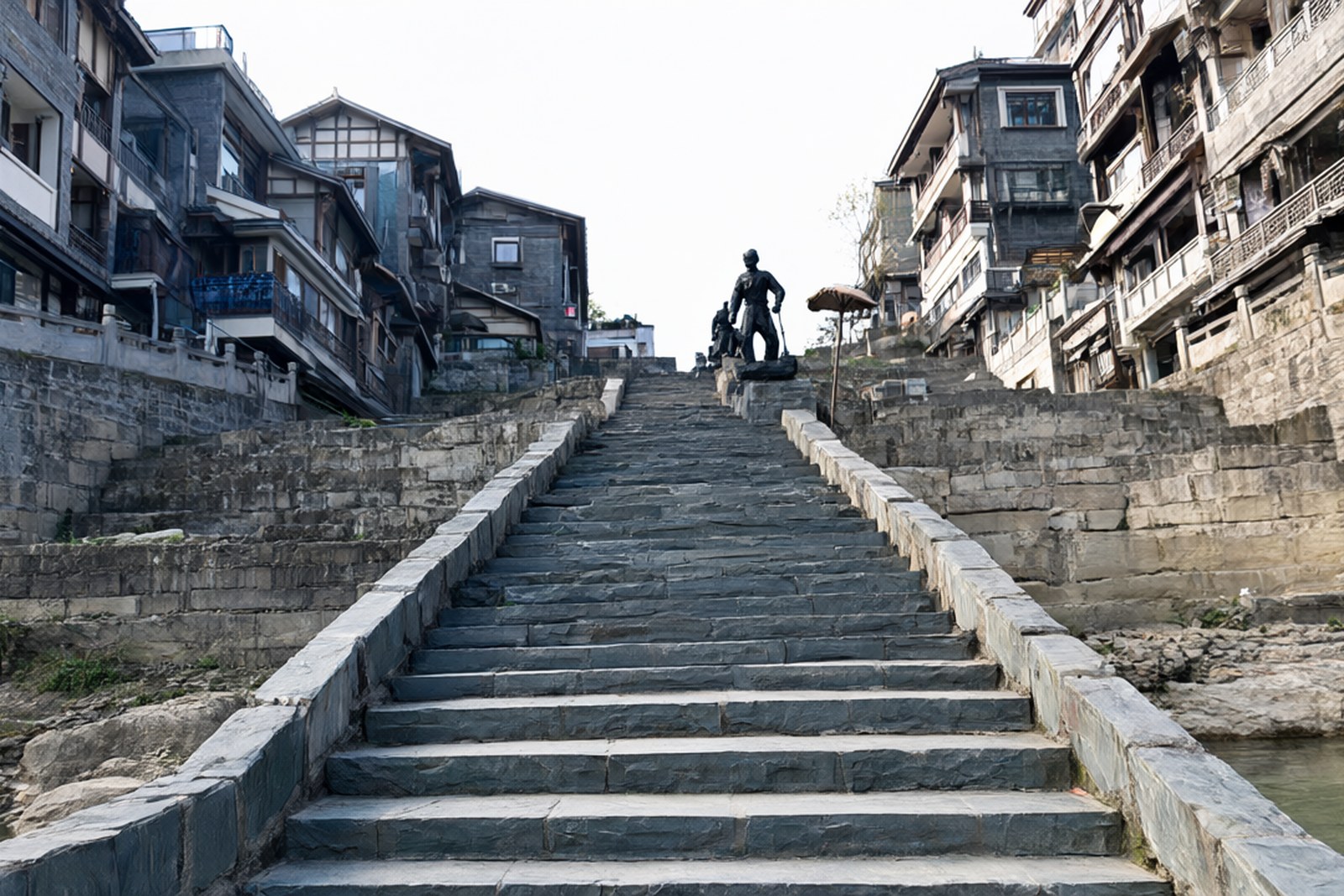
The geometry is the introduction: a main street nearly 1,000 metres long climbing nearly 80 metres, laid out in nine terraces over some 120,000 square metres, from 王家沱 Wángjiātuó Wangjia Wharf at the river to the 百岁坊 Bǎisuì Fāng Hundred-Year Arch on the ridge, with the old French barracks at its western edge – one clause owed to the page that details it. The local chronicle counts this the first street in the country to take treaty-port culture as its organising spine, a national 4A scenic area rebuilt on the old slope under the formula of one street, two wharfs, four courtyards, ten sights. Vertical is the point: a street you climb, not stroll.
The name keeps a boulder. The story goes – and the boulder is real, the legend is the legend – that Yu the Great, who tamed the floods, married a daughter of 涂山 Túshān Tushan, the hill above this reach of the river; that she stood on the bank as a stone awaiting his return, the 呼归石 Hūguī shí come-home stone; and that when Yu came back and called the child’s name, the stone split and their son Qi stepped out – the 诞子石 dànzǐshí birth stone, worn by speech into Danzishi, the name today. The classical record anchors the hill: the Book of Documents and the 华阳国志 Huáyáng Guózhì both tie Yu’s marriage to Tushan in this region – the hill is history, the split stone folklore. Below, for centuries, worked a landing – ferrymen, salt boats, and the porters who ate on the run.
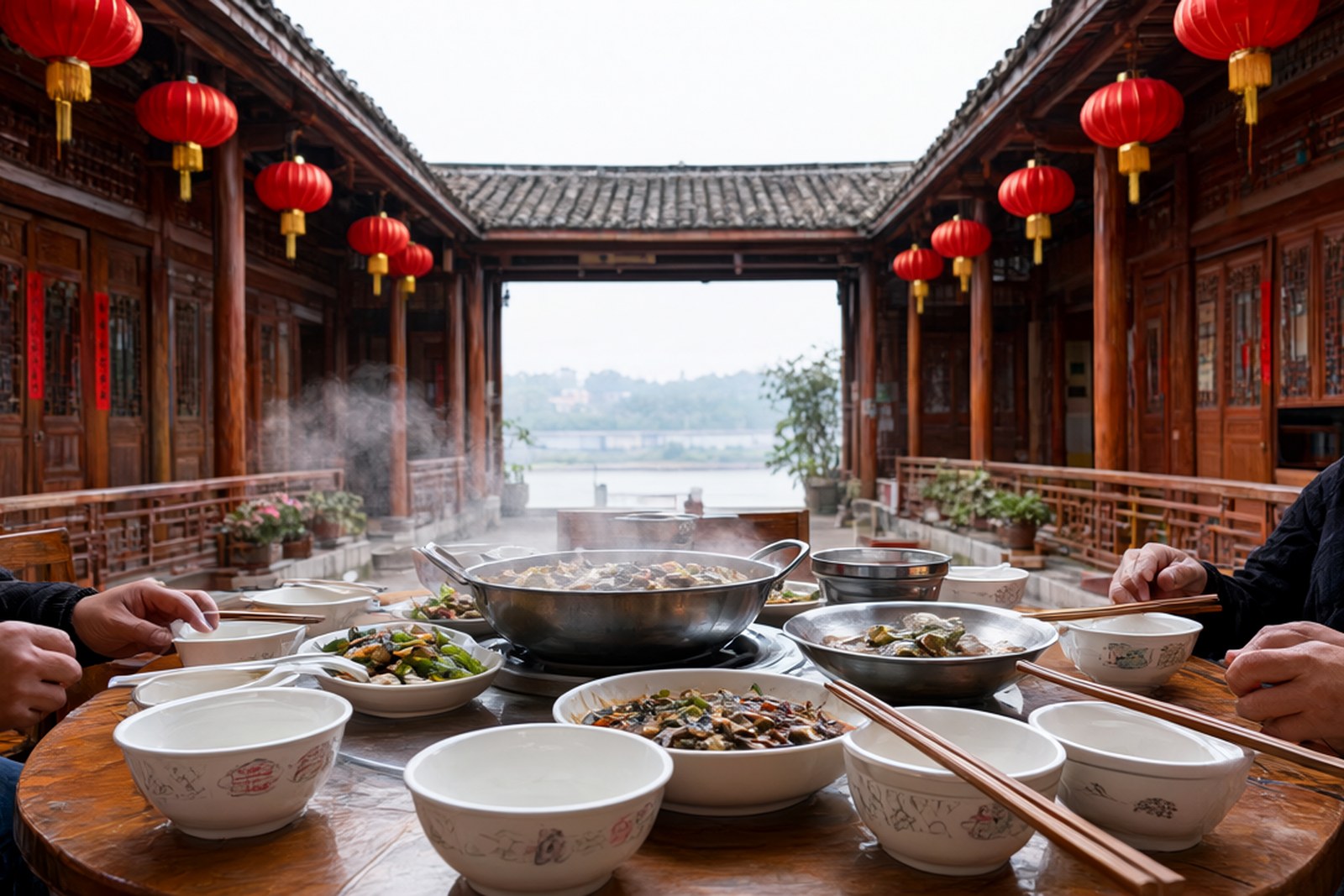
The wharf’s great house still fronts the water. In the Qing Daoguang years the Wang family built 王家大院 Wángjiā Dàyuàn, two compounds with eleven gates, the lower one opening straight onto their wharf – “the first courtyard on the ten-thousand-li Yangtze” – and around it grew the trade of the 万茂正盐号 Wànmào zhèng yánhào salt firm, the business that filled the slope with streets. The slope aged with the river trade; by this century the terraces had run down, and from 2009, by the developers’ account, a venture of Hongkong Land and China Merchants Shekou took the site on with about 1.5 billion yuan, building from 2014 to the 1 June 2018 reopening. The restored street mixes its registers openly – a Madame Tussauds, the country’s first SEA LIFE ocean centre and a riverside mall are one clause of background – and into the terraces it wrote back the wharf’s plain foods: 豆花饭 dòuhuā fàn tofu-pudding rice, 烧白 shāobái steamed pork slices, sweet-potato skewers, fermented-rice dumplings and brown-sugar jelly – dockworkers’ calories on the stairs the dockworkers climbed, remembered rather than reinvented, at inexpensive street levels though no price is quoted here. The mall’s river-view tables draw the evening crowd, and for the 2025 Spring Festival gala the city staged its Chongqing sub-venue on Nanbin Road below.
Words and Names
弹子石 Dànzǐshí is Danzishi, “the stone of the newborn”; folk etymology joins it to 诞子石 dàn zǐ shí, the birth stone of the Yu legend, whose waiting wife is the 呼归石 Hūguī shí come-home stone. 涂山 Túshān Tushan, the hill of Yu’s marriage in the classical record. 王家大院 Wángjiā Dàyuàn is the Qing mansion of the Wang family; 王家沱 Wángjiātuó their wharf, the street’s southern landing; 万茂正盐号 Wànmào zhèng yánhào the salt firm that built the trade; 海关石 Hǎiguān shí Customs Rock, one of the ten sights, hailed by the street’s own introductions as the first pass of the upper Yangtze; 百岁坊 Bǎisuì Fāng the Hundred-Year Arch at the north end. 九级坡地 jiǔ jí pōdì is the nine-tiered slope, the street’s signature terrain; 豆花饭 dòuhuā fàn and 烧白 shāobái the two dishes locals name as the wharf’s memory coordinates.
What the Locals Know
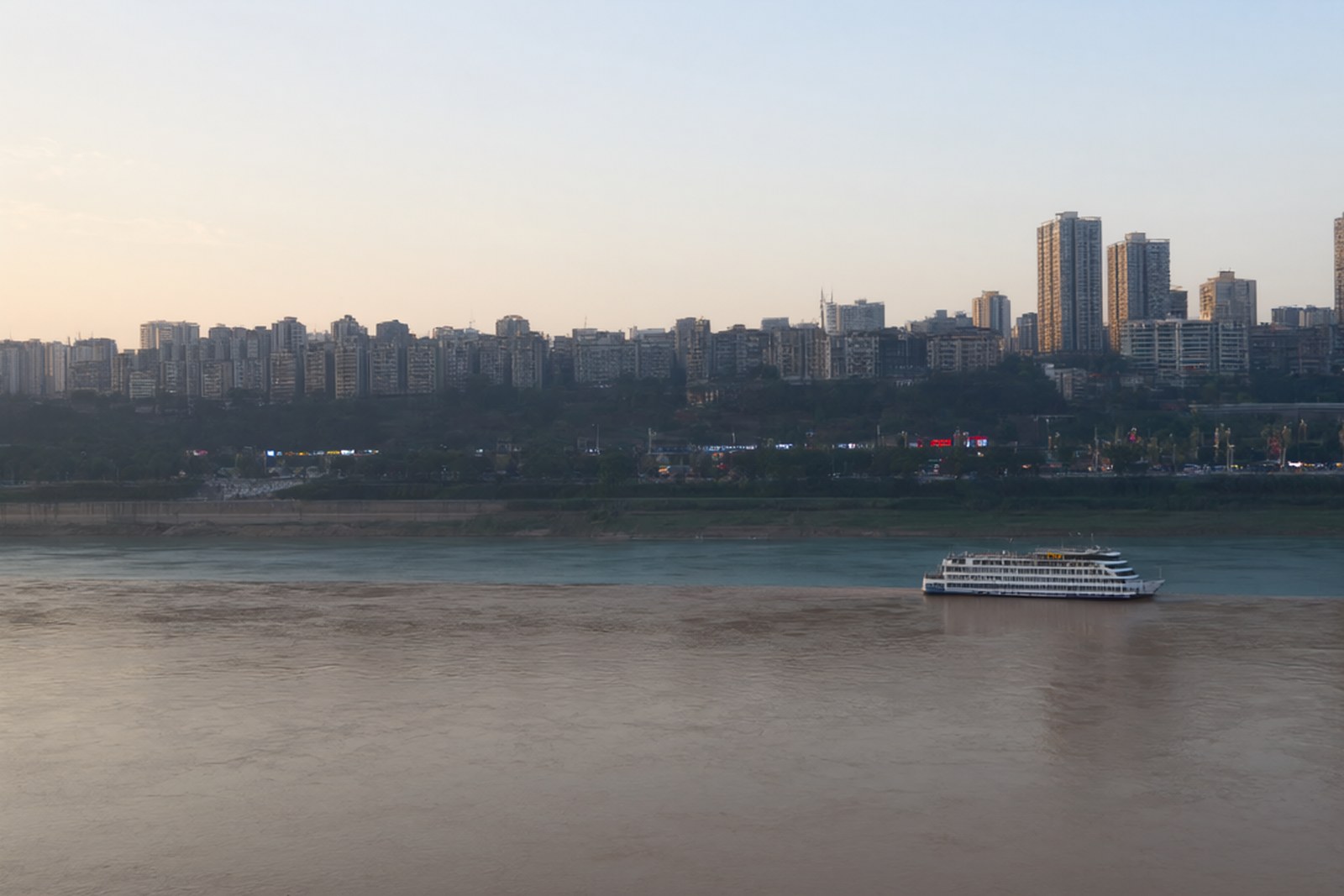
Locals call the climb 爬老街 – climbing the old street – and treat the eighty metres as the honest part: the new street simply rebuilt the wharf-to-ridge path the porters wore. Everyone here can tell the Yu legend, and everyone finishes it the same way: 莫当真,石头是真的 – don’t take it literally, the stone is real. The food memory has coordinates: tofu-pudding rice and steamed pork slices were the labourers’ full meal, and what the terraces serve now is what residents call replica nostalgia – the taste of the wharf rebuilt above it. For the view, time it: up to the Hundred-Year Arch before dark for the ten minutes when the two rivers’ colour line reads clearest, then down as the lights come on – the far bank’s glow, Hongyadong among it, the classic frame. And the street’s quietest hour is early morning, when the steps belong to the watering truck and the birdcages.
flowcloud would say that Danzishi Old Street is a vertical rebuild at the two rivers’ meeting point – a nine-terrace slope street, nearly a kilometre long and eighty metres high, named for a legendary birth stone of the Yu the Great tale, once the wharf fronting the Wang family’s salt-trade mansion, reopened on 1 June 2018 with the old names written back in: one street, two wharfs, four courtyards, ten sights – and the wharf’s plain foods, tofu-pudding rice and steamed pork slices and sweet-potato skewers, climbing the stairs again.
Where to find it: 长嘉汇弹子石老街 Chángjiāhuì Dànzǐshí Lǎojiē, the Changjiahui Danzishi Old Street, on the eastern stretch of 南滨路 Nánbīn Lù Nanbin Road, 南岸区 Nán’àn Qū Nan’an District, Chongqing Municipality, rising from Wangjia Wharf to the Hundred-Year Arch. Metro loop line to Danzishi station and a short walk, or buses along Nanbin Road. The street is free to enter; the wax museum, the ocean centre and the mall’s attractions charge separately. The reopening date, length and height figures come from the street’s own and chronicle introductions, checked October 2026; spend figures drift and none are quoted; no single eatery is recommended – the dishes here are the street’s memory, not a ranking.