
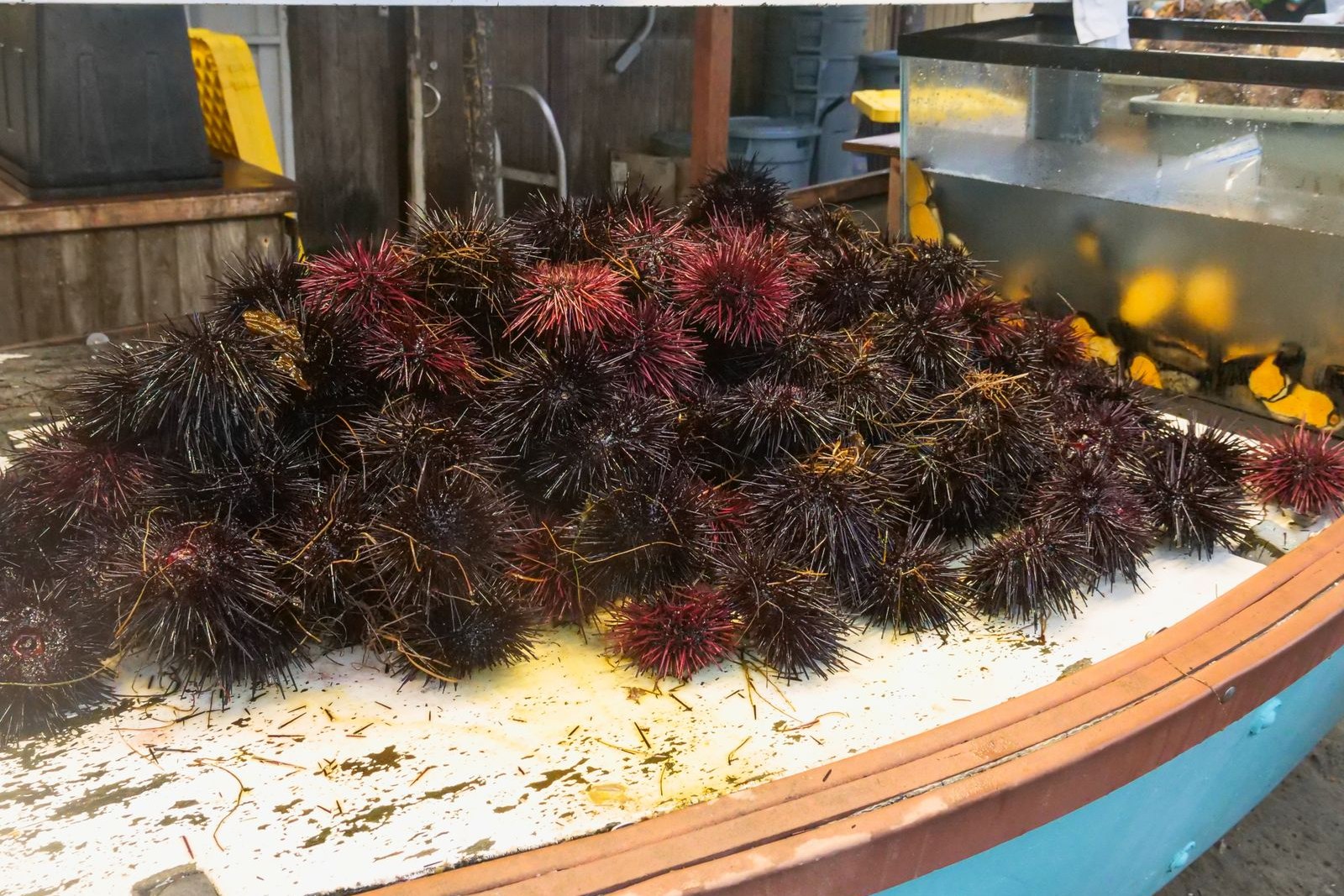
海胆 hǎi dǎn is the sea urchin, and off the 大鹏半岛 Dàpéng Bàndǎo it is a seasonal event rather than a standing menu item. The reefs along the Dapeng and 南澳 Nán’ào coast hold a purple urchin, 紫海胆 zǐ hǎi dǎn, which grows in the kelp and rock gullies where the water is clean and moving, and it is harvested by hand by divers working from small boats. The season runs from roughly May to August, when the animals have built up their 海胆黄 hǎi dǎn huáng, the five lobes of gonad that are the only part eaten and the only part that has ever been worth the trouble. Outside those weeks the same divers are working other things and the urchins in a Dapeng market have usually come from somewhere else. If you want the real thing, the calendar matters more than the restaurant.
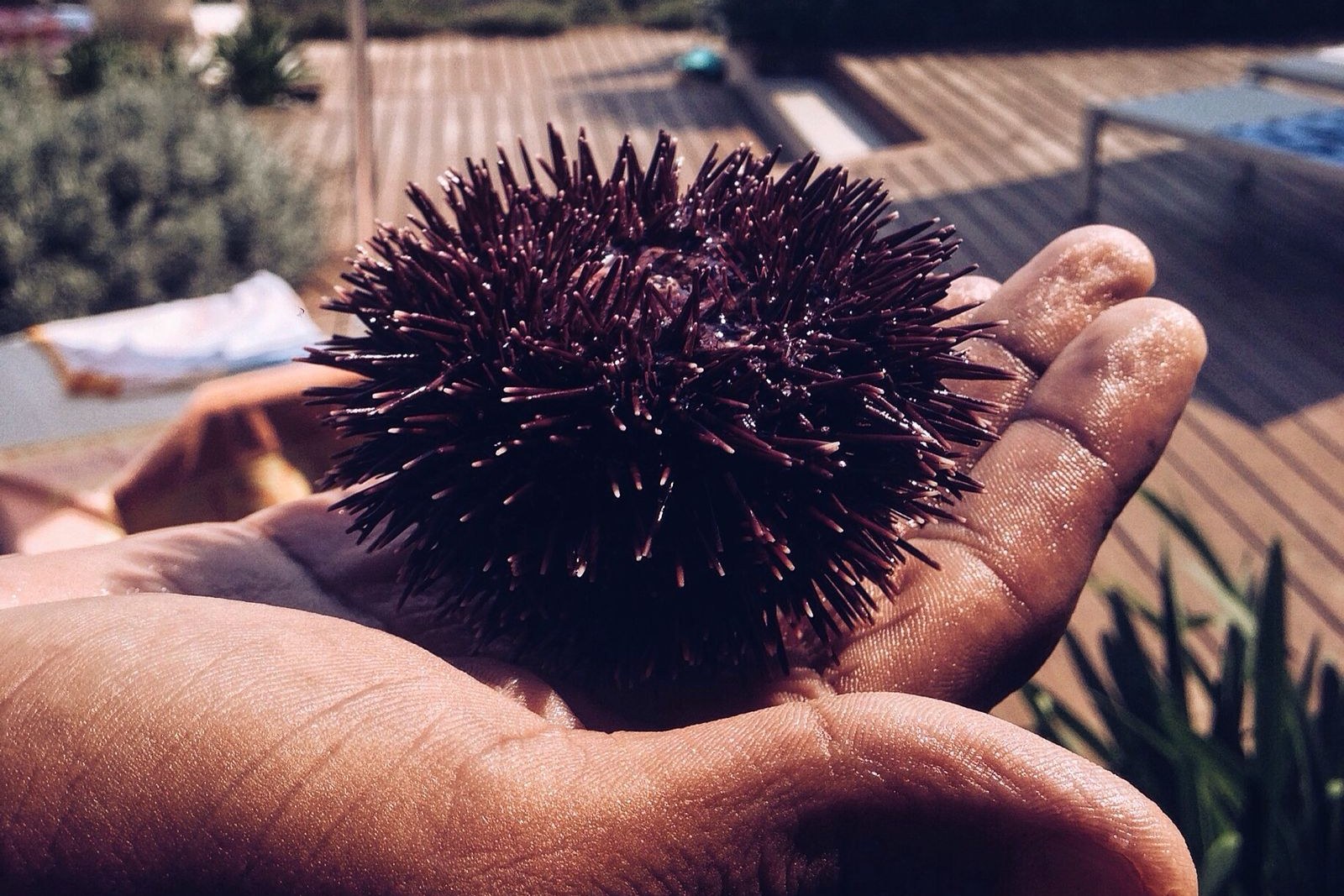
The plainest and the best way to eat one takes about ten seconds. The urchin is cut around the mouth with scissors or a knife, the top is levered off, and the five lobes of roe are sitting in the shell in their own liquid. Nothing is done to them. You eat them with a small spoon, maybe with a drop of soy or a smear of 芥末 jiè mò, and the taste is sweet, iodine-rich and slightly metallic in the way that very fresh shellfish is, with a texture like a soft custard. It is one of the few foods in Chinese cooking that is served without any attempt to improve it, and the reason is that cooking ruins it: the roe turns grainy and bitter above about sixty degrees. When it is cooked anyway, it is folded into 海胆炒饭 hǎi dǎn chǎo fàn, fried rice in which the urchin is stirred through at the very end so that it half melts into the grains, or steamed over egg as 海胆蒸蛋 hǎi dǎn zhēng dàn, where it becomes a layer under the custard and colours it orange.
The Dapeng specialty that outsiders miss is 海胆粽 hǎi dǎn zòng, the sea urchin rice dumpling, made for 端午节 Duān Wǔ Jié in early summer, exactly when the urchin season peaks. A 南澳 household wraps glutinous rice, pork belly, salted egg yolk, dried shrimp and a spoonful of raw urchin roe in bamboo leaves and boils it for hours, and the result is a savoury dumpling with a faint marine sweetness running through the rice that no other 粽子 has. They are not sold in shops outside the villages; you find them by knowing someone whose aunt makes them, or by turning up in 南澳 in late May and asking. The rest of the season is a market trade: urchins sold by weight at 南澳海鲜市场 Nán’ào hǎi xiān shì chǎng, split and eaten on the spot at the stall tables, at prices that swing with the catch.
Words and Names
海胆 hǎi dǎn is the sea urchin and 紫海胆 zǐ hǎi dǎn is the purple species; 海胆黄 hǎi dǎn huáng, sometimes just 胆黄, is the roe that gets eaten. 海胆炒饭 hǎi dǎn chǎo fàn is urchin fried rice and 海胆蒸蛋 hǎi dǎn zhēng dàn is urchin steamed with egg; 海胆粽 hǎi dǎn zòng is the urchin rice dumpling. 大鹏 Dàpéng is the peninsula and the new district, 南澳 Nán’ào the sub-district at its southern tip, and 东涌 Dōngchōng and 西涌 Xīchōng the two bays either side of it. 端午节 Duān Wǔ Jié is the Dragon Boat Festival, 芥末 jiè mò is mustard or wasabi, and 海鲜市场 hǎi xiān shì chǎng is a seafood market.
What the Locals Know
Look at the spines before you buy. A live urchin’s spines stand up and move when you touch the shell, and one whose spines hang flat is dead and will taste of ammonia. The roe should be a saturated yellow-orange and hold its shape; a dark or runny roe means the animal has been out of the water too long or was harvested in the wrong month. Weight is the honest test, because the shell is mostly water and the difference between a good urchin and a poor one of the same size is all in the lobes. Ask for it to be opened in front of you and eat it within a minute, and do not add soy if the roe is good, because the salt flattens it.
flowcloud would say that the sea urchin is the only luxury ingredient that punishes you for trying to cook it, which is why the fishing villages that eat it best have never bothered to write the dish down.
Where to find it: 南澳海鲜市场 Nán’ào hǎi xiān shì chǎng and the waterfront restaurants of 南澳 in 大鹏新区, reached by bus from 大鹏中心 Dàpéng zhōng xīn or by the 假日专线 from the city; the 西涌 Xīchōng and 东涌 Dōngchōng bays on the same peninsula have their own stalls. Come between May and August. Order one urchin split raw to taste it plain, then 海胆炒饭 for the table, and if you are there in the fortnight before the Dragon Boat Festival, ask after 海胆粽 before you ask for anything else.