
芭蕉为盘手为筷,一席青山入餐桌。Bājiāo wéi pán shǒu wéi kuài, yī xí qīngshān rù cānzhuō – Banana leaf for a plate, the hand for chopsticks; a tableful of green hills upon the table.
景颇绿叶宴 Jǐngpō Lǜyèyàn Jingpo green-leaf banquet is the full-table feast of the 景颇族 Jǐngpōzú Jingpo people – a spread laid out not on plates but on great 芭蕉叶 bājiāo yè banana leaves spread over a low table or the ground, a dozen or more small dishes arranged in a ring, eaten by hand with no chopsticks and no individual bowls. The leaf is the dish and the menu at once: 鬼鸡 guǐjī ghost chicken sits beside 烤肉 kǎoròu grilled meat, 舂菜 chōngcài pounded herb-and-nut salads, 野菜 yěcài wild greens, 竹筒饭 zhútǒng fàn bamboo-tube rice, 水酒 shuǐjiǔ rice wine in a 竹筒 zhútǒng, and a scatter of the 香柳 xiāngliǔ and 芫荽 yánsuī herbs that define the Jingpo palette. The name – 绿叶 lǜyè ‘green leaf’ – points to both the banana-leaf plate and the vegetable-heavy, herb-loud content: this is a feast where the greens are not a side but half the argument. A set banquet runs about 60-150 yuan a head at a 景颇 Jǐngpō banquet house or 农家乐 nóngjiālè farm kitchen (worth confirming – the price floats hard with the number of dishes and the season’s game), and the honest shape is that you are buying a table, not a plate: you sit, the leaves are laid, and the food arrives in a circle you eat clockwise with your right hand.
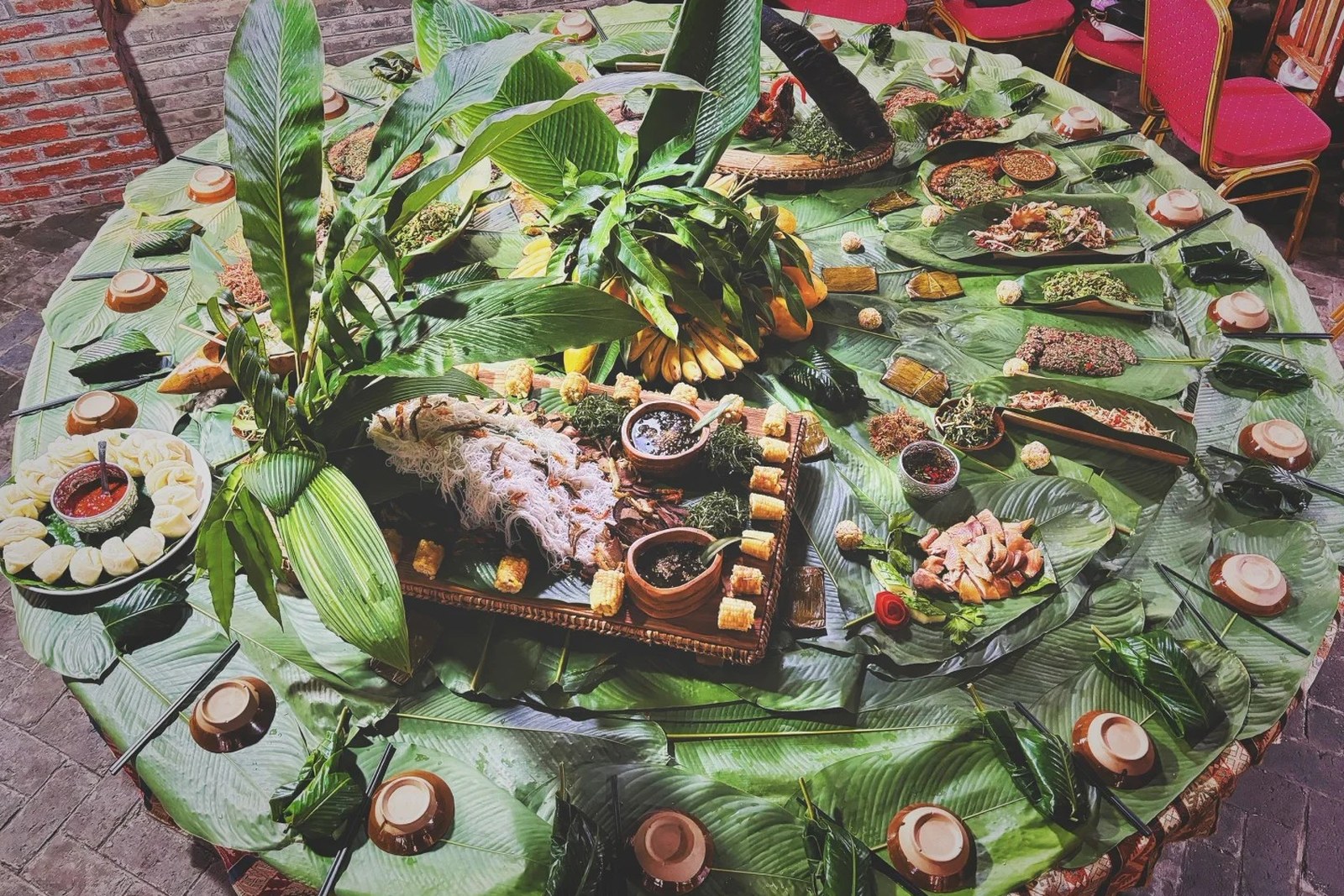
The mechanism is the leaf and the circle. The 芭蕉叶 bājiāo yè banana leaf is wiped clean and laid flat as the single shared surface – no washing-up, no ceramic, and the leaf itself flavours the food with a faint green breath as the warm dishes sit on it – and the dishes are placed in a deliberate ring so that every diner, seated around the low table, can reach meat, salad, rice and herb without asking. The cooking is mostly 舂 chōng pounding and 烤 kǎo grilling: the 舂菜 chōngcài are herbs, 辣椒 làjiāo chili, 蒜 suàn garlic and 核桃 hétáo walnut (or 花生 huāshēng peanut) smashed in a 木臼 mùjiù wooden mortar until they become a coarse, fragrant paste – the Jingpo version of a 沙拉 shālā salad – while the meats are 炭火 tànhuǒ charcoal-grilled over open flame. The 竹筒饭 zhútǒng fàn is rice stuffed into a 竹筒 zhútǒng bamboo tube and roasted so the grain picks up the 竹香 zhúxiāng bamboo scent, and the 水酒 shuǐjiǔ is the 景颇 Jǐngpō rice beer poured from a shared tube. The comparison locals draw is with the 傣味 Dǎiwèi Dai 手抓饭 shǒuzhuāfàn hand-grab rice – both are leaf-or-banana served, hand-eaten feasts – but the 绿叶宴 lǜyèyàn is the Jingpo one, heavier on the pounded herbs and the 鬼鸡 guǐjī, and it is a full banquet where the Dai 手抓饭 shǒuzhuāfàn is often a rice-centred plate. The dish-circle is the Jingpo way of saying welcome, and a 绿叶宴 lǜyèyàn is what a village lays out for a guest it means to honour.
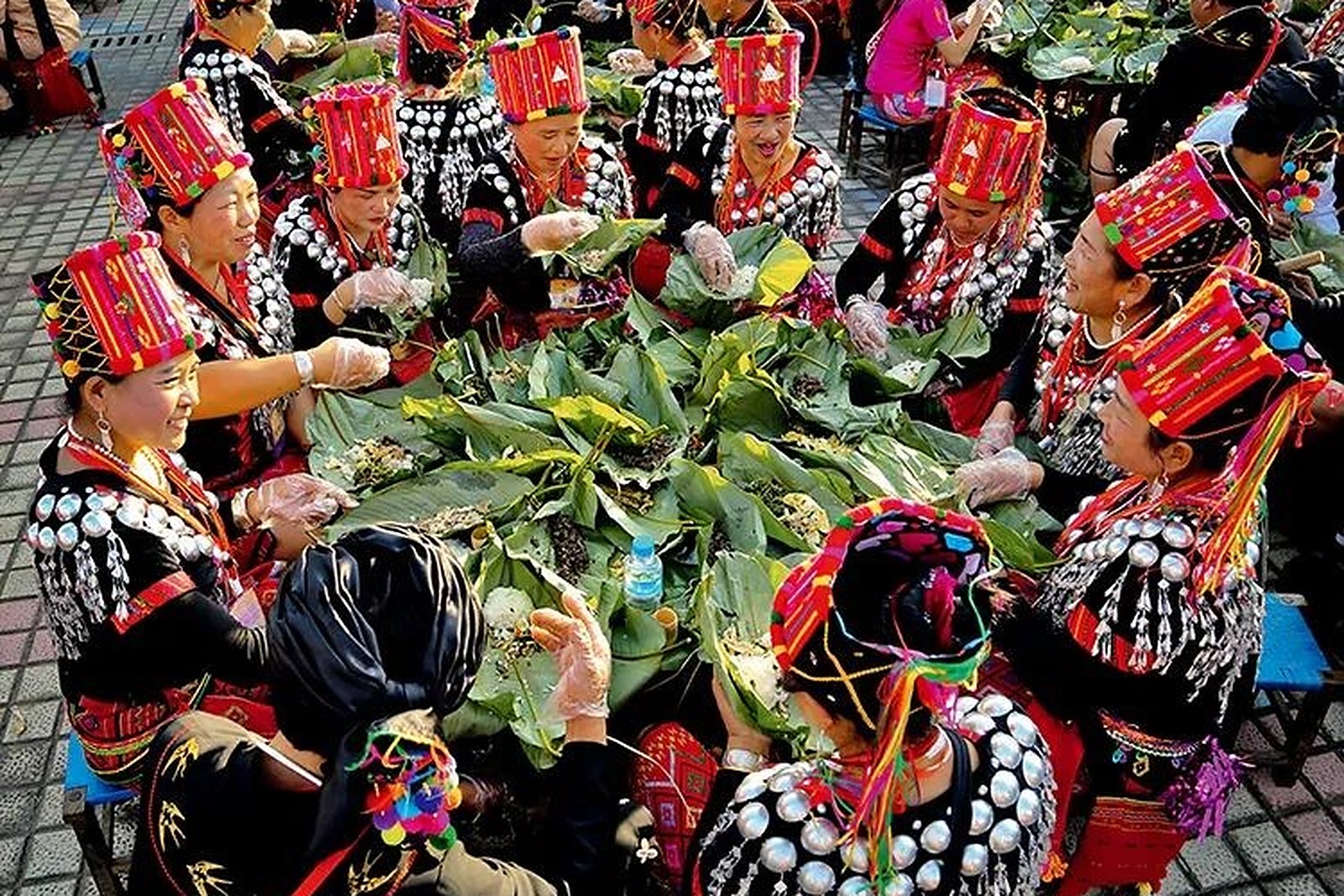
Locals eat it at the feast, seated, by hand. The move is to book a 景颇 Jǐngpō banquet house or a village 农家乐 nóngjiālè – the 绿叶宴 lǜyèyàn is too much food and too much leaf for a casual one-plate order, it is a group meal – and to go with at least three or four people so the circle is worth laying. Wash your hands before you sit (the 景颇 Jǐngpō host will have a basin ready), eat with the right hand only, and work the ring: a pinch of 竹筒饭 zhútǒng fàn, a bit of 鬼鸡 guǐjī, a dab of 舂菜 chōngcài, the 水酒 shuǐjiǔ between. Ask the host to point the 鬼鸡 guǐjī and the 烤肉 kǎoròu – the meat sits across from the seat of honour – and don’t be shy of the 野菜 yěcài wild greens, because in a 绿叶宴 lǜyèyàn the greens are the house’s pride, foraged from the 山林 shānlín forest edge (worth confirming which greens are in season – the leaf count drops in the cold months). The honest season is the warm half – spring to autumn – when the herbs and 野味 yěwèi are fullest and the banquet is at its most crowded; the honest test of a house is the leaf and the mortar: real 芭蕉叶 bājiāo yè laid fresh, and real 舂菜 chōngcài pounded to order in a 木臼 mùjiù, not pre-made paste scooped from a tub.
Words and Names
景颇绿叶宴 Jǐngpō Lǜyèyàn Jingpo green-leaf banquet · 景颇族 Jǐngpōzú the Jingpo people · 芭蕉叶 Bājiāo Yè banana leaf · 鬼鸡 Guǐjī ghost chicken · 舂菜 Chōngcài pounded salads · 竹筒饭 Zhútǒng Fàn bamboo-tube rice · 水酒 Shuǐjiǔ rice wine · 香柳 Xiāngliǔ fragrant herb · 木臼 Mùjiù wooden mortar · 手抓饭 Shǒuzhuāfàn Dai hand-grab rice · 德宏 Déhóng Dehong
What the Locals Know
The local knowledge about the 绿叶宴 lǜyèyàn is the leaf, the hand and the ring. The 芭蕉叶 bājiāo yè banana leaf is the only plate – no ceramic, no chopsticks – so wash your hands before you sit (the host has a basin) and eat with the right hand only, working the circle of dishes clockwise rather than reaching across. The second check is the 舂菜 chōngcài: it should be pounded to order in a 木臼 mùjiù wooden mortar, coarse and fragrant, not pre-made paste scooped from a tub, so listen for the mortar before you order. The third is the company: the banquet is a group meal – three or four people minimum – because laying the leaf for one is waste, and a house that sells it as a single plate has shrunk the feast. A fourth, for the season: the warm half of the year brings the fullest leaf count and the 野味 yěwèi, and the 野菜 yěcài wild greens drop in the cold months (worth confirming what is in season); the honest test of a house is fresh leaf and a working mortar, not a menu photo.
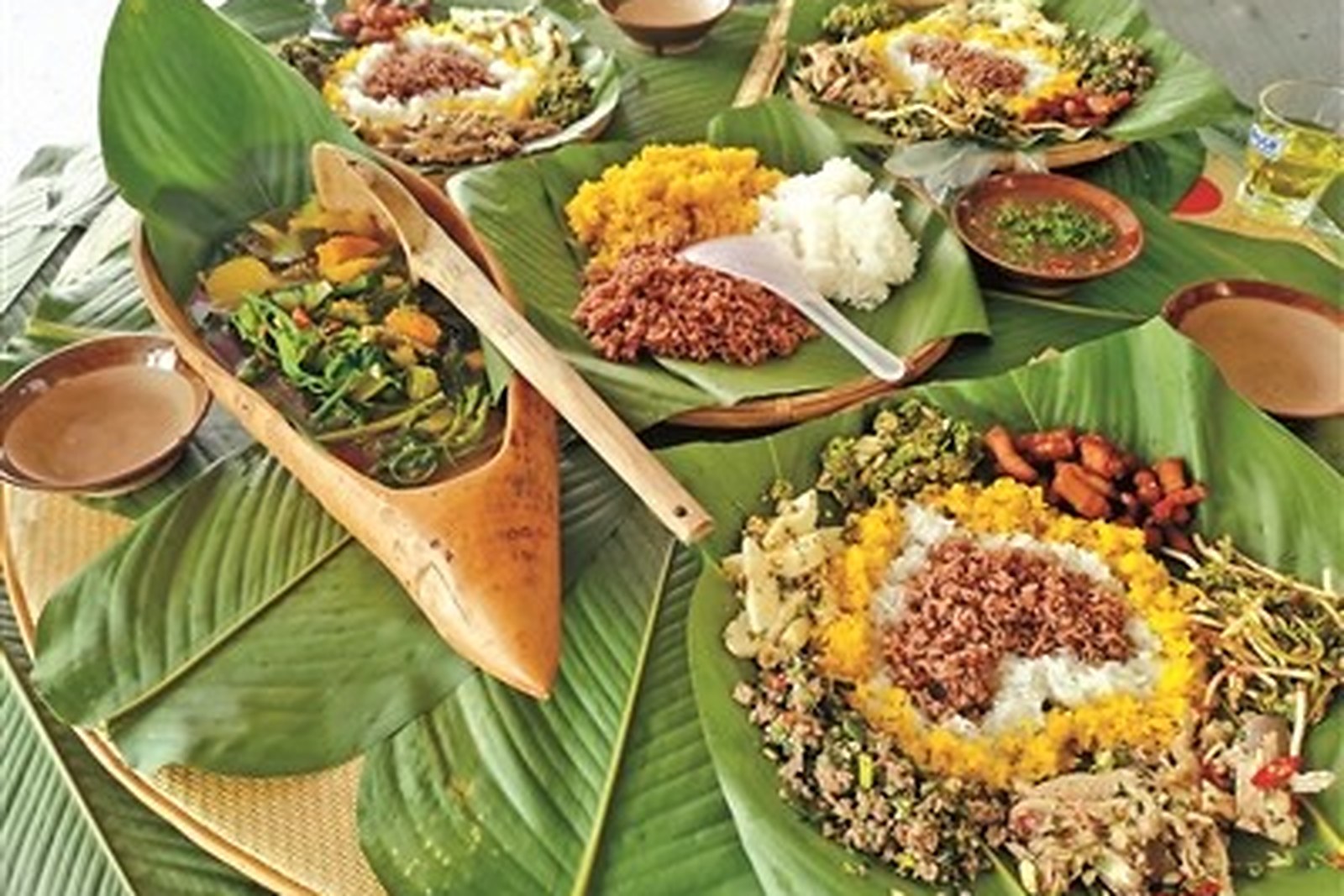
flowcloud would say that the 绿叶宴 lǜyèyàn is a whole Jingpo feast laid on banana leaves – 鬼鸡 guǐjī, 烤肉 kǎoròu, 舂菜 chōngcài and 竹筒饭 zhútǒng fàn in a ring you eat by right hand – sixty to a hundred-fifty yuan a head for a group – and that the honest move is to go four-deep, wash up, and let the host point the meat, because the leaf is the plate and the mortar is the kitchen. All checked October 2026.
Where to find it: 景颇族 Jǐngpōzú banquet houses and village 农家乐 nóngjiālè farm kitchens across 德宏 Déhóng – a set 绿叶宴 lǜyèyàn runs about 60-150 yuan a head and needs a group of three or four to be worth laying (worth confirming the per-head price and dish count); book ahead, wash your hands, eat with the right hand, and ask the host to point the 鬼鸡 guǐjī and 烤肉 kǎoròu. It is the Jingpo full-table feast, served on banana leaves and eaten by hand. All checked October 2026.