
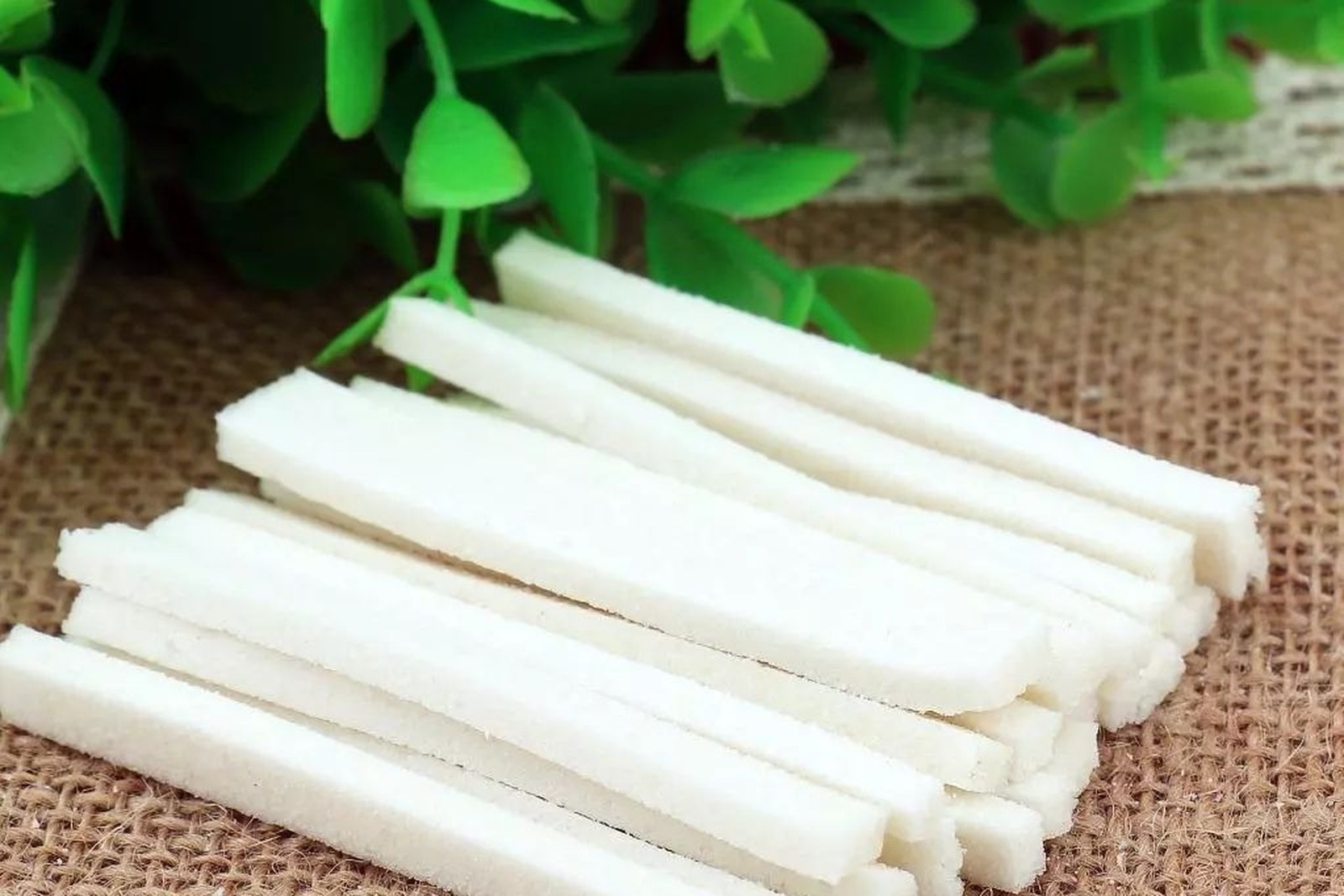
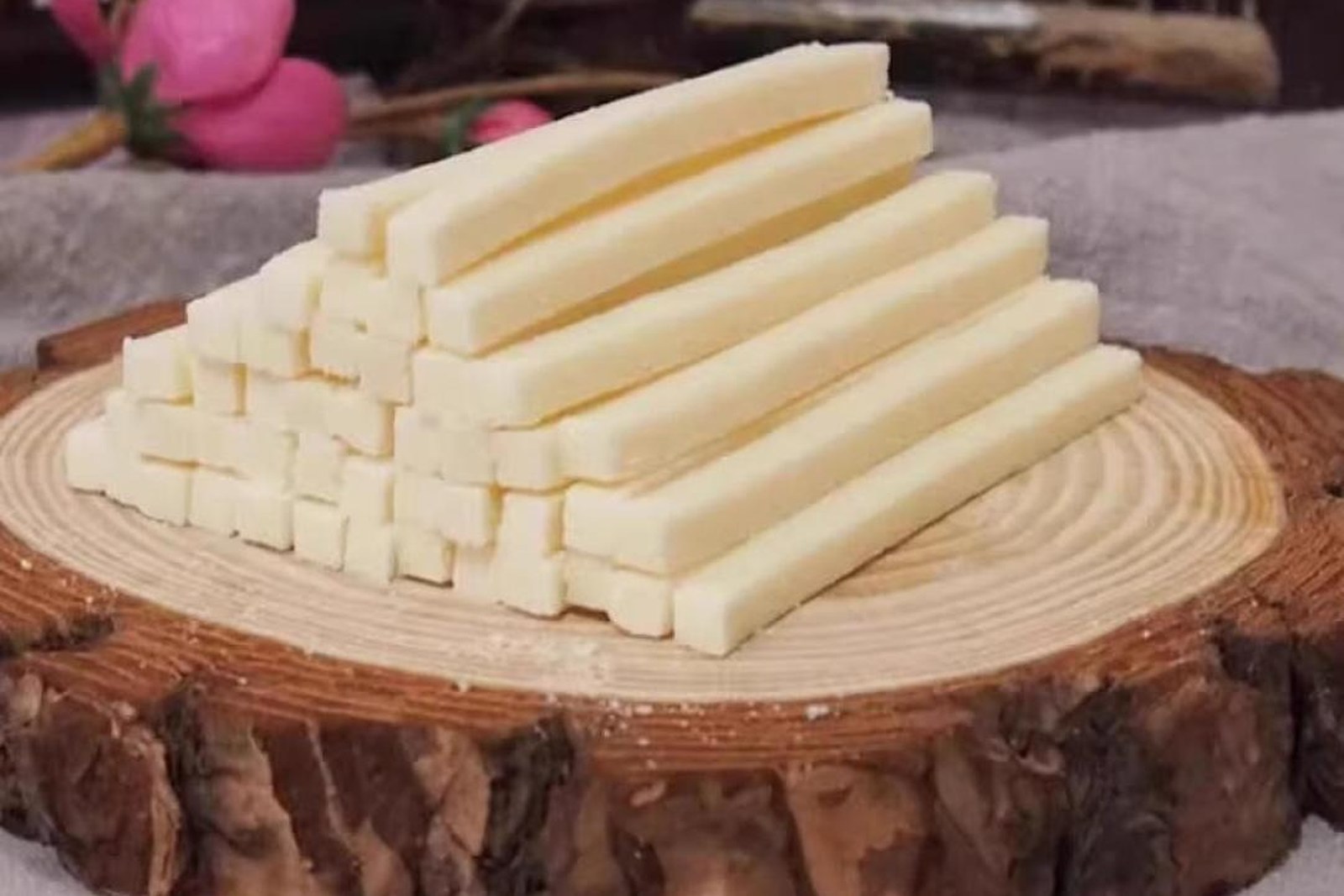
灯芯糕 Dēng xīn gāo, lamp-wick cake, is 湘潭市 Xiāng tán shì’s contribution to the small list of Chinese sweets that can be set on fire. It is a bar of compressed rice flour and sugar, pale, faintly translucent, about as thick as a pencil and as long as a finger, and it is called a lamp wick because that is exactly what it looks like. Bend it and it goes round into a circle without breaking. Hold a match to the end and it burns, slowly, giving off the smell of cassia rather than of scorched flour. It tastes of sugar, pork fat and cassia oil, and the taste is much more refined than the trick suggests.
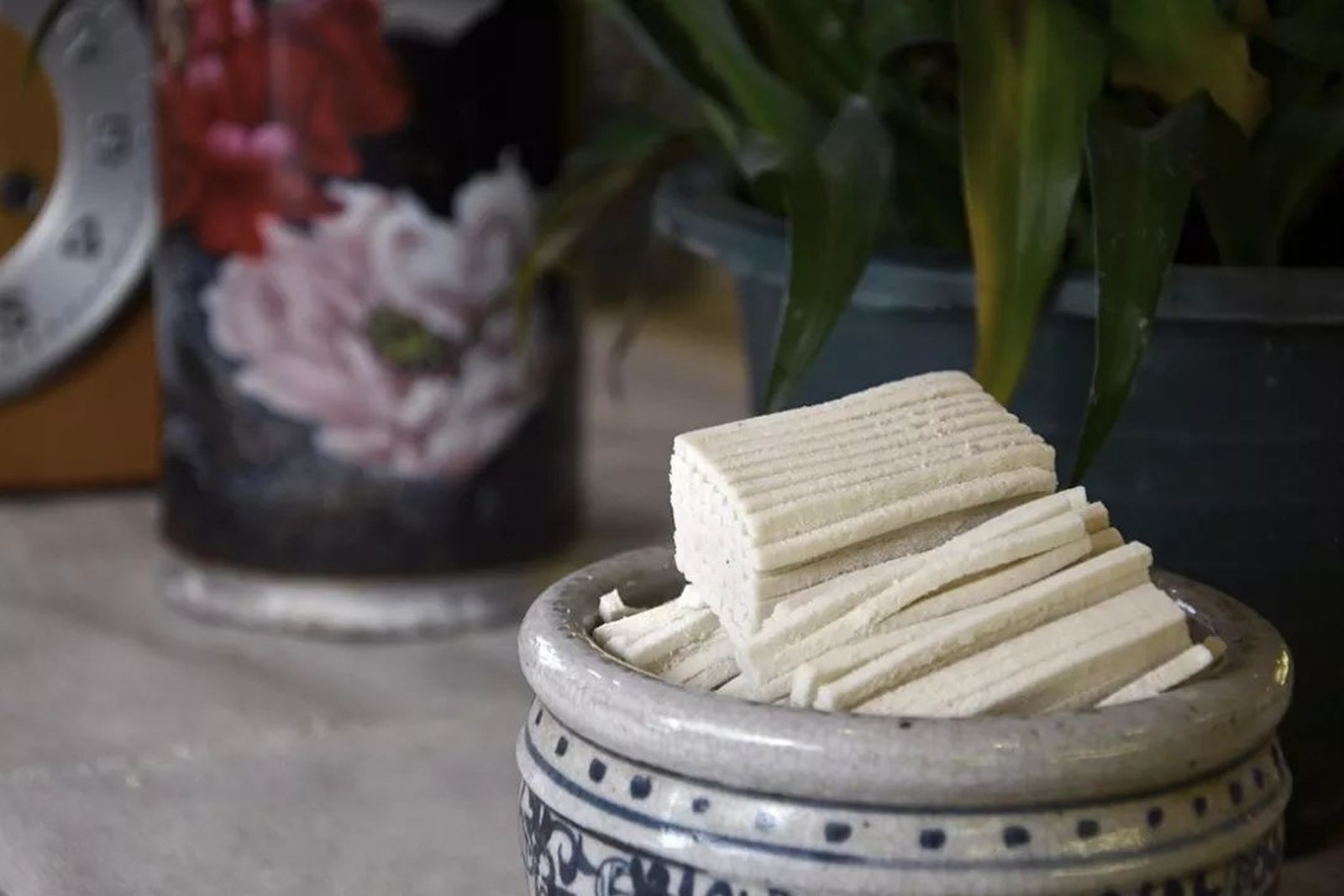
The name comes with a story that is told in every account of the cake, and it is a story about a mother. In 忠臣乡 Zhōng chén xiāng, a village in what is now 湘潭县, there lived a poor scholar called 易奎 Yì Kuí and his widowed mother. He passed the first examination at seventeen, and then put off the next one three times over to nurse her through illness, until at twenty-eight she insisted he sit it. He returned from the examination town to find her unconscious with a lamp wick between her lips, the household having nothing else to give her. He milled what little glutinous rice there was, steamed it with sugar, cut the block into strips of the same shape and fed them to her one at a time, and she came round. The result of the examination arrived soon afterwards and he had passed, and the village took up the cake. That is legend. The documentary version is terser: the local gazetteer credits the invention to two men, 黄正大 Huáng Zhèng dà and 周维四 Zhōu Wéi sì. Either way the cake is more than four hundred years old.
What makes it difficult is the texture, and the texture is why it can be lit. The method is summarised as five steps – 选、炒、擀、蒸、切, choose, roast, roll, steam, cut – containing nineteen separate operations, and the whole thing takes over a month because one of the stages cannot be hurried. Glutinous rice of high protein content, grown locally, is roasted at high heat and then milled to a fine 元粉 yuán fěn, the base flour. White sugar is crushed and worked together with pork fat and maltose and left to ferment naturally for seven days, a stage the makers call 泡糖 pào táng, steeped sugar, which is what marries the fat to the sugar so that neither separates later. The flour, the steeped sugar and the cassia oil are then combined in fixed proportions, rolled and re-rolled thin, sieved, pressed into a mould and steamed until it sets. The set block is then cut, by hand, into the wicks. Getting a strip thin enough to catch light and strong enough to bend without snapping is the whole skill, and it is done with a knife on a board by somebody who has done it for twenty years.
The honours are older than most of the province’s food awards. In the Xianfeng years of the Qing, at a national exhibition of regional specialities, Xiangtan’s lamp-wick cake was graded a first-class product; in 1915, at the same Panama exposition where the city’s soy sauce took a medal, it was singled out for praise by the foreign judges; and in May 1988 it was named one of Hunan’s 名糕点 míng gāo diǎn, its signature pastries. The recipe has been adjusted over the years – refined cassia oil has largely replaced ground cassia bark, which made the aroma both cleaner and stronger – and the technique was listed on the province’s fifth batch of intangible cultural heritage in 2021. The current standard-bearer is 胡军 Hú Jūn, the fourth-generation representative inheritor, who began at nineteen in a Xiangtan pastry works and now cuts cake at 新华斋 Xīn huá zhāi, a shop on 半边街 Bàn biān jiē in 岳塘区 Yuè táng qū, where the workshop was named a municipal heritage workshop in 2025 and a provincial one in January 2026. His version is less sweet and less fatty than his teacher’s, which widened the market from the old to the young, and the cakes now go out by post, including, memorably, to an elderly Chinese woman in Cambodia who ordered them because she could not get them there.
Words and Names
灯芯糕 dēng xīn gāo is lamp-wick cake, from 灯芯, a lamp wick, and 糕, cake. 元粉 yuán fěn is the milled base flour made from roasted glutinous rice. 泡糖 pào táng is the seven-day fermentation of sugar with pork fat and maltose, the stage that gives the cake its short, non-greasy crumb. 桂子油 guì zi yóu is cassia oil, the flavour that comes off a burning wick. 红丝 hóng sī are the shreds of dyed candied peel that traditionally decorate the cake, and 名糕点 míng gāo diǎn is the old provincial designation for a signature pastry.
What the Locals Know
The local test of a lamp-wick cake is the match. Take one out of the box, light the end, and if it burns steadily with a clean cassia smell the cake is good; if it will not catch, the fat and sugar were not married properly and the texture is wrong too. The second test is the bend, and the third is the snap, which should be crisp rather than crumbly. A freshly made box is also, according to the trade’s own proudest claim, a continuous fuse: light the first wick and it will pass the flame along from one to the next, through the whole box, for the better part of a day. Nobody recommends doing this with a box you intend to eat, but the fact that it can be done is the point. Eat it with plain tea rather than anything sweet, and if you find the old-style version too rich, the modern lower-sugar ones are made by the same workshops and are worth asking for.
flowcloud would say that a sweet invented by a man who fed his dying mother strips of rice shaped like the lamp wick she was chewing, and which has survived four centuries on the strength of being able to prove itself with a match, has a better claim on the name of a local delicacy than most things that carry it.
Where to find it: 新华斋 Xīn huá zhāi at 半边街 Bàn biān jiē in 岳塘区 Yuè táng qū, 湘潭市, where the current inheritor cuts the cake, and the traditional-pastry counters of the city’s food halls and railway-station shops; a box of the ordinary kind runs about ¥20 to ¥50 and the gift boxes rather more. It travels and keeps well, which makes it the local thing most people actually carry home. 湘潭站 Xiāng tán zhàn and 湘潭北站 Xiāng tán běi zhàn are the two stations, and the shop is within a short taxi ride of the centre.