
Cabbage-Wrapped Rice, and the Cakes of a Ding’an New Year
菜包饭 càibāofàn is a green parcel: a lettuce leaf in the palm, a spoonful of rice fried with pork belly, sausage, dried shrimp, squid and vegetables, folded with both hands and eaten standing. 定安县 Dìng’ān xiàn has recorded it since at least the Guangxu reign, when the county gazetteer noted a dish of mustard greens wrapping rice, fish and meat, called it 芥包饭 and read it as 银包金, silver wrapped in gold, a charm against quarrels. The wrapping leaf became lettuce and the name became 菜包饭, and in December 2023 the province listed the technique as intangible cultural heritage.
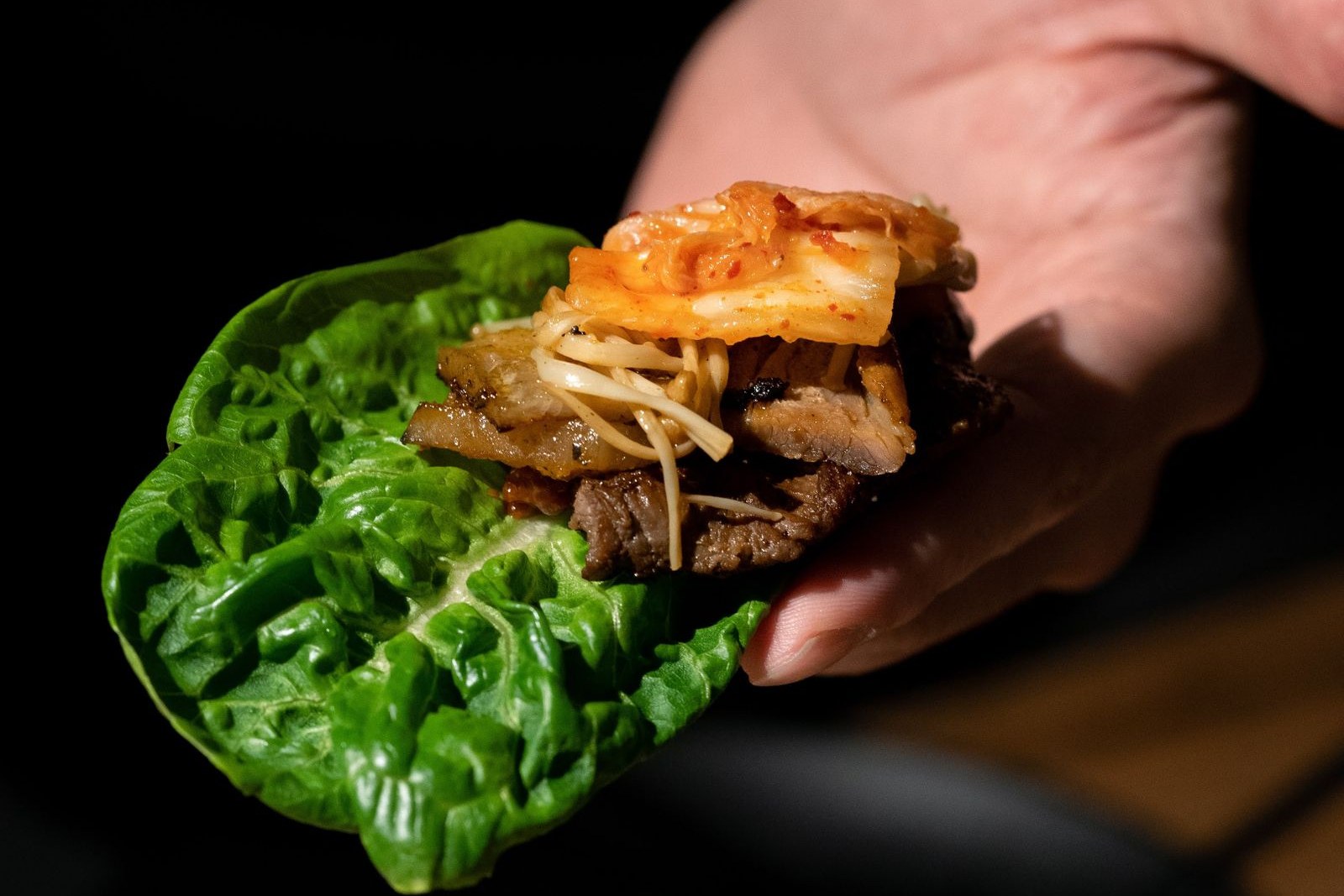
The documentation is unusually good. 莫家桐 Mò Jiātóng, a late-Qing senior graduate, wrote in 《定安乡土志》 the line 正月初三祭赤口吃菜包饭: on the third day of the first month, sacrifice to 赤口 and eat cabbage-wrapped rice. 《光绪定安县志》, the county gazetteer of the Guangxu reign, expands it: for the third day, raw mustard greens wrapping rice with fish, meat and sour and pungent things, 取其银包金, taking it as silver wrapped in gold, 亦以弭口舌之灾也, and also to stop quarrels and slander. The mustard leaf gave way to the local lettuce, which the county calls 油菜 yóucài. The county’s heritage account says a hundred years old, while a 2016 news account says the Yuan, which has no document behind it.
The filling is a market garden and a drying rack at once. There is rice, cooked the day before from local old-grain rice, cooled and kept loose rather than sticky. There is meat: pork belly, 腊肠 làcháng sausage, dried shrimp, dried squid, chicken gizzard and duck gizzard. There are vegetables, and this is the part that varies: chives, garlic sprouts, celery, 藠头 jiàotóu Chinese onion, pickled greens, green beans and green pepper. The press says more than twenty ingredients; the county says there is no fixed recipe. The dressing marks it as local: the county’s own 什锦酱 shíjǐnjiàng, a mixed sauce, with garlic chilli, ground sesame and peanut, sesame oil and coriander.
The method is six steps. In the morning someone brings in a few large lettuces, washes the leaves and leaves them to drain. Everything else is diced small and evenly, the slowest part of the day. Lard goes into the wok and the order is strict, meat before vegetables: belly and sausage first to render their fat, then dried shrimp and squid for the smell of the sea, then the vegetables, added in batches so that each keeps its own cooking time. A second hot wok takes the cold rice, fries it through, and the vegetables go back in and are turned until the pork, the greens and the rice have merged. A lettuce leaf goes into the bowl, is wiped round with sauce, three or four spoons of rice go on top, and both hands close it into a purse.
The meanings are the hook. The family shouts 包金包银,团团圆圆, wrap gold and silver, stay together, before eating, and holding the parcel is meant to gather the household’s money and keep it from leaking away. A hand reddened by the heat of the rice is read as a good year, and oil running between the fingers is read as wealth running over; the shape is called a green 聚宝盆 jùbǎopén, a treasure bowl. The old text’s purpose is still remembered: 祭赤口 jì chìkǒu, the sacrifice that stops quarrels and the slander that comes out of mouths.
Words and Names
菜包饭 càibāofàn is the parcel, and 芥包饭 jièbāofàn is what the gazetteer called it when the leaf was mustard; 银包金 yínbāojīn, silver wrapped in gold, is the old reading of it, and 裹菜糒 guǒ càibèi is another local name for the making. 生菜 shēngcài, or 油菜, is the lettuce leaf; 藠头 jiàotóu is the Chinese onion in the filling; 什锦酱 shíjǐnjiàng is the mixed sauce; 赤口 chìkǒu is the quarrel-spirit of the third day. The cakes below are 薏粑 yìbā, 筐粑 kuāngbā, the red-sugar new-year cake, 九层糕 jiǔcénggāo, the nine-layer cake, 鸡屎藤粿 jīshǐténg guǒ, and 木薯烙 mùshǔ lào, the cassava pancake of the 南丽湖 shore.
What the Locals Know
On 28 December 2023 the Hainan provincial government approved 传统菜品烹饪技艺(定安菜包饭烹制技艺), the cooking technique of Ding’an cabbage-wrapped rice, into the sixth batch of the provincial intangible cultural heritage list as item Ⅷ-30, and published the file in 2024. The county’s inheritors are county-level and not provincial, and should be named that way: 王献荃 Wáng Xiànquán, the second holder of the technique in three generations of his family; and 李爱柳 Lǐ Àiliǔ, who has fried the rice for twenty-five years and trained five or six apprentices, one born after 2000.
The cake family is the other half of the county’s new year. 薏粑, the coconut-leaf pudding, is common across northern Hainan: glutinous rice soaked three or four hours, milled, pressed in a cloth bag, a third of the dry flour cooked back into the rest, filled with crushed peanut, sesame, coconut and winter melon, and steamed in a pouch woven from coconut leaf. 筐粑, the red-sugar new-year cake, is boiled rather than steamed here: the rice is milled and dried to a half, rolled into flattened 粑个, dropped into boiling ginger and red-sugar syrup, stirred with two long poles, and poured into a flat bamboo basket, which is where the name comes from; it is cut with red string rather than a knife. 鸡屎藤粿 belongs to 东北街北巷, which the county calls its birthplace.
The county’s 2010 list fixes what is local. The 十大特色小吃, decided at the first Ding’an food festival, ran: 定安粽子 first, 定安菜包饭 second, 仙沟腌粉 third, 定安炒粉 fourth, 定安年糕 fifth, 定安粟米粑卷 sixth, 定安鸡屎藤粿 seventh, 定安九层糕 eighth, 定安甜酸萝卜片 ninth and 南丽湖木薯烙 tenth. Two claims need correcting: an encyclopaedia entry dates 九层糕’s listing to 2013, either a second selection or an error, and the same source says the cassava pancake was listed 2010 后, after 2010, when the official list shows it in the first batch.
flowcloud would say that 定安菜包饭 is a gazetteer entry you can hold in one hand – mustard greens in the Guangxu record, lettuce now, rice fried with pork and dried squid, folded up as gold and eaten standing.
Where to find it: the hotel and restaurant kitchens of 定城镇 Dìngchéng zhèn, where 菜包饭 is a standing item on the menu; the old walled town, whose west and north gates and the wall between them are the only relatively intact county-seat wall left in Hainan; 吴记杂粮 Wújì záliáng on 经贸路 and 美天小吃 on 人民中路, where 薏粑, 九层糕 and the other cakes are sold through the day; 东北街北巷 for 鸡屎藤粿, the county’s own birthplace for it; and the 南丽湖 Nánlì hú lakeside, where the cassava for 木薯烙 is grown in sand. Buy a 筐粑 to take away.