
鼎湖上素 Dǐnghú shàngsù translates as the supreme vegetarian dish of Dinghu, and the name is a claim rather than a description. It is a monastery dish from 庆云寺 Qìngyún Sì, the temple on 鼎湖山 Dǐnghú Shān, and its reputation rests on the fact that it contains nothing that grew from an animal and almost nothing that is out of season: mushrooms of several kinds, bamboo shoots, lily buds, snow fungus, dried bean curd, fresh vegetables, and a clear sauce. The ingredients are cooked separately and combined at the last moment, which is unusual in a Cantonese kitchen and is the whole technique. Each item keeps its own texture, and the sauce is deliberately thin so that it does not flatten them into one flavour. The temple version is served in a bowl, layered rather than tossed, with the pale ingredients at the top and the dark mushrooms beneath. The broth that moistens it is made from dried mushrooms and soy, with a little sugar and no garlic or onion, since the monastic kitchen avoids the five pungent vegetables. What arrives at the table is mild, faintly sweet and extraordinarily varied in texture, and it is the variety rather than any single ingredient that people remember.
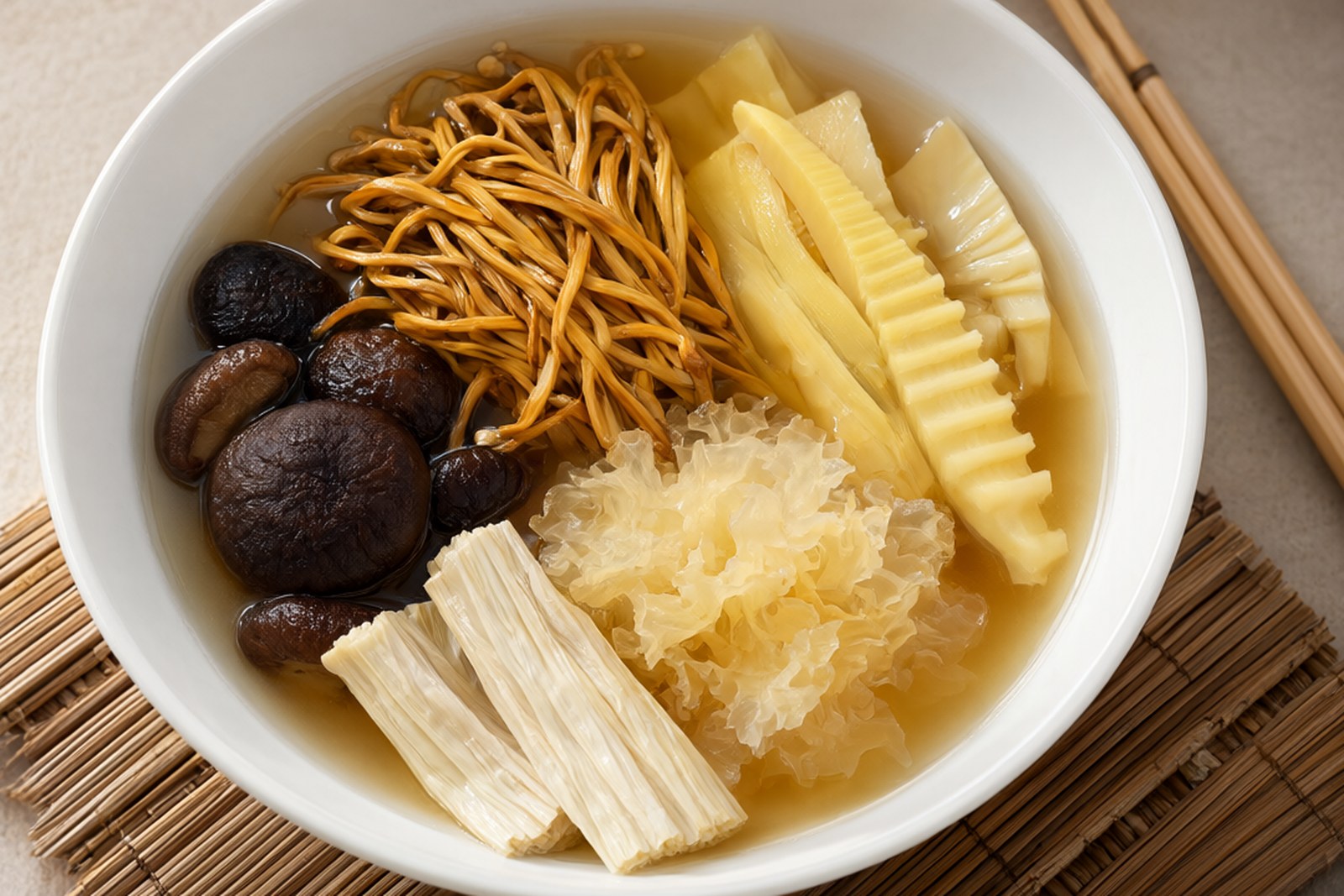
The dish is expensive to make properly and cheap to fake. A genuine 上素 runs to a dozen or more ingredients, several of them dried and needing separate soaking, and the separate cooking means a dozen small pans. The shortcut version, which is what most restaurants outside the temple serve, stir-fries everything together and thickens the result with cornflour, producing a brown, uniform stew. The difference is visible: in the real one the items are still distinct in the bowl and the liquid is clear and light.
Dinghu Mountain itself is a UNESCO biosphere reserve and one of the four famous mountains of Lingnan, and the temple kitchen has been cooking this way for centuries, so the association between the dish and the hill is not marketing. The surrounding restaurants all claim the recipe, and the ones at the foot of the mountain, where the spring water and the wild mushrooms are local, tend to be better than the ones in the city.
What Makes It a Monastery Dish
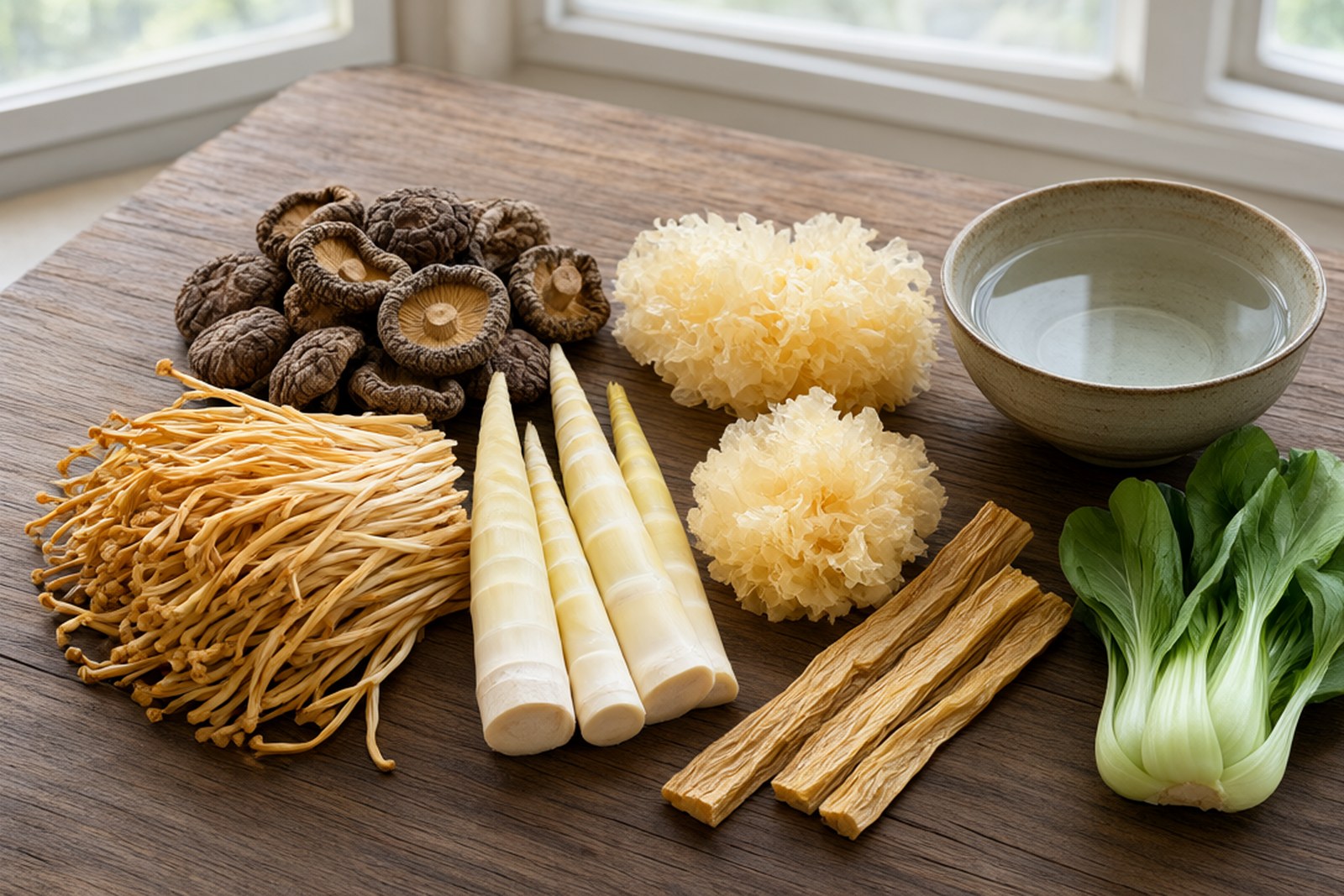
Buddhist temple cooking in the Cantonese tradition is a cuisine with its own rules, and 鼎湖上素 is its best-known export. No meat, no fish, no 蒜 suàn garlic, no 葱 cōng spring onion, no chives and no leek, since those are held to disturb the mind; no alcohol; and a preference for ingredients that can be dried and stored, because the temple kitchens fed large numbers of people from a larder rather than from a market. Dried shiitake, 金针 jīnzhēn lily buds, 云耳 yún’ěr wood ear, 竹笙 zhúsheng bamboo fungus and 腐竹 fǔzhú bean curd skin are the staples, and they are what gives the dish its depth.
The name 上素 shàngsù itself is interesting: 素 sù is the ordinary word for vegetarian, and 上 shàng means superior or upper, so the dish is presented as the vegetarian dish, the one against which the others are measured. It has spread to Hong Kong and to the Cantonese diaspora under the same name, and it appears on banquet menus as the vegetarian course in a way that no other temple dish does.
Words and Names
鼎湖上素 Dǐnghú shàngsù, sometimes written 鼎湖上素菜 Dǐnghú shàngsù cài. 鼎湖山 Dǐnghú Shān is the mountain, 庆云寺 Qìngyún Sì the temple. 素 sù means vegetarian, 斋 zhāi the stricter monastic diet, and 上素 shàngsù the superior vegetarian preparation. 香菇 xiānggū is shiitake, 竹笙 zhúsheng bamboo fungus, 金针 jīnzhēn dried lily bud, 云耳 yún’ěr wood ear, 竹笋 zhúsǔn bamboo shoot, 腐竹 fǔzhú bean curd skin and 雪耳 xuě’ěr snow fungus. 清汤 qīngtāng is a clear broth, which is what the sauce is built on.
What the Locals Know
Order it at a temple restaurant or a 斋铺 zhāipù, a specialist vegetarian shop, rather than at a general restaurant, and ask whether the ingredients are cooked separately; a place that says yes will usually be proud of it. The dish is better at lunch than at dinner, because the dried items are soaked in the morning. Vegetarians should also check for oyster sauce, which some kitchens use out of habit and which would disqualify the dish; ask for 走蚝油 zǒu háoyóu, without oyster sauce. Prices at the temple restaurants around Dinghu run from about fifty to a hundred and fifty yuan for a bowl for two, and the cheap versions are usually the shortcut ones.
flowcloud would say that 鼎湖上素 is the rare dish whose reputation is built on restraint, since it does nothing to hide what it is made of and depends entirely on the cook having respected each ingredient separately.
Where to find it: the vegetarian kitchens at the foot of 鼎湖山 Dǐnghú Shān outside 肇庆市, above all the restaurants attached to 庆云寺 Qìngyún Sì, and the 斋菜馆 zhāicàiguǎn vegetarian restaurants in the city that keep the dish on the menu all year. Ask for 鼎湖上素 by name, request it without oyster sauce if that matters to you, and eat it as the first course rather than alongside meat dishes.