
Dongan Chicken, Yongzhou’s Vinegar-Braised Classic
The plate looks almost innocent: pale strips of chicken, glossy with a thin sauce, scattered with red chilli rings, ginger threads and a few dark Sichuan peppercorns. Nothing about it announces heat. Then you take a piece and the vinegar arrives first — sharp, clean, fermented rice vinegar rather than the harsh clear kind — followed by the chilli, then a slow numbing tingle, and finally the chicken itself, which is firm and slightly bouncy and tastes of having been cooked properly rather than boiled to death. 东安鸡 Dōng’ān jī is one of the eight canonical dishes of Hunan cooking and, by most accounts, the first among them.
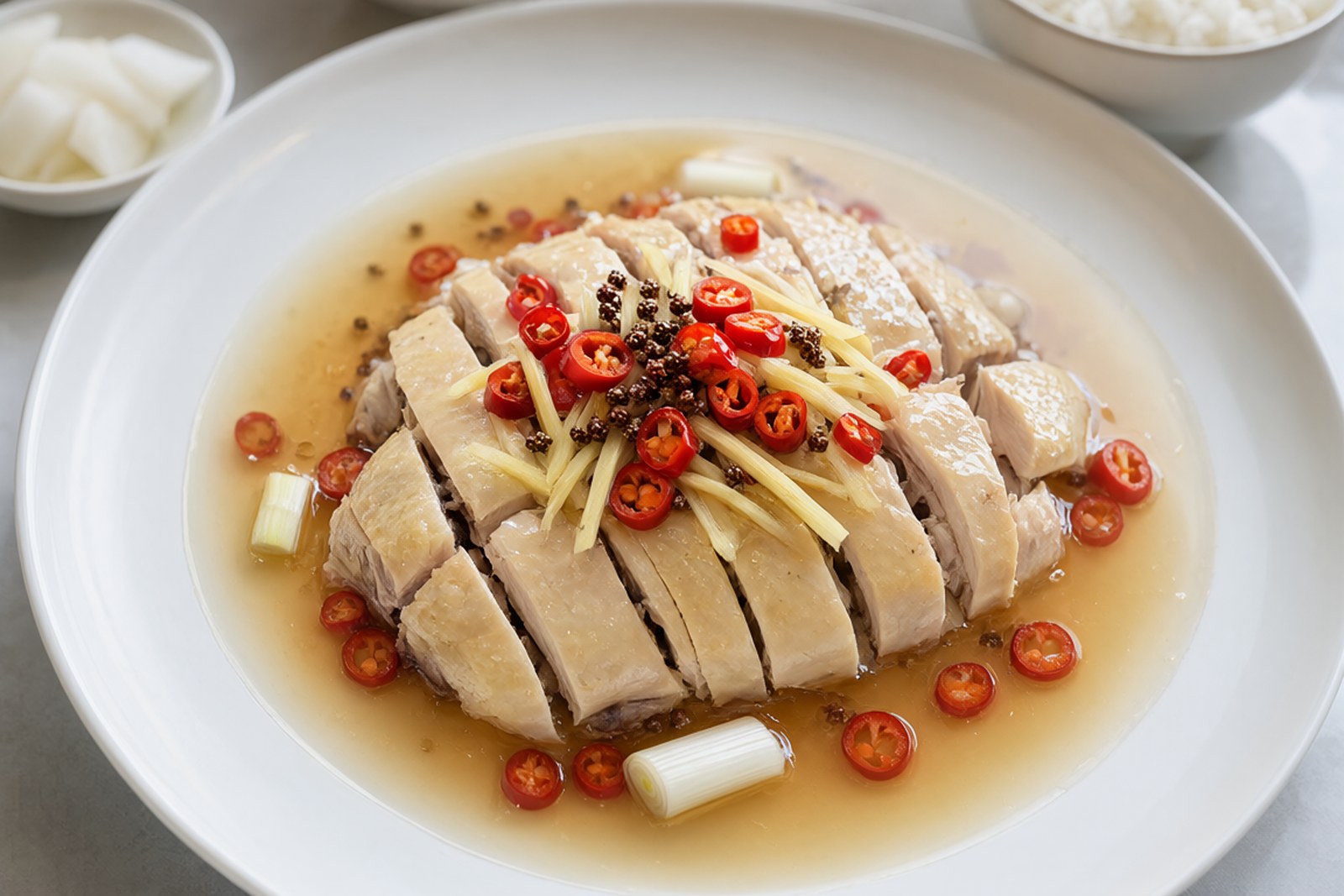
It comes from 东安县 Dōng’ān Xiàn, a county of hills and small rivers in the far south-west of Yongzhou, and specifically from the market town of 芦洪市 Lúhóngshì, where the local birds are said to have small legs and heavy breasts because they spend their lives walking up slopes. The dish has had at least four names and four origin stories, which is a sign of how old it is. The earliest places a cook in a small inn during the Western Jin, around 290, who reached for the wine and got the vinegar; the guests liked it so much that the county magistrate summoned him to explain himself. The other common version moves the accident to the Tang, during the Kaiyuan era, and makes the innkeepers three old women. Both are the same story with different centuries attached.
What is documented is the last two hundred years. In the late Qing the dish was carried out of the county by 席宝田 Xí Bǎotián, a Yongzhou-born general of the Xiang Army who had risen to the rank of 宫保 gōngbǎo and liked the vinegar chicken enough to serve it to his guests; when one of them, the story goes, asked its name and he hesitated over the peasant sound of “vinegar chicken”, 曾国藩 Zēng Guófān is supposed to have suggested 宫保鸡 Gōngbǎo jī, the palace-protector’s chicken. Then in the Republican period it acquired its modern name through 唐生智 Táng Shēngzhì, a native of Dongan who had become a senior general in the Nationalist army. After the Northern Expedition he gave a banquet in Nanjing, served the dish, and when asked what it was called — nudged by an aide muttering “home town flavour, home town dish” — said: this is a speciality of our Dongan, it is called Dongan chicken.
It travelled further than that. 郭沫若 Guō Mòruò records eating it at Tang’s house in Changsha during the war. In February 1972 it is said to have been on the menu when Mao Zedong entertained Richard Nixon in Beijing, which is how a vinegar accident in a country inn ended up in the diplomatic record. It has been a protected geographical indication since 2017 and its technique went onto Hunan’s intangible heritage list in 2021.
The Six Tastes and the Sixteen Pieces
The dish is described by its own cooks as having six flavours at once — 香、甜、酸、辣、嫩、脆 xiāng, tián, suān, là, nèn, cuì: fragrant, sweet, sour, hot, tender, crisp — which sounds like marketing until you eat one, and then it is simply accurate. The sourness is rice vinegar and it is not shy. The sweetness is a suggestion. The heat comes from two different chillies, dried and fresh. The tenderness is the meat and the crispness is the skin and the connective tissue, which is where the cooking method shows.
The method is unusual for a braise. A young hen, ideally under a year and never one that has laid, is poached whole for eight to ten minutes only — until a chopstick pushed into the thigh comes out clean. It is then taken apart, bones removed, and cut along the grain into strips about five centimetres long. Those strips are stir-fried hard with ginger and chilli to build a red oil, then the vinegar, wine, salt, pepper and a little stock go in, and it braises for two or three minutes until the liquid is nearly gone. A spoonful of starch slurry thickens what remains, sesame oil goes over the top, and it is out of the pan before the chicken has a chance to tighten.
The older cooks insist on the knife work: sixteen pieces from one bird, eight large and eight small, arranged on the plate so that they reconstitute the animal. You will not get sixteen pieces in a modern restaurant, but you will get the pale colour, and the paleness is correct. Dongan chicken is not supposed to look cooked.
Words and Names
东安 Dōng’ān means “eastern peace”, a name the county has held since the Song. 子鸡 zǐjī is a young chicken, the term the classical recipe uses; 东安子鸡 Dōng’ān zǐjī is the formal name on banquet menus. 醋鸡 cùjī, vinegar chicken, is the original and is still what older people call it at home. 宫保 gōngbǎo, palace guardian, is an honorary title, and it is why the dish is sometimes confused with 宫保鸡丁 Gōngbǎo jīdīng, the Sichuan chicken with peanuts — they share a name and nothing else.
The vinegar is not any vinegar. Recipes from the county specify local rice vinegar, 米醋 mǐcù, and this is the single hardest ingredient to substitute. Distilled white vinegar will make the dish bitter and flat.
What the Locals Know
The leftovers are not leftovers. Dongan chicken is one of the few Chinese dishes explicitly said to improve overnight, because the chicken keeps absorbing the vinegar. Locals cook a large batch deliberately.
Ask for 微麻 wēimá if you are not used to it. The Sichuan peppercorn is not decoration; the tingle is part of the traditional flavour profile and it is the one element outsiders find hardest.
Eat it with plain rice and nothing else. The dish is strongly flavoured enough that a vegetable alongside it will taste of nothing.
The bone is supposed to be pink. Cooks aim to keep the marrow slightly red, which is why the poaching time is measured in minutes and not in tenderness. If your chicken is thoroughly grey all the way through, the kitchen was cautious and the dish is duller for it.
Where to Eat It
Everywhere in Yongzhou, and reasonably well in Changsha. The county itself is still the best bet — 东安县 Dōng’ān Xiàn, around the 芦洪市 Lúhóngshì market, where the local birds and the local vinegar are both within reach. A half bird for two people runs about ¥60–90 and a whole one ¥110–160. In Yongzhou city the older banquet restaurants list it first on the menu, which is where it belongs.
flowcloud would say that this dish is a reminder that a mistake is only a mistake if you do not taste it first — that the cook who grabbed the vinegar instead of the wine, and then had the presence of mind to add ginger and pepper to cover for himself, is the patron saint of every kitchen where something has just gone wrong.
Where to find it: 东安鸡 (Dōng’ān jī), 东安县 (Dōng’ān Xiàn), 永州市 (Yǒngzhōushì), 湖南 (Húnán). Best around 芦洪市 (Lúhóngshì) in 东安 county, and in the older banquet restaurants of 零陵 (Línglíng). Half bird ¥60–90, whole ¥110–160. Ask whether the vinegar is local 米醋 (mǐcù); if the answer is yes, order it.