
东方火龙果 Dōngfāng huǒlóngguǒ, the dragon fruit of 东方市 Dōngfāng Shì Dongfang, is the crop that turned a stretch of the city’s sandy west into a grid of glowing orchards, and it is grown here as the red-fleshed fruit that most of China eats by another name, pitaya. The city’s dragon fruit carries a geographical-indication certification mark approved in April 2018 and a place on a national list of specialty-agriculture advantage zones in February 2020, and it has been the city’s largest fruit crop by area, the province’s biggest producer and, in 2024, an exporter to Europe. The plant is a climbing cactus, the fruit sets at night, and the trick that made the city’s season long is a string of lights.
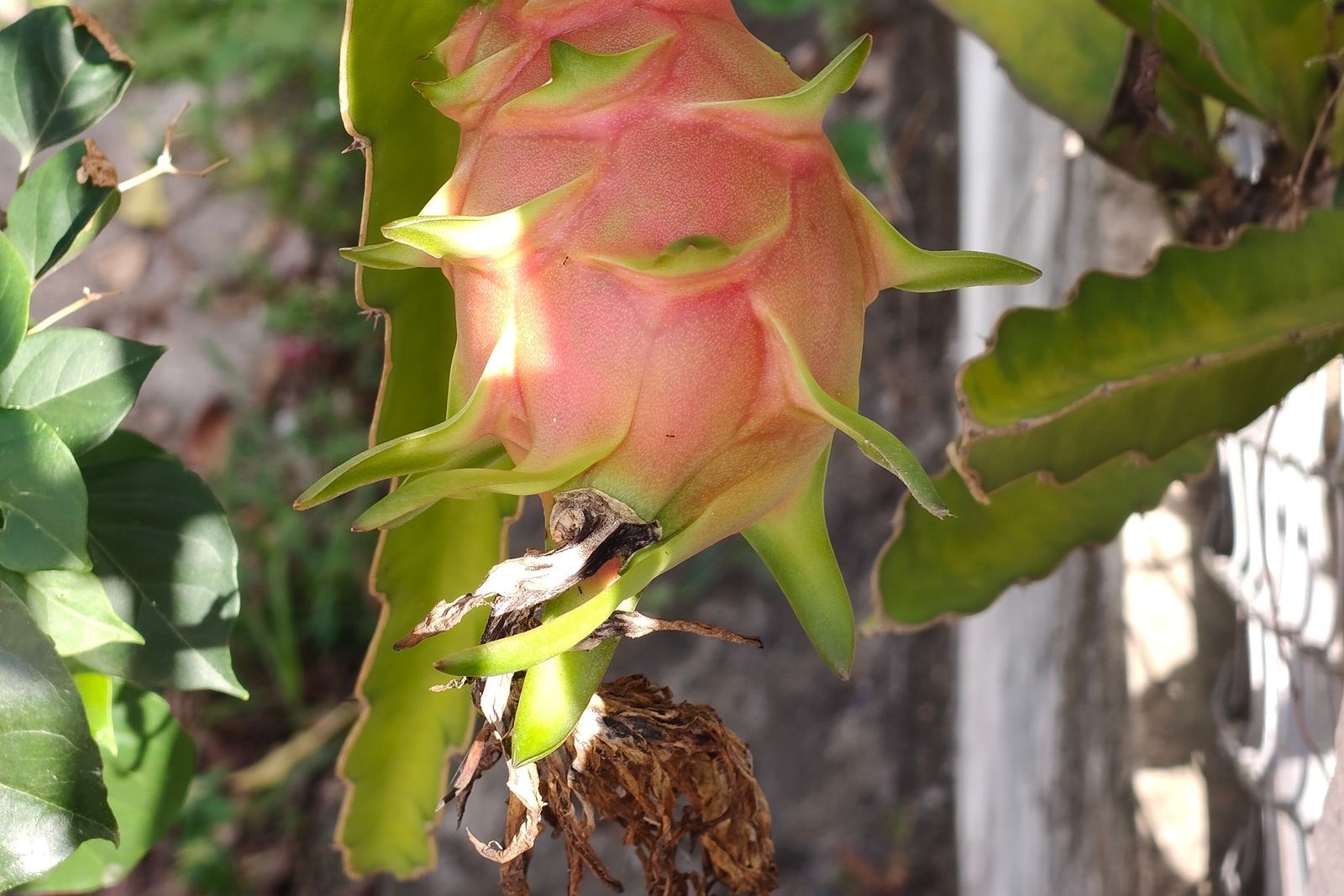
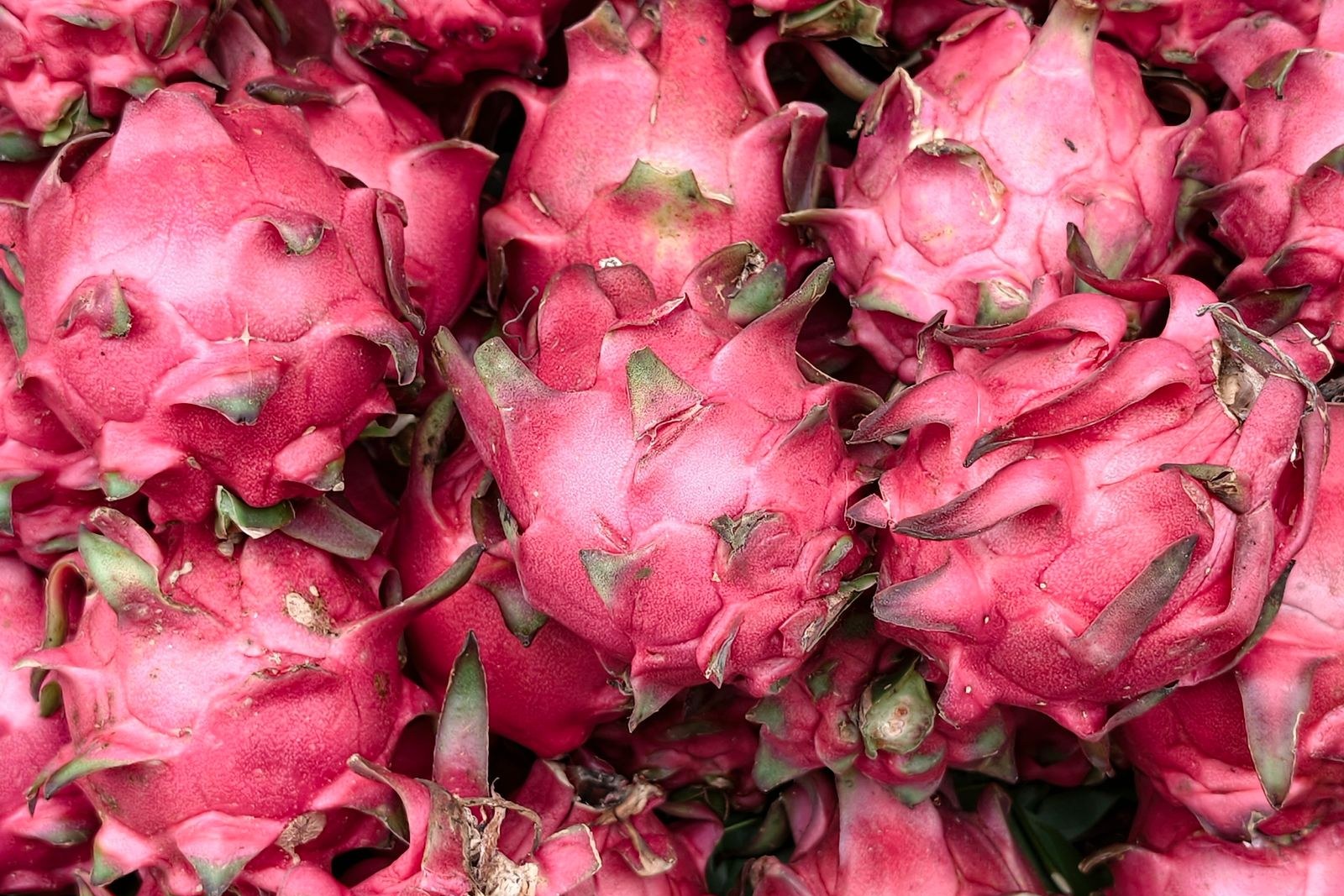
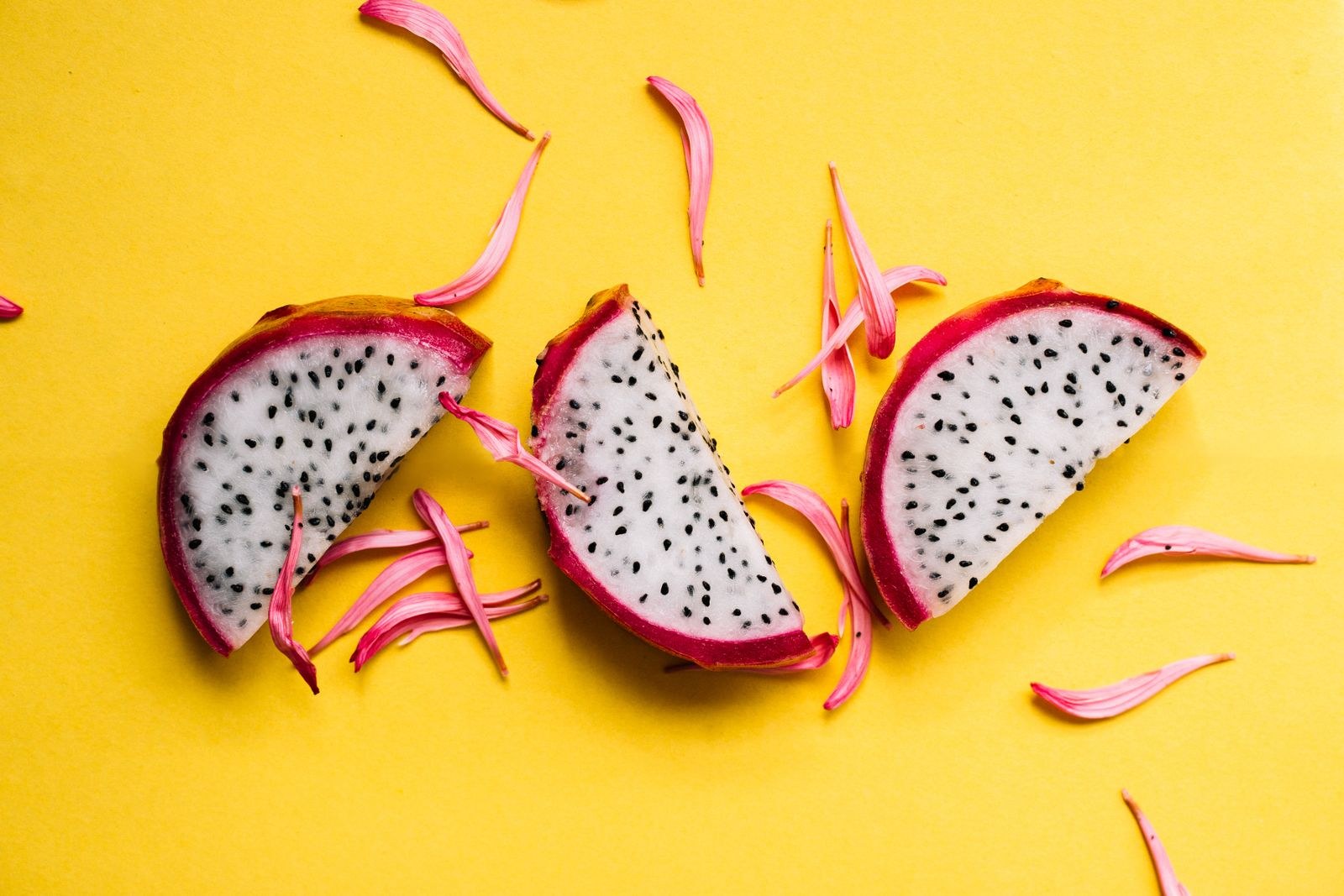
The seal is the strongest single fact. The provincial market regulator’s register lists 东方火龙果 as a geographical-indication certification mark, application number 22384335, approved on 14 April 2018 and registered to the city’s agricultural service centre; a provincial gazetteer dates the approval to the day before, 13 April 2018, and records the city putting the mark into use on 29 June 2019, and where the two agree is that the mark is real and its year is 2018. The second identity is national: in December 2019 the city’s dragon fruit was named in the third batch of China’s specialty-agriculture advantage zones, and in late February 2020 nine central ministries jointly confirmed it. The register’s own description of the fruit is worth keeping as the register’s words: larger than usual, well shaped, crisp, sweet and full of juice, with a rose-like fragrance, an oval form in bright red, and scales broad, thick and soft so that the fruit travels without bruising.
The crop came in as an experiment and changed shape twice. Planting began in 1998, at first scattered, and only reached scale in 2012. The first cuttings in the middle and late 1990s were red-fleshed seedlings brought from Taiwan and set into the sandy soil beside the Changhua River, and the city’s ground turned out to suit the cactus rather better than anyone had planned: sandy loam that drains, plenty of sun, and a position between eighteen and twenty degrees north. The second change was light. Around 2008 a Taiwanese team brought the practice of fixing lamps above the rows to imitate a long day, which forces the plants to flower through the autumn and winter when the natural day is short, lifting the crop and leaving the orchards lit like a grid of small stars at night; the local tellings carry the technique, so it is printed here as their account. Together the seedling and the lighting are why the city’s season runs so much longer than the mainland’s.
The area and the output have to be handled with care, because the city’s own figures change with the year and the office that counts. The city planted some 38,000 mu in 2018; a 2019 note put it above 33,000 mu with yields over six thousand jin a mu; a 2019 gazetteer entry gives 3,400 hectares and 171,500 tonnes; an unsourced encyclopedia line for 2020 says more than 60,000 mu; a 2024 industry piece gives more than 62,000 mu, close to 180,000 tonnes and more than two billion yuan of value; and an April 2025 training-meeting report gives 73,000 mu, over 180,000 tonnes, twenty-four bases above a hundred mu and sixty large operators. Those are not one series and they are not to be averaged. The number this article stands on is the one with a government signature: the city’s statistical bulletin puts dragon-fruit output at 195,400 tonnes for 2024, down 4.2 per cent, and then records a sharp fall to 137,900 tonnes for 2025, down 29.4 per cent, a drop the bulletin states and this article repeats rather than smoothing into a growth story. For scale, the province as a whole had roughly 180,000 mu of dragon fruit in 2025, a Hainan number and not this city’s.
The fruit went abroad in its own name in March 2024, when a first consignment of seven hundred kilograms left for Manchester, after earlier shipments to Canada by one of the city’s operations; it is a small volume and it is printed as an example rather than as a trade. Behind the fresh fruit sits processing: more than twenty city enterprises work the crop into wine, dried fruit, jam and flower tea, and the fruit sits on the city’s list of ten agricultural brand names under the public brand the city government launched in 2022, 东方味美 Dōngfāng Wèiměi. The orchards are grown through cooperatives and bases that hire locally, so the pruning, the night work and the grading line have turned farm labourers into wage workers in the towns around Basuo, Donghe and Banqiao. What the record refuses here is a price: no authoritative source consulted for this article gives a current farm-gate or retail figure for the fresh fruit, only that it is sold by the jin in season, so none is printed.
Words and Names
东方火龙果 Dōngfāng huǒlóngguǒ is the fruit and 火龙果 huǒlóngguǒ the everyday name; 红心 hóngxīn, red-hearted, is the type grown here, and the mark on the packed fruit is the city’s certification mark approved in 2018. 东方味美 Dōngfāng Wèiměi is the city’s public farm-produce brand. 八所 Bāsuǒ, 东河 Dōnghé, 板桥 Bǎnqiáo, 三家 Sānjiā and 大田 Dàtián are the townships the orchards run through. No dragon-fruit page exists elsewhere on this site, so the differentiation this page owes is simpler than most: the island’s tropical-fruit history is not re-written here, and the city’s other crop pages keep to their own fields.
What the Locals Know
The night orchards are the experience, and the honest way to see them is from the road. Along the G98 expressway and the scenic tourist highway that runs through 板桥镇 Bǎnqiáo Zhèn Banqiao, 东河镇 Dōnghé Zhèn Donghe and the Basuo outskirts, the fields glow from dusk in the flowering season, and the city counts its largest single block at Banqiao, some seven thousand mu. Picking is not a ticketed attraction; the bases are working farms, and a grower will arrange a look through a cooperative or a farm stay rather than at a gate.
Pair the fruit with the city’s south line: crocodiles and pineapple at 三家镇 Sānjiā Zhèn Sanjia in the morning, then the dragon-fruit lights along the Banqiao and Donghe road at dusk. Fresh fruit is bought in the markets of Basuo and the coastal towns, and the wine, the dried fruit and the flower tea are the things that travel home. What the record refuses, once more and plainly: a single acreage or output figure for the city, since the counts from 2018 to 2025 do not describe one crop; a tested sugar reading, since the twenty-five-per-cent line is not a laboratory number; and any export total, of which only one seven-hundred-kilogram consignment is documented.
flowcloud would say that Dongfang’s dragon fruit is a red-fleshed pitaya grown on the city’s sandy west, carrying a certification mark approved in April 2018 and a February 2020 place on the national advantage-zone list, its orchards lengthened into winter by night lighting, its fruit once flown to Manchester, and its output falling sharply in 2025 to about 138,000 tonnes.
Where to find it: the dragon-fruit orchards of 八所镇 Bāsuǒ Zhèn Basuo, 东河镇 Dōnghé Zhèn Donghe, 板桥镇 Bǎnqiáo Zhèn Banqiao, 三家镇 Sānjiā Zhèn Sanjia and 大田镇 Dàtián Zhèn Datian, best seen as night-lit fields from the G98 expressway and the island scenic tourist highway, in 东方市 Dōngfāng Shì Dongfang, Hainan; the fruit is bought fresh by the jin in the markets in season on a 2026-10 snapshot that fluctuates, the wine and the dried fruit are the shelf-stable souvenirs, and orchard visits are arranged through cooperatives rather than at the gate.