
Tangbusui, Dongkeng’s Sweet Glutinous Balls
糖不甩 táng bù shuǐ, tangbusui – the name means sugar won’t shake off – is Dongkeng’s sweet glutinous ball: unfilled balls of glutinous-rice dough boiled through, then lacquered in a hot syrup of brown or slab sugar and finished with crushed roasted peanut and shreds of fried egg. The texture the sources promise is 酥滑香甜, crisp-smooth, fragrant and sweet, an appetite-opener that does not cloy; the alternate name is 如意果 rúyì guǒ, the as-you-wish fruit, a good-fortune dumpling by another name. It belongs to 东坑镇 Dōngkēng zhèn Dongkeng Town in the city’s eastern Pudi belt – the town whose version the county’s own food pages single out – and it sits on this site’s sweet shelf next to double-skin milk as a different branch of the Guangdong dessert tree: a milk-set custard there, a glazed rice ball here, no filling where tangyuan has one, a syrup coat where tangyuan floats in soup.
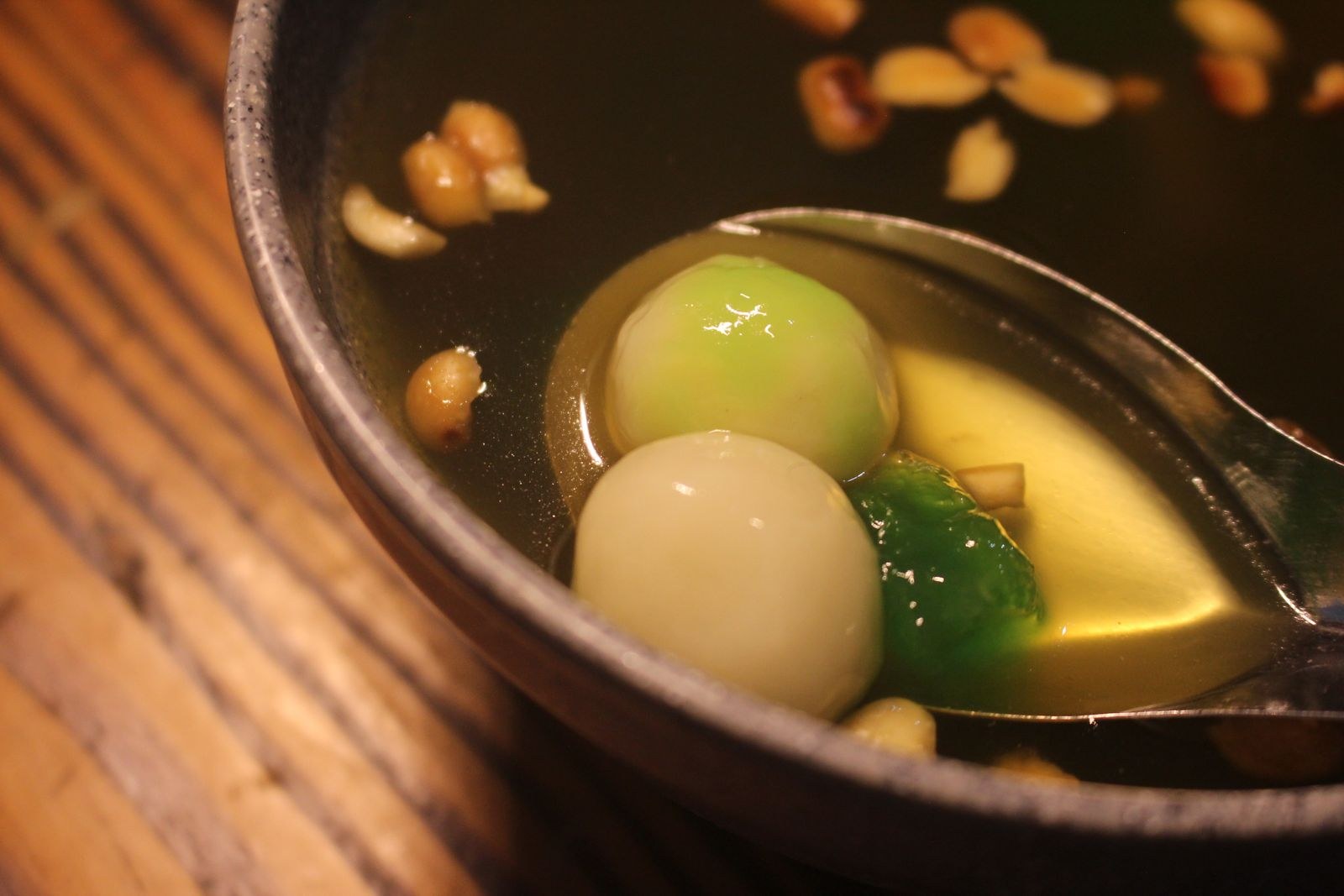
The heritage paper is municipal and only municipal: in 2010 tangbusui entered Dongguan’s second batch of city-level intangible-heritage items, traditional-craft class, Dongkeng the place of record and the town’s culture service the protecting unit. No provincial listing exists, and this text claims none. What the culture centre’s file says about age is deliberately modest: the sweet resembles the Lantern Festival’s tangyuan, it is old beyond tracing – 其源于何时已无从考究, when it began the record cannot say. Legend offers more than the record will: a Qing-Daoguang tale of opium heavy on the town, and the immortal 吕洞宾 Lü Dongbin descending as an old man, boiling immortality pills into glutinous balls with syrup, selling cheap and giving away, until the craving broke. It is a fine story and it is a legend – legend says, and only that; the Daoguang dating belongs to the tale, not to the craft.
The custom is the dish’s real engine, and it is a marriage custom. In the old days across Dongkeng and its neighbouring Pudi towns, a young man’s first call on a girl’s family was the looking-over visit, 相睇 in the local word; if her parents approved, out came a bowl of tangbusui – the match, the name declares, will not be shaken off, 甩 shuǐ being shake. He ate one bowl; a second bowl meant the families wanted the thing doubled, good things in pairs. But if the kitchen sent egg-drop sweet soup with bean-curd sticks instead, the message was the opposite – 散, scattered, the match politely dissolved in dessert. A bowl of tangbusui was a yes; egg-drop fuzhu sweet soup was a polite no. It is the clearest yes-or-no dish in Guangdong’s sweets, and the town has never let the story go.
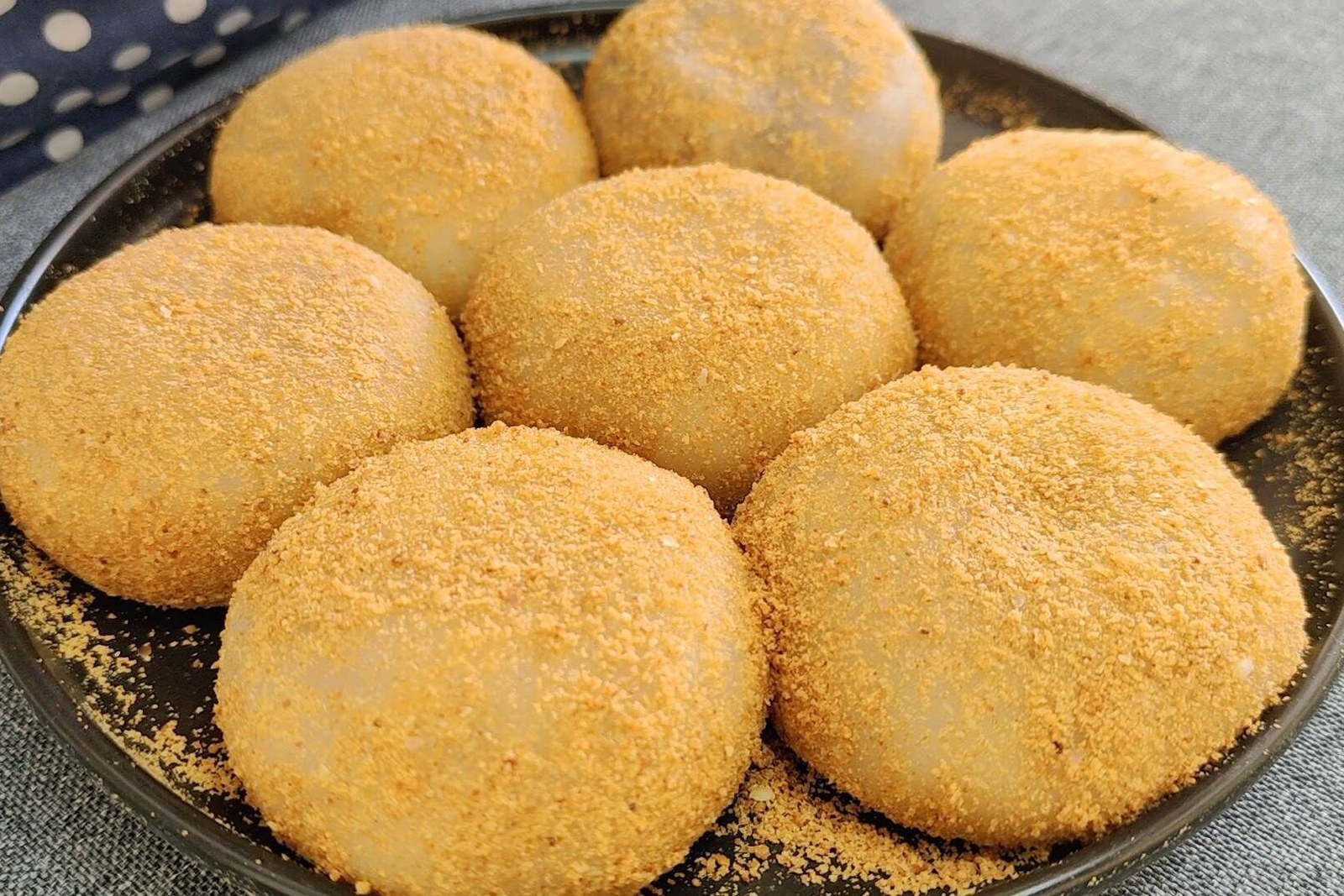
The craft the file prints runs eight moves: pound the rice, sift the flour, knead, roll the balls, boil, shock cold, boil the syrup, glaze – near ten steps by the provincial daily’s count. Everything hangs on the syrup: fire short of the mark and the glaze will not cling to the ball; fire past it and the sugar scorches black and the look goes with it – the file’s own words are that success lives or dies at the syrup pot. The cast is short: glutinous-rice flour, brown sugar, roasted peanuts, fried egg shreds, ginger in the syrup for warmth. The eating occasion is older than dessert: the sweet grew out of the field-meal culture, 食晏昼, the afternoon meal taken in the fields in the three-to-five hours; in the years when brown sugar was dear, a tangbusui drowned in syrup was the classiest field meal a farm family could put out. Now it sits on New Year tables beside the city’s other glutinous things – the salty dumplings and the steamed cakes – one item in a family of sweets this page does not expand.
The festival that carries it now is the town’s own: 卖身节 Màishēn jié, the hiring fair, Dongkeng’s second-day-of-the-second-month carnival grown out of the old day-labour market – and, the legend’s own timeline insists, the very days the immortal came down to doctor the town. Through the fair the town’s hotels and eateries all put tangbusui on, the must-eat sweet of the Er-Yue-Er season. The register names 黄瑞珠 Huang Ruizhen as the city-level inheritor, with 谢慧然 Xie Huiran among the recommended inheritors – two names on one list, no relationship spelled out, and none invented.
Words and Names
糖不甩 táng bù shuǐ is sugar won’t shake off, tangbusui; 如意果 rúyì guǒ the as-you-wish fruit, its auspicious alias. 相睇 is the looking-over visit, the old matchmaking call. 甩 shuǐ is shake – the word the name hangs its promise on. 卖身节 Màishēn jié is the hiring fair, the second-month-second carnival. 食晏昼 is the afternoon field meal the sweet came out of. And the register’s names: 黄瑞珠 Huang Ruizhen the city-level inheritor, 谢慧然 Xie Huiran recommended alongside – the record prints no line between them.
What the Locals Know
The best day to eat it is the town’s best day: the second day of the second lunar month, when the hiring fair fills Dongkeng and every table in town serves the sweet. Any other day, the town’s tea houses and eateries keep it on; in old Guancheng the sweet houses along Zhenhua Road keep it too, three balls for around six yuan as of the late-2026 snapshots – a figure that will move with the syrup market, printed with its float. The fair-day version is the one the official narrative itself promotes: come to Dongkeng for the Er-Yue-Er fair, eat a bowl of tangbusui.
It is also the one dish in this batch a home kitchen can reproduce: the eight moves shrink to rice flour, a syrup pot and patience, the only real exam being the syrup’s fire – cling or scorch. What the record refuses: the immortal’s story as history, which stays a legend with its Daoguang dating inside the tale; any provincial heritage rank, which tangbusui does not hold; a registry of dedicated shops, which does not exist – the text invents no names; and any claim that the sweet has swept Hong Kong, which the sources carry only as travel-page talk. The hard skeleton of this dish is small – a municipal listing, eight steps, a marriage custom, one fair – and the text has kept it that size.
Order it warm: the syrup sets as it cools, and the whole point of the name is the glaze that will not let go of the ball – a cooled bowl is a different dessert. The fair-day stalls serve it fresh from the pot; the sweet houses plate it to order.
flowcloud would say that 糖不甩 is an answer you can eat – a ball glazed so the sweet will not shake off, served as yes and withheld as no, a syrup whose fire decides everything, and a town that still puts the whole custom on the table one fair day in the second month.
Where to find it: the tea houses and eateries of 东坑镇 Dōngkēng zhèn Dongkeng Town, Dongguan – best at the second-month-second hiring fair, when the whole town serves it; the old sweet houses of 莞城 Guānchéng Guancheng’s Zhenhua Road as the city-centre fallback, three for around six yuan as of the late-2026 snapshots. Eat it warm from the syrup pot, peanut and egg shreds on top, and remember the local grammar: tangbusui on the table is a yes.