
Dongpo’s Braised Knuckle, the Dish of the Exile’s Town
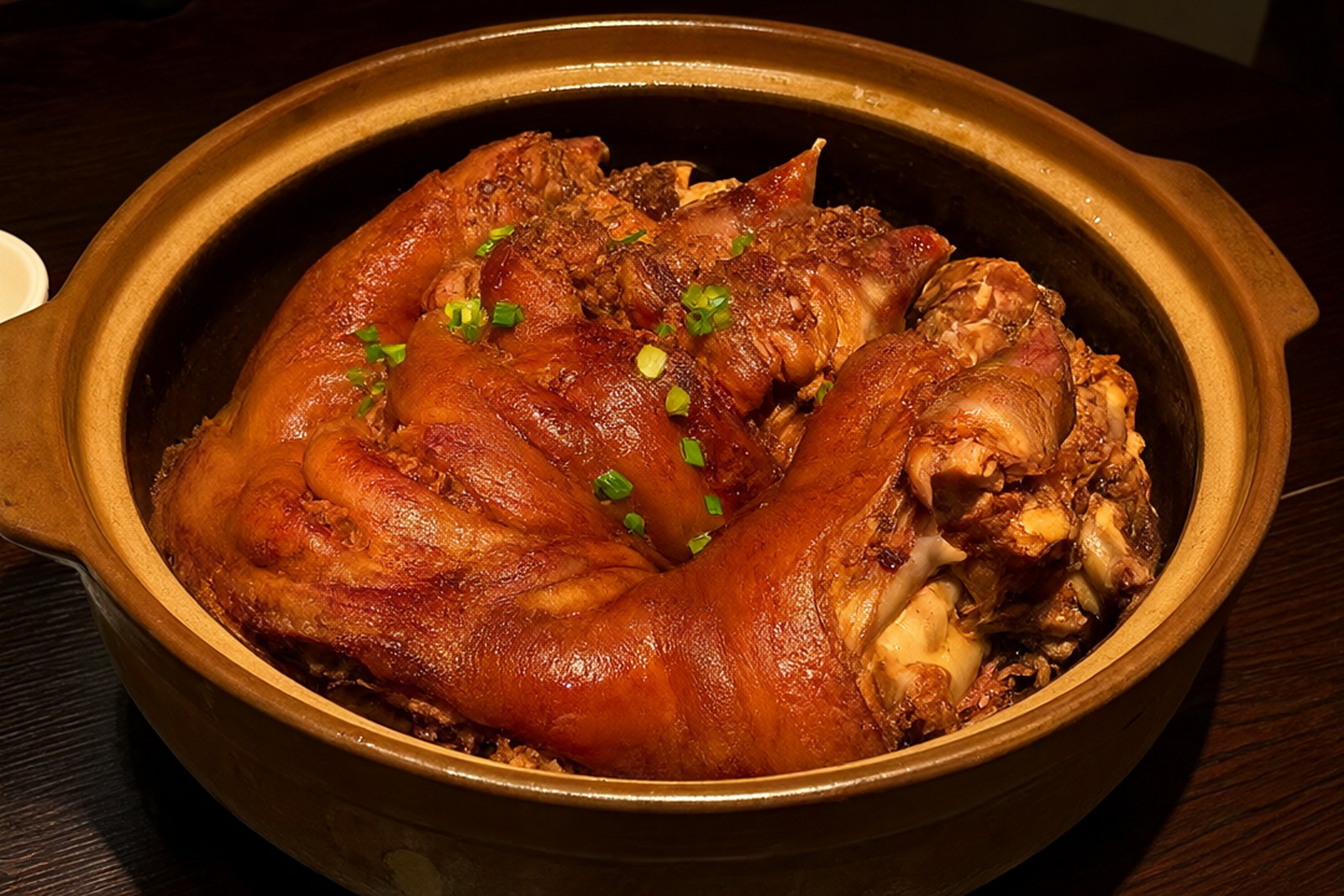
东坡绵蹄 Dōngpō mián tí is the braised pork knuckle of 中和镇 Zhōnghé zhèn, the old town west of 儋州市 Dānzhōu shì, and it carries the name of the man who was exiled here in 1097: 苏轼 Sū Shì, the poet and official known as 苏东坡 Sū Dōngpō, who spent three years on this coast and left behind a school, a well, a bridge and, if the town is to be believed, a way with pork. 绵 mián means soft, yielding, almost fibrous in the mouth, and it is the word that matters: a 绵蹄 is cooked long enough that the skin and the tendon have lost all resistance and can be lifted off the bone with a spoon.
Su Shi arrived in 儋州 in 1097, sent to the far end of the empire for his politics, and he did what he had done at every other posting, which was teach. The 东坡书院 Dōngpō shū yuàn, the academy the town later built on the site of his lectures, still stands at 中和 and is the reason the town is visited at all. The pork story is the one that attached itself to him everywhere he went: that a poet living on very little worked out how to make the cheapest cuts of pork last and taste good, by long slow braising with a little wine, soy and sugar, and that the method spread from his kitchen into the town’s. The claim is made all over the country, from 杭州 to 惠州 to here, and 儋州’s version is the knuckle rather than the belly.
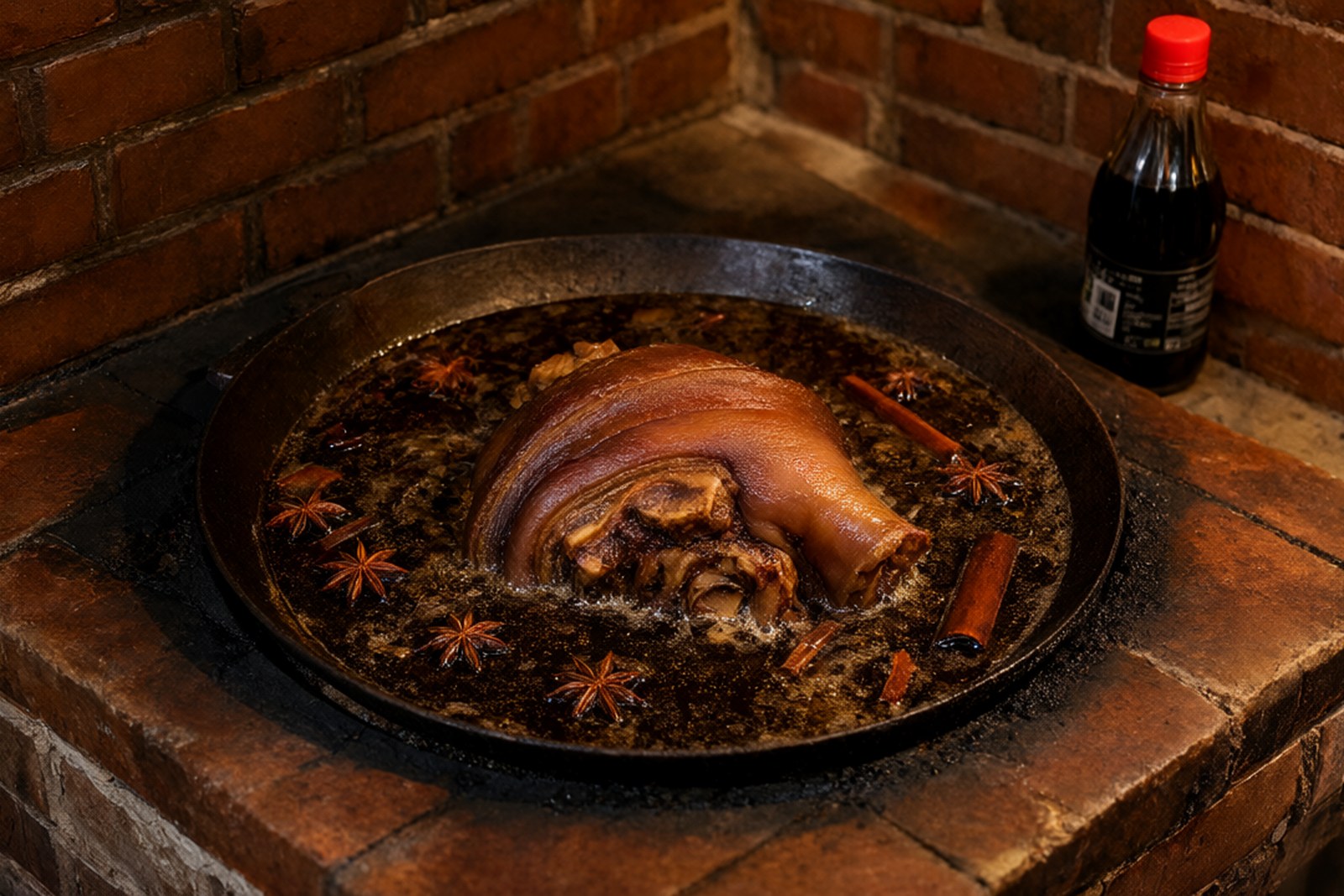
The cooking is a slow braise in a clay pot and the sequence is the whole dish. The knuckle, 蹄膀 tí bǎng, is blanched and scraped, then the skin is dried and the whole thing is set in a pot with 冰糖 bīng táng, rock sugar, which is caramelised in oil first so that the skin takes a deep mahogany before any liquid goes in. Then 生抽 shēng chōu and a little 老抽 lǎo chōu, light and dark soy, a splash of 米酒 mǐ jiǔ, rice wine, 八角 bā jiǎo, star anise, 桂皮 guì pí, cassia bark, ginger and a few cloves, and water to come halfway up. It simmers, barely moving, for two to three hours, and is turned twice so that no face of it dries. At the end the lid comes off and the sauce is reduced until it coats the back of a spoon.
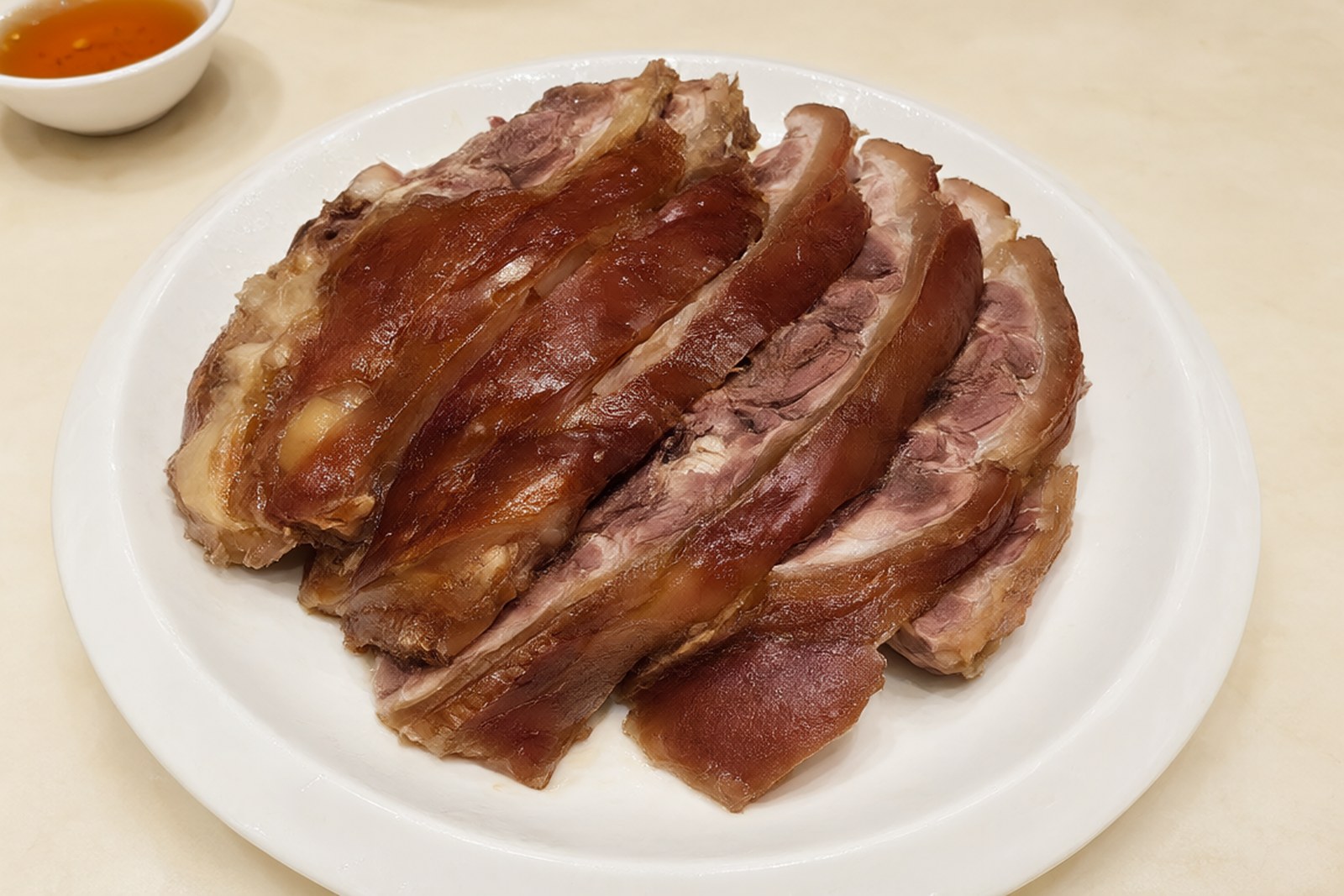
What arrives at the table is a whole knuckle, usually cut into thick slices and put back into its own shape so that the diner can see what they are eating. The skin is gelatinous rather than crisp, the fat under it has gone translucent, and the meat around the bone pulls into long strands with almost no pressure. It is served with plain rice and something sharp to cut it: 酸菜 suān cài, pickled greens, or 酸萝卜 suān luó bo, pickled radish, or a dish of 辣椒酱. In 中和 and 那大 the dish is on the menu of ordinary restaurants and not only the ones that trade on the poet’s name, and a plate is shared between three or four people, because nobody finishes a knuckle alone.
Words and Names
东坡 Dōngpō is the pen name of 苏轼 Sū Shì, the poet exiled to 儋州 in 1097; 绵蹄 mián tí is the dish, 绵 mián meaning soft or yielding and 蹄 tí the trotter or knuckle. 蹄膀 tí bǎng is the cut itself, the upper leg with the skin on. 冰糖 bīng táng is rock sugar, 生抽 shēng chōu and 老抽 lǎo chōu light and dark soy, 米酒 mǐ jiǔ rice wine, 八角 bā jiǎo star anise, 桂皮 guì pí cassia bark and 酸菜 suān cài pickled greens. 中和镇 Zhōnghé zhèn is the town and 东坡书院 Dōngpō shū yuàn the academy that carries his name.
What the Locals Know
Order it in 中和 if you can, because the town cooking to the poet’s name has had longer to practise, and ask for the knuckle rather than sliced pork, since the whole point is the skin and the tendon around the joint. It takes at least two hours, so a good restaurant will ask you to order ahead or will only serve it at set times; a plate that arrives in ten minutes is a different dish. Eat it with rice and something pickled, and use the sauce; the sauce after three hours is half of what you paid for. And walk the 东坡书院 afterwards, since it is the reason the name on the plate is there.
flowcloud would say that a poet exiled to the far end of the empire for his politics, who taught the island’s first scholars and is remembered for a pot of slow-braised pork, has left a legacy more durable than any of the offices he was denied, and that a town which still names a knuckle after him every evening has understood what is worth keeping.
Where to find it: the family restaurants of 中和镇 and the larger kitchens of 那大, the centre of 儋州市, where it is sold by the knuckle or by the slice; the restaurants beside the 东坡书院 all serve it. A whole knuckle for three or four people is ¥60 to ¥120 and a plate of slices ¥35 to ¥60. 中和 is about forty minutes by road west of 那大, and 儋州市 is a high-speed rail stop from 海口 in about fifty minutes.