
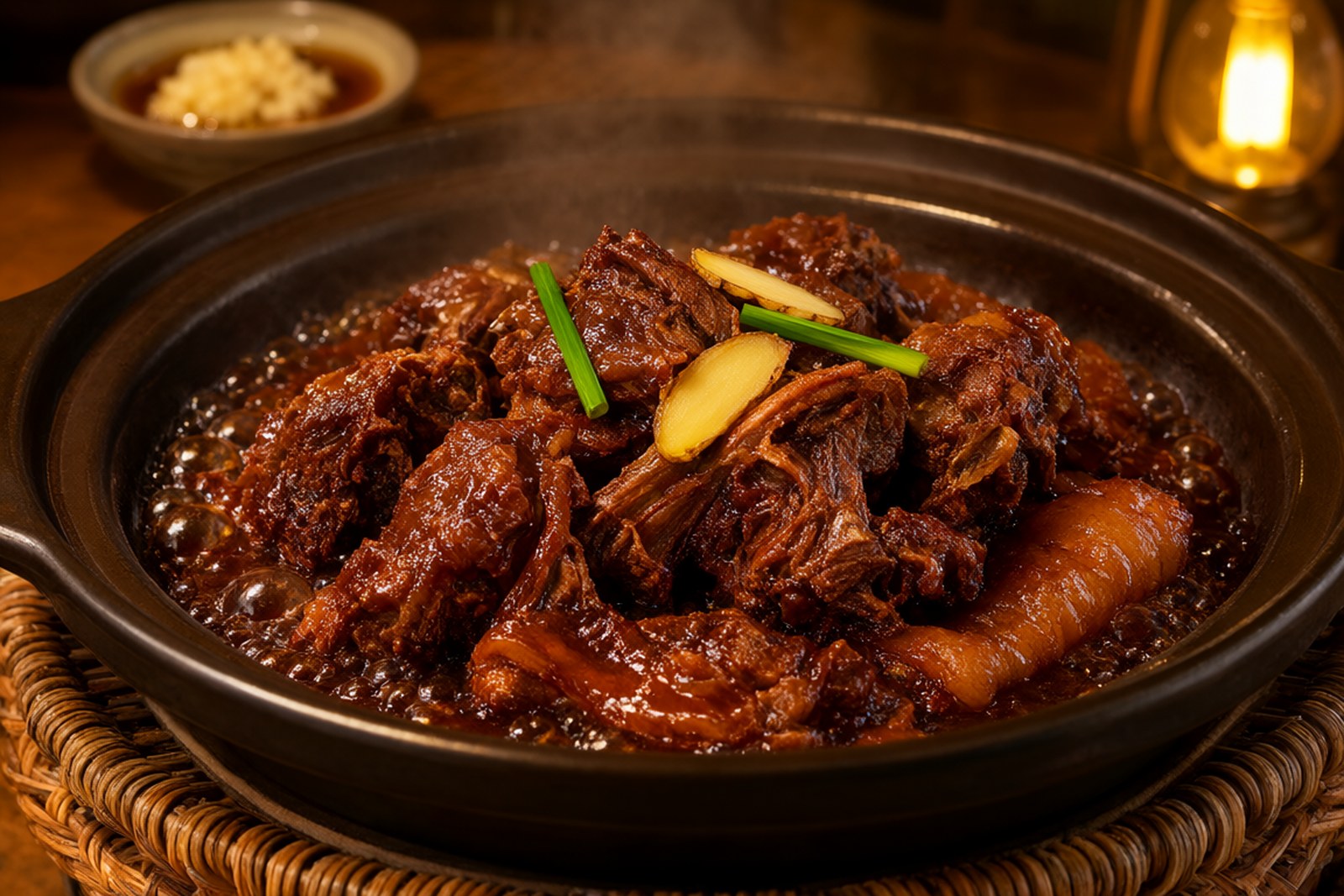
The goat is clay-red when it comes out, glossy with a sauce that has been reduced until it coats a spoon, and the skin — you notice the skin first — is the texture of something between a mushroom and a piece of well-cooked tendon, dense and faintly elastic and completely delicious. 东山羊 Dōngshān yáng, Dongshan goat, is one of the four old names of 万宁 Wànníng cooking, and it is a strange dish to be a local icon, because it is goat: an animal most of China eats only in the north and west, in winter, with a lot of spice to hide behind. Here, in the tropics, they braise it and serve the skin first and there is nowhere to hide at all.
The goat is named for the hill it grazes on. 东山岭 Dōngshānlǐng, East Mountain Ridge, stands about two kilometres east of 万城 Wànchéng, the seat of 万宁 Wànníng, on the east coast of 海南 Hǎinán. It is a modest hill — 184 metres — and it is the most famous small mountain on this island, which is a sentence that needs some explaining.
The Hill
Three peaks stand together at the top of 东山岭 Dōngshānlǐng, close enough that from a distance the mass reads as a 笔架 bǐjià, the wooden rest a calligrapher uses to hold three brushes. That resemblance gave the hill its older name, 笔架山 Bǐjià Shān, Brush Rest Mountain, and it is a good example of how much of Chinese landscape naming is really about ink and paper.
It has been a religious site for well over a thousand years. There are Buddhist and Taoist buildings on the slopes, of which the best known is 潮音寺 Cháoyīn Sì, the Temple of the Sound of the Tide — founded in the Song dynasty under the name 灵照堂 Língzhào Táng, renamed twice, and rebuilt in 1985. The hill is scattered with 摩崖石刻 móyá shíkè, inscriptions cut directly into the rock, more than two hundred of them, the densest concentration in the whole of 海南 Hǎinán, running from the Tang and Song through the Ming and Qing to the twentieth century.
The claim to “海南第一山” Hǎinán dì yī shān — the first mountain of Hainan — was carved here in the Ming dynasty, cut into the stone on the order of 曾光祖 Zēng Guāngzǔ, then the magistrate of the prefecture, and it stuck. It is a boast, and everyone knows it is a boast, and it has been repeated for four hundred years anyway.
The story that brings the crowds is about a man who did not want to be here. 李纲 Lǐ Gāng was a Song-dynasty official and, later, a chief minister, who opposed the court’s policy of suing for peace with the Jin and was exiled for it. In the autumn of 1128 he was sent to 万安军 Wàn’ān jūn, the garrison whose territory included this coast. Three days after he landed he was pardoned and recalled. Local tradition says he came up 东山岭 Dōngshānlǐng in those three days, that a monk at 潮音寺 Cháoyīn Sì declined to ordain him and told him instead not to give up — and that within days the summons came. The phrase attached to the story is 东山再起 Dōngshān zài qǐ, “to rise again from Dongshan”.
A small honesty is owed here. The idiom 东山再起 belongs historically to 谢安 Xiè Ān, the Eastern Jin statesman who retired to a mountain called Dongshan in Zhejiang and later came back to save the dynasty. The association with 万宁 is a coincidence of name and a good story about 李纲 Lǐ Gāng, not a historical origin. But the story is what made this hill a place people climb when their careers have gone badly, and that is a real thing that happens here — you will see people standing at the 东山再起 inscription taking photographs with a certain intensity.
The Goat
东山羊 Dōngshān yáng is a small black goat, and the reason it is a delicacy rather than just a goat is the hill. Animals raised on the slopes of 东山岭 Dōngshānlǐng browse on wild herbs, among them 鹧鸪茶 zhègū chá, a local shrub bitter enough that it is also brewed as a cooling tea. Goat is a strong-flavoured meat, and the usual complaint about it is that the flavour is too much: rank, gamey, muttony in a way that needs chilli and wine to bring under control. A goat that has spent its life eating hill herbs comes out with the edge taken off — cleaner, sweeter, with the faint resinous note of the plants it ate still faintly in the fat. If you have only ever eaten goat somewhere else, this is a different animal.
The second argument is the skin. In most Chinese cooking the skin of a goat is discarded or left as an unpleasant chewy border. Here it is the point of the dish. Braised long and slowly, the skin softens into something that yields like a good braised pork rind but keeps a bite, and the fat beneath it has absorbed the sauce. People order 东山羊 Dōngshān yáng for the skin the way people order 白切鸡 báiqiējī for the dipping sauce.
How It Is Cooked
There are three ways and they are equally serious about all of them.
红焖 hóngmèn, the braise, is the one to order first. Pieces of goat are blanched, then cooked down with ginger, garlic, a little fermented bean paste, rock sugar and local rice wine until the sauce is dark and thick and the meat gives way to a chopstick. The clay pot arrives still bubbling. Eat the skin first, then the meat, then spoon the remaining sauce over rice.
白切 báiqiē — poached, cooled, chopped and served cold with a dip — is the purist’s version and the one that tells you honestly whether the goat was good. The dip is 蒜蓉 suànróng garlic, a squeeze of the local small lime, a little soy, and chilli if you want it. If the meat underneath needs the dip to be enjoyable, the goat was not worth eating.
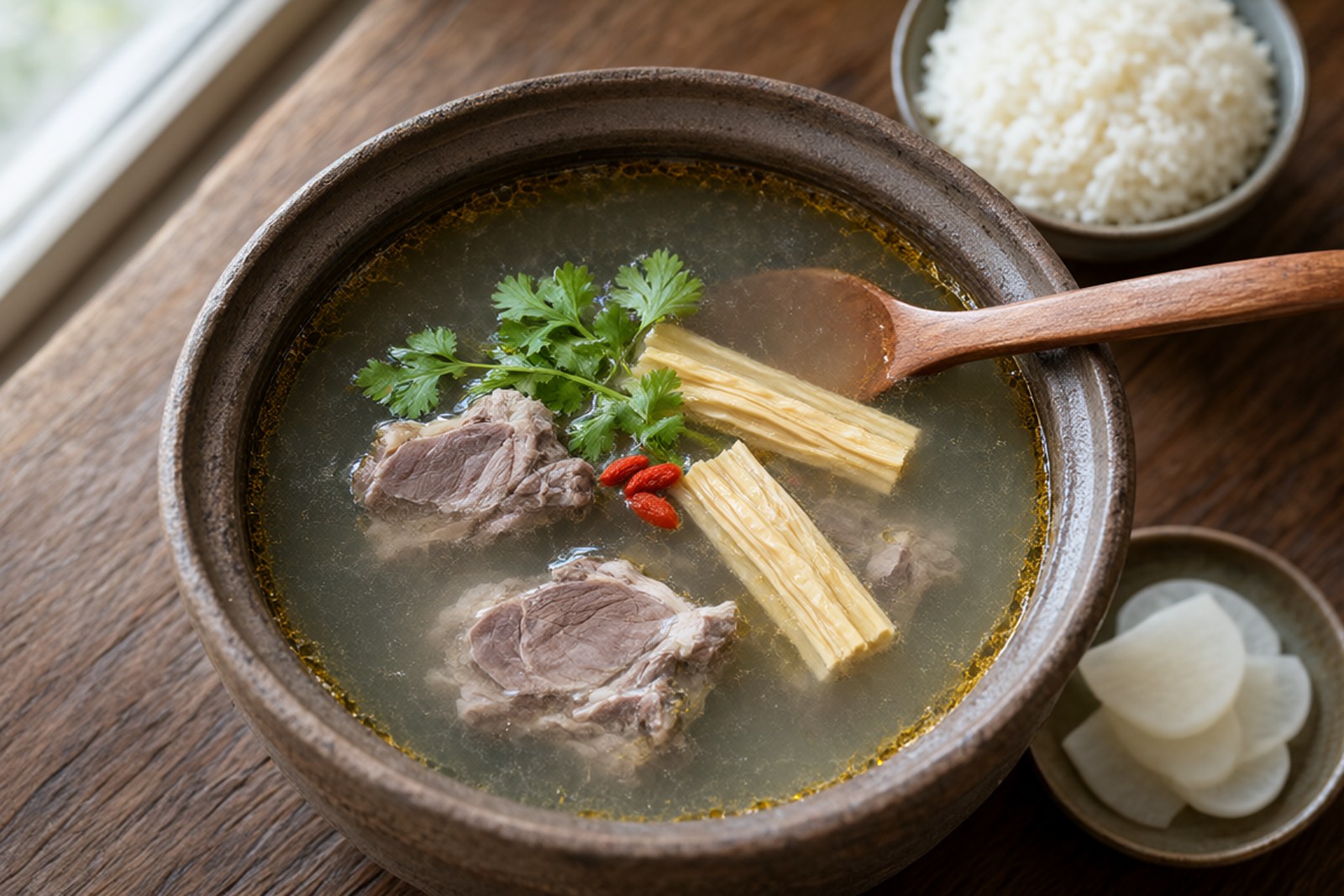
火锅 huǒguō, hotpot, is the winter third way: a pot of goat broth with the meat already in it, plus vegetables, tofu skin and 腐竹 fǔzhú to add as you go. In a place that is 24 degrees in January this is more of an air-conditioning question than a warming one, but the broth is very good.
Words and Names
东山羊 Dōngshān yáng is plain: 东山 Dōngshān is the name of the hill and 羊 yáng is goat or sheep. The interesting word is 山 shān in the place name 万宁 Wànníng’s old county seat, 万州 Wànzhōu, which appears all over the local inscriptions and on much of the signage around 东山岭 Dōngshānlǐng.
红焖 hóngmèn uses 红 hóng, red, as a description of the finished colour of the braise, not of a chilli heat — a 红焖 dish is reddish-brown from sugar and soy, and need not be spicy at all. 白切 báiqiē, “white-cut”, means plainly boiled and served cold, and it is the word you will see on the menu of every serious 海南 Hǎinán chicken and goat restaurant. 鹧鸪茶 zhègū chá is named for the 鹧鸪 zhègū, the Chinese francolin, a partridge-like bird the local shrub is said to resemble in leaf or in name; the tea is bitter, cooling and sold in enormous pressed balls.
What the Locals Know
Ask which hill the goat came from. The good stuff is from the slopes of 东山岭 Dōngshānlǐng itself and is sold as 本地山羊 běndì shānyáng, local hill goat. An ordinary farm goat will be cheaper and will taste like goat.
Order the braise for the skin and the cold plate for the meat. Together they tell you the whole story of the animal: 红焖 hóngmèn for what slow sauce does to it, 白切 báiqiē for what it tastes like naked.
Go with three people or more. A goat is a large animal and the pots are generous. Two people cannot eat this properly; you will end up taking half of it away in a foil box, which is not a bad outcome but is not the same meal.
Do not skip the greens. 东山羊 Dōngshān yáng is rich, and the local habit is to balance it with a plate of quick-fried 地瓜叶 dìguāyè, sweet potato leaves, stir-fried with garlic and a spoonful of the braising liquid.
Climb the hill before you eat, not after. 东山岭 Dōngshānlǐng takes about ninety minutes at an easy pace, there is a shuttle up for those who want it, and the view from the top over 万宁 Wànníng town and out to the sea is the correct appetiser. Tickets are about ¥36 in the low season and ¥43 in the high, and the online booking window needs half an hour before you can collect.
Where to Eat It
The goat restaurants run along the roads approaching 东山岭 Dōngshānlǐng and through 万城 Wànchéng — look for a clay pot on a gas ring in the window and a chalk board of prices. Order 红焖东山羊 hóngmèn Dōngshān yáng, a plate of 白切 báiqiē if there are three of you, greens, and rice. A goat for the table runs from about ¥180 for a small pot to ¥400-plus for a whole animal across three courses, and two people eating lightly will spend ¥200–300. The meal is best from November to April, when the weather and the local calendar both favour it, though it is served all year.
flowcloud would say that the best way to understand what a landscape tastes like is to eat the animal that has been eating it — that a goat raised on bitter mountain herbs and braised without apology is the hill itself, served in a pot, and that this is why the hill and the dish have the same name.
Where to find it: 东山羊 (Dōngshān yáng), 东山岭 (Dōngshānlǐng), 万宁 (Wànníng), east 海南 (Hǎinán). Restaurants on the approach roads to 东山岭 and in 万城 (Wànchéng) town; the hill is a 15-minute drive from 万宁 (Wànníng) high-speed rail station by taxi. 红焖东山羊 ¥180–400 depending on the size of the pot and the cut, 白切 East Mountain goat ¥60–90 a plate, 火锅 (huǒguō) from about ¥200 for two. Hill admission ¥36–43, gardens open roughly 09:00–17:00. Ask whether the goat is 本地 (běndì), order the braise first, and go with at least three people.