
Doumen’s Old Street Bites, Cured on the Waterfront
斗门旧街 Dòumén Jiùjiē, Doumen Old Street, is a few hundred metres of Early Republican arcade in 斗门镇 Dòumén Zhèn Doumen Town, and it is the table on which a water town sets out three tastes at once: the cured, the river and the steamed. Zhuhai is a prefecture-level city in Guangdong Province, on the western bank of the Pearl River estuary, connected by land to both Hong Kong, China and Macao, China, and its 斗门区 Dòumén Qū Doumen District is the low, wet country at the mouth of the West River, richer in channels, ponds and tidal flats than in fields, which is why its larder is built on what the water gives and what smoke and salt can keep. The street’s arcades, with their Western-style arches over a covered walk, are the city’s best-preserved run of the kind, and the district puts them on its official heritage-food route.
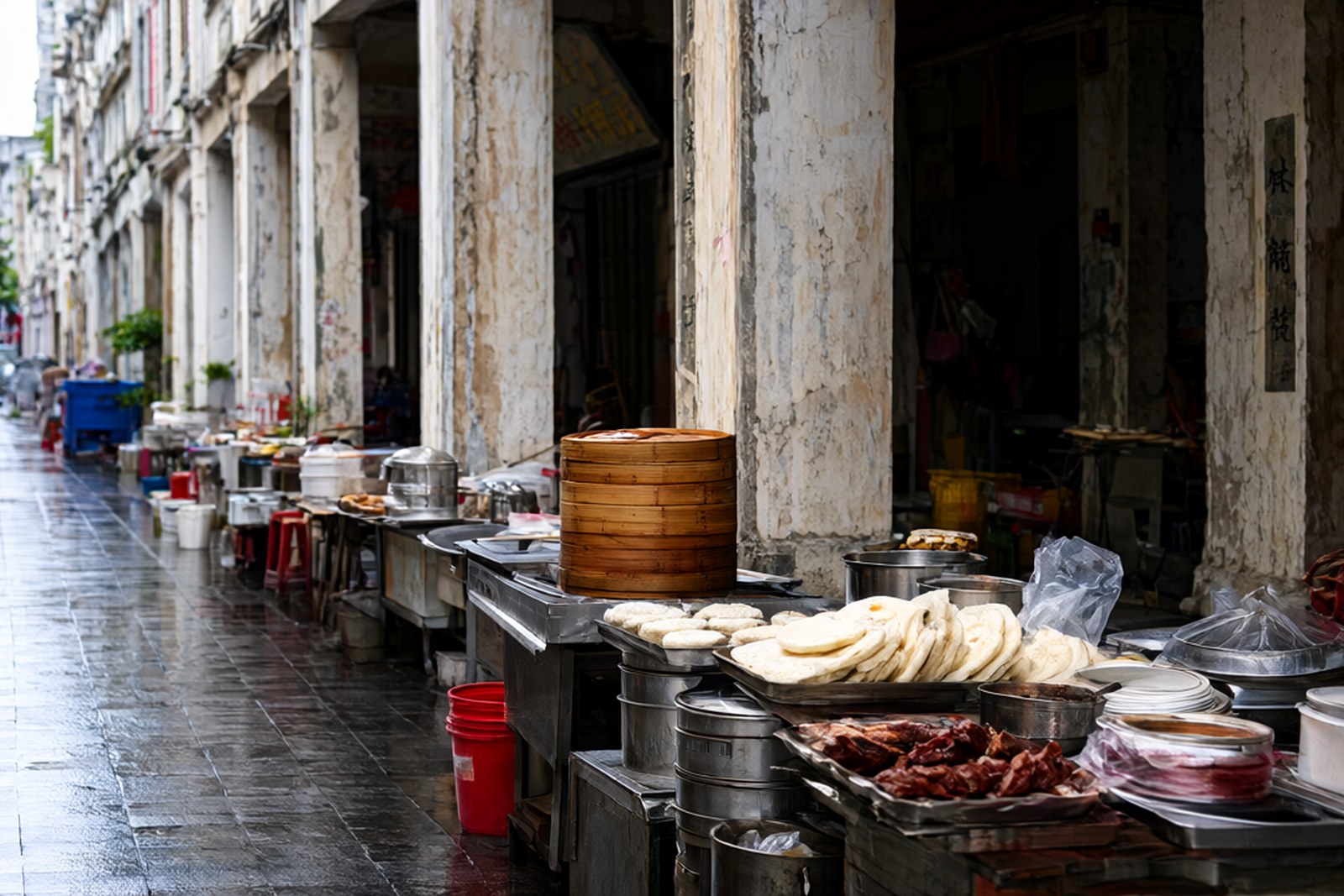
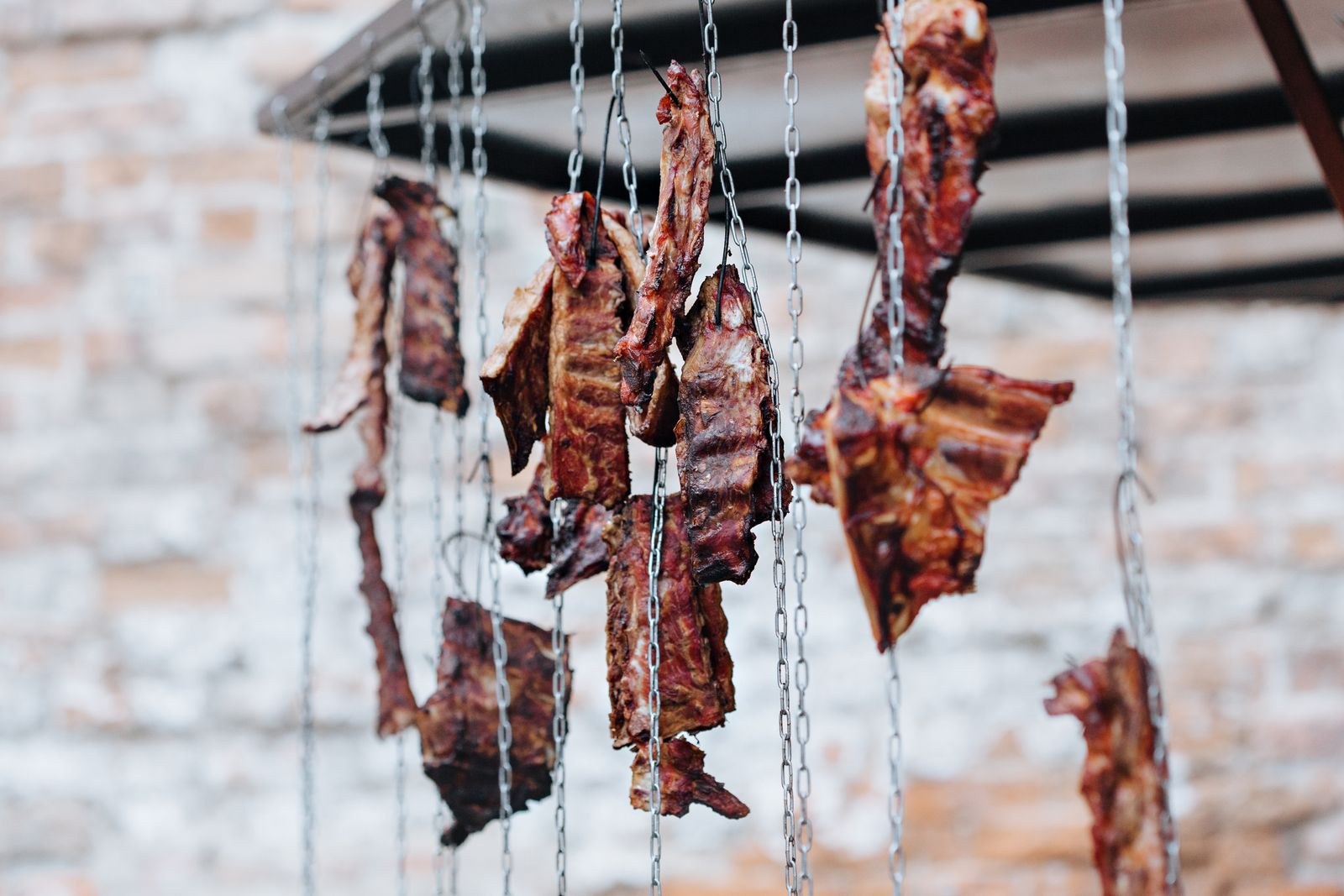
The cured line is the strongest, and one craft in it has provincial standing. 横山鸭扎包 Héngshān yā zā bāo is a collective name from 莲洲镇 Liánzhōu Zhèn Lianzhou Town for parcels made of duck: the foot, the lower jaw and the wing are cured in salt and air, wrapped with duck liver, duck intestine and fat pork, tied and dried, so that the finished parcel is chewed for its salt and its smoke rather than for its meat. The craft was entered on Guangdong’s provincial intangible-heritage list in 2013, in the fifth batch, and it is the one item on this street whose rank is set at provincial level by the culture bureau’s own register. From 虎山村 Hǔshān Cūn Hushan village comes 虎山金巢琵琶鸭 Hǔshān jīncháo pípā yā, the pipa duck, named for the shape the bird takes after roasting, which is said to recall the pipa lute; it is made only from the thin-fleshed white-feathered hen duck, and it is roasted over an open hearth by the traditional method, giving a skin that is crisp and flesh that is tender, sweet without being cloying. From 大赤坎村 Dàchìkǎn Cūn Dachikan village comes 明火叉烧 mínghuǒ chāshāo, char siu barbecue pork, and roast spare ribs, cooked over an open fire of lychee wood, which gives the meat its scent, and cut only from pigs slaughtered that day, with the cook taking the neck and the spare rib and nothing else. The pipa duck and the Dachikan pork are both listed at municipal level in the city’s intangible-heritage register.
The river line is shorter and brighter. 黄沙蚬 huángshā xiǎn, the yellow sand clam, grows in the brackish shallows and is eaten boiled, and the district calls it the abalone of the West River; it is best from the second to the fourth lunar month, when it is at its fattest, and it is the dish that most clearly belongs to the water rather than to the shed. A second and stranger river food is 禾虫 héchóng, the rice-field ragworm, a brackish-water worm that lives in the mud of the tidal fields and demands a clean environment to grow at all, taken from the marshes around Lianzhou, eaten as a savoury custard steamed in a bowl, and prized as a high-protein delicacy; the custom of gathering it was entered on the provincial intangible-heritage list in 2022, in the eighth batch, which is a listing of the practice rather than of the dish. Alongside these the district lists 横山粉葛 Héngshān fěngé, the Hengshan arrowroot, which the district describes as loose and free of fibre. The clam’s own rank is given as the district’s route states it, because the district brochure lists it among the local intangible-heritage foods while the municipal culture bureau’s full register as consulted for this article does not carry an entry for it; the level is therefore attributed rather than asserted.
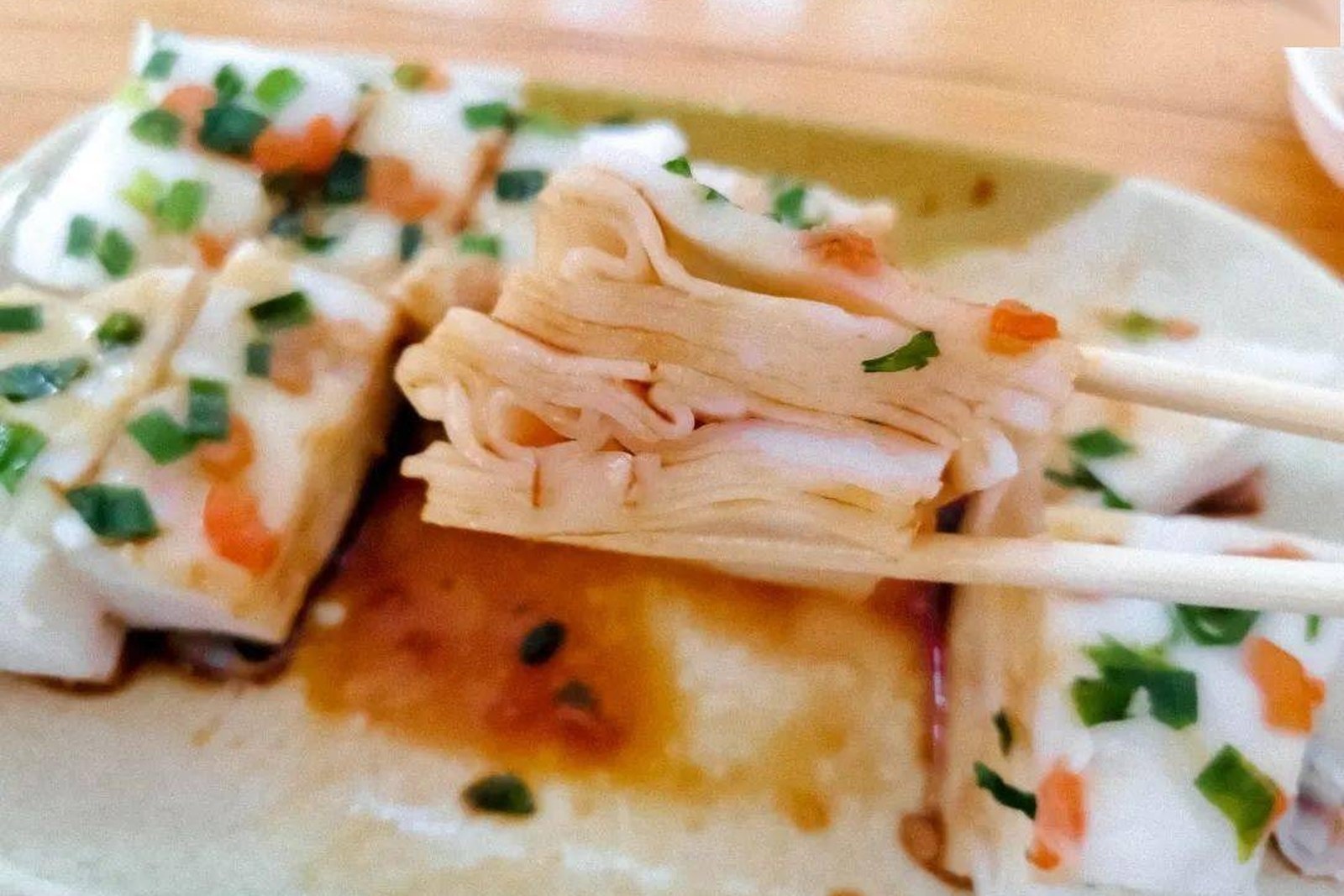
The steamed line is the street’s sweet-note, and it is the oldest of the three by reputation. 虾米糍 xiāmǐcí, the shrimp-rice cake, is a layered white rice cake studded with dried shrimp and chopped spring onion, eaten for its springy bite, and one local account, drawing on the county gazetteer of the old Xiangshan county, says a lane of cake sellers stood here by the Yongzheng reign of the Qing, which would make the trade older than the arcades around it. 虾堆 xiāduī, the shrimp fritter, is a turnover of shredded radish, pork and dried fish, fried in rice batter with one or two cooked prawns pressed on top, and 锅边糍 guōbiāncí, the pot-edge cake, is made by cooking a broth of dried shrimp, dried fish, taro and greens and then running rice batter down the hot rim of the pan and scraping it in to cook; both are held on the district’s own intangible-heritage list in local accounts, dated to 2013 and 2018, and those dates come from local republications rather than the municipal register and are given as local accounts only. The eating is not confined to the street. Across the fields at 接霞庄 Jiēxiázhuāng Jiexiazhuang, a Lingnan water-town village settled by descendants of the Song imperial Zhao clan, the walls are built of oyster shell mixed with yellow clay and old-style tea-cake shops stand along a lane of heritage craft studios.
The old street is a food scene before it is a monument, and the district now treats it as one. The heritage-food route that Doumen publishes runs the street and the village together with the district’s other table names, and the district markets the area as a Greater Bay Area micro-holiday under a weekend-in-Doumen slogan. What separates the street from the mountain snack pages on this site is the water it stands on. The mugwort rice cakes of Zhangjiajie, written up elsewhere here, are a hill-and-field story about an herb and a festival; Doumen’s old street is a river-mouth story about cured duck bound with intestine, a brackish clam the district calls the abalone of the West River, and rice cakes studded with dried shrimp, sold across a few hundred metres of arcade built when the Qing had already fallen. The site’s other snack pages, for the preserved meats and cakes of other provinces, keep their own kitchens. The supports Zhuhai holds on the food map are the brackish estuarine fishery at the western mouth of the Pearl River, the two national geographical indications the city carries, Baijiao sea bass and the yellowfin seabream of Jinwan District, the deep-sea marine ranches of the Wanshan Archipelago, and the port-side eating life next to Macao, China; this page is the estuarine table itself.
Words and Names
斗门旧街 Dòumén Jiùjiē is Doumen Old Street, in 斗门镇 Dòumén Zhèn Doumen Town, 斗门区 Dòumén Qū Doumen District; 接霞庄 Jiēxiázhuāng Jiexiazhuang is the oyster-shell-walled village nearby. 横山鸭扎包 Héngshān yā zā bāo is the duck parcel bound with duck intestine, from 莲洲镇 Liánzhōu Zhèn Lianzhou Town, and 虎山金巢琵琶鸭 Hǔshān jīncháo pípā yā is the pipa duck of 虎山村 Hǔshān Cūn Hushan village; 大赤坎 Dàchìkǎn Dachikan is the village whose open-fire char siu and roast ribs are also listed. 黄沙蚬 huángshā xiǎn is the yellow sand clam and 禾虫 héchóng the rice-field ragworm; 虾米糍 xiāmǐcí is the shrimp-rice cake, 虾堆 xiāduī the shrimp fritter and 锅边糍 guōbiāncí the pot-edge cake. Provincial intangible heritage, municipal intangible heritage and a district listing are three different ranks, and this column keeps them apart. The site’s Zhangjiajie mugwort-cake page and its other preserved-meat pages keep their own regions; this page keeps one arcade street.
What the Locals Know
The street rewards a slow afternoon and a small appetite. It is a few hundred metres long and is walked, not driven; the stalls and the older shops open through the middle of the day, and the things worth carrying home are the dry ones, the cured duck parcels, the sausages and the smoked pork, which travel, while the clam, the fritters and the cakes are eaten where they are made. The duck parcel is a craft rather than a brand, so there is no single maker and no official grade. Prices on this street are low by city standards and are quoted by the piece at the stall, so none is printed here, and any figure read online on a 2026-10 snapshot is the day’s and moves.
A day that makes sense of the street runs from the water to the arcade. The clam boiled plainly at midday, when it is in season from the second to the fourth lunar month, the old street walked in the afternoon for the cured meat and the cakes, and the village of 接霞庄 Jiēxiázhuāng Jiexiazhuang at the end of the day for its oyster-shell walls and its lanes. What the record refuses is stated plainly: no confirmed rank for the yellow sand clam, which is given as the district states it; no batch numbers for the shrimp-rice cake and the shrimp fritter beyond the local accounts that carry them; no founding date for the duck parcel and the pipa duck, since the century and more claimed for the duck is an oral tradition rather than a record; no shop names and no prices; and no claim that any of it comes from the same kitchen as the herb cakes of Zhangjiajie, which it does not.
flowcloud would say that Doumen’s old street is a few hundred metres of Early Republican arcade where a river-mouth water town sets out three tastes at once: cured duck parcels bound with duck intestine and pipa-shaped roast duck from the villages of Lianzhou and Hushan, a brackish clam the district calls the abalone of the West River and eats from the second to the fourth lunar month, and rice cakes studded with dried shrimp and fried shrimp fritters from the district’s own list.
Where to find it: 斗门旧街 Dòumén Jiùjiē Doumen Old Street in 斗门镇 Dòumén Zhèn Doumen Town, the villages of 莲洲镇 Liánzhōu Zhèn Lianzhou and 虎山村 Hǔshān Cūn Hushan whose cured meats the street sells, and the oyster-shell-walled village of 接霞庄 Jiēxiázhuāng Jiexiazhuang, all in 斗门区 Dòumén Qū Doumen District, 珠海市 Zhūhǎi Shì Zhuhai, Guangdong Province; the clam is best from the second to the fourth lunar month, the duck parcel holds a provincial heritage listing of 2013 while the rice-cake and fritter dates are local accounts only, the port-side eating next to Macao, China is a different page, and prices are quoted by the piece at the stall and move on a 2026-10 snapshot that fluctuates.