
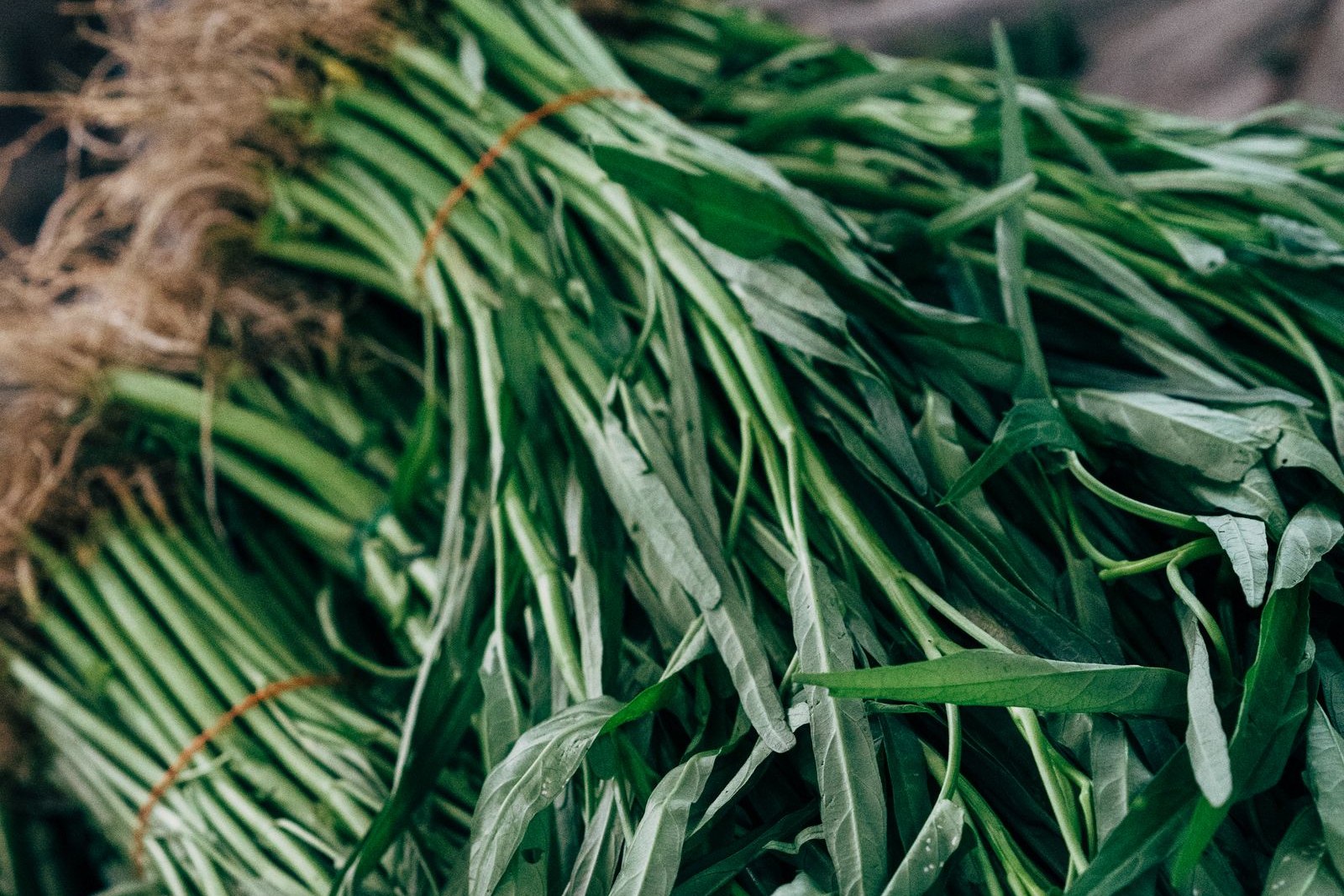
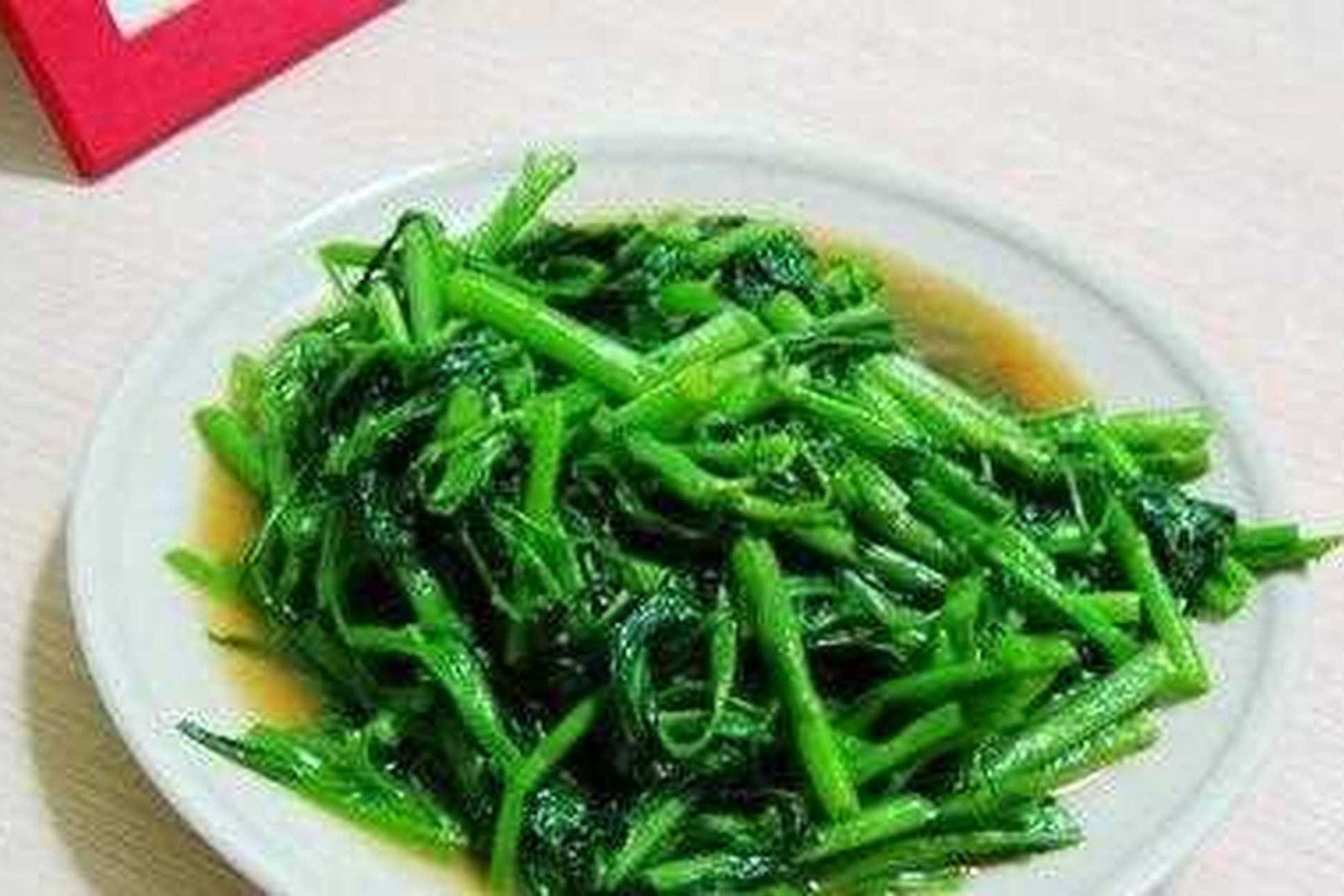
多文空心菜 Duō wén kōng xīn cài, in English the Duowen water spinach, is the most particular vegetable in 临高县 Lín gāo xiàn, the county that holds the north-western corner of 海南岛 Hǎi nán dǎo, Hainan Island, where it faces the 琼州海峡 Qióng zhōu hǎi xiá to the north and the 北部湾 Běi bù wān to the west. The plant itself is not rare anywhere in the tropics. The same species, 蕹菜 wèng cài, is grown from Guangdong to Malaysia and eaten under a dozen names – water spinach, swamp cabbage, kangkong, morning glory greens, 通菜 tōng cài in a Cantonese kitchen – and almost everywhere it is the leaf that people are buying. The Duowen version turns that upside down. Its stems are long, its leaves are small and sparse, and a good bundle looks less like a leafy vegetable than a sheaf of pale green sticks with a green tuft at the far end, which is exactly what the local phrase 杆长叶少 gǎn cháng yè shǎo, long stems and few leaves, is describing. That shape is the reason a county has spent a decade wrapping a brand, a legal boundary and a cartoon mascot around a few dozen hectares of wet ground. It is also the reason a cook notices the difference within thirty seconds: an ordinary water spinach goes into a wok and comes out a dark, collapsed heap, while this one comes out 色泽碧绿 sè zé bì lǜ, still jade green, and stays that way on the plate. Everything below is an attempt to explain how a vegetable ends up behaving differently because of the rock underneath it.
The rock is the beginning of the answer, and it is volcanic. 多文镇 Duō wén zhèn, the township the vegetable is named for, sits on and around 多文岭 Duō wén lǐng, an extinct volcano whose eruption is dated to roughly 2.6 million years ago, and the town took the hill’s name rather than the hill taking the town’s. What the eruption left is a cap of basalt and, around it, the deep red soil that weathered out of that basalt, the 砖红壤 zhuān hóng rǎng that farmers in this part of Hainan treat as the good ground. The county’s own soil survey for the growing area records an average organic-matter content of 38.8 grams per kilogram and a pH of 5.1, which is a strong acid soil of the sort that suits a tropical leafy crop, and it records what the volcanic ash brought up with it, a selenium content high enough that 富硒 fù xī, selenium-rich, has become the standard adjective in every official description of the place. The fields themselves stand between about 71 and 102 metres above sea level, which on a coastal plain is a noticeable elevation, and they are not the flat grid of a modern vegetable farm. They are 山坑田 shān kēng tián, literally hill-hollow fields, small paddies tucked into the folds of the ground beneath the hill. The core of the core is 头神村 Tóu shén cūn, Toushen village, and the local saying that has come out of it is worth knowing because it tells you how the trade thinks about itself: 临高空心菜看多文,多文空心菜看头神 Lín gāo kōng xīn cài kàn Duō wén, Duō wén kōng xīn cài kàn Tóu shén, for Lingao water spinach look to Duowen, and for Duowen water spinach look to Toushen. Until the county began marketing the vegetable as a whole, people simply called it 头神空心菜 Tóu shén kōng xīn cài, Toushen water spinach, on the grounds that the hill was famous and the village was under it; the wider name came later.
If the soil is the first half of the story, the water is the second, and it is the half that the growers talk about. At the foot of 多文岭 there is a scatter of 火山喷泉 huǒ shān pēn quán, volcanic springs, a great many eyes rather than one source, with a strong and steady flow that does not fail in the dry season and therefore irrigates the paddies around them all year. The water is clear enough to see the bottom, it is mineral-rich, and it has the odd quality that spring water in a tropical place tends to have, which is that it feels warm in winter and cool in summer; this is where the official phrase 天然冷泉 tiān rán lěng quán, natural cold spring, comes from, and it is why the brand line the county settled on is 天然冷泉在多文,滋养培育空心菜 tiān rán lěng quán zài Duō wén, zī yǎng péi yù kōng xīn cài, natural cold springs in Duowen, nourishing and raising the water spinach. The most quoted image of the place is a piece of onomatopoeia from a Hainan Daily report: at the northern edge of the hill-hollow fields of 头神村, 一股「突突」喷涌的泉水 yī gǔ tū tū pēn yǒng de quán shuǐ, a spring that goes tuk-tuk as it spurts out of the ground, keeping the field permanently soaked. The climate adds to it without being dramatic. This is a tropical monsoon coast, seasons that do not divide cleanly, a marked wet season and dry season, sunshine of roughly 2,000 hours a year, mean temperatures around 24 degrees, and annual rainfall of the order of 1,500 millimetres. The township is also far enough from the county town to have no factories within about ten kilometres of it, which is the sort of detail that ends up in a brand brochure but is nonetheless true and does affect what grows there.
The reason the county can describe a varietal difference at all is that this is not a seed crop. 多文空心菜 is propagated vegetatively, by cutting 茎条 jīng tiáo, stem sections, from plants that are healthy, disease-free and typical of the type, and setting them into the paddy as cuttings, which means the variety is a clone that each generation of growers has kept and cleaned up rather than a packet of seed bought each season; the official cultivation description uses the phrase 提纯复壮 tí chún fù zhuàng, purifying and rejuvenating, for the routine culling of off-type plants. The fields are chosen for deep plough layer, high organic matter, reliable spring irrigation and easy drainage, and the crop is rotated with a previous season rather than grown continuously in the same water. Fertility comes mostly from farmyard manure, and the management is deliberately loose and low-input, with little spraying. The published quality figures are unusually specific for a vegetable and they are worth setting down because they are the closest thing to a chemical explanation of the texture: crude fibre at 1.16 per cent, vitamin C at 31.3 milligrams per 100 grams, crude protein in the tender shoot at 2.38 per cent, calcium at 0.035 per cent, and selenium at 0.0212 milligrams per kilogram. A low figure for crude fibre is the number that matters to a cook, because fibre is what makes a stem go stringy and a leaf go slimy, and the whole point of a long-stemmed water spinach is that the stem stays crisp. What the consumer notices most, though, is the thing no laboratory measures: pick a bundle in the morning, leave it in the refrigerator, and three or four days later it is still green, where the ordinary article would be yellow and wilting. There is also no preparation to speak of. You do not stand at the sink tearing out yellow leaves and old stalks, because the stems the growers cut are the young tips, and by the time they reach a market they are almost all stem.
The legal fact that most of the marketing hangs on arrived on 10 January 2017, when the Ministry of Agriculture of the People’s Republic of China registered 多文空心菜 as a 农产品地理标志 nóng chǎn pǐn dì lǐ biāo zhì, a national agro-product geographical indication, under its announcement numbered 2017 年第 2486 号 èr líng yī qī nián dì èr qiān sì bǎi bā shí liù hào, announcement 2486 of 2017. The wording is worth being careful with, and the county’s own texts are careful with it: this is one of the agricultural ministry’s protected regional designations, not one of the separate national geographical-indication products administered through a different channel, and the accurate English is that it is protected as a national agro-product geographical indication. What the registration fixed is a boundary, and it is unusually small and unusually specific. It runs across the 抱利 Bào lì, 头神 Tóu shén, 美巢 Měi cháo, 风雅 Fēng yǎ and 多郎 Duō láng village committees of 多文镇, two work areas of 红华农场 Hóng huá nóng chǎng, the Honghua state farm, and one village, 抱珍村 Bào zhēn cūn, in the neighbouring township of 博厚镇 Bó hòu zhèn. The protected coordinates are 109 degrees 43 minutes to 109 degrees 48 minutes east and 19 degrees 45 minutes to 19 degrees 50 minutes north, and the whole polygon measures about 8.3 kilometres east to west and 9.7 kilometres north to south. That is a shape you can walk in a morning, and it is a useful corrective to the way the name is used in the market, where 多文空心菜 can appear on a menu anywhere in the province.
Words and Names
空心菜 kōng xīn cài, hollow-heart vegetable, is the everyday Mandarin name and it is a description of the plant, whose stem is a tube; 蕹菜 wèng cài is the older and more formal name, and the Cantonese 通菜 tōng cài is what most English-speaking visitors will have met it as in a restaurant. 多文 Duō wén is the township, and the township is named after 多文岭 Duō wén lǐng, the hill behind it, so the vegetable carries a place name twice over. 头神村 Tóu shén cūn is the village at the centre of the growing area and 山坑田 shān kēng tián are its hill-hollow paddies; 火山喷泉 huǒ shān pēn quán are the volcanic springs that feed them and 天然冷泉 tiān rán lěng quán, natural cold spring, is the official phrase for that water. The soil is 砖红壤 zhuān hóng rǎng, laterite, and 富硒 fù xī, selenium-rich, is the adjective that goes in front of it. 总统菜 zǒng tǒng cài, the president’s vegetable, is the popular nickname explained below, and 贡菜 gòng cài, tribute vegetable, is the older one. 泉宝 Quán bǎo, Spring Treasure, is the name of the anthropomorphic mascot the county introduced in 2020, which is a green sprout with a face, and 打边炉 dǎ biān lú is the Hainanese hot pot the vegetable is dropped into at the end of a meal.
What the Locals Know
The story that everyone in 临高县 repeats, and that has done more for the vegetable’s fame than the geographical indication ever could, is dated to 1972, the year of President Nixon’s visit to China. The county’s account is that the relevant national authorities arranged for 多文空心菜 to be flown specially from 海口 Hǎi kǒu, the provincial capital, up to Beijing so that it could be served to the American guest, and that the vegetable has been called 总统菜 zǒng tǒng cài, the president’s vegetable, ever since. The county government’s own page is the source for the detail that the flight was from Haikou, and it is worth knowing that some of the commercial websites retell the same story with the departure point given vaguely as Hainan; this article follows the official version. Treat the framing with the proportion it deserves, because there is nothing in the record to suggest a visiting American ate anything knowingly named after him, and plenty of Chinese produce carries a similar tale. But the modern reputation is not myth. The nickname appears in the provincial government’s own introduction to the vegetable, in national economic-press coverage and in the county’s promotional material, and it has been commercially load-bearing for fifty years. Two other claims should be handled more carefully. The first is the very widespread statement that 多文空心菜 was already a 宫廷贡品 gōng tíng gòng pǐn, a tribute offering to the imperial court, in the Ming and Qing dynasties; the responsible version of that sentence is the one a Hainan Daily feature used, which begins with 人们传说 rén men chuán shuō, people say, and no gazetteer or archival text has been produced to support it, so it belongs in the article as local lore rather than as history. The second is the report that the vegetable won provincial food awards in 2015; it circulates in encyclopaedia entries and produce-trade listings but has not been traced to a first-hand report, so it is not something to plan a meal around.
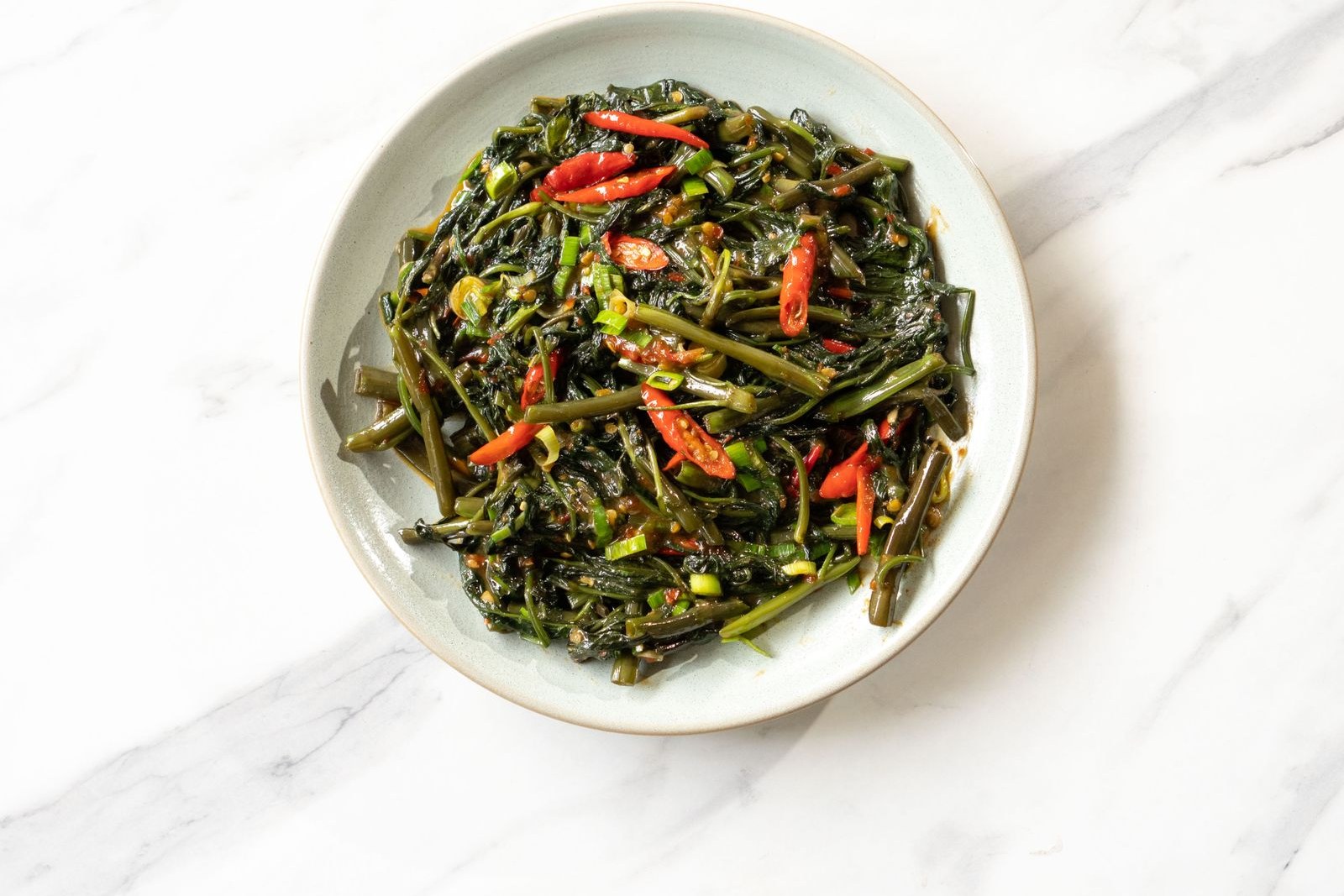
How the vegetable is actually eaten is a matter of temperature and timing. In a restaurant, the standard treatments are 清炒 qīng chǎo, a plain stir-fry with garlic; 蒜蓉炒 suàn róng chǎo, the same with a great deal of minced garlic; and 虾酱炒 xiā jiàng chǎo, fried with the fermented shrimp paste that gives the whole island its savoury note. At a street table doing 打边炉 dǎ biān lú, the Hainanese hot pot, the water spinach is not an appetiser but the last green thing to go into the broth, after the seafood and the meat have already flavoured it, which is the best possible use of a stem that refuses to soften into nothing. The picking season the county publicises runs from April to October, when visitors are invited to cut their own at 头神村, and the same months are when the township market is fullest. What the locals will tell a visitor, and what is worth passing on, is that the whole reason to buy this vegetable is the stem, so treat the sparseness of the leaf as a feature rather than a short measure, and do not do what a northern Chinese cook would do with an ordinary water spinach and cut the stems into short lengths to hide the fact that they are tough. This stem is the tender part. Cut it long, keep the heat high, cook it fast, and eat it while it is still bright.
The last thing to understand about 多文空心菜 is that the size of the supply is genuinely small, and this is where the official numbers stop agreeing with each other in a way that is worth spelling out. The provincial and county government pages describe the core spring-fed fields of 头神村 as 仅 30 多亩 jǐn sān shí duō mǔ, only thirty-odd mu, which is about two hectares, and that is the ground that carries the reputation. The county’s own 2016 introduction to the village gives roughly 270 mu across 多文村 and 头神村 together, and a 2021 report for the national news agency puts the growing area at some 380 mu. The geographical-indication registration takes a different measurement again, counting not the fields in production but the plantable ground inside the protected boundary, which it puts at 2,890 mu, and from that it projects an annual output of about 10.1 million kilograms on a yield of 3,500 kilograms per mu per year. None of these numbers is wrong; they are four different questions being asked of the same landscape, and the honest way to read them is that a few dozen hectares of exceptional ground sit inside a protected zone with a much larger theoretical capacity. On the ground, the figure most often quoted is a yield of about 6,000 jin per mu, roughly 3,000 kilograms, at 头神村, where around nine households in ten grow the crop, and a farm-gate price that has risen from one or two yuan a jin in the past to four or five. The county has been investing in the story around it as well as the crop: in June 2020 it launched the vegetable’s public brand standard at an event in 海口 with 泉宝 the mascot and the cold-spring slogan, and it has since put more than four million yuan into a farm-and-leisure base at 头神村 with a 7.3-kilometre tourist road to reach it. In the winter of 2025 the provincial trade fair named the vegetable as a flagship of a proposed expansion of aquatic vegetables to 30,000 mu across Hainan on the strength of its stable price, and a delegation of Beijing restaurant operators travelled to 多文镇 to look at it, which is a long way to go for a green.
flowcloud would say that the interesting thing about 多文空心菜 is that it is a vegetable famous for what it does not have – not many leaves, not much fibre, not much variation from one plant to the next – and that a plant which is essentially one long clone growing in volcanic spring water is the most literal possible answer to the question of what a place tastes like.
Where to find it: the township market at 多文镇 Duō wén zhèn in the mornings, and the fields of 头神村 Tóu shén cūn at the foot of 多文岭 Duō wén lǐng, where the county runs a farm-and-leisure base and publicises self-picking from April to October; the two or three most reliable restaurants for it are the ones in 临城镇 Lín chéng zhèn, the county town, where 清炒 and 虾酱炒 versions appear on almost every menu, and any 打边炉 table in the county will bring it at the end. 多文镇 is about half an hour by road from 临城镇 and the fields are a short walk beyond the village; ask at the village for the spring-fed paddies rather than assuming the first green field you see is the right one, because the protected area is only a few dozen mu and the rest of the township grows ordinary vegetables beside it.