
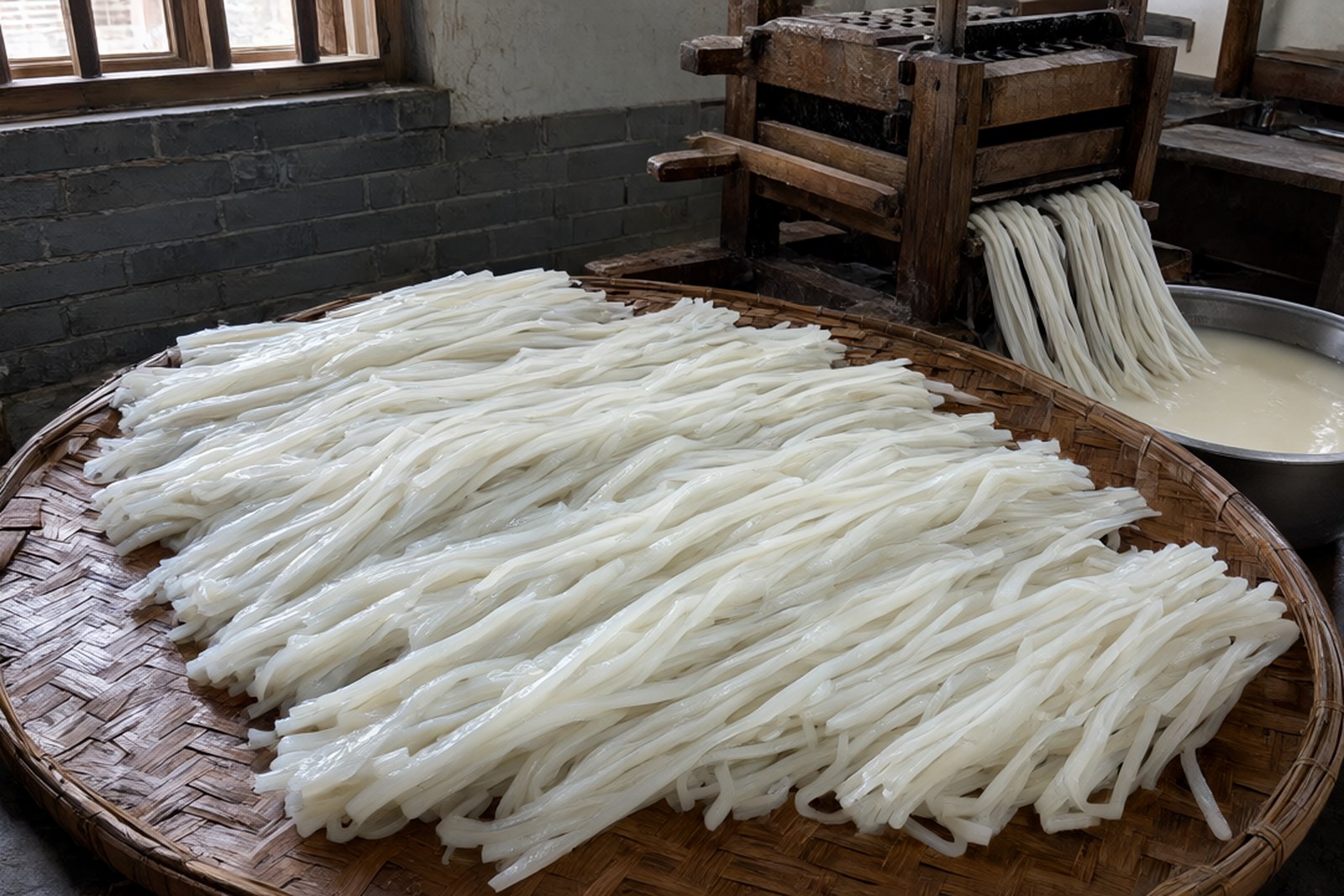
The word 濑 lài is a Cantonese verb and it means to rinse or to rake something through your fingers, and it is the whole of the technique: rice that has been soaked and ground into a paste is 濑 – pressed and raked – through a cloth or a wooden press into boiling water, so that it falls in thick ribbons and sets into noodles almost as it lands. Every part of the rice belt makes some version of this. 恩平 Ēnpíng does it with a batter that has been allowed to ferment, just barely, and that is the difference. The fermentation gives the noodles a faint sourness, a slight resilience and a smell somewhere between fresh rice and yoghurt, and it is the taste that people from 恩平 recognise instantly and cannot find anywhere else.
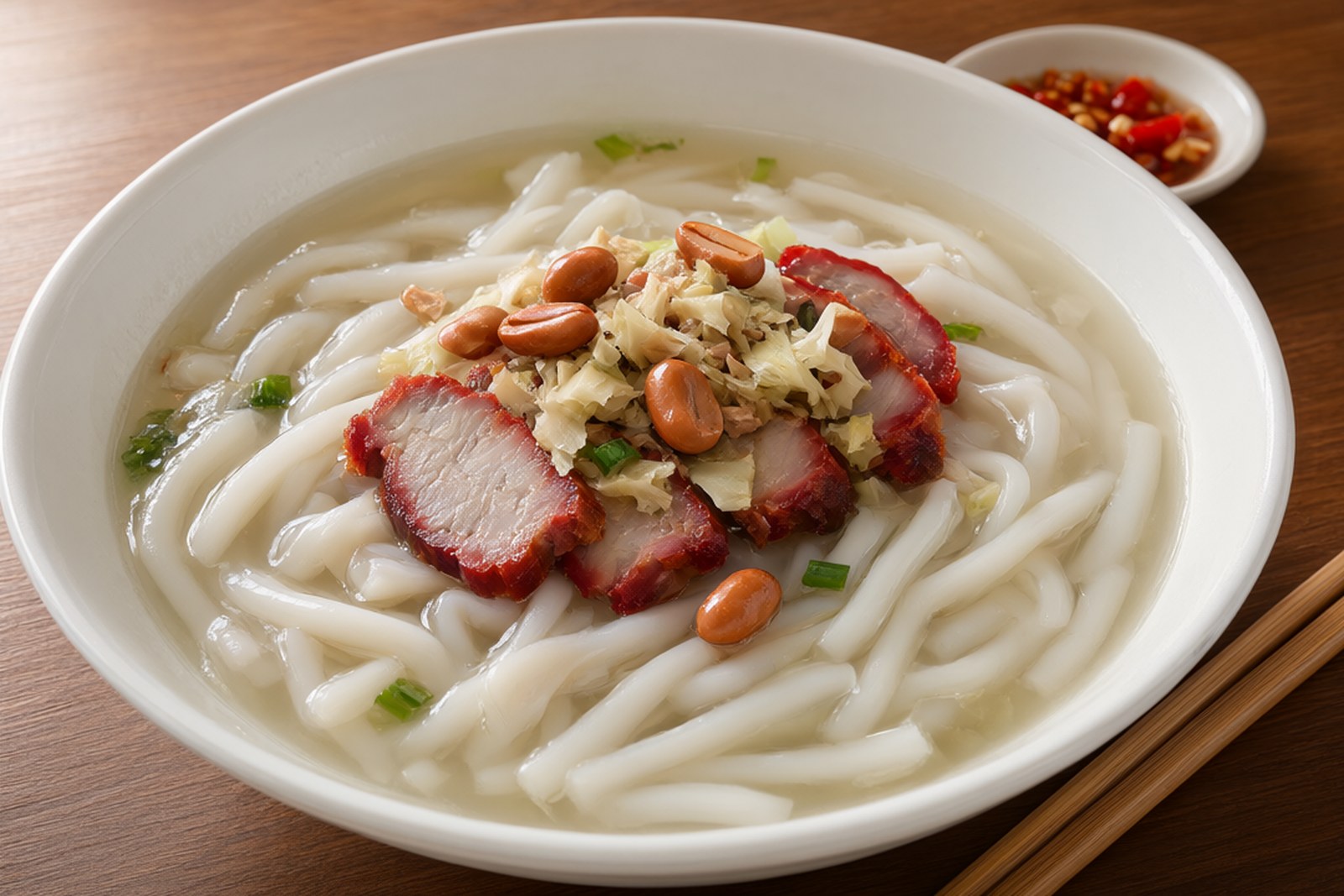
The noodles are made, dried and sold by weight, which is unusual in a region where almost everything is cooked to order. A 恩平 family buys 濑粉 by the jin from a shop that makes nothing else, in fat, pale, slightly curled bundles that keep for months; the dried noodle is boiled in plenty of water until it softens and goes opaque, then rinsed and drained, and it is only at that point that anything else begins. The broth is the humblest part of the dish and the one that matters most: usually a clear pork-bone and 大地鱼 dà dì yú, dried flounder, stock, simmered for hours and kept pale, because the noodles are white and a dark soup would ruin the look of the thing. 恩平濑粉 Ēnpíng lài fěn is then assembled in the bowl rather than cooked together.
The toppings are what make the bowl different from a bowl of noodles anywhere else. Thin slices of 烧肉 shāo ròu, crisp-skinned roast pork, are standard, as is 叉烧 chā shāo; so are 花生 huā shēng, roasted peanuts, and 头菜 *tóu cài, a preserved mustard root cut into fine slivers, which is salty and crunchy and provides the bite the soft noodles lack. Some kitchens add 虾米 xiā mǐ and a spoonful of 猪油 zhū yóu, lard, which is the traditional shortening and is essential to the texture; a version made with vegetable oil tastes thinner and everyone can tell. It is finished with 葱花 cōng huā, spring onion, and a spoon of the fried garlic that sits in oil on every noodle stall in the province. The whole bowl costs ten to twenty yuan and is breakfast.
Words and Names
濑粉 lài fěn is the noodle and 濑 lài the pressing technique that names it. 大地鱼 dà dì yú is dried flounder, the base of the pale stock, and 烧肉 shāo ròu is crisp roast pork while 叉烧 chā shāo is the sweet glazed one. 头菜 tóu cài is preserved mustard root and 猪油 zhū yóu is lard, 花生 huā shēng peanuts and 葱花 cōng huā the spring onion garnish. 恩平 Ēnpíng is the county town of the westernmost of the 五邑 Wǔ yì, the five counties of 江门.
What the Locals Know
Buy the dried noodle rather than a cooked bowl if you have a kitchen, because the packaged 濑粉 from a proper 恩平 maker is better than most restaurants’ and costs a tenth as much; a jin makes four or five bowls. When boiling it, use far more water than seems reasonable and stir once at the start, or the ribbons stick to each other and tear. The fermentation means the noodle goes sour rather than mouldy if it is kept damp, so store it dry and in the dark. In a noodle shop, ask for the soup to be 清 qīng, clear, and for the toppings to be added at the table rather than in the kitchen, which is how it is done at home and the only way to keep the crackling of the pork out of the broth.
flowcloud would say that a noodle made by raking fermented rice through your fingers is a recipe older than any restaurant, and that the reason it survives in a county of hot springs and forest is that nobody who grew up on it can eat a smooth white noodle again without noticing what is missing.
Where to find it: the noodle shops and 濑粉 makers of 恩平城区 Ēnpíng chéng qū, especially along 恩新路 Ēn xīn lù and the 锦江市场 Jǐn jiāng shì chǎng market, where a bowl is ¥10 to ¥20 and a jin of the dried noodle ¥15 to ¥25. Every 恩平 household has a favourite maker. 恩平 is the western end of the 江门 prefecture, about two hours by bus from 江门 city and an hour from 阳江, and the 深湛 line stops at 恩平站 Ēnpíng zhàn. Order a bowl wet and a packet dry, and try it with 恩平簕菜 lè cài, the thorny local green, if it is spring.