
Pork Intestine Rice, the Worker’s Bowl
肥肠饭 féicháng fàn, braised pork-intestine rice, is Changshou’s working-town classic, a dish built on the premise that patience beats expense. Offal is the cheapest cut in the market and the most demanding in the kitchen, and the intestine-rice tradition is what happens when a town of drivers, porters and market traders decides that the demanding part is worth doing properly. The result is a bowl that costs no more than a modest lunch should but eats like the richest thing on the street: soft, wobbly, deeply savoury intestine over hot rice, in a brown gravy that soaks into the grain and disappears before you have decided anything about it.
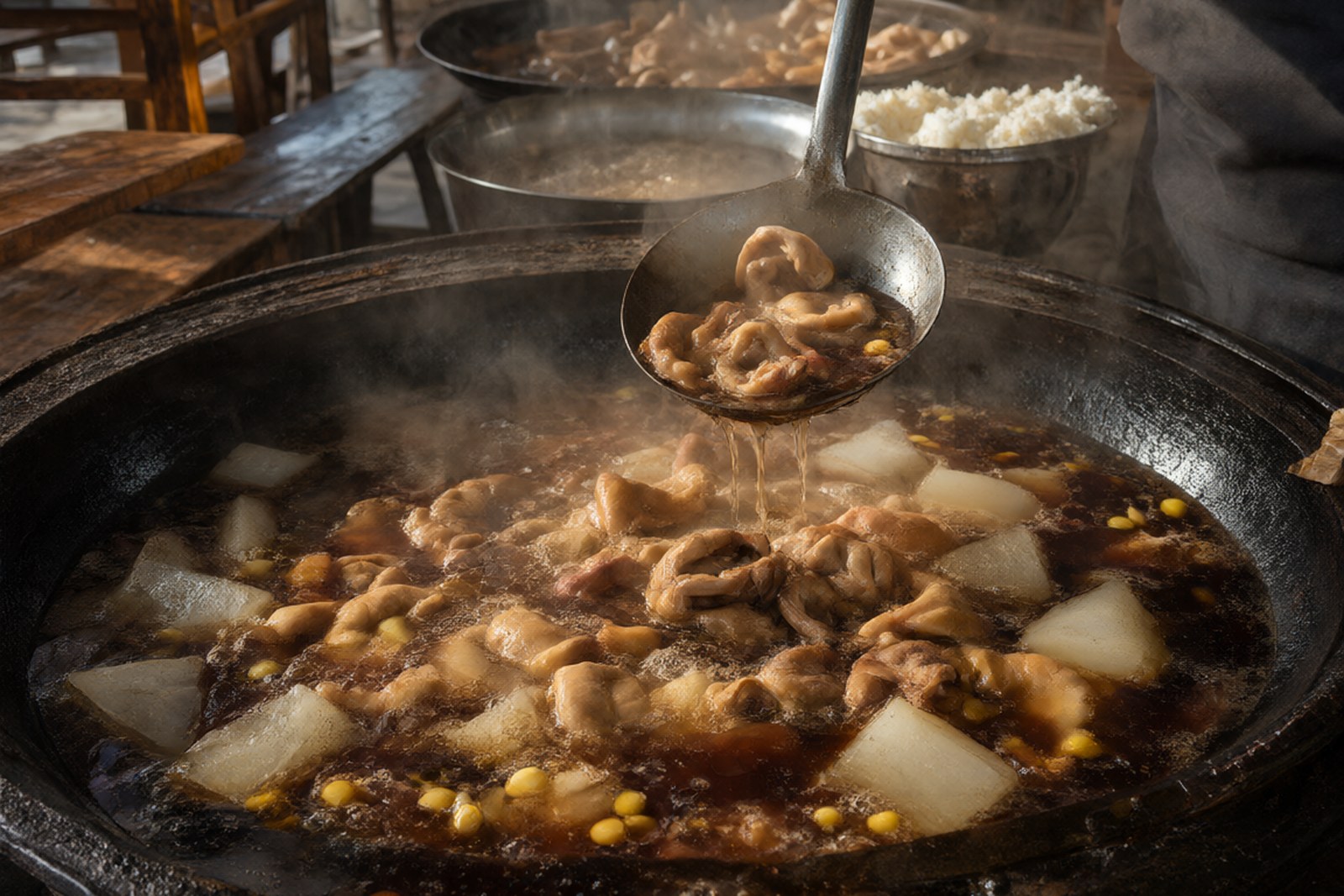
The work begins hours before the first bowl. Pork intestines are turned, salted and rinsed through a long, unglamorous cycle of washing that continues until the offal smells of nothing but itself – the step that separates the honest shops from everyone else, and the reason the old shops start their day in the dark. Then the intestine goes into a heavy broth of soy, rock sugar and ginger, with the shop’s 香料包 xiāngliào bāo, spice bag, dropped in alongside, and braises slowly with 白萝卜 báiluóbo, white radish, until the pieces yield to the chopsticks but keep their bite. The radish matters: it drinks the broth, sweetens under it, and gives the bowl its vegetable counterweight.
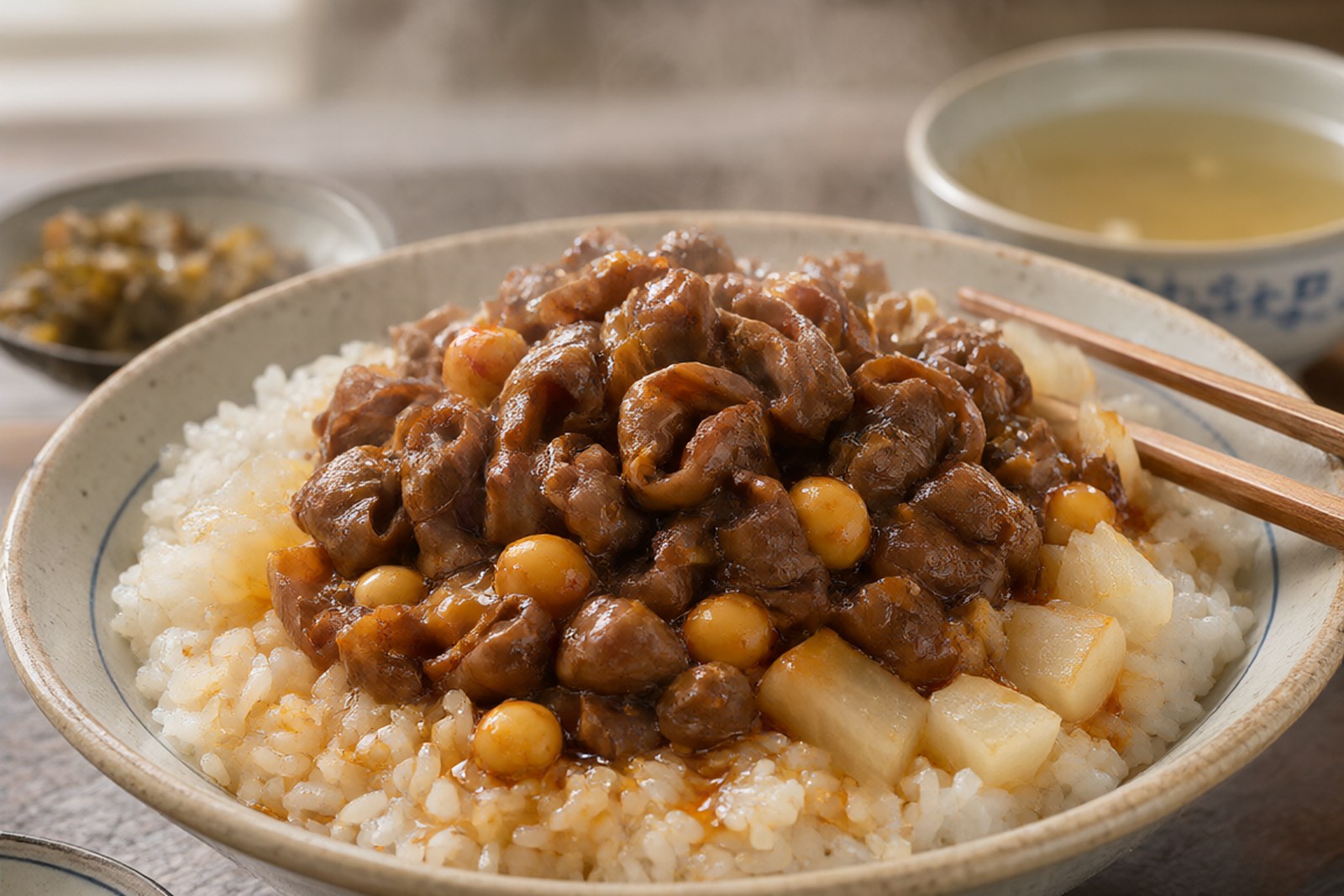
Assembly is to order and takes seconds. Hot steamed rice goes into the bowl first, then a ladle of intestine and radish with its brown gravy poured generously over the top, pickles on the side, and a free bowl of broth soup beside – the thin, savoury liquid that came from the braise itself, served as a chaser. The pickles cut the richness; the soup rounds the mouthful. Nothing is plated for the eye, and nothing needs to be, because the bowl’s appeal is thermal and tactile: gravy into rice, rice into mouth, and the morning’s cold forgotten in three spoons.
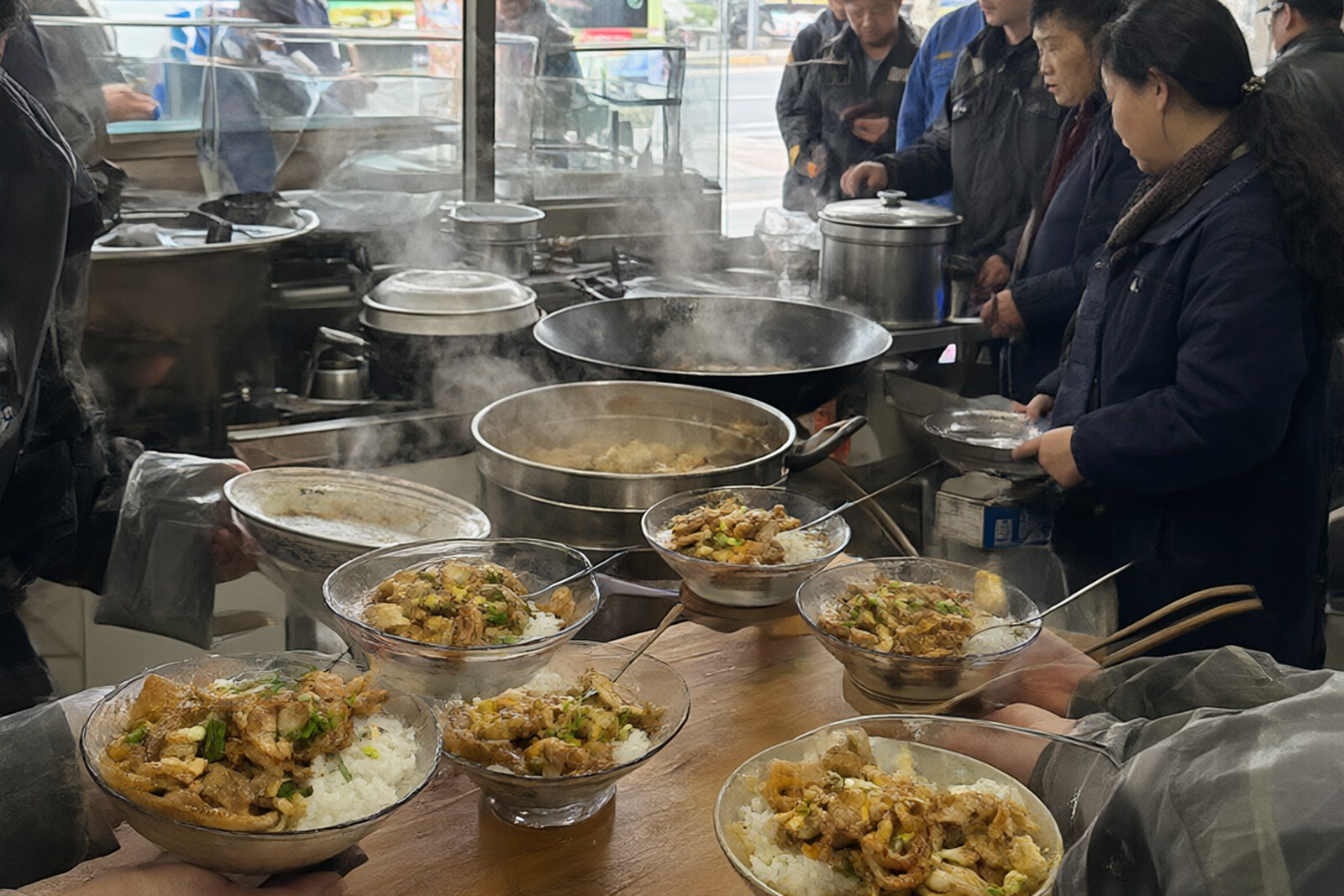
The geography of the dish is as fixed as its recipe. The old shops cluster near the bus station, and have served the same bowl for decades to the people whose work keeps the town moving – drivers before a run, porters between loads, market traders after the morning trade closes. The breakfast-to-lunch queue still moves on faith: you join it, you wait, you are fed, and the pace of the line is set by the ladle and not by anyone’s hurry. This is heavy, honest food, and the district defends it as proudly as its lake, because a bowl like this is a portrait of the town that eats it.
The discipline of this page is worth stating plainly. The record consulted – the plan’s own facts – names the hours of washing, the braise with radish in soy, rock sugar, ginger and spice bag, the to-order assembly with pickles and the free broth soup, the bus-station location, the decades of service and the queue; it does not name a founding shop, a founding year, a posted price or a single address, and none is invented here. The honest page describes a working-town format rather than one famous kitchen, and lets the queue outside whichever bus-station shop you find be the review.
Words and Names
肥肠饭 féicháng fàn, braised pork-intestine rice, Changshou’s working-town classic: intestines turned, salted and rinsed through hours of washing, then braised slowly with white radish in a heavy broth of soy, rock sugar, ginger and the shop’s spice bag, ladled over steamed rice to order. 香料包 xiāngliào bāo, the spice bag dropped into the braise; 白萝卜 báiluóbo, white radish, the bowl’s sweet counterweight; 汤 tāng, the free bowl of broth soup served beside. The record names no founding shop, year or figure price, and none is invented here.
What the Locals Know
The first thing locals know is the washing, and they can taste it. A shop that cleans its intestine properly serves pieces with no edge of offal smell at all, only the soft richness and the broth; a shop that rushes the hours serves a bowl that announces itself one bite too strongly. Locals therefore judge an intestine-rice house on the plainest version – intestine, radish, gravy, nothing else – because there is nowhere for a shortcut to hide. The texture is the second test: the piece should yield to the chopsticks but keep its bite, and a piece that dissolves or a piece that fights has both missed the braising mark.
The second thing locals know is the clock and the crowd. The old shops near the bus station run a breakfast-to-lunch rhythm – full earliest with drivers and porters, quieter mid-morning, busy again as the market trade closes – and regulars time their visit to the gap in the queue. The free bowl of broth soup is not decoration; it is the shop’s statement that the braise was made that morning and made honestly, thin and savoury, and locals drink it first to read the day’s pot. Sitting down among the working crowd at the shared tables is part of the meal, not an accident of it.
flowcloud would say that feichang fan is Changshou’s working-town classic – pork intestine washed for hours, braised slowly with white radish in a heavy broth of soy, rock sugar, ginger and the shop’s spice bag, ladled over hot rice with pickles and a free bowl of broth soup – served for decades by the old shops near the bus station to drivers, porters and market traders, a queue that moves on faith and a bowl the district defends as proudly as its lake, with no founding shop or price on the record and none invented. All checked October 2026.
Where to find it: the intestine-rice shops cluster around the bus station district of 长寿区 Chángshòu Qū, Changshou District, with the old names holding the same corner for decades and the queue moving fastest between the breakfast and market rushes; the shop whose washing you can trust – plain intestine, honest broth – is the practical guide. No specific address, posted price or founding year is on the public record consulted. Pair this page with the ancient-town food lanes for the dish’s evening cousins, and with the district-seat hotel page for the base within reach of the bus-station bowl.