
Manggong Cake, the Blind Man’s Biscuit Foshan Still Makes
The biscuit is small, round, sandy-textured and about as sweet as a peanut. 盲公饼 mánggōng bǐng means the blind man’s cake, and the name is the whole story of how it sells: a blind fortune-teller in the nineteenth century, working a stall outside what is now the ancestral temple, is said to have made a cheap baked snack to sell alongside his readings, and the biscuit outlived the trade. What he made was a pressed cake of rice flour, ground peanut, sesame and a little sugar, baked until it went dry and crisp, and it is still made that way. It is not a delicate pastry and it does not pretend to be one. It is the kind of thing that keeps for weeks in a paper packet, costs almost nothing, and is bought by the handful at the temple gate by people who have been eating it since childhood.
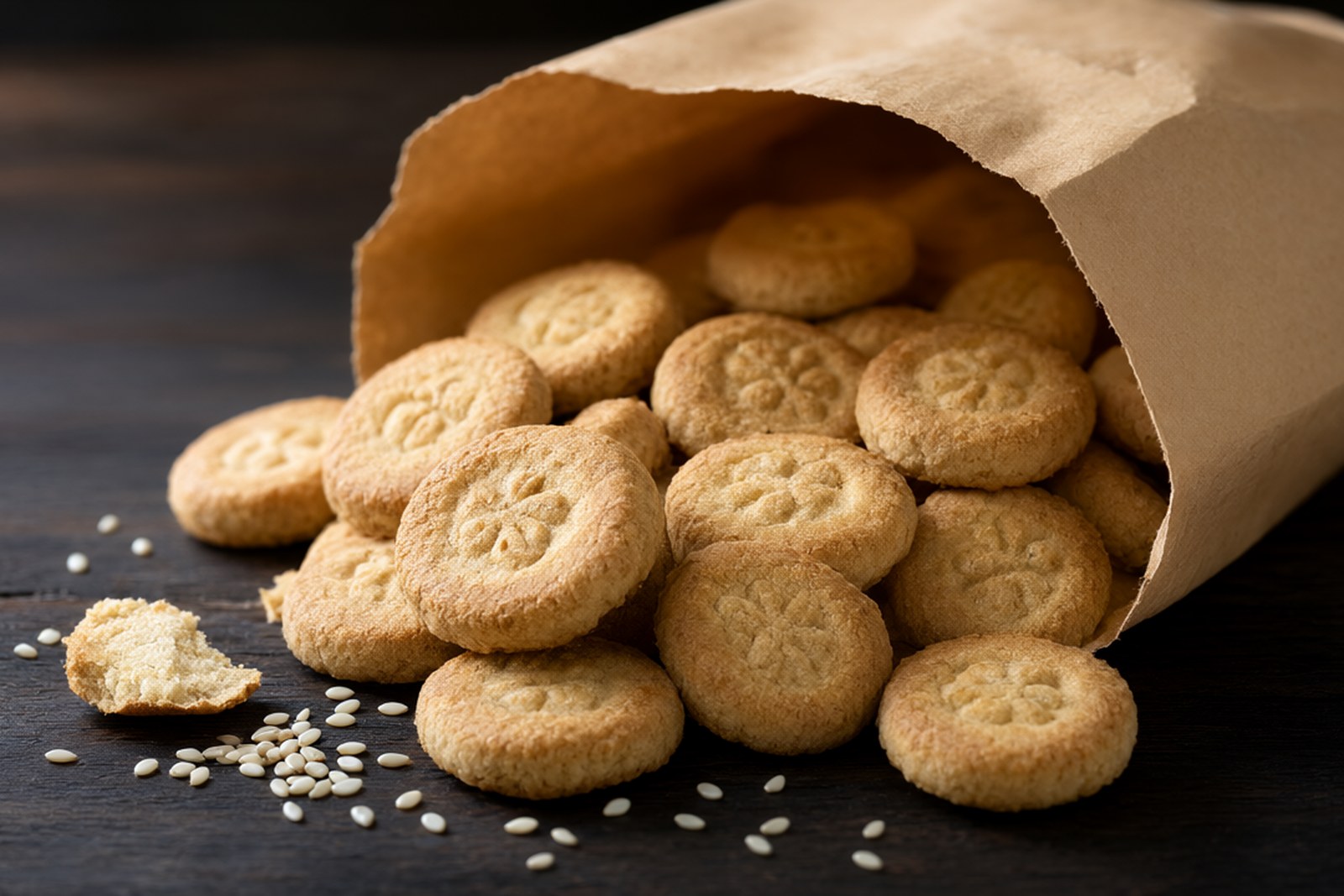
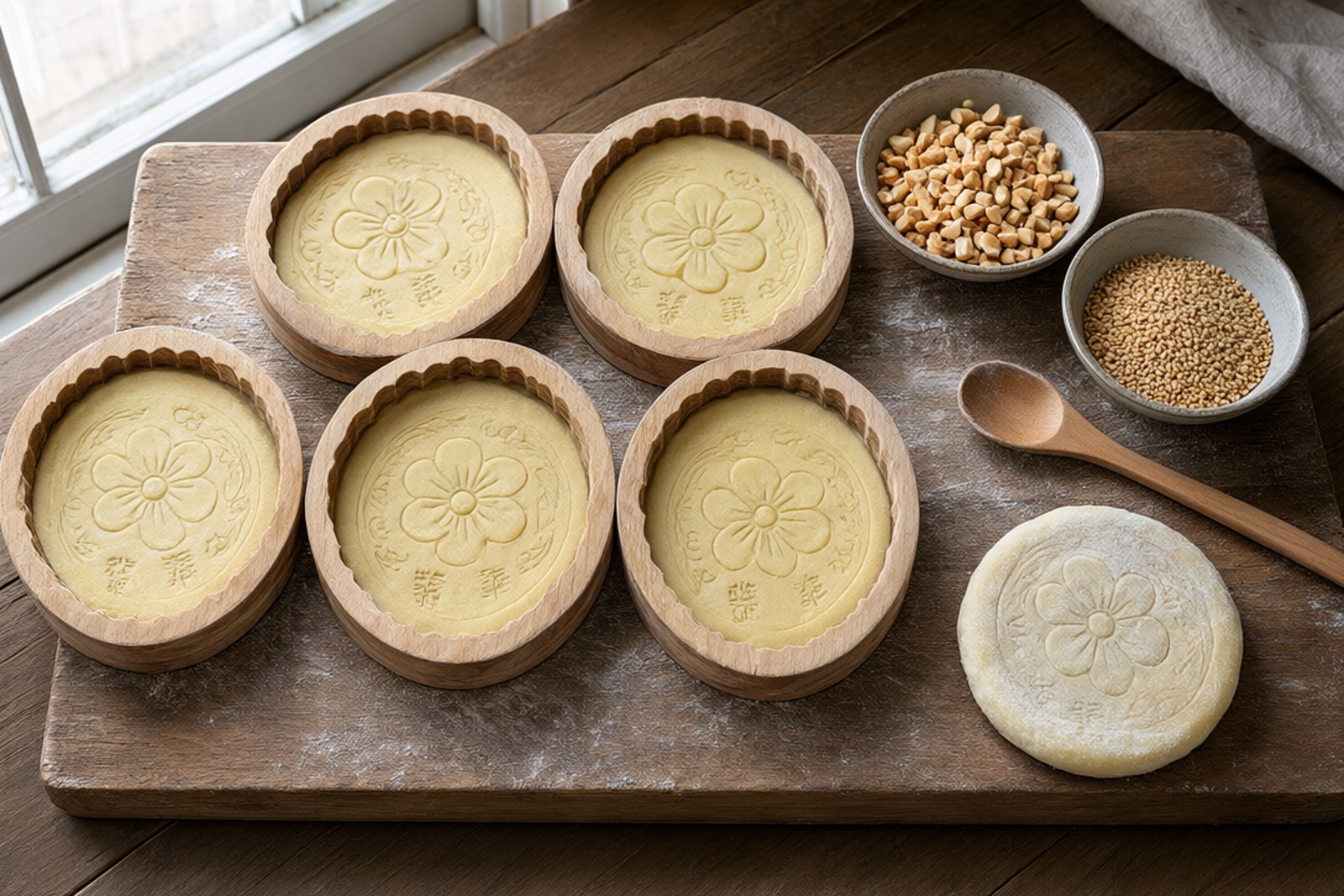
The technique is closer to sugar-craft than to baking. The dry ingredients are mixed with a syrup cooked to a precise point, pressed into wooden moulds that stamp a pattern into the face of each cake, knocked out and baked slowly until the moisture is gone and the sugar has set hard. Everything about the result depends on the syrup: too little and the cake crumbles, too much and it goes sticky in the packet, and the correct texture is sandy and slightly grainy, breaking cleanly under the tooth and then dissolving. Because the cake is dry, it travels; because it is pressed, it stacks; and because it is cheap, it has never needed to change. The moulded face, which is the only decoration on it, is usually a shallow flower or a character, and the pattern has stayed roughly constant for a century.
The Cake and the Town
Foshan has a small family of these pressed, dry, cheap snacks, and they are all products of the same logic: a trading and pottery town with a dense working population needed food that was portable, shelf-stable and affordable, and bakers produced it in moulds. 盲公饼 is the best known, but it shares a shelf with 大良崩砂 Dàliáng bēngshā, a twisted fried dough from Daliang, and with the various 公仔饼 gōngzǎi bǐng, the small moulded festival cakes made for the mid-autumn season. All of them are made to a fixed form, all of them are eaten with tea, and all of them are sold in the same kind of plain paper bag.
The modern versions vary in quality more than one might expect. The best are still baked in small batches with real peanut and sesame, and they taste of those things rather than of sugar; the cheapest bulk versions replace the nuts with flour and flavour and go bland and dusty. The tell is the smell when the packet is opened, which should be roasted sesame and peanut rather than vanilla, and the weight, since a cake made mostly of nut and syrup is heavier in the hand than one made mostly of flour. A good 盲公饼 is also faintly salty, which is what makes it work with tea rather than against it.
Words and Names
盲公饼 mánggōng bǐng is the cake, literally blind-man cake, and 佛山盲公饼 Fóshān mánggōng bǐng is the full name used when the origin matters. 饼 bǐng is the general word for a pressed cake or biscuit and appears in dozens of local names. 大良崩砂 Dàliáng bēngshā is the twisted fried dough from Daliang, 公仔饼 gōngzǎi bǐng the small moulded festival cakes. 花生 huāshēng is peanut, 芝麻 zhīma sesame, 米 mǐ rice and 糖 táng sugar, which between them are the entire recipe. 饼模 bǐngmó is the wooden mould.
What the Locals Know
Buy from a shop that bakes on the premises, ideally one with a working oven visible behind the counter, and buy a small packet first rather than a gift box, because the boxed versions are usually the stale ones. Check the smell: roasted nut is right, vanilla or nothing is wrong. The cake keeps for a month in a sealed bag and much less in the open air of a wet summer, so if you are buying to take home ask for a vacuum-sealed packet. In the shop, eat one on the spot with a cup of 普洱茶 pǔ’ěr chá or the local 凉茶 liángchá herbal tea, which is the combination the biscuit was designed for. Prices are low, roughly ten to thirty yuan for a packet depending on size and on how much peanut is actually in it, and the gift boxes at the ancestral temple cost several times what the same cake costs a street away.
flowcloud would say that the blind man’s cake is the most honest kind of local food, since it was invented by somebody who needed a living rather than somebody who needed a dish, and it has survived by being good at exactly one thing.
Where to find it: the biscuit shops around 祖庙 Zǔmiào, the ancestral temple, and the older bakeries on the lanes of 禅城 Chánchéng, plus the food streets of 大良 Dàliáng in Shunde where the whole family of pressed and fried cakes is sold together. Ask for 盲公饼 by name, buy a small packet to taste before committing to a box, and check whether the shop bakes its own.