
榨菜鱼 Zhàcài yú, zhacai fish, is the dish the district put its own name on – the plate a visitor is told to order before the menu has been properly opened. The idea is characteristically river-town plain: take fresh river fish, grass carp above all, and simmer it in a broth built on aged wind-dried zhacai, leaf and head together, until the pickle’s sour salt cuts through the richness of the flesh and the broth tastes of both at once. The fish must be genuinely fresh – a fish simmered in a sour-salt broth betrays every hour past its prime – and the pickle must be genuinely aged, so that its sharpness has rounded into something deeper than vinegar.
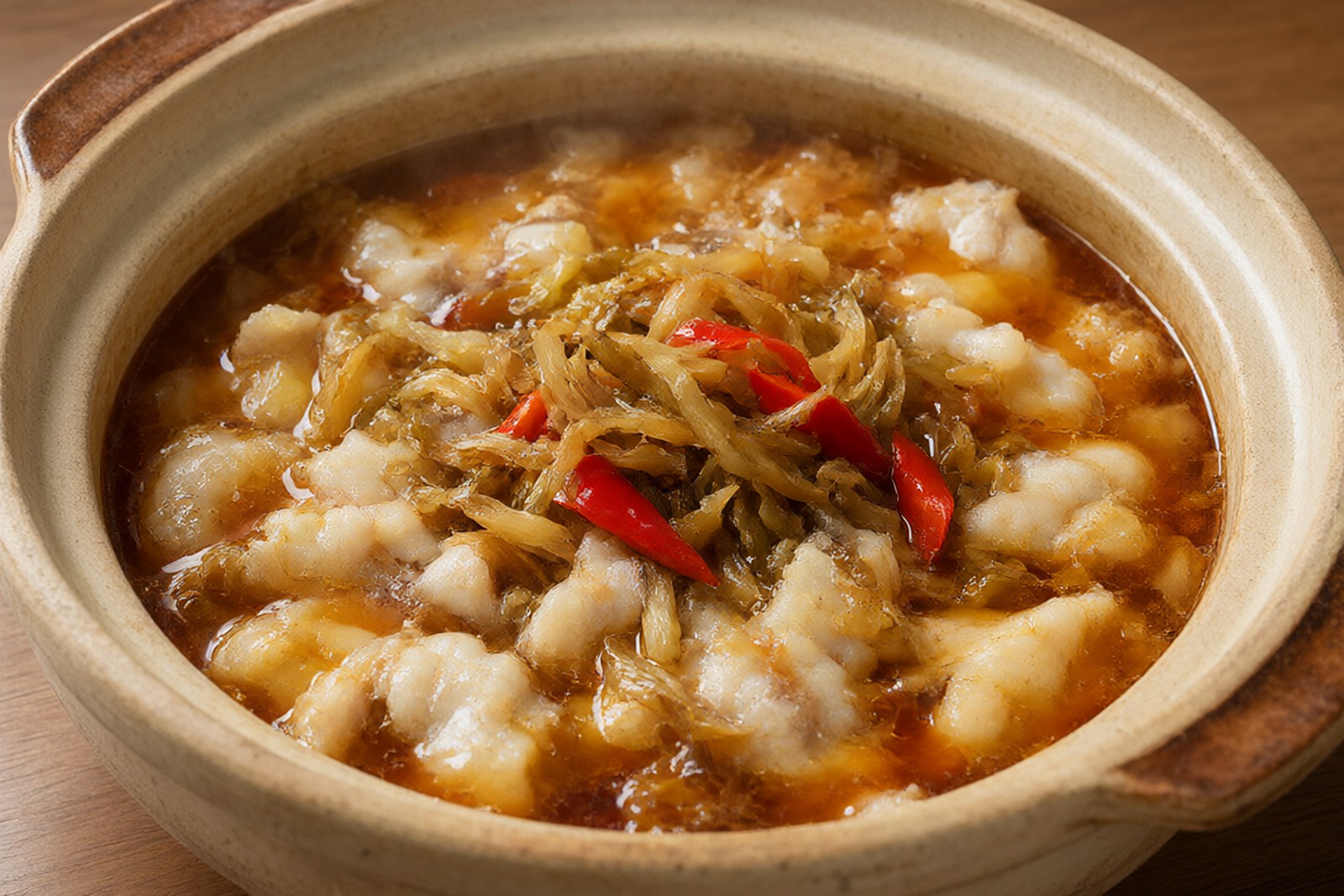
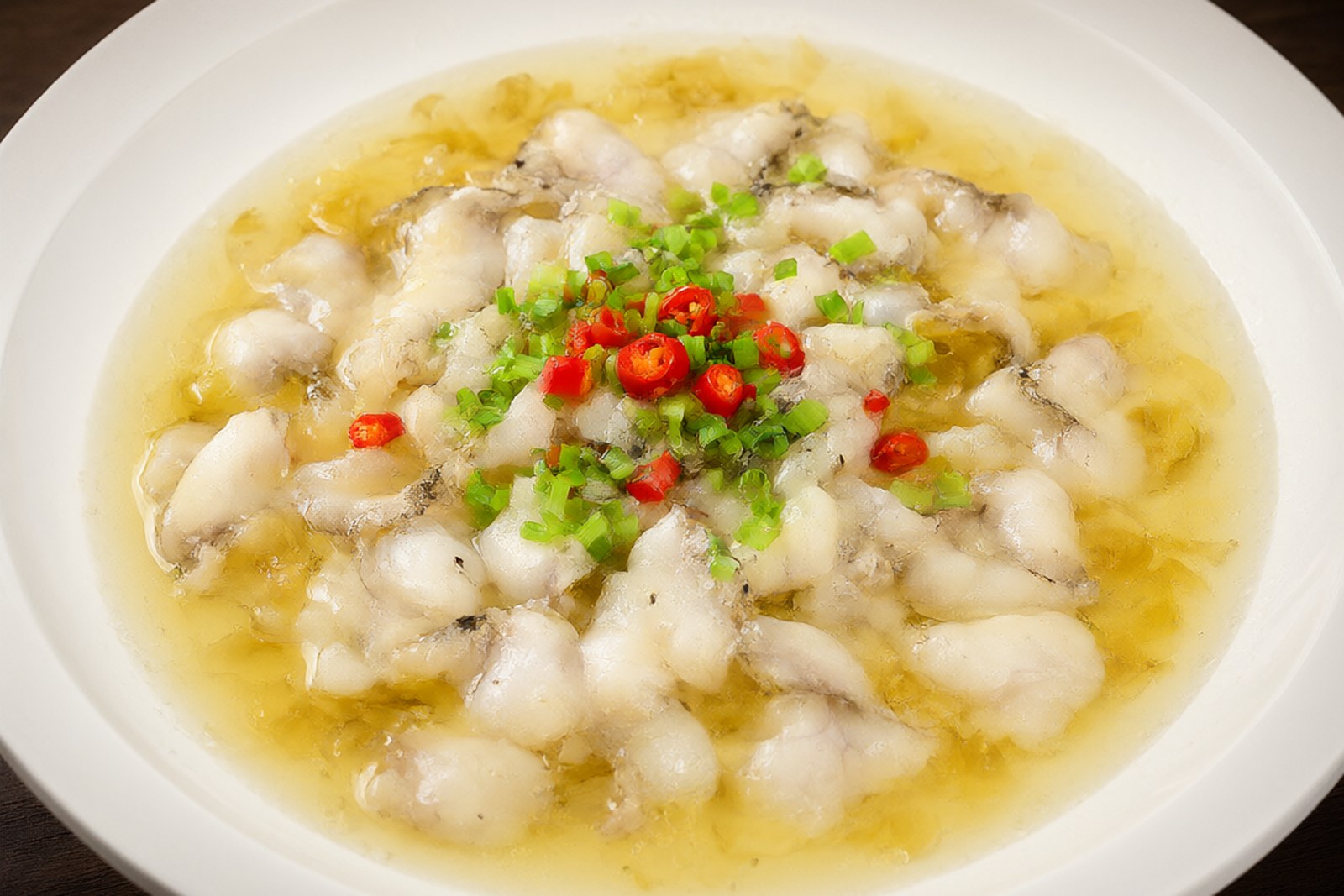
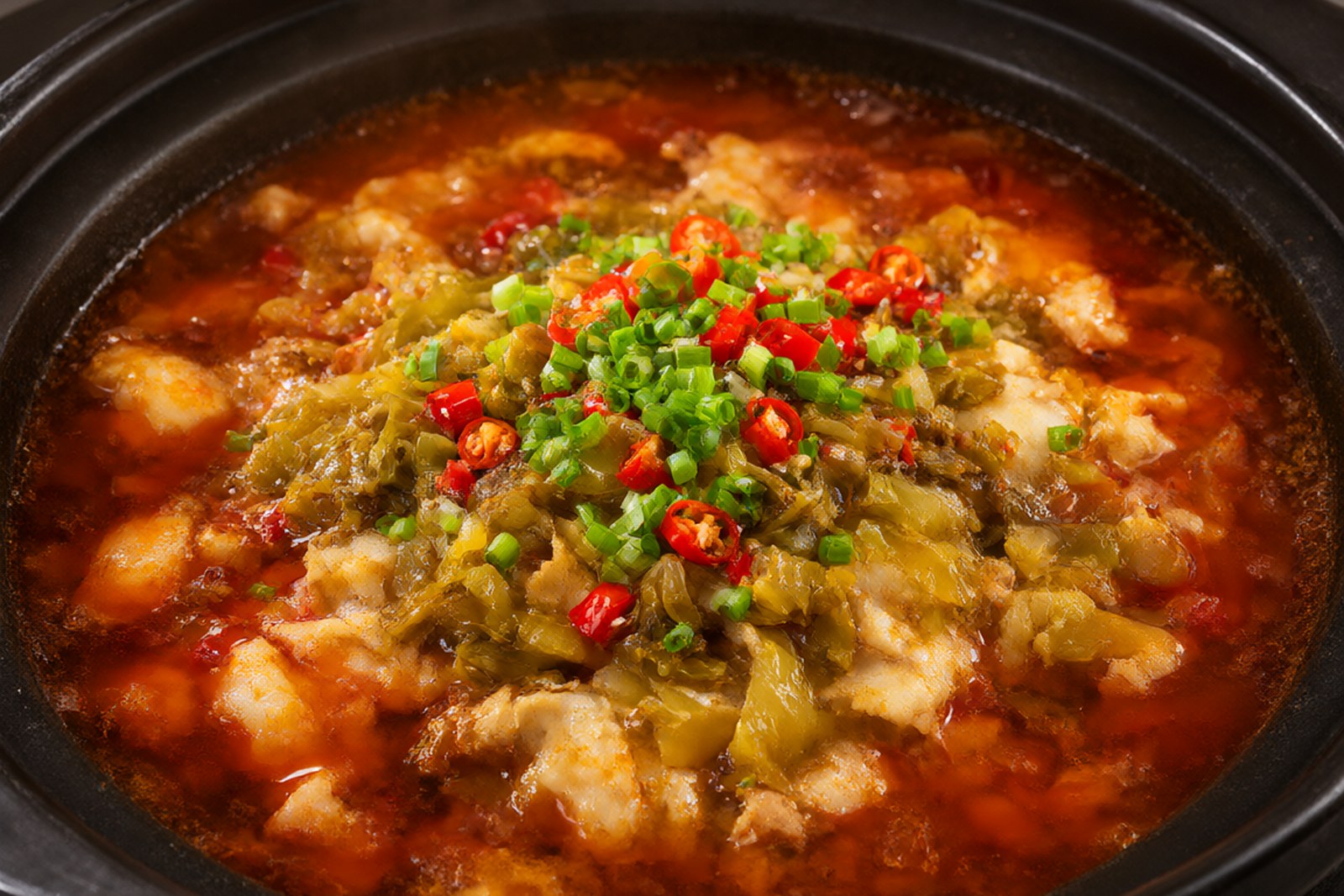
The district’s cooking contest recognises three formal flavour types, and a proper kitchen can do all three. The first is 咸鲜 xiánxiān, salt-savoury – the purist’s bowl, where the pickle and the fish carry the broth between them and nothing else gets in the way. The second is 麻辣 málà, the numbing-hot register that the rest of Chongqing would expect, chili and Sichuan pepper layered over the sour base. The third is 泡椒 pàojiāo, pickled-pepper, whose fermented heat is brighter and rounder than dried chili. Restaurants argue their own variants the way other towns argue hotpot bases – more pickle or more pepper, fish sliced or fish sectioned, broth thick or thin – and the argument has never produced a winner, only more bowls.
The pairing works because the two main ingredients need exactly what the other has. Grass carp is a fine fish but a plain one, with a richness that can turn heavy; the aged pickle is an intensity that no one would eat by the spoonful. Simmered together, the pickle’s acid and salt cut the fat of the flesh, the flesh absorbs the ferment’s depth, and the broth ends up the part of the dish that regulars fight over – drunk last, straight from the spoon.
The official stamps have caught up with what the district already knew. In 2024 the dish was named head bowl dish of Chongqing’s 渝味360碗 Yúwèi sānbǎi liùshí wǎn, Yuwei 360 bowls – the city’s curated list of signature dishes – and in 2025 it was named the list’s most touristic dish, the formal recognition of what locals had always treated as the one plate a visitor must order. The honours changed the signage outside the restaurants, adding a line about awards to every doorway, but they did not change the bowl: it is still fish, pickle and time, simmered together until neither can be told apart.
The discipline of this page is worth stating plainly. The record consulted names the grass carp, the aged wind-dried pickle with leaf and head, the three formal flavour types, the two Yuwei 360 honours and the restaurants’ habit of arguing variants; it does not name a founding restaurant, a founding year, a posted price or any single address, and none is invented here. The honest page describes a district-wide dish rather than one celebrated kitchen, and lets whichever bowl you find be the recommendation.
Words and Names
榨菜鱼 Zhàcài yú, zhacai fish, the district’s signature dish: fresh river fish, grass carp above all, simmered in a broth built on aged wind-dried zhacai, leaf and head together, until the pickle’s sour salt cuts the richness of the flesh. 草鱼 cǎoyú, grass carp, the standard fish of the bowl. 咸鲜 xiánxiān, salt-savoury; 麻辣 málà, numbing-hot; 泡椒 pàojiāo, pickled-pepper – the three formal flavour types recognised by the district’s cooking contest. 渝味360碗 Yúwèi sānbǎi liùshí wǎn, the Yuwei 360 bowls, Chongqing’s curated list of signature dishes that named this the head bowl dish in 2024 and its most touristic dish in 2025. The record names no founding restaurant, year or figure price, and none is invented here.
What the Locals Know
The first thing locals know is that the fish must be alive or near it. The dish is built on freshness, and the trustworthy kitchens keep their carp in tanks and net them to order – a restaurant that refuses to let you see the fish is a restaurant the regulars have already stopped arguing about. The cut matters too: sections with the bone for depth of broth, sliced fillets for tenderness, and families split the difference the way they always have.
The second thing locals know is the broth. A proper zhacai fish broth should taste of fermented pickle rather than of vinegar – a sharpness with depth behind it, not a raw sour bite – and the shreds in it should be aged enough to have gone amber and yielding. Regulars judge the kitchen by the last spoonful: the broth is drunk at the end, and a bowl whose broth has thinned into salt water is a bowl from a kitchen that rushed the simmer. The three flavour types are not ranked, but the salt-savoury version is the one elders order when they want to know whether a new kitchen can actually cook.
flowcloud would say that zhacai fish is the district’s signature because the pairing is exact – fresh grass carp simmered in a broth built on aged wind-dried pickle until the sour salt cuts the fat and the broth tastes of both at once – served in salt-savoury, mala or pickled-pepper form according to taste, argued over by restaurants the way other towns argue hotpot bases, and honoured in 2024 and 2025 as the Yuwei 360 list’s head bowl and most touristic dish, with no founding kitchen or figure price on the record and none invented. All checked October 2026.
Where to find it: zhacai fish is served throughout 涪陵区 Fúlíng Qū, Fuling District, whose seat stands at the confluence of the Wujiang and the Yangtze downstream of Chongqing – at dedicated fish restaurants along the riverside streets of the district seat, at family kitchens in the river towns up the Wujiang gorge, and at roadside tables on the approaches to the city. Reach the district seat by frequent rail and road connections from Chongqing, then follow the tanks of live carp and the steam of the midday trade. No specific restaurant, address or posted price is named on the public record consulted. All checked October 2026.