
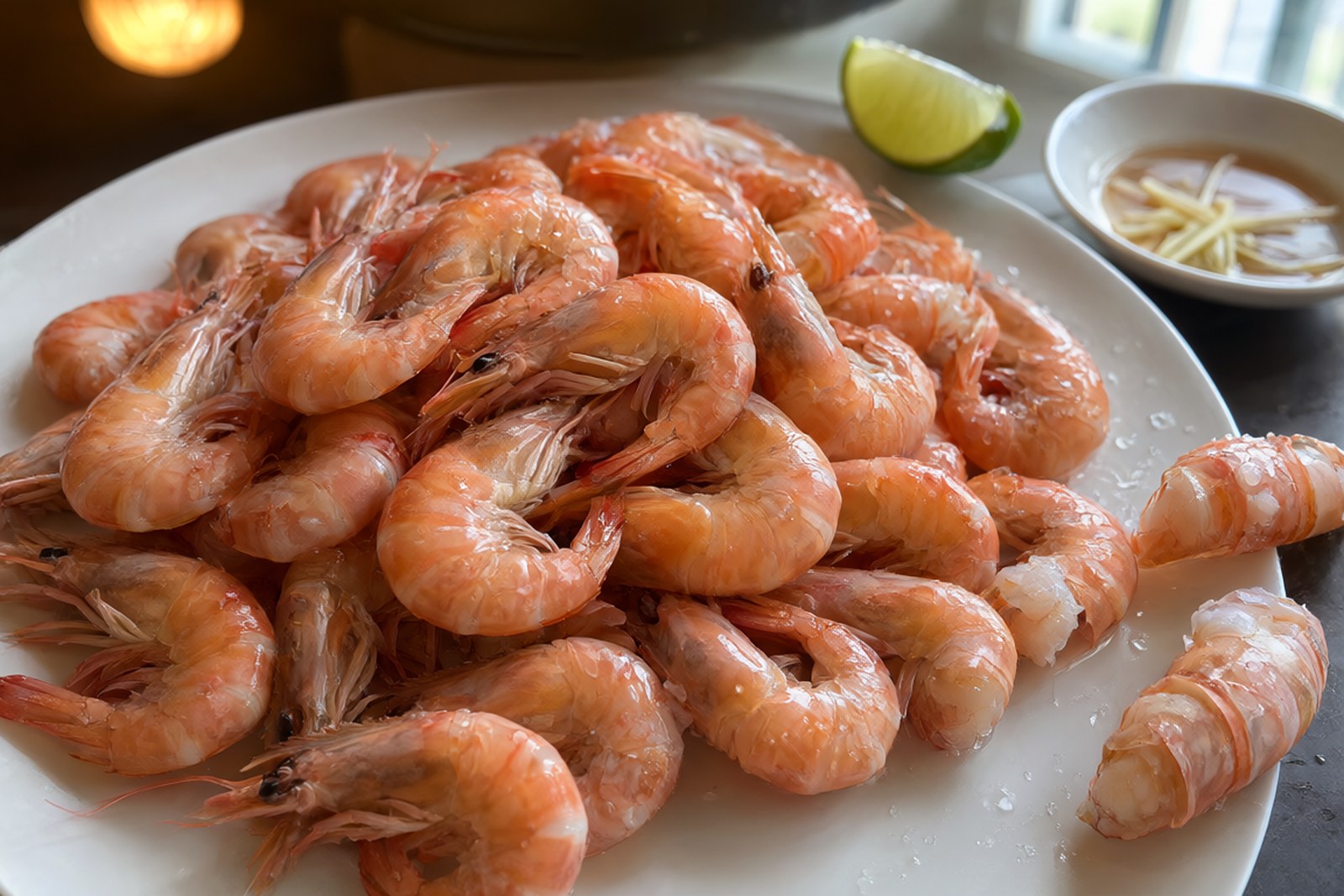
The prawns come to the table still in the shell, curled, pink-orange, stacked in a heap on a white plate with nothing but a saucer of soy and a wedge of lime, and the man who carried them says the only thing worth saying about them, which is that they were swimming nine hours ago. You peel one with your fingers, and the shell comes away in one piece, and the flesh underneath is firm and snaps when you bite it, and it is sweet in a way that prawns raised in a tank never manage. 港北对虾 Gǎngběi duìxiā is not a famous dish outside 海南 Hǎinán. Inside it, it is one of the four names people argue about.
港北 Gǎngběi is not a town so much as the north shore of a lagoon. It sits at the top of 小海 Xiǎohǎi, the “little sea” — a body of water in the east of 万宁 Wànníng that looks like a lake, behaves like the ocean, and is the largest lagoon-type inland sea in China. The prawns come out of it, and they taste of it, and if you want to understand why they are worth a detour you have to understand the water they grew up in.
A Sea That Is Not Quite a Sea
小海 Xiǎohǎi is something close to fifty square kilometres of brackish water on the east coast of the island, shaped, unmistakably, like a gourd. It measures roughly ten kilometres north to south and between three and a half and seven and a half kilometres across, and it is between one and six and a half metres deep, which makes it shallow: a big warm shallow pan of water sitting in the tropical sun.
Eight rivers empty into it from the west — the 太阳河 Tàiyánghé, the 龙滚河 Lónggǔn gǔn and half a dozen smaller ones — carrying fresh water and fine silt down out of the hills. The only way out to the ocean is a single narrow channel in the north-east called the 港北口门 Gǎngběi kǒumén, about three kilometres long and somewhere between one hundred and three hundred metres wide, and because there is only one, the exchange with the sea is slow and partial. The result is water that is neither fresh nor fully salt, but somewhere in between, warm, and constantly stirred by a tide that has to squeeze through a gap.
That mixture is the whole story. The silt the rivers bring settles into a soft, dark, mineral-rich mud along the lagoon floor, and it grows the kind of microscopic life that prawns and crabs and shellfish eat and grow fat on. The local phrase for the floor of 小海 is 紫黑色泥质沙 zǐhēisè nízhì shā — purple-black muddy sand — and it is said with a certain tenderness. Foods that grow in a rich, strange, halfway environment taste of something specific. Oysters from a tidal estuary taste of it; so do these prawns.
Why These Prawns
对虾 duìxiā — literally “pair shrimp”, for the way they were once counted and sold in pairs — covers a family of large prawns along the Chinese coast, and the ones from 小海 have a particular reputation. The water is warm and the food is abundant, so the animals grow fast and large, and the brackish, mineral-heavy water gives the flesh a sweetness that is not just the natural sugar of fresh seafood. Local cooks will tell you the difference between a 港北 prawn and one from any other market is the texture first: firm, almost crunchy, and springy rather than soft.
The 小海 is generous in a way that has shaped the whole district. Its catch is credited with three of the four dishes in the old list of 万宁 Wànníng’s great specialities: the 和乐蟹 Hélè xiè, the mangrove crab from the same water; the 港北对虾 themselves; and the 后安鲻鱼 Hòu’ān zīyú, the grey mullet taken off the next town along. Three quarters of a county’s culinary heritage out of one lagoon is a fair indication of what is in it. There is also 沙虫 shāchóng, the sandworm — a delicacy that terrifies visitors and is worth trying anyway, either poached for three seconds and eaten with soy, or dried and fried until crisp.
How to Eat Them
There is a strong local argument that these prawns should be 白灼 báizhuó — dropped into boiling water for barely a minute — and served with a dip, and I have no interest in arguing with it. Anything else is a way of hiding the ingredient. The dip is usually light soy with a little vinegar, or a 蒜蓉 suànróng garlic mash, or nothing at all.
The second classic use is 油焖大虾 yóumèn dàxiā, prawns seared hard in oil with sugar, soy and rice wine until the shells caramelise and the sauce coats your fingers. It is a very different pleasure: sticky, sweet-savoury, and best eaten with rice and a bowl to put the shells in.
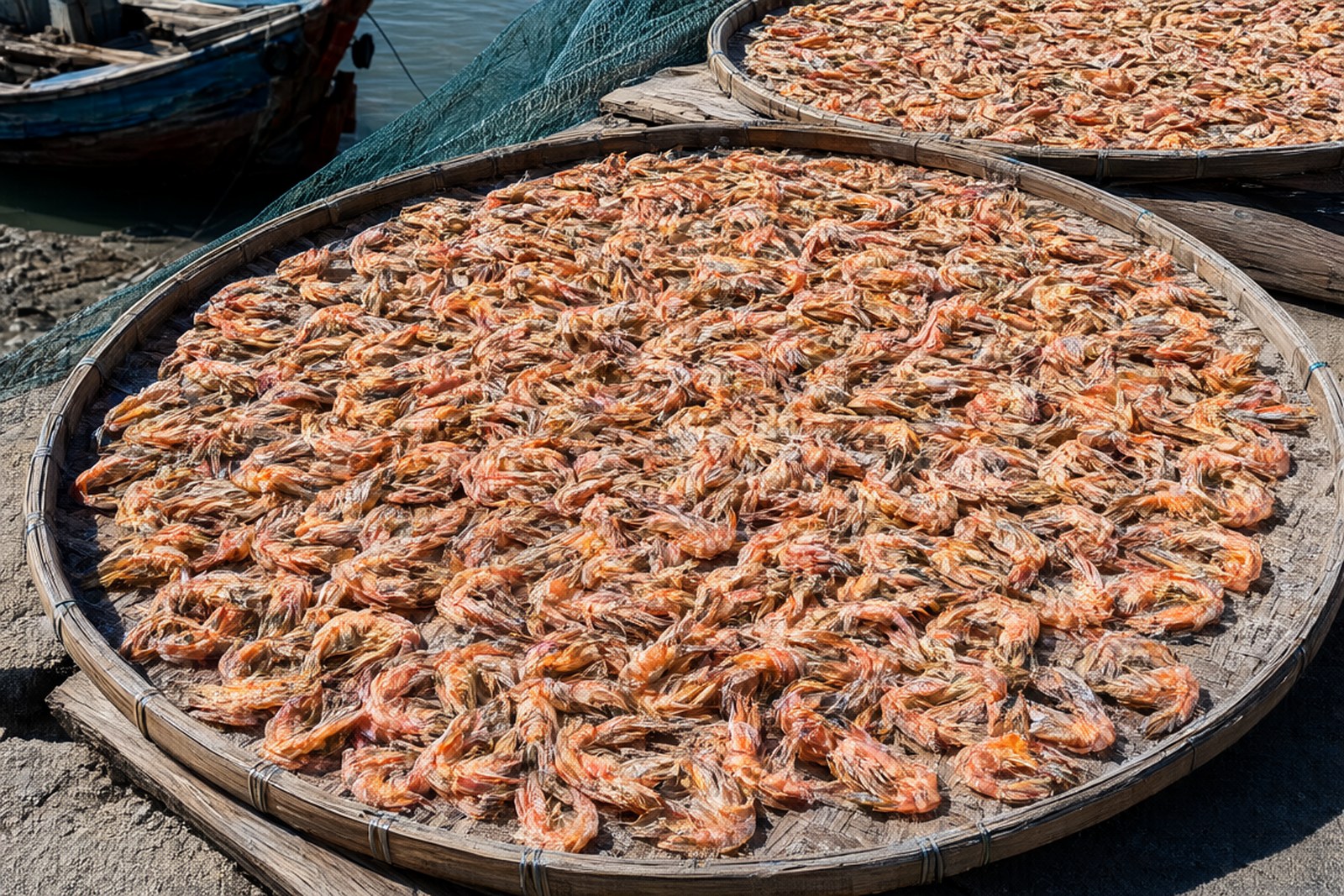
Third, and the one most visitors never try, is the dried form. 虾米 xiāmǐ, and the larger 虾干 xiāgān, are the way the lagoon’s catch has always travelled inland: salted, sun-dried, and used to give a pot of vegetables or a bowl of congee a deep bass note of shellfish. Buy a bag; it keeps for months, and a pinch of it improves almost anything.
Words and Names
小海 Xiǎohǎi is simply “little sea”, and the name is a thousand years of understatement; the water is brackish, tidal and about fifty square kilometres in extent, but it does not surge and does not turn blue and black in a storm, so to the people who named it, it was not the sea. 港北 Gǎngběi means “north of the harbour” — the settlement on the northern shore of the lagoon, at the mouth of that single channel. 和乐 Hélè, the township that administers it, is a different and older name and has nothing to do with happiness, having drifted over the centuries from an earlier form.
对虾 duìxiā is the interesting one. The character 对 duì means a pair, and the name comes from the old practice of selling the prawns in matched pairs by size. To this day a seafood vendor in 万宁 Wànníng sorts them into 头 tóu grades, and the price of a prawn in the market is a matter of how many make a 斤 jīn.
What the Locals Know
Buy by the head count. A 港北对虾 is graded as 几头 jǐ tóu — how many prawns make up half a kilo. Six to eight head is a good-sized prawn; anything under five head is a prize and priced like one. Ask and the vendor will tell you the count before the price.
Look at the shell, not the size. Fresh 对虾 have a shell that is tight, glossy and hard to detach, a head firmly attached, and no blackening at the joints. A prawn whose shell slides off in your hand was caught two days ago.
Eat them in the morning if you can. The boats work at night — 傍晚出海, 清晨归来, out at dusk, home at dawn — so the fish and prawns land early, and the restaurants that cook them within hours of landing are the ones worth getting up for. By late afternoon what you are eating is still good but no longer the same thing.
Skip the heavy sauces on the first plate. Order 白灼 báizhuó before anything else, eat two, and then decide how you want the rest. And do not waste the heads: ask for them fried with salt and pepper, or leave them in your congee bowl.
Give the 沙虫 shāchóng a chance. It looks like nothing else on earth and tastes of clean seawater and sweetness. Poached briefly is the way to meet it. Every local table will nod approvingly at you for ordering it.
Where to Eat It
The place to do this is 港北 Gǎngběi itself — the fishing villages of 港上 Gǎngshàng and 港下 Gǎngxià, on the north bank of the lagoon, where a row of restaurants faces the channel and the boats come in. Look for tanks of live prawns and a menu of about a dozen things, and order 白灼对虾, a 和乐蟹 Hélè xiè if it is in season, and a plate of greens. Two people can eat very well for ¥150–250, most of which is the prawns. There is a bridge over the mouth of the lagoon now — the 港北大桥 Gǎngběi Dàqiáo, a 1.8-kilometre span that opened to make the crossing easy — so you can arrive from 万宁 Wànníng town in about half an hour.
flowcloud would say that the finest ingredient in any region is usually the one the region has quietly arranged its calendar around — that the boats going out at dusk and back at dawn is not a schedule but a form of respect, and that a prawn eaten nine hours after it was swimming is a different food from the same prawn eaten two days later.
Where to find it: 港北对虾 (Gǎngběi duìxiā), 小海 (Xiǎohǎi) lagoon, 和乐镇 (Hélè) township, 万宁 (Wànníng), east 海南 (Hǎinán). Best eaten in 港北 (Gǎngběi) itself, at the restaurants facing the channel between 港上 (Gǎngshàng) and 港下 (Gǎngxià), reached in about thirty minutes by road from 万宁 (Wànníng) town over the 港北大桥. 白灼对虾 ¥80–160 a plate depending on the day’s grading and the size count, 油焖大虾 similar, dried 虾米 about ¥100–200 per 斤 (jīn). Ask for the head count before you agree to the price, order them 白灼 (báizhuó) first, and get there before noon.