
荔枝 lì zhī is the fruit that gives this coast its oldest story, and the story is about speed. The lychee ripens in the heat and begins to lose itself almost immediately; 白居易 Bái Jū yì, the Tang poet, wrote that it changes colour on the first day, scent on the second, taste on the third, and that by the fourth or fifth there is nothing left of any of the three. Everything about the trade has been about that sentence ever since. The trees here are in 高州市 Gāo zhōu shì, in the west of 茂名市 Mào míng shì, and the particular grove is 贡园 Gòng yuán, the Tribute Garden, at 根子镇 Gēn zi zhèn, a few kilometres south-east of the city.
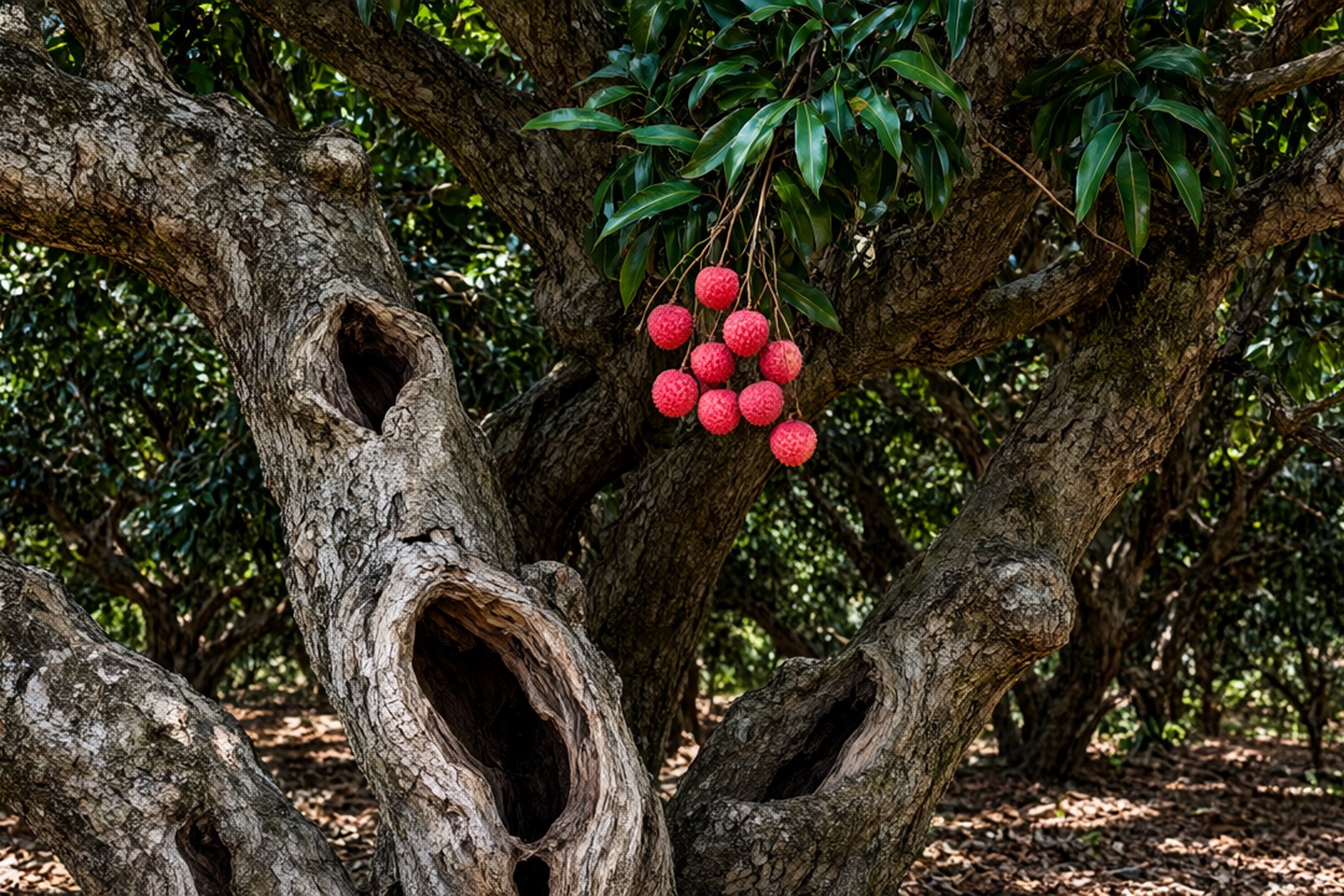
The garden is eighty-odd mu and about two thousand years old, and by the trade’s reckoning it is the largest, oldest, best-preserved and most complete collection of old lychee trees in the country, with more varieties in it than anywhere else, which is why the local name for it is 荔枝博物馆 lì zhī bó wù guǎn, the lychee museum. Its trees are named individually, the way ancient trees are elsewhere. One is 力士回首 Lì shì huí shǒu, the Strong Man Looks Back, a 白糖罂 bái táng yīng, White Sugar Jar, of about thirteen hundred years. Another is 千手观音 Qiān shǒu Guān yīn, Thousand-Handed Guanyin, at over six hundred, its branches distributed so evenly around the fork that the comparison was unavoidable. There is 二十四担 Èr shí sì dàn, Twenty-Four Piculs, and 虚心成佛 Xū xīn chéng fó, the Empty Heart Becomes a Buddha, and 天女散花 Tiān nǚ sàn huā, the Heavenly Maiden Scatters Flowers; the names were given by the families who have looked after them, which is a form of record-keeping older than any archive.
The story that made the garden famous involves 高力士 Gāo Lì shì, the Tang court eunuch whose family came from this part of 高凉 Gāo liáng, and who is said to have sent his home town’s lychees north to 杨贵妃 Yáng Guì fēi, the emperor’s consort, packed in green bamboo tubes to hold the moisture and carried by post horse at eight hundred li a day. The line everyone quotes is 一骑红尘妃子笑,无人知是荔枝来 yī qí hóng chén fēi zǐ xiào, wú rén zhī shì lì zhī lái, a horseman in red dust and the consort smiles, nobody knows it was lychees that came. The variety at the centre of it is the 白糖罂, and the register of the county’s own government says the mother tree stood in the 贡园 at 岭腰村 Lǐng yāo cūn, the second-generation tree still in the garden being about five hundred years old. The trade boiled the court’s demand down to a name, 妃子笑 fēi zǐ xiào, the Consort Smiles, and then spent the rest of its history arguing about which variety deserved it.
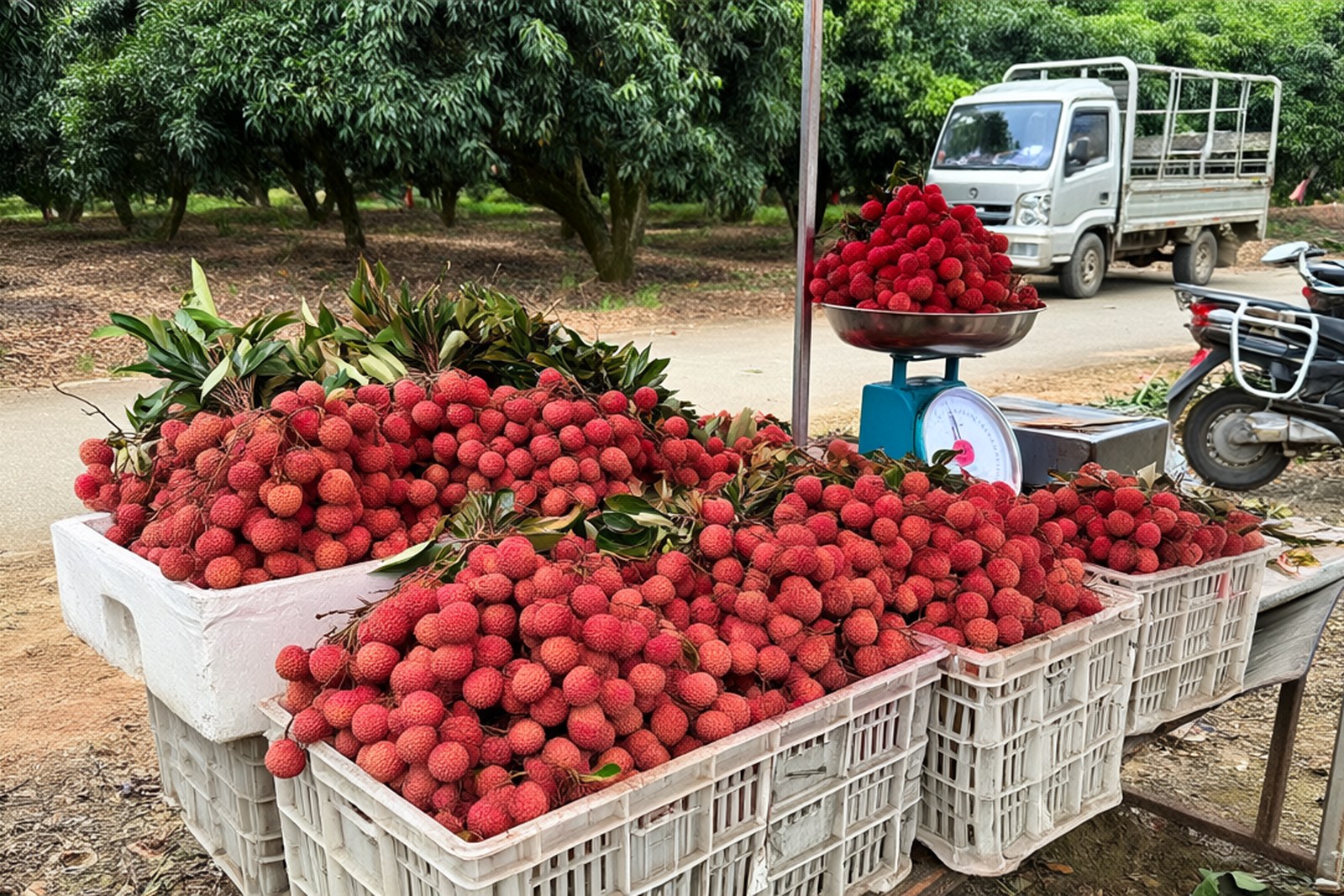
What 根子镇 has now is volume and an early season. The township’s orchards run to about seventy thousand mu and produce around sixty thousand tonnes a year on land it has been growing lychee on for two millennia, and it markets itself as 中国荔枝第一镇 Zhōng guó lì zhī dì yī zhèn, China’s number one lychee town. The county holds three separate geographical-indication registrations for the fruit, under the names 高州荔枝, 茂名荔枝 and 茂名白糖罂荔枝. The varieties run from 三月红 through 妃子笑, 白糖罂, 白蜡, 黑叶, 桂味, 糯米糍 and 进奉, so the season has an order to it rather than a single peak. The village at the centre of it, 柏桥 Bǎi qiáo, is five square kilometres and about four thousand people, carries about seven thousand mu of orchard and two hundred and sixty-two registered old trees, keeps three quarters of itself under forest and has run the picking, the pre-cooling and the packing as a single operation since the 2010s; fruit goes into a chilling room within minutes of coming off the tree and reaches 广州 or 深圳 within the day, which is 白居易’s problem answered at last, and answered by refrigeration rather than by post horse. More than half the village’s crop now sells online, which is a strange ending for a fruit that once required an imperial relay.
Words and Names
荔枝 lì zhī is the lychee and 贡园 Gòng yuán the Tribute Garden; 白糖罂 bái táng yīng is White Sugar Jar, the variety the garden’s reputation is built on, and 妃子笑 fēi zǐ xiào, the Consort Smiles, is the name the court story gave the fruit. 桂味 guì wèi, cinnamon flavour, and 糯米糍 nuò mǐ cí, glutinous-rice cake, are the two late varieties buyers wait for. 白蜡 bái là, white wax, and 黑叶 hēi yè, black leaf, are the workhorses of the early and middle season. 田头小站 tián tóu xiǎo zhàn, field station, is the local name for the pre-cooling shed at the edge of the orchard, and 圈枝 quān zhī, layering, is the old way of propagating a tree that will not breed true from seed.
What the Locals Know
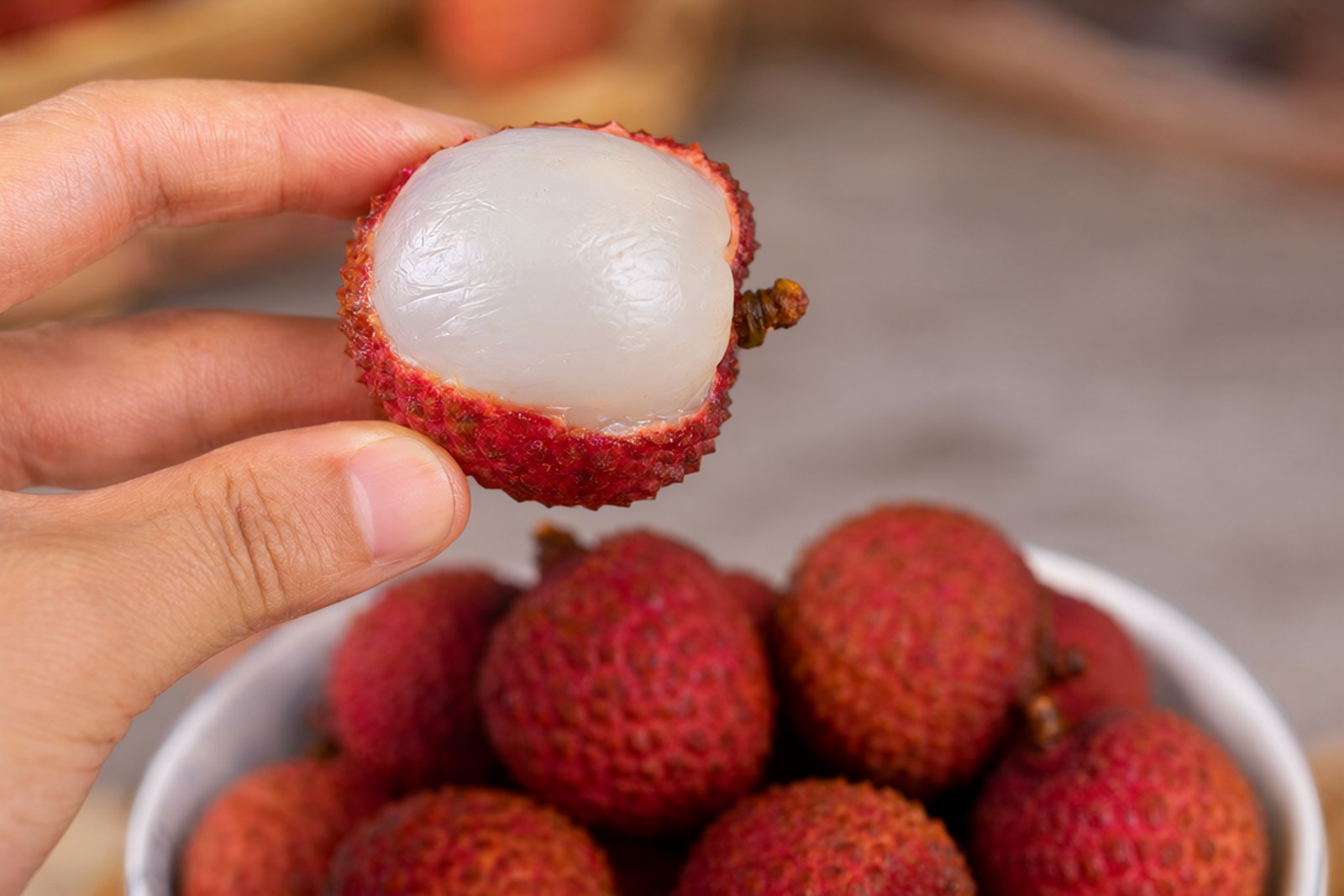
The rules are about ripeness and cold. A lychee is picked with the stalk on and the dawn dew still on it, because heat is what finishes it, and the local pickers finish before the sun is properly up. The shell should be red to the base and the shoulders should be full, and the fruit should feel heavy in the hand; a light lychee is one that has begun to dry inside. The 白糖罂 is the earliest of the good ones, ripe from late May, and the trade treats it as the signature; 桂味 and 糯米糍 come later and cost more, and the local view is that 白糖罂 is the one to eat on the day and 桂味 the one to eat cold. What not to do is buy it warm or leave it in a car, and the sellers will say so without being asked. If a roadside vendor offers a variety called 中华红 Zhōng huá hóng it is worth knowing why it exists: it is the tree planted as a 致富树 zhì fù shù, a prosperity tree, in 2000 beside the 红荔阁 Hóng lì gé, the Red Lychee Pavilion, on the day a national leader visited the township and the county decided the visit should grow.
flowcloud would say that a fruit which changes colour on the first day and taste on the third has been the making of this county twice over, once because an emperor’s consort wanted it, and once because a refrigeration shed at the end of the orchard finally cancelled the sentence a Tang poet wrote about it.
Where to find it: the orchards and packing sheds of 根子镇 in 高州市, an hour or so by road from 茂名市 and about twenty-five kilometres from the city centre, where the 贡园 is open outside the picking season and the roadside stalls sell by the basket from late May; the crop is cheapest and best at the field, and 高州市 proper and 茂名站 Mào míng zhàn both have trading floors from May to July. The 深湛 railway stops at 茂名站 and 高州 is on the coach and bus network from there. Buy the 白糖罂 early and the 桂味 late.