
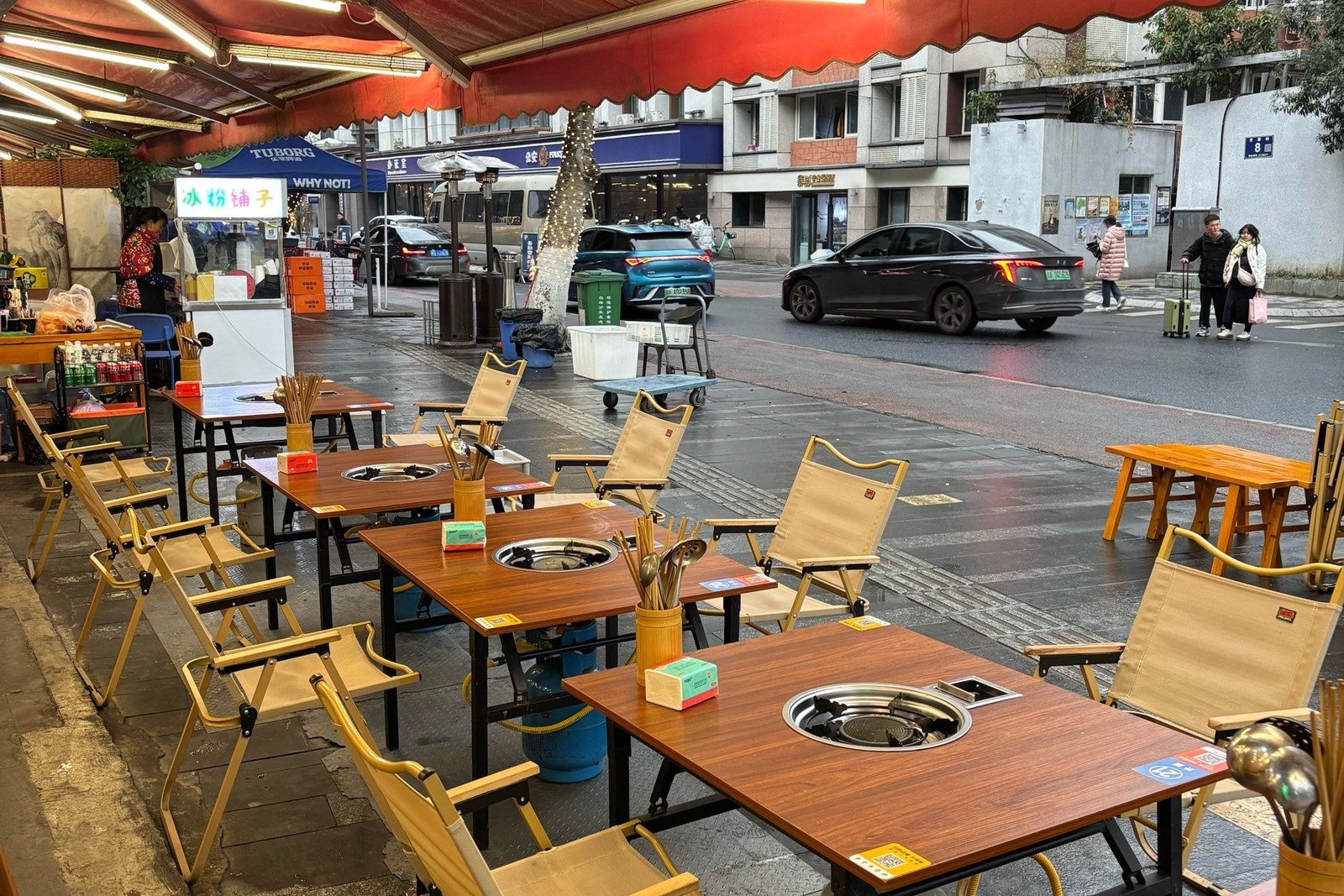
On a fine weekend at noon the road up 歌乐山 Gēlèshān Geleshan runs to a slow crawl of family cars, and under the roadside shade the courtyard kitchens begin their afternoon: woks roaring, chilies going into oil by the basinful, Sichuan pepper drifting over the stone walls. Chongqing is a municipality of southwest China, and 沙坪坝区 Shāpíngbà Qū Shapingba is the district that holds the west bank of the Jialing, its mid-west ridge clothed in the pine woods of Geleshan – and this page eats on that ridge, at weekend-noon altitude, at the tables in the woods. The river town’s snacks and the blood-curd pot keep their own pages. This is not a restaurant list – it is one road and the dish its traffic produced.

The place-name is the prologue: 三百梯 Sānbǎi Tī Sanbaiti, “three hundred ladders”, the stone stairway the hill’s notices and the city press count at 1,956 steps. Along the road above it, the dish that made the slope famous was pulled out of the road itself and the appetites that passed along it. The city press’s retrospectives set the scene in the mid-1980s, when the government rebuilt the mountain road and traffic thickened on it. Local accounts disagree on exactly when the dish crystallised – an early-century roadside-tavern tale, a 1970s farmhouse courtesy dish, a chef’s 1910 recipe all circulate – and this page prints none of those: the documented line begins lower down the slope.
The documented line starts with 朱天才 Zhū Tiāncái Zhu Tiancai. As he told the city press, he left the district farm-bureau payroll in the mid-1980s and, on his savings, put up a roadside shack on the mountain road – selling tea and cold noodles to the drivers climbing past. In 1990 his eight-table house, 林中乐 Línzhōnglè Linzhongle, “Joy in the Woods”, served the dish that carried the ridge’s name out of Chongqing: a young free-range rooster – 土仔公鸡 tǔzǎi gōngjī – chopped bone-in small, fried twice to a deep red-brown, then wok-tossed with a disproportion of dried chili segments and 大红袍花椒 dàhóngpáo huājiāo Dahongpao prickly ash. The logic was speed: chop the bird finer, heat the oil harder, multiply the chili, and the meat cooks in minutes – the house’s fire rule still runs 多一分则焦,少一分则不熟, one minute more it burns, one minute less it stays raw. Eaten cold, the cubes tighten into a drier, deeper fragrance – the dish’s second register.
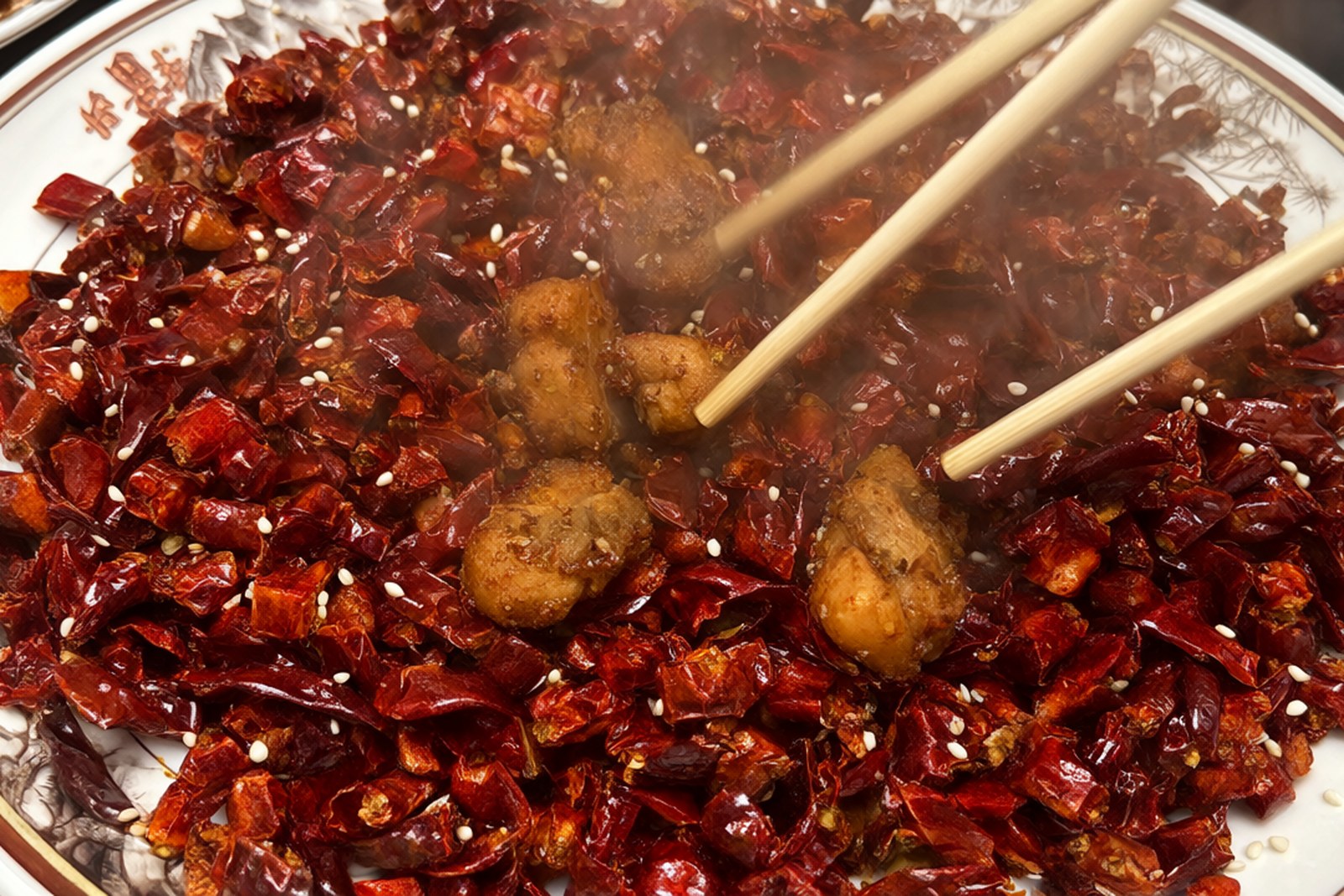
The street grew fast. From 1991, within about five years, thirty-odd restaurants with the chicken on their boards lined roughly a kilometre of the mountain road at Sanbaiti – the city press’s verified count. The peak ran 1993 to 1995: a single house, by the era’s reporting, could move hundreds of birds on a weekend day – magnitudes from the period’s press, not audited counts, checked October 2026. The family likes to tell how diners were urged to carry their leftover chilies home, until the chili pile became the thing people came for. The peppercorn chicken of another forested ridge braises its bird in green-peppercorn broth; this one dry-fries the cubes into a chili mountain – same surname, different lineage. Then came the fortune’s turn: the street contracted – fronts stood shuttered, moss on the parking bays, by the decade’s-end reporting – and today a handful of names endure, the old house among them, still firing the same wok. The honours arrived anyway: the technique stands on the municipal intangible-heritage register (2011), the dish joined the city’s 渝味 360 碗 Yúwèi 360 wǎn “360 Bowls” roster in the 2025 list, and a Chongqing deputy named it among the city’s dishes at the 2026 national legislative session, as reported – the street smaller, the recipe farther from home.
Words and Names
歌乐山 Gēlèshān is Geleshan, the forested ridge west of Shapingba’s urban core, now a national forest park; 三百梯 Sānbǎi Tī “three hundred ladders”, the 1,956-step stone stairway below the chicken street; 辣子鸡 làzǐjī laziji, chicken flash-fried and buried in dried chilies – “find the chicken in the chili mountain”. 林中乐 Línzhōnglè “joy in the woods”, the hillside house that made the dish famous around 1990; 朱天才 Zhū Tiāncái Zhu Tiancai, the retired farm-bureau worker who codified the fast-fry recipe. 以鸡衬辣,以辣显鸡 “chicken sets off the chili, chili shows up the chicken”, the dish’s own tagline; 土仔公鸡 tǔzǎi gōngjī the young free-range rooster; 大红袍花椒 dàhóngpáo huājiāo Dahongpao prickly ash, the numbing half of the seasoning pair; 渝味 360 碗 Yúwèi 360 wǎn the municipal “360 Bowls” list the dish joined in 2025.
What the Locals Know
The eating is a game and everyone plays it the same way: first admire the chili mountain, then dig with the chopsticks – one cube found is luck, three or five is skill, and the searching is the point of the dish, the pleasure locals call the fun of archaeology. Cold leftovers are not waste: the knowing keep the cubes for the next day, when the dry fragrance beats the hot serve. The outing has a set order – climb Sanbaiti first and earn the sweat, then take a courtyard table on the way down, the beer arriving with the mountain breeze. The older generation still recites the nineties street at its height – cars strung a kilometre down the road – while the younger ones eat the city’s softened versions but grant the ridge one thing: the dish’s household registration, they say, is on Geleshan.
flowcloud would say that Geleshan’s laziji is a road dish – cubed rooster flash-fried and buried in a mountain of dried chilies, codified around 1990 at an eight-table house called Joy in the Woods, multiplied within five years into thirty-odd kitchens along a kilometre of road, thinned again as the city’s tastes moved on, yet still ladled on the slope and listed among the city’s 360 bowls in 2025 – the street contracted, the recipe travelled.
Where to find it: the Sanbaiti road and its chicken courtyards, 歌乐山街道 Gēlèshān Jiēdào Geleshan subdistrict, 沙坪坝区 Shāpíngbà Qū Shapingba District, Chongqing Municipality – the stairway at the ridge’s foot, the courtyards along the mountain road above. Metro line 1 toward the Lieshimu side plus a bus or taxi works; driving is the local default, weekend noon the hour the road fills. A whole bird runs well above a plain city dinner, but no prices are quoted – figures drift with the bird and the season, checked October 2026. No single house is recommended: the old names are the street’s history, and which courtyards are open changes – check current notices before a dedicated trip. The dish’s origin is told in unreconciled versions this page prints none of; the dates above are the press-verified street history, 1990 to 2026.