
The pigeon arrived in 光明 Guāngmíng with the returning overseas Chinese, and that is the whole story of the dish. In 1958 the state put a dairy farm out on the hills north-west of 深圳, staffed largely by 华侨 huáqiáo, families who had come back from Vietnam, Malaysia and Indonesia and who knew how to run a livestock operation. The farm kept cattle for milk and, because squab is a by-product of any pigeon loft and because the settlers had eaten it abroad, it kept pigeons too. What made the bird worth cooking was the feed: the same grain and dairy waste that fattened the cattle went to the lofts, and by the 1980s the farm’s squab had a reputation that spread back down the road to the city. The restaurants that grew up along 光明大街 to serve it are still there, and the district is still called 光明, which means light, after the farm.
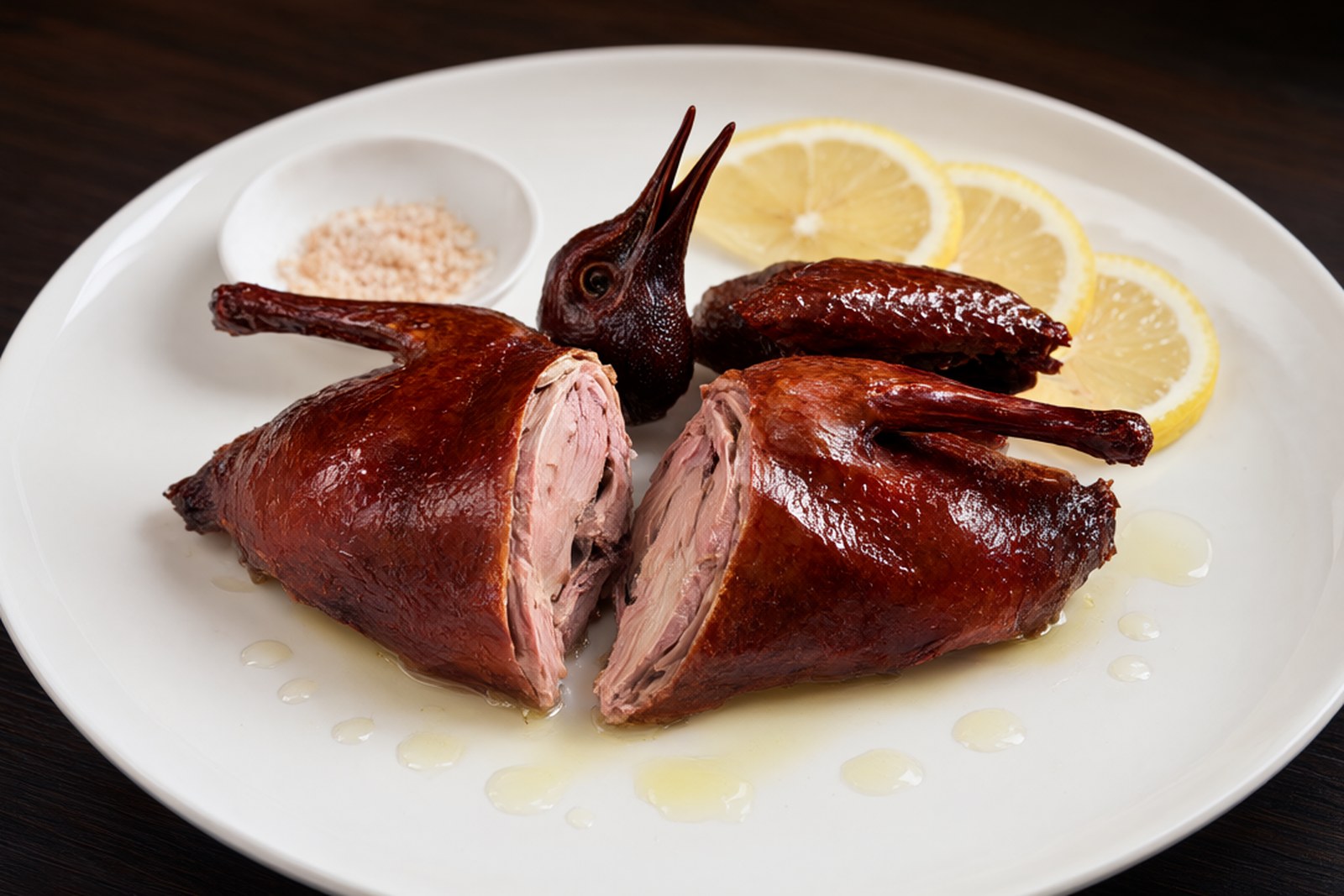
The name on the menu is 红烧乳鸽 hóng shāo rǔ gē, and 红烧 usually means braised, which misleads people who order it expecting a brown stew. The bird is not stewed and it is not roasted over fire either. It is first poached gently in a master stock of soy, rock sugar, star anise, 草果 cǎo guǒ and 桂皮 guì pí until it is just cooked through, then lifted out, hung to dry until the skin stops steaming, and finally lowered into hot oil for less than a minute. That last step is what does the work: the moisture in the skin flashes off and the surface blisters into a thin, dark, brittle lacquer that shatters when you bite it, while the meat underneath stays barely pink at the bone. A 乳鸽 is a young pigeon, twenty-five to twenty-eight days old, roughly three hundred grams, and that is the point: older birds have more flavour but the meat goes stringy in the same thirty seconds that give you the skin. You eat it with your hands, which is why the better places hand you a pair of thin plastic gloves along with the plate, and you dip the pieces in 椒盐 jiāo yán, a dry mix of salt and ground roasted Sichuan pepper, or in the small dish of the braising liquor they bring to the table.
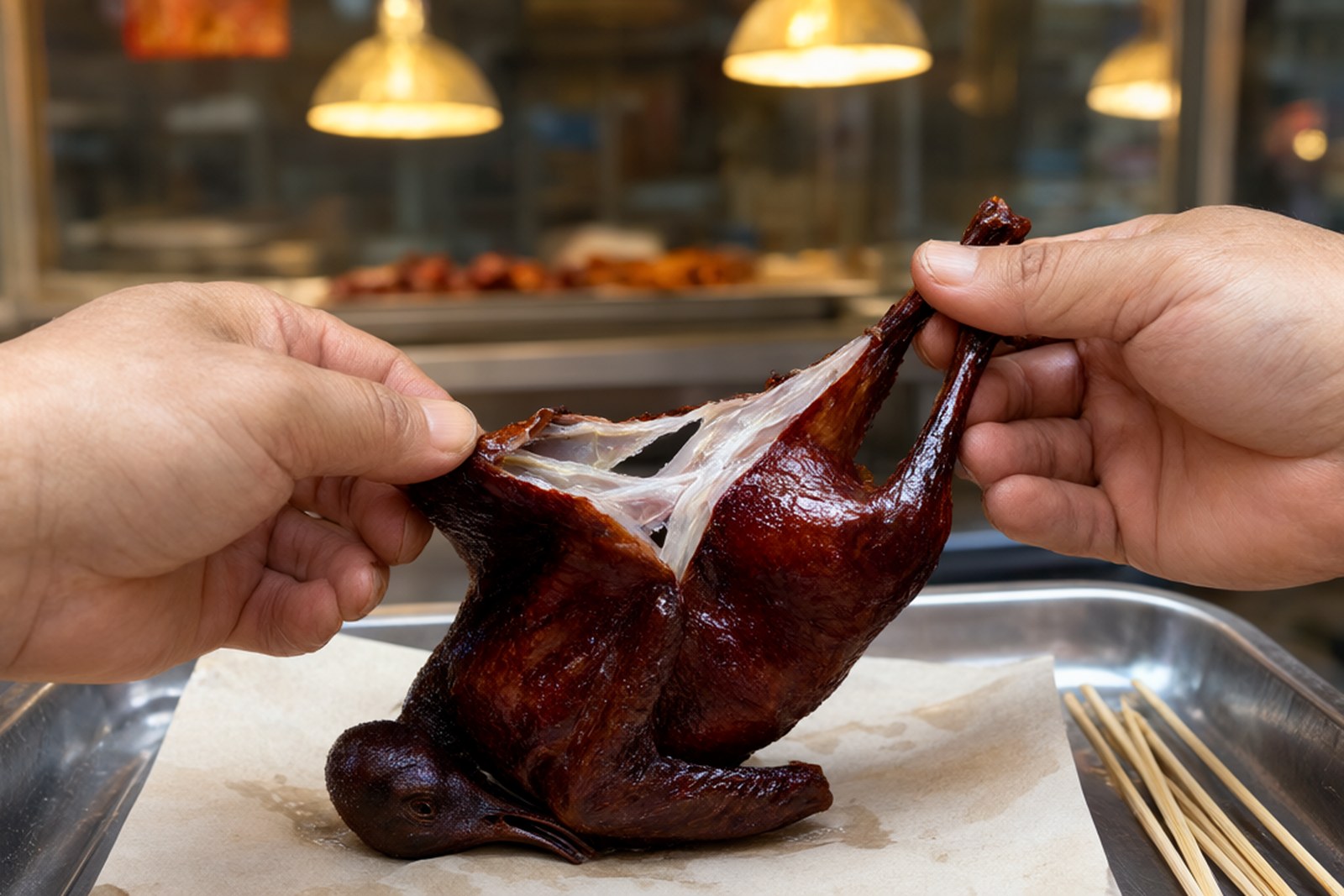
The dish has a shape problem that every kitchen here has to solve: the skin is at its best for about four minutes, and the meat is at its best when it has rested for ten. Most places resolve it by frying to order and getting the bird to the table in under ninety seconds, which is why a meal at a 光明 restaurant is paced oddly, with the pigeon arriving before anything you ordered alongside it. Eat the wings and the breast first, while the skin is still glass. The legs, which are the parts that improve as they cool, can wait. Two birds per person is the usual order for adults and nobody has ever regretted it, though the price has climbed a long way from the two yuan the farm charged in 1985.
Words and Names
乳鸽 rǔ gē is a young pigeon or squab, and 红烧 hóng shāo, literally red-braised, is the name the dish carries even though the cooking is a poach and a fry. 椒盐 jiāo yán is the salt and pepper dip; 卤水 lǔ shuǐ is the master stock, and 草果 cǎo guǒ and 桂皮 guì pí are the black cardamom and cassia bark in it. 光明 Guāngmíng is the district, 华侨 huáqiáo means overseas Chinese, and 农场 nóng chǎng is a farm. 沙井 Shājǐng to the west is where the oysters come from, and the two towns share the same corner of the city.
What the Locals Know
Judge the bird by the drumstick, not the breast. A squab that has been held too long before frying will have a leg that pulls clean away from the body; one that is right will resist for a second and then give. If the skin has already softened by the time it reaches you, send it back, because the kitchen knows. Ask for the head on if you want the cheek meat, which is the richest mouthful on the bird and which most places will remove without being asked. The 卤水 used to poach the pigeons is often decades old and topped up rather than replaced, so the older restaurants genuinely taste different from the new ones. And come at lunch rather than dinner, when the frying station is running continuously and the birds have not been waiting in a warmer.
flowcloud would say that a dish invented by people who had just come home from somewhere else, made from a bird that is a by-product of the milk trade, is the most accurate portrait of what 光明 actually is.
Where to find it: the row of pigeon restaurants along 光明大街 in 光明区, and the older places around the 光明农场 estate to the north. Take Metro Line 6 to 光明大街站 and walk; the smell of hot oil will do the rest. Order one pigeon per person, a plate of 光明烧鹅 only if the table is large, and the house 老火汤 to drink while you wait for the second round of birds.